
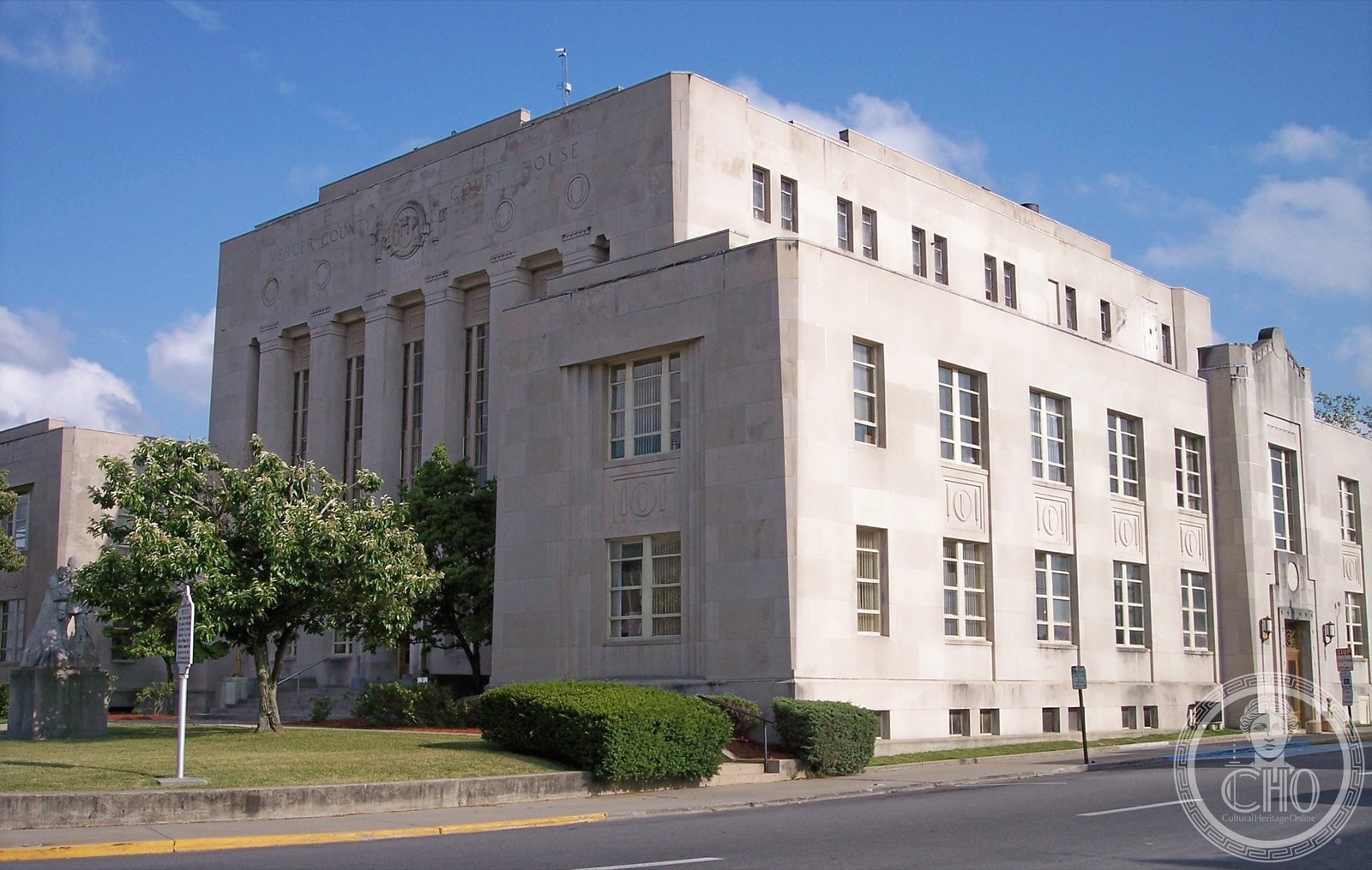
Mercer County Courthouse
A 1932 Art Deco courthouse in the southern West Virginia coalfields—one of dozens of Depression-era civic buildings that brought modern architecture to the Appalachian interior.
At a glance
The Mercer County Courthouse stands in Princeton, West Virginia, the county seat of Mercer County in the southern coalfield region near the Virginia border. Built in 1932, the building’s Art Deco design carries the characteristic compressed ornament and geometric massing of early-Depression-era public architecture—a period when local governments across Appalachia were still investing in new civic buildings despite the economic crisis, often with the help of state and federal funding. Princeton itself is a small city, but the courthouse’s confident architecture reflects the prosperity that coal royalties and railroad revenues had brought to the region in the preceding decades.
Key facts
- Completed: 1932
- Style: Art Deco
- Function: County courthouse
- Location: Princeton, WV (county seat of Mercer County)
- Region: Southern West Virginia coalfields, near Virginia border
- GPS: 37.3661°N, 81.1005°W
History
Mercer County was formed in 1837 from Logan and Tazewell counties and named for General Hugh Mercer, the Scottish-born physician and officer who was mortally wounded at the Battle of Princeton during the American Revolution—a connection that likely reflects the same Revolutionary-era memory that named the county. The region’s economic character was shaped by the late nineteenth-century coal boom: the Flat Top Coal Field, which runs through Mercer County, was among the richest bituminous coal deposits in the eastern United States, and by the early twentieth century, Princeton was a prosperous county seat with railroad connections to the coalfields above and the manufacturing cities below.
The courthouse was built in 1932 as the Depression’s first wave was hitting the coalfields hard—coal demand had collapsed, mines were laying off workers, and the regional economy was contracting. The decision to proceed with a substantial new courthouse in Art Deco style nonetheless reflects the institutional priorities of county government, which continued to function and to invest in its infrastructure even as the private economy stalled. Art Deco was by then the dominant idiom for new public buildings across the United States, conveying both modernity and stability to a population that needed reassurance on both fronts.
Mercer County’s economy evolved through the twentieth century as coal employment declined and service industries grew. The courthouse has continued as the seat of county government, serving the administrative and judicial needs of a county whose population and economy have shifted significantly since the building was designed.
What you see
The Mercer County Courthouse presents an Art Deco facade in which the entrance bay is emphasized through vertical massing—a slight projection and upward stepping that draws the eye to the main doors—while the flanking wings extend horizontally with continuous window banding. This is a common courthouse formula of the early 1930s: the building must signal authority (hence the vertical emphasis at the center) while also communicating accessibility and civic normalcy (hence the horizontal wings). The ornamental vocabulary is concentrated at the entrance and cornice: geometric panels, simplified pilasters, and carved decorative elements that identify the building as public and important without the excess of an earlier Beaux-Arts courthouse.
The scale of the building is appropriate to a county seat rather than a major city—this is civic architecture conceived for walking distances and human proportions, not for viewing from a car at highway speed. The courthouse sits on a prominent downtown lot, visible from multiple approaches, and its materials (stone and brick with metal trim) have weathered well, keeping the building readable as a product of its era despite decades of use.
Practical information
- Access: Public building, accessible during business hours (Monday–Friday)
- Location: Princeton, WV, downtown near the intersection with Mercer Street
- Parking: Street parking and municipal lots in the downtown area
- Time needed: 15 minutes for exterior observation
Getting there
Princeton lies along US Route 460 in southern West Virginia, approximately 90 miles south of Charleston and 25 miles west of the Virginia state line. By car from Interstate 77, take Exit 9 for Princeton and follow US Route 460 into the town center. The courthouse is in the core of downtown Princeton. The nearest airport is Mercer County Airport (BLF), approximately 5 miles from downtown, with limited regional connections; most visitors arrive by car. Bluefield, Virginia—the sister city across the state line—is within 20 miles.
Nearby
- Mercer County Airport / Bluefield — the airport and neighboring city of Bluefield, Virginia straddle the state line, sharing a downtown commercial corridor
- Camp Creek State Park — 20 miles north, forested WPA-era state park in the New River watershed
- Tamarack: The Best of West Virginia — Beckley, 30 miles north, the state’s flagship crafts and cultural center adjacent to I-77
- New River Gorge National Park — 45 miles north, one of the newest U.S. national parks, centered on a dramatic gorge in the southern West Virginia coalfields
Sources
- West Virginia State Archives, Mercer County government records — archives.wvculture.org
- West Virginia Encyclopedia, “Mercer County,” wvencyclopedia.org
- National Register of Historic Places nomination, Mercer County Courthouse, U.S. Department of the Interior
- West Virginia Historic Preservation Office, Survey Files
- Wikimedia Commons — image CC BY-SA 2.5
Find it on the map
See this place and what’s around it →📷 Diventa un fotografo di Cultural Heritage Online
Condividi le tue foto dei luoghi: restano pubblicate con la tua firma come autore. Più vengono viste, più ti fai conoscere — e presto un concorso premierà le foto più apprezzate.
Accedi o registrati gratis per aggiungere una fotoDo you manage this place?
This page is read by travellers and heritage enthusiasts who find it on Google. Keep it accurate — and make it work for you. Free for non-profit heritage institutions.