
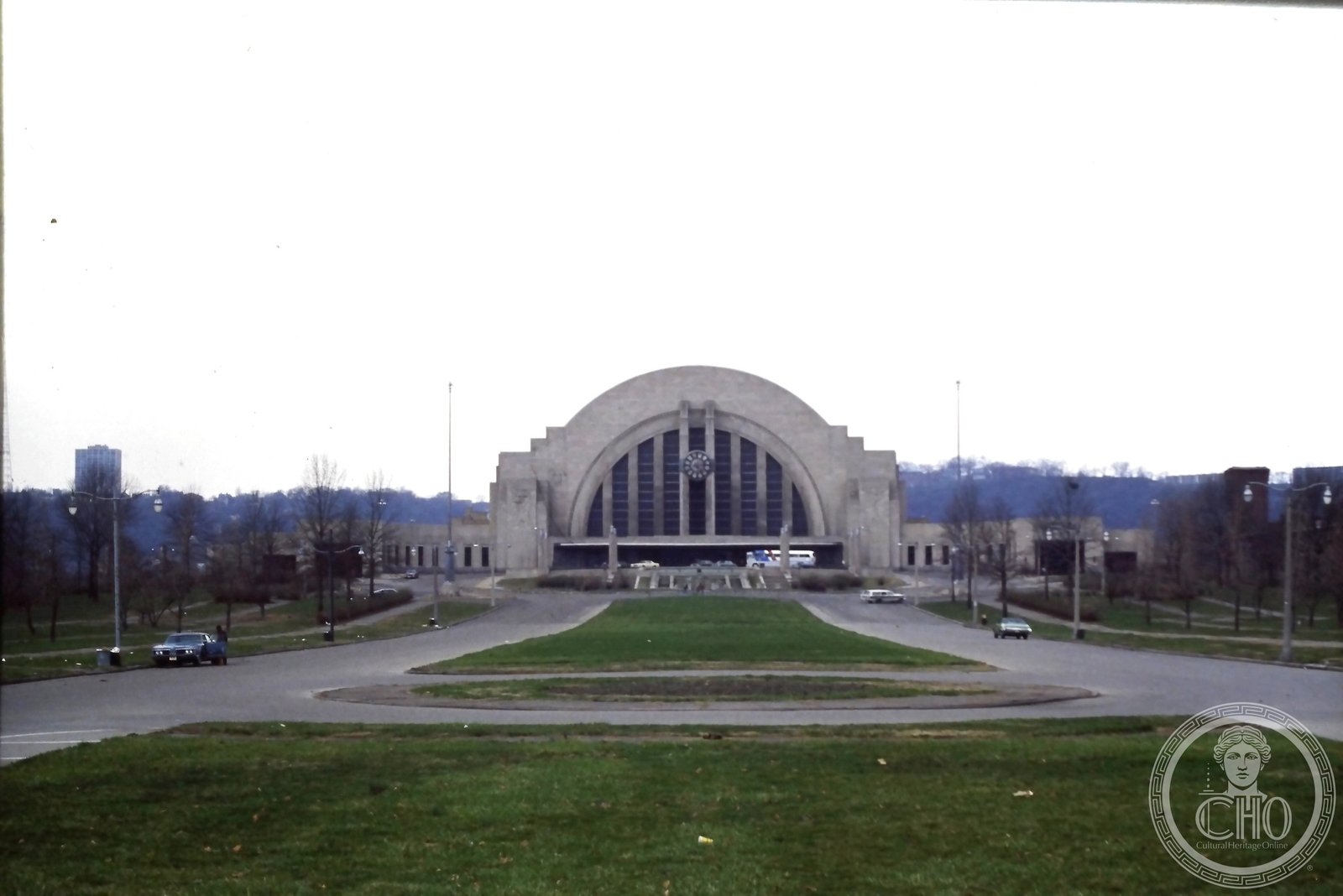
One of America’s great Art Deco train stations: a half-dome the width of a city block, lined inside with mosaics that turned a rail concourse into a civic gallery.
At a glance
Cincinnati Union Terminal opened on March 31, 1933, at the western edge of downtown Cincinnati—a colossal Art Deco structure whose half-dome facade, approximately 216 feet wide, remains one of the most recognizable silhouettes in American architecture. Designed by Fellheimer & Wagner with Paul Philippe Cret as consulting architect, the terminal consolidated Cincinnati’s three competing rail stations into a single monument to the railroad age. Inside, German-American artist Winold Reiss created a series of mosaic murals depicting Cincinnati’s workers and industries that transformed the main concourse into an involuntary museum. Today the building operates as the Cincinnati Museum Center, home to several permanent natural history, history, and children’s collections, and was substantially restored after a multi-year campaign completed in 2018.
Key facts
- Opened: March 31, 1933
- Architects: Fellheimer & Wagner (Alfred Fellheimer and Steward Wagner); Paul Philippe Cret, consulting
- Mural artist: Winold Reiss (1886–1953)
- Style: Art Deco / Streamline Moderne
- Current use: Cincinnati Museum Center (since 1990)
- Designation: National Historic Landmark (1977)
- Address: 1301 Western Avenue, Cincinnati, OH 45203
- GPS: 39.1053°N, 84.5417°W
History
The decision to build a unified Cincinnati terminal came after decades of inefficiency: the city’s three major stations—Central Union Depot, the Baltimore & Ohio station, and the Cincinnati, New Orleans & Texas Pacific depot—forced passengers and freight to navigate separate facilities on opposite sides of downtown. Planning began in the late 1920s, and the commission went to the New York firm of Fellheimer & Wagner, specialists in large-scale rail infrastructure who had also designed Buffalo’s Central Terminal. Paul Cret, the French-born Philadelphia architect known for his academic rigour and Beaux-Arts training applied to modern programs, joined as consultant—his influence is visible in the monumental discipline of the facades.
The terminal opened at the depth of the Great Depression, a deliberate act of civic confidence in Cincinnati’s future as a rail hub. During the Second World War it served as a major military transit center, processing hundreds of thousands of troops. Passenger traffic peaked in the 1940s and fell sharply in the postwar decades as automobile travel expanded and the federal government invested in highways rather than rails. The last regularly scheduled trains departed in 1972, leaving an enormous structure without its primary purpose.
The subsequent decades brought the standard threats: demolition proposals, fires, and neglect. A preservation campaign organized in the 1970s eventually prevailed, and the building reopened as the Cincinnati Museum Center in 1990. A comprehensive restoration campaign, completed in 2018, addressed structural deterioration and restored much of Reiss’s mosaic work to its original brilliance.
What you see
The exterior is defined by the half-dome, which gives the terminal its immediately recognizable profile against the Cincinnati skyline. The dome is not purely decorative—it encloses the vast main rotunda—but its scale operates first as civic gesture: a statement that this is a building of consequence, visible from across the Ohio River. The two flanking wings, lower and more horizontal, complete the composition and house the station’s operational spaces. The limestone and brick materials read as sober and permanent, the Art Deco ornament concentrated at the entrance surround and the roofline coping rather than spread uniformly across the surfaces.
Inside, Winold Reiss’s mosaics command attention from every angle in the main concourse. Reiss, trained in Munich and celebrated for his portraits of African Americans and Native Americans, adapted his figurative style to the demands of industrial-scale tile work: the Cincinnati workers—steelworkers, shoemakers, printers, soap-makers—are rendered with the clarity of illuminated manuscripts and the scale of billboard paintings. The mosaic lunettes survive the conversion to museum use intact, giving the institution a permanent collection it did not commission and cannot easily replicate.
Practical information
- Open: Tuesday–Sunday, 10 AM–5 PM; closed Mondays and major holidays
- Admission: Museum admissions vary by collection; free to enter the main rotunda
- Time needed: 2–4 hours for museum collections; 30 minutes for the architecture alone
- Tip: The exterior half-dome is best photographed in late afternoon light from the parking apron
- Website: cincymuseum.org
Getting there
Cincinnati Union Terminal stands at 1301 Western Avenue, approximately one mile west of downtown Cincinnati’s central business district in the Camp Washington neighborhood. By car from downtown, head west on Central Parkway to Western Avenue; the terminal is visible from a considerable distance. The Cincinnati Metro bus network connects downtown to the terminal. A streetcar line (The Connector) links the central city to areas east of downtown but does not directly serve the terminal; a rideshare or taxi from downtown takes under ten minutes. Ample surface parking surrounds the building.
Nearby
- Eden Park and the Cincinnati Art Museum — Beaux-Arts and Victorian hilltop museum complex, 4 miles east via Mount Adams
- Carew Tower (1930), downtown Cincinnati — Art Deco skyscraper and observation deck in the heart of the central business district
- Roebling Suspension Bridge (1866) — the prototype for Brooklyn Bridge, crossing the Ohio River between Cincinnati and Covington, Kentucky
- Great American Ball Park and the Ohio riverfront — walkable from downtown, with views to Covington’s historic Mainstrasse Village
Sources
- Cincinnati Museum Center, History of Union Terminal, cincymuseum.org
- National Register of Historic Places Nomination, Cincinnati Union Terminal, 1972
- National Historic Landmark Designation, 1977
- Architectural Record and contemporary press coverage of the terminal, 1933–1934 (ProQuest Historical Newspapers)
- Wikimedia Commons — image CC BY 4.0
Find it on the map
See this place and what’s around it →📷 Become a Cultural Heritage Online photographer
Share your photos of places: they stay published under your name as the author. The more they're seen, the more you get noticed — and soon a contest will reward the most appreciated photos.
Log in or sign up free to add a photoIs this page about you?
This page is read by travellers and heritage enthusiasts who find it on Google. Tell us how you are connected to this place and we will take it from there.