
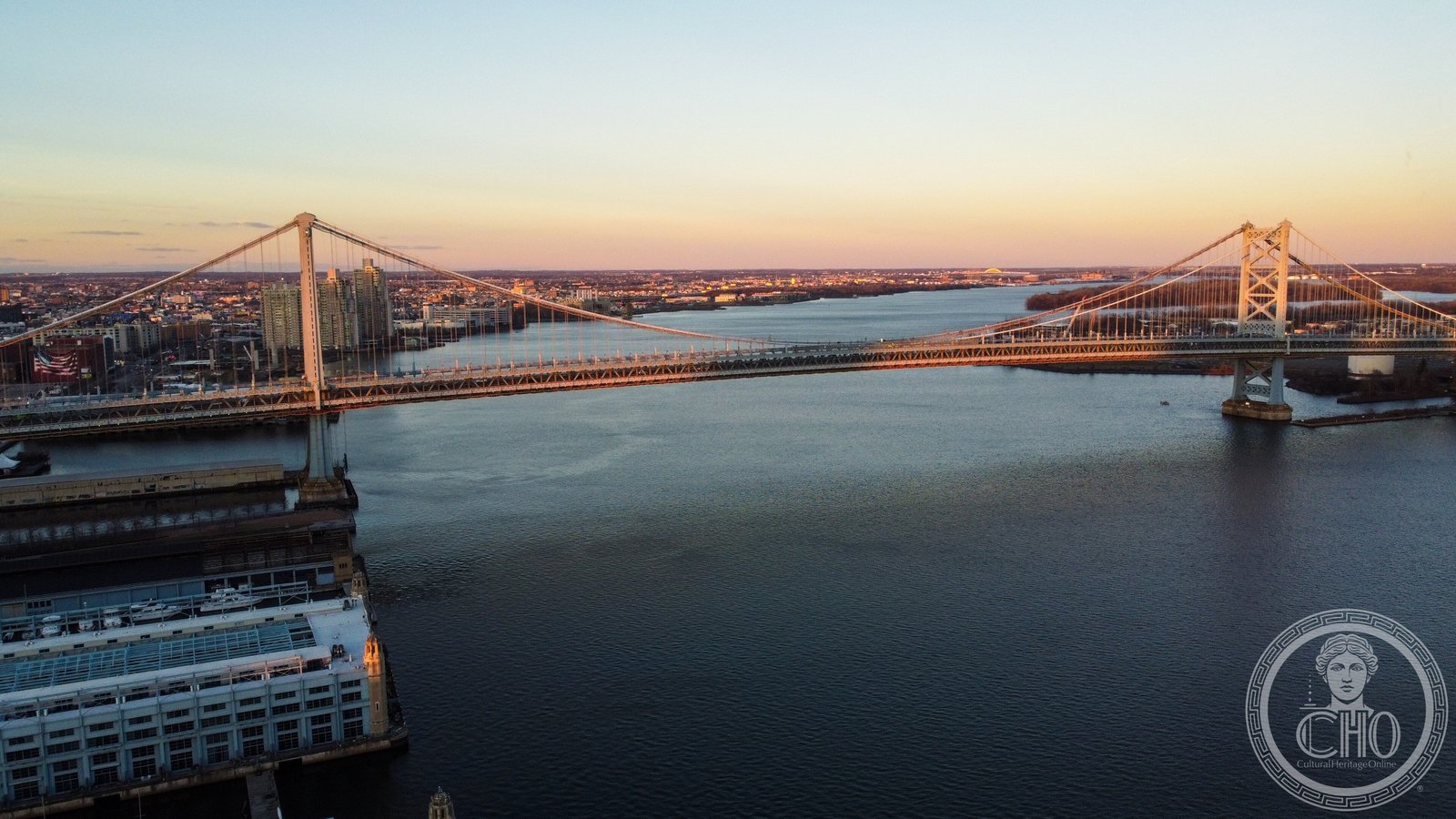
Benjamin Franklin Bridge
America’s oldest major Art Deco suspension bridge carried the first automobile traffic across the Delaware River in 1926 — and carried trolleys, then rapid transit, for a century after that. Its blue towers have anchored Philadelphia’s riverside skyline ever since.
At a glance
The Benjamin Franklin Bridge links Philadelphia’s Market Street with Broadway in Camden, New Jersey, across a main span that was the longest in the world when the bridge opened in July 1926. Ralph Modjeski engineered the structure; Paul Cret — a French-born architect who taught at the University of Pennsylvania — gave it the stone-finished towers and masonry anchor houses that mark it as one of the finest fusions of engineering and Art Deco design in the American Northeast. The bridge carries motor traffic on the upper deck and PATCO Speedline rapid transit on the lower, and opens its pedestrian walkway to the public on both shores.
Key facts
- Opened: July 1, 1926 (as Delaware River Bridge)
- Renamed: Benjamin Franklin Bridge, 1956
- Chief engineer: Ralph Modjeski
- Architectural consultant: Paul Cret (1876–1945)
- Span record: World’s longest suspension bridge at opening
- Connects: Market Street, Philadelphia / Broadway, Camden, NJ
- Operator: Delaware River Port Authority (DRPA)
- Transit: PATCO Speedline rapid transit (lower deck)
History
Planning for a Delaware River crossing between Philadelphia and Camden had advanced through the early 1920s under the Delaware River Joint Commission, the body that preceded today’s Delaware River Port Authority. Ralph Modjeski, whose bridges already stood on the Mississippi and across major Midwestern rivers, was appointed chief engineer. Paul Cret — born in Lyon, France in 1876, trained at the École des Beaux-Arts, and by then a fixture on the University of Pennsylvania faculty — served as architectural consultant, responsible for the towers’ stone masonry, the anchorage houses, and the decorative programme across the full structure.
The bridge opened on July 1, 1926, as the Delaware River Bridge, with a main span that made it the world’s longest suspension bridge. Trolley lines ran across it from the outset — a double-deck structure from the beginning, with rail on the lower level. When the trolley era ended and the PATCO Speedline electrified rapid transit was introduced, the rail function transferred to the lower deck in a form the bridge’s original structure had always been capable of carrying.
In 1956, the bridge was renamed in honour of Benjamin Franklin, whose experiments, civic inventions, and role in founding the city’s institutions had made him Philadelphia’s defining figure. The blue paint that now colours the towers and cables arrived during a subsequent repainting campaign.
What you see
The towers rise in paired stone-clad columns above each shore, their masonry finished with Gothic-inflected detail that Cret derived from his Beaux-Arts training in Paris and refined for the American industrial scale. The cables descend from the tower saddles in long catenary curves to the anchorage houses — heavy masonry structures on both shores that carry the full tension of the bridge. The deck hangs between them over the Delaware, wide enough to carry four lanes of traffic and two rail tracks with pedestrian walkways outside both main cables.
The Philadelphia approach sits just north of Old City, making the bridge visible from Penn’s Landing and the Delaware River waterfront. From the walkway itself, the skyline presents itself in an almost theatrical recession: the Beaux-Arts and Art Deco towers of Center City — the PSFS Building (1932) among them — line up behind the bridge’s masonry anchor house in the middle distance.
Practical information
- Pedestrian walkway open daily from approximately 7 am to 9 pm; check the DRPA website for current hours and seasonal closures
- Access to the walkway from the Philadelphia side at 5th Street and Race Street; from Camden at the Broadway approach
- PATCO Speedline stops at 8th and Market Street (Philadelphia) and Broadway–Camden (NJ); the bridge is crossed as part of the line
- Allow 30–45 minutes for a one-way walk across the full span; strong winds are common at mid-span
- Vehicle toll applies westbound (Philadelphia-bound); pedestrians and cyclists free
Getting there
From central Philadelphia, SEPTA’s Market-Frankford Line (Blue Line) connects 30th Street Station to 5th Street/Independence Hall in approximately 10 minutes, placing the bridge pedestrian entrance a short walk north. The PATCO Speedline departs from 8th and Market Street for Camden and southern New Jersey, crossing the bridge as part of every journey. From Amtrak at 30th Street Station, the Market-Frankford Line and the PATCO provide connections without requiring a car.
Nearby
- Benjamin Franklin Museum — underground museum on Franklin Court, just south of Market Street, 5 minutes on foot
- Independence National Historical Park — the Liberty Bell, Independence Hall, and the Constitutional Convention complex, within 10 minutes’ walk
- Penn’s Landing — Delaware River waterfront park and marina, directly below the Philadelphia bridge approach
- PSFS Building (1932) — Philadelphia’s landmark Art Deco skyscraper, now a hotel, visible from the bridge walkway
Sources
- Delaware River Port Authority, Benjamin Franklin Bridge history and engineering documentation
- Elizabeth Greenwell Grossman, The Civic Architecture of Paul Cret (MIT Press, 1996)
- American Society of Civil Engineers, National Historic Civil Engineering Landmark designation
- Philadelphia Inquirer archive, July 1926 opening coverage
- National Register of Historic Places listing
Find it on the map
See this place and what’s around it →📷 Diventa un fotografo di Cultural Heritage Online
Condividi le tue foto dei luoghi: restano pubblicate con la tua firma come autore. Più vengono viste, più ti fai conoscere — e presto un concorso premierà le foto più apprezzate.
Accedi o registrati gratis per aggiungere una fotoDo you manage this place?
This page is read by travellers and heritage enthusiasts who find it on Google. Keep it accurate — and make it work for you. Free for non-profit heritage institutions.