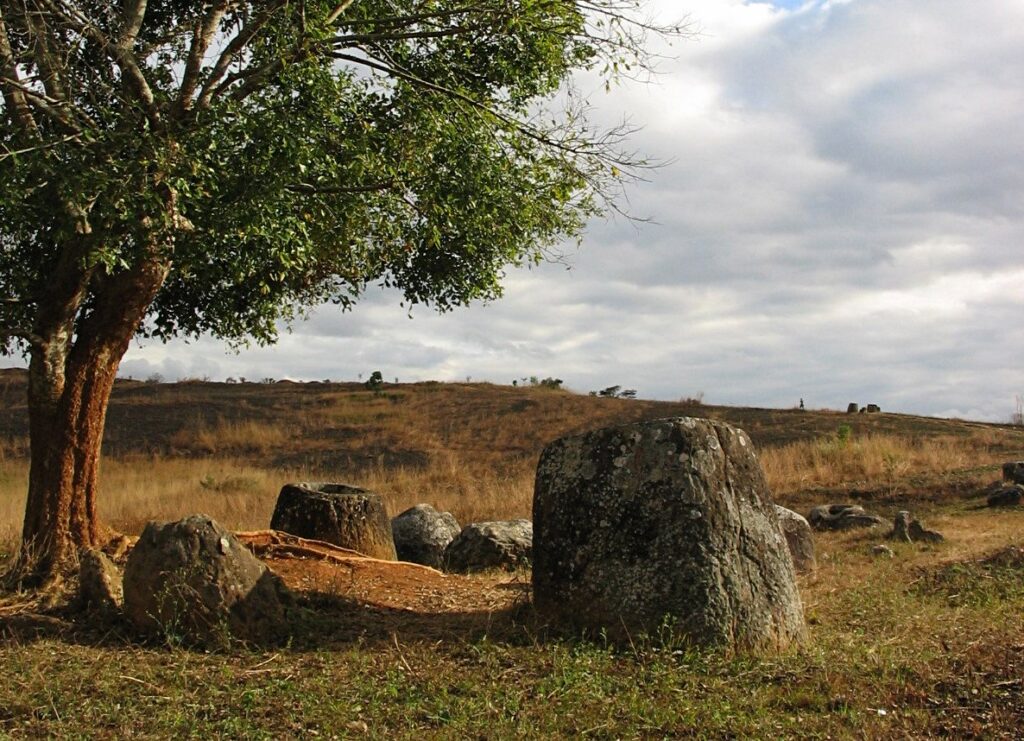
The Megalithic Jar Sites in Xieng Khouang — Plain of Jars (ທົ່ງໄຫຫິນ, “Thong Hai Hin” — “Plain of Stone Jars”), inscribed by UNESCO in 2019 as Laos’s first cultural World Heritage site, consists of a series of sites on the Xieng Khouang Plateau (also called the Xieng Khouang Plain) in northern Laos where thousands of stone jars — carved from single blocks of granite, sandstone, or conglomerate stone and ranging in height from approximately 0.5 m to 3.0 m, weighing from under 1 tonne to approximately 14 tonnes — are scattered across a landscape of approximately 1,000 km² in the Xieng Khouang Province of northern Laos. The Plain of Jars is one of the most unusual and least understood megalithic sites in the world — the jars were clearly created over a sustained period by a sophisticated culture with significant stone-working capabilities and a consistent funerary tradition (the jars are now interpreted by most archaeologists as funerary urns, used for secondary burial — the body was placed in the jar after initial decomposition, the bones collected and placed in the jar, which was then sealed and left in its landscape position — though the function was debated for decades), but the culture that made them left no written records and no clear ethnic successor community that preserves an oral tradition about the jars’ purpose. The archaeological chronology of the Plain of Jars (based on AMS radiocarbon dating of organic material found inside some jars and from associated burials around the jars) places the main period of jar creation and use at approximately 500 BCE–500 CE — a 1,000-year Iron Age period during which the Xieng Khouang Plateau supported a large and organised society capable of quarrying, transporting, and carving stone blocks of up to 14 tonnes from quarries up to 10 km from the jar sites. The UNESCO inscription covers 15 individual jar site clusters across the Xieng Khouang Plateau, with approximately 2,100 individual jars inventoried in the current archaeological record (the total number of jars on the plateau is likely significantly higher, as many are known to remain uninvestigated in areas not yet surveyed).
The jar sites and the Xieng Khouang heritage corridor Site 1 Thong Hai Hin · Site 2 Hai Hin Phu Salato · Site 3 Hai Hin Lat Khai · Phonsavan · Luang Prabang — 0 to 220 km
The 15 UNESCO-designated jar sites are distributed across the Xieng Khouang Plateau at various distances from the provincial capital Phonsavan (which serves as the main base for visiting the sites). The three most accessible and most visited sites are: Site 1 (Thong Hai Hin, approximately 15 km west of Phonsavan — the largest site, with approximately 334 individual jars, including the largest jar on the plateau [approximately 1.9 m diameter, approximately 3 m height, estimated weight approximately 14 tonnes], and the most developed visitor infrastructure with a formal walking path connecting the jar clusters); Site 2 (Hai Hin Phu Salato, approximately 25 km south of Phonsavan — a more remote site with 90 jars on a hill slope, requiring approximately a 15-minute walk uphill from the parking area); and Site 3 (Hai Hin Lat Khai, approximately 35 km south of Phonsavan — 150 jars spread across a wide area of flat plateau, with views of the surrounding mountain landscape). The specific archaeological features of the jar sites that distinguish them from other megalithic traditions worldwide include: the standardised cylindrical/barrel form of the jars (despite being carved individually from different stone types and in different locations, the jars maintain a consistent cylindrical form with a lip rim, suggesting a consistent cultural template); the presence of carved stone disc “lids” at some sites (approximately 7% of jars have associated stone disc lids — whether the lids were used to seal jars in use or were added to mark jar positions after the burial period is not clear); and the carved human figure on one jar at Site 1 (a bas-relief human figure, approximately 30 cm high, on the exterior of a large jar — the only figurative carving found on the jars in the entire corpus, whose significance for interpreting the jar function is debated). The Xieng Khouang Plateau is also historically significant as the site of some of the heaviest bombing of the Vietnam War/Secret War (approximately 1964–1973 CE) — the US Air Force conducted extensive bombing operations over the Xieng Khouang Plateau (which was the contested zone between Royal Lao Government and Pathet Lao/North Vietnamese forces), and the landscape contains an estimated 80 million unexploded ordnance (UXO) items, primarily cluster bomb sub-munitions. The UXO contamination is a continuing public health crisis in Xieng Khouang Province (Laos has been described as the most heavily bombed country per capita in history) and affects access to some jar sites — visitors must stay strictly on marked paths at all UNESCO jar sites.
Practical information
The Plain of Jars is accessed via Phonsavan (the provincial capital of Xieng Khouang Province), which has a domestic airport (PXS — domestic flights from Vientiane 40 minutes, from Luang Prabang 30 minutes, with multiple daily services on Lao Airlines and other carriers). Phonsavan is also accessible by bus from Vientiane (approximately 10–12 hours via Highway 7 — spectacular mountain scenery but a long journey on mountain roads) and from Luang Prabang (approximately 8–10 hours). UXO awareness: all jar sites have visible UXO warning signs (skull-and-crossbones) at site boundaries — do not walk off marked paths under any circumstances, and do not touch metal objects found on the ground. All paths at the 15 UNESCO jar sites are surveyed and cleared by the UK-based UXO Lao organisation and are safe. The MAG (Mines Advisory Group) visitor information centre in Phonsavan provides education about the UXO issue and the ongoing clearance work. Accommodation in Phonsavan: several guesthouses and hotels, adequate quality for a 2-night stay (recommended to visit 3 sites per day and spend 2 nights). The Xieng Khouang Heritage Museum in Phonsavan has displays on both the jar culture archaeology and the Vietnam War bombing history. Best visiting months: November–April (dry season; September–October the plateau can be misty). The jar sites are uncrowded relative to other Southeast Asian UNESCO sites — even in peak season the visitor numbers are modest.
Frequently Asked Questions
Who made the Plain of Jars and what were they for?
The identity of the culture that created the Plain of Jars remains one of the major unsolved questions of Southeast Asian archaeology — uniquely for a site of this scale and duration of use, there is no surviving ethnic community in the region that claims direct descent from the jar-makers or preserves an oral tradition about the jars’ purpose, and no written records from the culture that made them. The current archaeological consensus is: (1) The jars were made during the Iron Age, approximately 500 BCE–500 CE, by a culture archaeologists call the “Plain of Jars culture” or “Jar Culture” — a culture that used iron tools (iron objects have been found in archaeological contexts associated with the jars), had significant logistical organisation (capable of quarrying and moving 14-tonne stone blocks over 10 km), and had a standardised cultural tradition of jar-making maintained over a 1,000-year period. (2) The function of the jars was funerary — the best current interpretation is that the jars were used for secondary burial (the Lao term for a practice widely documented in mainland Southeast Asia from prehistoric to historical periods: the body was first deposited in a primary burial and left to decompose; the bones were then collected, cleaned, and placed in a secondary container — the stone jar in this case — for final deposition). The evidence for the funerary function is: human bone fragments and teeth have been found inside many jars during systematic excavation; glass and stone beads and iron objects associated with burial goods have been found around many jars; and the spatial distribution of the jars (scattered across the plateau, not concentrated at specific ritual locations) is consistent with a long-used mortuary landscape rather than a ceremonial or agricultural function. (3) The ethnic identity of the jar-makers is unknown. The most common speculation in older literature is a connection to the Mon-Khmer speaking populations who were widespread in mainland Southeast Asia during the Iron Age, but no genetic studies conclusively linking modern populations to the jar-makers have been published. A Lao oral legend collected in the 19th century CE attributes the jars to a legendary king named Khun Cheung who used them to brew and store rice wine to celebrate a military victory — this legend is not accepted as historical by archaeologists but is mentioned in the local tourism context. (4) The Plain of Jars is genuinely comparable in its archaeological mystery to the megalithic traditions of South Asia (Deccan megalithic, where large stone burial chambers of approximately the same date dot the landscape without a clear successor culture) and of Atlantic Europe (the megalithic tomb tradition of Neolithic and Bronze Age Britain, Ireland, France, and Iberia, where the tomb-builders similarly left no written records and are known only from their monuments and burials).
What is the Secret War and how did it affect the Plain of Jars?
The “Secret War” is the informal name for the covert US military involvement in Laos during the Vietnam War period (approximately 1964–1973 CE) — “secret” because the US involvement was officially denied by the American government during the war (the 1962 Geneva Accords had established Laos as a neutral country and prohibited foreign military intervention, creating a legal fiction of Lao neutrality that all parties nominally maintained while engaging in extensive military operations). The Xieng Khouang Plateau — the Plain of Jars area — was the primary military battleground of the Secret War, because its central position on the Laos-Vietnam border and its road network made it the key terrain feature for both the Royal Lao Government/CIA-backed forces (including the Hmong army under General Vang Pao, headquartered at Long Cheng approximately 30 km south of the Plain of Jars) and the Pathet Lao/North Vietnamese forces (whose supply lines along the Ho Chi Minh trail passed through Xieng Khouang Province). The US Air Force and CIA Air America conducted an intensive bombing campaign over the Xieng Khouang Plateau from approximately 1964 to 1973 CE — official records released after the war show that the US dropped approximately 2.5 million tonnes of bombs on Laos during this period (more than all bombs dropped in World War II combined by all sides, though the figures and comparisons are disputed), of which approximately 30% were cluster bombs (“bombie” in Lao terminology) whose sub-munitions (small submunitions, approximately 5 cm diameter, contained in hundreds per cluster bomb casing) were designed to spread over a wide area and kill or wound people in the open. The estimated 80 million unexploded cluster bomb sub-munitions remaining in Lao soil (approximately 30% of all cluster sub-munitions dropped failed to explode on impact and remain live in the ground) are the source of the ongoing UXO crisis in Laos — since 1975 CE, more than 20,000 Lao civilians have been killed or maimed by UXO, with the Xieng Khouang Province among the most contaminated areas. The UXO contamination at the Plain of Jars sites was cleared by systematic survey and demining operations, primarily by UXO Lao (the government UXO clearance agency) and MAG (UK-based international demining charity), specifically to allow the UNESCO inscription (which required that the inscribed sites be accessible for visitors without UXO risk). The clearance operations at the jar sites required the use of metal detectors, manual probing, and careful removal of sub-munitions that had been buried or overgrown at the sites for 50 years. The juxtaposition of the 2,500-year-old stone funerary jars and the 50-year-old bomb craters and clearance markers is one of the most striking and historically resonant heritage landscapes in Asia.
EXCERPT: Plain of Jars, Laos, UNESCO-inscribed 2019, is the Xieng Khouang Plateau megalithic landscape — 2,100 stone Iron Age funerary jars (500 BCE–500 CE), some 14 tonnes and 3 metres high, created by a culture whose identity remains unknown, scattered across a plateau also pockmarked by 80 million UXO items from the 1964–1973 US Secret War bombing campaign.
META: UNESCO World Heritage Sites near Plain of Jars Laos: Town of Luang Prabang 220 km west (UNESCO 1995), Vat Phou Champasak 400 km south (UNESCO 2001) — Plain of Jars Xieng Khouang Phonsavan Laos UNESCO 2019, megalithic jars Iron Age funerary burial, Secret War Vietnam War UXO unexploded bombs, Hmong Pathet Lao northern Laos heritage.
Sources
- S1 — UNESCO World Heritage Centre — Megalithic Jar Sites in Xiengkhuang – Plain of Jars (Ref. 1587) — https://web.archive.org/web/20230601000000/https://whc.unesco.org/en/list/1587/
- S2 — UNESCO World Heritage Centre — Statement of Outstanding Universal Value (Ref. 1587) — https://whc.unesco.org/en/list/1587/
Spotted an error? Write to the editors and we correct it the same day.