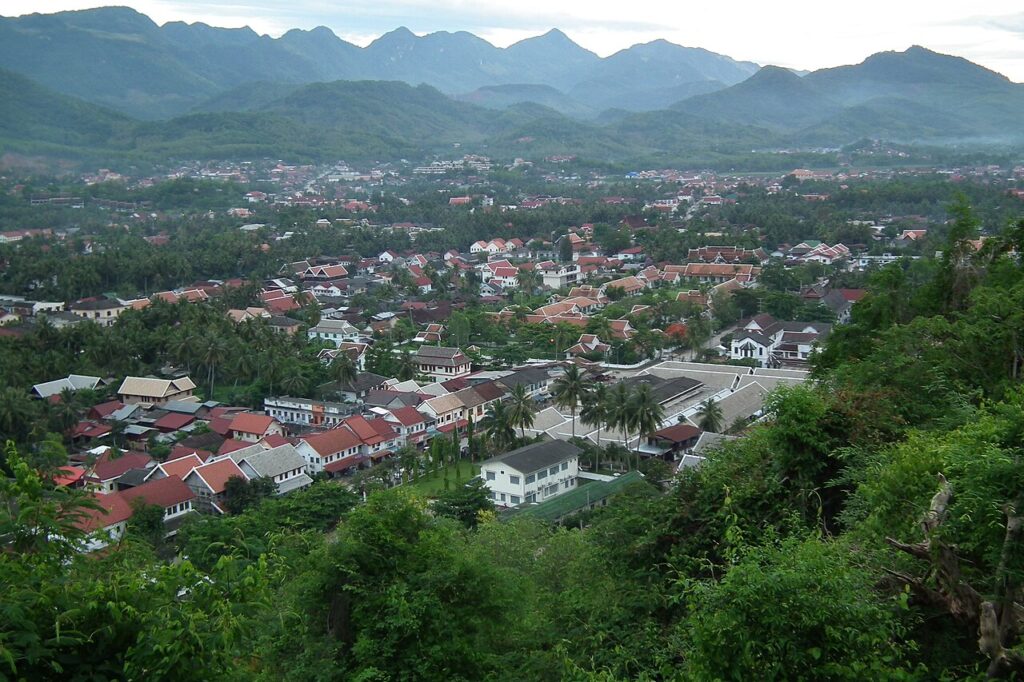
The Town of Luang Prabang (ຫຼວງພະບາງ, “Luang Prabang” — “Royal Buddha Image”, named for the Phra Bang golden Buddha statue that is the palladium of the Lao kingdom, believed to have been cast in Ceylon approximately 1st century CE and brought to Laos via Cambodia in the 14th century CE), inscribed by UNESCO in 1995 as an outstanding example of the fusion of Lao traditional architectural and urban structures with those built by the European colonial authorities in the 19th and 20th centuries, is the best-preserved royal capital of Southeast Asia — a small town (permanent population approximately 56,000, in the bend of the Mekong River where the Nam Khan River joins the Mekong at the tip of the peninsular site) that served as the capital of the Lan Xang Kingdom (Lane Xang Hom Khao, “Kingdom of a Million Elephants Under the White Parasol”, founded approximately 1353 CE by King Fa Ngum) from 1353 CE until 1560 CE (when the capital was moved to Vientiane), and as the royal capital of the Luang Prabang Kingdom (a successor state and French protectorate) from 1707 CE until 1975 CE — making it 622 years of royal capital status across two major periods of Lao history. The outstanding universal value of Luang Prabang rests on the intact survival of the pre-modern royal capital’s urban fabric: approximately 34 Buddhist temples (wats) distributed through the town, including Wat Xieng Thong (1560 CE, the most important royal temple, built by King Setthathirath the year the capital was moved away — the temple that best exemplifies the specific Luang Prabang temple architectural style with its “sweeping low roof” form, the roof cascade of five descending tiers touching the ground at the front, the golden “tree of life” mosaic on the rear wall, and the Funerary Carriage house alongside), and the riverfront French colonial streets with their stucco villas and the royal palace museum (the Haw Kham, built by the French colonial government for King Sisavang Vong in 1904–1909 CE and now the National Museum of Luang Prabang).
Luang Prabang’s temples and the Laos heritage corridor Wat Xieng Thong · Phou Si · Kuang Si waterfall · Vat Phou Champasak — 0 to 550 km
The Luang Prabang UNESCO site’s most significant individual monuments include: Wat Xieng Thong (the “Temple of the Golden City”, built 1560 CE by King Setthathirath II as the royal temple of the Lan Xang kingdom before the capital moved to Vientiane — the temple that remained the coronation site and primary royal religious complex of the Luang Prabang Kingdom through the colonial period, with the Funerary Carriage House (built to house the royal funeral chariot of King Sisavang Vong, 1885–1959 CE) containing an elaborately carved gilded carriage 12 metres long that was used for the funeral procession in 1961 CE, and the rear wall mosaic of multicoloured glass pieces depicting the “tree of life” set against a terracotta background in a style unique to the Luang Prabang temple tradition); the Phou Si Hill (the 100-metre-high hill at the centre of the Luang Prabang peninsula, with the golden That Chomsi stupa at its summit — the hill is sacred in Lao tradition as the navel of the universe of Luang Prabang, and the circumambulation of the hill at That Luang festival time is one of the principal religious observances of the town); and the Tak Bat ceremony (the dawn alms-giving procession in which orange-robed Buddhist monks walk through the main streets of Luang Prabang in silence while residents kneel on the roadside to offer sticky rice and cooked food in their alms bowls — the ceremony occurs every morning before dawn and is the primary living cultural practice that defines the specific character of Luang Prabang as a Buddhist monastic town). The Kuang Si waterfall (approximately 29 km south of Luang Prabang, accessible by road or river — a three-tiered turquoise-pool waterfall system at the edge of the mountain forest above the Mekong valley, with a bear rescue centre operated by the Free the Bears charity at the site entrance) is the primary natural attraction near the town. Vat Phou (the pre-Angkor Khmer/Lao mountain temple, UNESCO-inscribed 2001, approximately 550 km south in Champasak Province) is the most significant secondary heritage site in Laos.
Practical information
Luang Prabang is accessible by: domestic flights from Vientiane (approximately 40 minutes, daily services) and from Chiang Mai, Bangkok, Hanoi, and other regional cities; by road from Vientiane (approximately 8–10 hours by bus via Highway 13 — a scenic mountain road along the Nam Ou valley); and by the Laos-China Railway (opened December 2021 — from Boten on the Laos-China border to Vang Vieng, 3.5 hours, with bus connection to Luang Prabang, or the full Kunming-Vientiane route includes the Luang Prabang stop). Visa on arrival is available for most nationalities at Luang Prabang airport. The UNESCO protected town is compact — all major temples within walking distance of the main Mekong riverfront street (Sisavangvong Road). Accommodation: extensive boutique hotel and guesthouse options in both converted colonial-era French villas (the most characteristic form of Luang Prabang accommodation, some within the UNESCO core zone) and modern resorts on the outskirts. The Tak Bat ceremony starts before 06:00 — stay within the town to participate properly. UNESCO and the Luang Prabang authorities request that visitors observe the ceremony respectfully from the designated viewing areas rather than crowding the monks or using flash photography. Best visiting months: November–March (dry season, temperatures 20–32°C; April–May the hottest, June–October monsoon with dramatic Nam Khan flooding). The Boun Khao Phansa (Buddhist Lent opening) and Boun Ok Phansa (Buddhist Lent closing) festival periods feature illuminated boat racing on the Mekong.
Frequently Asked Questions
What is the Tak Bat ceremony and why is it important to Luang Prabang?
The Tak Bat (ຕັກບາດ, “alms offering”, formally called “Sai Bat” in Lao Buddhist terminology — the Thai term “Tak Bat” is widely used in tourist contexts) is the dawn merit-giving ceremony in which resident and visiting Buddhist monks and novices (approximately 200–300 robed monks walk daily in the largest processions, from all 34 temples in the town simultaneously, converging on the main roads of the UNESCO town) walk the main streets of Luang Prabang in silent single-file, with alms bowls held in front of them, while kneeling laypeople offer cooked sticky rice and pre-prepared food packets from baskets at the roadside. The ceremony begins before dawn (05:30–06:00 approximately, when the first light is sufficient for the monks to walk safely but before full daylight) and takes approximately 30–45 minutes for the procession to pass each point on the main route. The Tak Bat ceremony is practised throughout Theravada Buddhist mainland Southeast Asia (in Thailand, Cambodia, and Myanmar as well as Laos), but the Luang Prabang version has a specific significance because: (1) the concentration of monks in a small historical town creates a procession of exceptional scale relative to the resident population; (2) the tradition has been maintained continuously in Luang Prabang from the Lan Xang period (13th–14th century CE) without interruption even through the French protectorate period and the Pathet Lao revolution (1975 CE) that abolished the monarchy and established the Lao People’s Democratic Republic; (3) the ceremony occurs in the UNESCO World Heritage town’s historical urban fabric (the colonial-era stucco houses and temple walls that line the route create the specific visual character of the ceremony — orange-robed monks against whitewashed colonial-Lao architecture — that has become the iconic image of Luang Prabang); (4) the merit-giving aspect of the ceremony is central to Lao Theravada Buddhist practice, in which the act of giving food to monks (generating merit, “boun” in Lao) is the primary religious practice for lay Buddhists and has specific significance for women (for whom merit-giving through Tak Bat is one of the most important religious actions). The tourist management of the Tak Bat ceremony has become controversial: the large number of tourists photographing the ceremony (some with intrusive behaviour — flash photography, close approach, buying food of inappropriate types from tourist-market sellers to offer) has been identified as a threat to the ceremony’s authentic character. UNESCO and the Luang Prabang authorities have issued guidelines requesting that tourists observe from designated viewing areas, not use flash photography, and not buy the commercial food packets sold near the route specifically to tourists (as these are not authentic merit-giving items). The ceremony is among the most significant examples of living religious heritage in Luang Prabang’s UNESCO Outstanding Universal Value.
What is the Lan Xang Kingdom and what is its historical significance?
The Lan Xang Kingdom (ລ້ານຊ້າງ, “Kingdom of a Million Elephants Under the White Parasol” — the white parasol being the royal emblem of Theravada Buddhist kingship in mainland Southeast Asia, the symbol of royal legitimacy derived from the Indian Buddhist tradition of the “cakkavatti” or “wheel-turning monarch”) was the dominant political power in the middle Mekong region from its founding by King Fa Ngum approximately 1353 CE to its fragmentation into three successor kingdoms approximately 1707 CE — a period of 354 years during which Lan Xang was one of the largest states in Southeast Asia by territory, encompassing the modern territory of Laos, northeastern Thailand (Isan), and portions of southern Yunnan and northern Cambodia. King Fa Ngum (who united the Mekong valley principalities under Lan Xang sovereignty approximately 1353 CE following a military campaign supported by the Khmer Empire of Angkor, whose princess he had married) is the founder-hero of the Lao national tradition — he introduced Theravada Buddhism as the state religion of Lan Xang (bringing Buddhist monks, religious texts, and the Phra Bang golden Buddha image from Cambodia), established Luang Prabang as the capital (at the Mekong-Nam Khan confluence, the traditional sacred site of the pre-Buddhist Mekong settlements), and defined the territorial and administrative structure of the kingdom that his successors maintained for three and a half centuries. The Lan Xang kingdom reached its peak of territorial power under King Setthathirath II (1548–1572 CE, who built Wat Xieng Thong in 1560 CE, moved the capital to Vientiane in 1560 CE, built the That Luang stupa in Vientiane in 1566 CE, and successfully resisted a major Burmese invasion by King Bayinnaung in 1565 CE) and King Sourigna Vongsa (1637–1694 CE, the “golden age” ruler under whom Lan Xang was prosperous and at peace for 57 years, and who received Dutch East India Company trade envoys — the earliest recorded Western diplomatic contact with the Lao kingdom). The 1707 fragmentation of Lan Xang into three successor kingdoms (Luang Prabang in the north, Vientiane in the centre, and Champasak in the south) was the political event that created the territorial and political fragmentation of the Lao region that the French colonial administration found when they arrived in 1893 CE and which became the basis of modern Laos’s political boundaries. The UNESCO World Heritage inscription of Luang Prabang (1995) thus preserves the capital city of the Lan Xang kingdom as the primary tangible heritage of the most significant Lao political entity in history.
EXCERPT: Town of Luang Prabang, Laos, UNESCO-inscribed 1995, is the best-preserved royal capital of Southeast Asia — 622 years of royal capital status, 34 Buddhist temples (including Wat Xieng Thong’s five-tier roof that touches the ground), the daily Tak Bat dawn alms procession of 200+ robed monks, and the Phou Si golden stupa above the Mekong-Nam Khan confluence.
META: UNESCO World Heritage Sites near Town of Luang Prabang Laos: Vat Phou and Associated Ancient Settlements 550 km south (UNESCO 2001), Plain of Jars 220 km east (UNESCO 2019) — Luang Prabang Mekong Laos UNESCO heritage, Lan Xang kingdom Lao capital, Wat Xieng Thong temple architecture, Tak Bat dawn alms monks ceremony, Kuang Si waterfall, Laos-China railway.
Sources
- S1 — UNESCO World Heritage Centre — Town of Luang Prabang (Ref. 479) — https://web.archive.org/web/20230601000000/https://whc.unesco.org/en/list/479/
- S2 — UNESCO World Heritage Centre — Statement of Outstanding Universal Value (Ref. 479) — https://whc.unesco.org/en/list/479/
Spotted an error? Write to the editors and we correct it the same day.