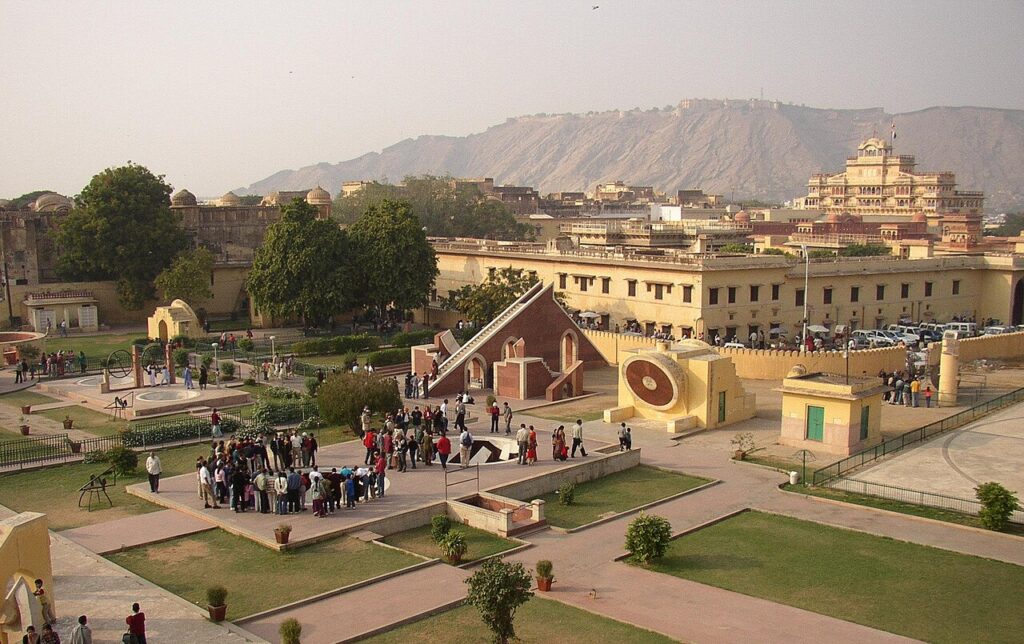
Jantar Mantar, Jaipur (जंतर मंतर, जयपुर, Sanskrit “yantra mantra” — instruments and formulae), inscribed by UNESCO in 2010, is the largest and best-preserved of the five astronomical observatories (Jantar Mantars) constructed in the 1720s–1730s CE by Maharaja Sawai Jai Singh II (1688–1743 CE, the ruler of the Jaipur kingdom, one of the most intellectually capable of the 18th-century Rajput rulers — simultaneously a military commander, an astronomer, a mathematician, a city planner who founded the planned city of Jaipur in 1727 CE on a grid plan with 9 blocks based on the traditional Hindu vastu shastra town planning principles, and the patron of the astronomical observatory programme that produced the five Jantar Mantars at Jaipur, Delhi, Varanasi, Ujjain, and Mathura) — a complex of 20 monumental masonry astronomical instruments designed to measure time, predict celestial events, calculate latitudes, and track the positions of the sun, moon, and planets with precision comparable to contemporary European observatory instruments, all built without metal components using the specific material properties of lime plaster and marble (the materials’ thermal expansion characteristics were factored into the instrument calibrations). The most impressive instrument is the Samrat Yantra (Emperor Instrument, जंत्र सम्राट) — at 27.4 m in height, the world’s largest sundial, which can measure local solar time to an accuracy of approximately 2 seconds on a clear day using the shadow of its triangular gnomon (the diagonal wall rising from south to north at an angle of 27° — the latitude of Jaipur) cast on two adjacent quadrant scales calibrated with divisions of 2 seconds of time on the arc of the scale at the gnomon’s base.
Jantar Mantar’s astronomical complex and the Jaipur City heritage ensemble Samrat Yantra · Jai Prakash Yantra · Jaipur Old City · Amber Fort · Keoladeo — 0 to 50 km
The Jantar Mantar complex within the Jaipur city wall (on the edge of the Walled City, immediately adjacent to the City Palace and the entrance to the Hawa Mahal neighbourhood) contains 20 instruments designed by Maharaja Jai Singh II in consultation with the Persian astronomer Muhammad Sharif and the Sanskrit astronomical tradition represented by the Siddhanta texts — the instruments combine the Islamic astronomical tradition (astrolabe measurements, equatorial coordinates, spherical trigonometry) with the Vedic astronomical tradition (the nakshatras star catalogue, the calculation of muhurta auspicious times for ritual observances) in what was one of the last major synthesis attempts between Islamic and Hindu astronomical traditions before the European observational tradition (with its telescopes, Newtonian mechanics, and logarithmic tables) rendered both traditions obsolete for practical prediction within the following century. The 20 instruments include: the Samrat Yantra (world’s largest sundial, capable of 2-second accuracy); the Jai Prakash Yantra (two hemispherical bowls sunk in the ground, calibrated with intersecting marble arcs, used to measure the position of the sun within the zodiac and the time of transit); the Ram Yantra (two complementary cylindrical structures open to the sky, used for measuring altitude and azimuth of celestial objects); the Rashivalaya Yantra (12 identical instruments each calibrated for one zodiac sign, used to determine when the sun enters a particular zodiac and to calculate astrological charts); and the Disha Yantra (a compact instrument to measure the altitude and declination of celestial objects). The mathematical precision of the Jantar Mantar instruments is documented in the specific engraved calibration marks visible on the marble scales — the finest divisions on the Samrat Yantra’s quadrant scale represent 2 seconds of time (approximately 0.008°of arc), which requires the engraving of a mark approximately 1 mm wide on an arc of approximately 7 m radius, a measurement accuracy equivalent to contemporary precision machining. The Jaipur Jantar Mantar was used for the compilation of the Zij-i-Muhammad Shahi astronomical tables (published approximately 1732 CE), which updated the existing Islamic Zij astronomical tables using Jai Singh II’s own observational data and corrections, and were dedicated to the Mughal Emperor Muhammad Shah — one of the last significant contributions of the Islamic astronomical tradition before its replacement by Newtonian mechanics.
Jaipur City (UNESCO 2019, the inscription that covers the entire historic walled city of which Jantar Mantar is a component — the 1727 CE planned city with its 9-block grid, the City Palace complex, and the Hawa Mahal observatory-style building) and Amber Fort (approximately 11 km north of Jaipur, the earlier Rajput fort-palace on the Aravalli hills from the 16th–17th centuries CE, with the Sheesh Mahal mirror hall and the Diwan-i-Aam public audience hall) together create the full heritage sequence of Jaipur and the Amber Kachwaha Rajput dynasty. Keoladeo National Park (UNESCO 1985, approximately 50 km east of Jaipur — see separate CHO article) is the natural heritage complement.
Practical information
Jantar Mantar is in the heart of Jaipur’s Old City (the walled city, approximately 1 km from Jaipur railway station, adjacent to the City Palace and the Hawa Mahal). Jaipur has a major airport (Jaipur International Airport, JAI, approximately 12 km from the Old City) with international and domestic connections (direct to Delhi, Mumbai, and major Indian cities; seasonal international charters). Jaipur is one of the “Golden Triangle” tourist circuit cities (Delhi–Agra–Jaipur) and is extremely well-connected by train, bus, and road. The Jantar Mantar is managed by the Archaeological Survey of India. Open daily 09:00–16:30 (last entry). Admission fees apply (foreign visitor rate). Audio guide available. Visiting time: 1.5–2.5 hours for a comprehensive visit with interpretation. Combine with the City Palace (immediately adjacent, the royal museum of the Jaipur ruling family) and the Hawa Mahal (the “Palace of Winds”, the five-storey 1799 CE screen facade that was a zenana — women’s quarters — observation gallery overlooking the main street, 950 windows allowing women of the royal household to observe the street below without being observed themselves). The Amber Fort day excursion (11 km north, approximately 30 minutes from the Old City by car) is the standard full-day Jaipur itinerary. Best visiting months: October–March (post-monsoon Rajasthan, temperatures 15–28°C, clear skies ideal for astronomical instrument photography and Samrat Yantra shadow observation). At summer solstice (June 21), the Samrat Yantra shadow moves at approximately 1 mm per second — an instructive demonstration of the instrument’s precision calibration to the solar cycle.
Frequently Asked Questions
How did Maharaja Sawai Jai Singh II build such accurate astronomical instruments and why did he need them?
Maharaja Sawai Jai Singh II (born 1688 CE, ruled Jaipur kingdom from 1699 to 1743 CE — the title “Sawai” meaning “one-and-a-quarter”, granted by the Mughal Emperor Aurangzeb to indicate that Jai Singh was one-and-a-quarter times as capable as an ordinary man, a backhanded compliment that became his formal title) built the five Jantar Mantars for a specific practical purpose within the framework of 18th-century Indian court administration: the compilation of a new and more accurate set of astronomical tables to replace the existing Zij-i-Ulugh Beg tables (compiled by the Timurid ruler and astronomer Ulugh Beg at his Samarkand observatory in 1428–1437 CE) that were by the early 18th century demonstrably inaccurate for the prediction of astronomical events — the errors in the existing tables were causing discrepancies in the calculation of auspicious times (muhurta) for Hindu rituals, the prediction of eclipses (important for ritual and court purposes), and the determination of calendar dates (the Hindu lunisolar calendar requires accurate calculation of the moon’s position relative to the solar year). The specific political motivation for the astronomical programme is documented in the Zij-i-Muhammad Shahi’s dedication: Jai Singh had observed errors of up to 15 minutes in eclipse prediction using the existing tables, errors that were causing practical difficulties in the synchronisation of Hindu ritual observances. He requested from the Mughal Emperor permission to build new observatories, was granted that permission (and imperial financial support), and proceeded to design the instruments personally in consultation with European, Islamic, and Sanskrit astronomical sources. The design approach that produced the Jantar Mantar instruments was novel: rather than building instruments with moving parts (astrolabes, armillary spheres — the standard European and Islamic instrument types of the period), Jai Singh designed fixed masonry instruments at a scale where the physical precision of the stone and lime plaster construction could achieve the accuracy that only small precision-machined metal instruments could achieve in the European tradition. The scale advantage is direct: the Samrat Yantra’s quadrant scale at the base of the 27.4 m gnomon has an arc length of approximately 7 m per quarter circle; the finest division that can be reliably engraved in marble at this scale is approximately 1–2 mm, representing approximately 2 seconds of time. A portable astrolabe or quadrant of European design would have an arc length of approximately 15 cm per quarter circle, limiting precision to approximately 1 minute of time — 30 times less accurate than the Samrat Yantra. The accuracy advantage of the large fixed masonry instruments over the portable instruments of the period was documented by Jai Singh in his own comparison measurements (described in the preface to the Zij-i-Muhammad Shahi), which showed that his Samrat Yantra consistently produced more precise eclipse timing results than the portable instruments that European and Islamic astronomers used. The reason that the Jantar Mantar tradition did not lead to further development in Indian observational astronomy (i.e., why Jai Singh’s programme remained an isolated episode rather than the foundation for a continuous astronomical tradition as the European observatory tradition was becoming) was that the telescope — already established in European astronomy since Galileo’s observations in 1609 CE — provided a qualitatively different class of observational precision that no fixed masonry instrument, however large, could match; and the adoption of Newtonian mechanics after Newton’s Principia Mathematica (1687 CE) gave European astronomers the theoretical framework to calculate planetary positions analytically without requiring the extensive observational data that the Zij table tradition relied on. Jai Singh was aware of European telescopic astronomy (he owned copies of works by Flamsteed and De La Hire, and exchanged astronomical data with European Jesuit astronomers) but chose not to incorporate the telescope into his observational programme, an intellectual decision that is debated by historians of science.
Are any of the Jantar Mantar instruments still functional and how accurate are they?
All 20 instruments at the Jaipur Jantar Mantar are in a structurally intact and potentially functional state — the masonry construction (lime plaster on brick core, with precision-engraved marble scales) has been maintained by the Archaeological Survey of India through periodic conservation programmes, and the instrument calibrations (the engraved scales and the geometric relationships between instrument components) are physically unchanged from the 18th-century originals. The Samrat Yantra functions as a sundial whenever the sky is clear and the sun is above the horizon: the shadow of the 27.4 m triangular gnomon falls on the graduated quadrant scales on either side, and the position of the shadow on the scale can be read to 2 seconds of time — a reading that can be verified against a precise atomic clock. In practice, comparisons between Samrat Yantra readings and GPS time have demonstrated that the instrument achieves its design accuracy of approximately 2 seconds under good conditions (clear sky, no atmospheric refraction anomalies, accurate plumb-line reading of the shadow). The Jai Prakash Yantra (the hemispherical bowl instruments) can be used to measure the sun’s position in the zodiac and to identify the star overhead at any given moment of the night (the cross-wire filaments stretched across the bowl opening cast a cross-shadow on the bowl surface, identifying the celestial coordinate of the zenith). The Ram Yantra (the two complementary cylindrical structures with graduated altitude scales) can measure the altitude and azimuth of any celestial object visible from within the cylinder. The primary functional limitation of the Jantar Mantar instruments for contemporary practical use is that they measure solar time (the position of the sun in its daily arc across the sky) rather than standard time (the uniform 24-hour clock synchronized to a specific meridian that is the basis of contemporary timekeeping) — the solar time reading from the Samrat Yantra must be corrected for the “equation of time” (the systematic difference between solar time and mean solar time, which varies by up to 16 minutes through the year) to convert to contemporary standard time, a correction that Jai Singh’s original instrument design did not need to incorporate because 18th-century timekeeping was still based on solar time rather than mean time. Modern visitors can observe Forest Department staff demonstrating the Samrat Yantra shadow reading at midday (when the shadow is shortest and most precisely positioned on the noon line) and comparing the instrument reading with a clock — the comparison typically shows agreement within approximately 2–3 minutes, which represents the combined effect of the 2-second instrument precision and the need for the equation-of-time correction.
EXCERPT: Jantar Mantar, Jaipur, UNESCO-inscribed in 2010, is a 1720s astronomical observatory complex with 20 masonry instruments including the Samrat Yantra — the world’s largest sundial (27.4 m) measuring solar time to 2-second accuracy, built by Maharaja Sawai Jai Singh II to produce more accurate astronomical tables than the existing 15th-century Islamic ones.
META: UNESCO World Heritage Sites near Jantar Mantar Jaipur India: Jaipur City Rajasthan (same city, UNESCO 2019), Hill Forts of Rajasthan (Amber Fort 11 km, UNESCO 2013), Keoladeo National Park Bharatpur 50 km (UNESCO 1985) — Jaipur Rajasthan UNESCO heritage circuit, Jantar Mantar astronomical instruments Sawai Jai Singh II, Rajput observatory architecture.
Sources
- S1 — UNESCO World Heritage Centre — The Jantar Mantar, Jaipur (Ref. 1338) — https://web.archive.org/web/20230601000000/https://whc.unesco.org/en/list/1338/
- S2 — UNESCO World Heritage Centre — Statement of Outstanding Universal Value (Ref. 1338) — https://whc.unesco.org/en/list/1338/
Spotted an error? Write to [email protected] and we correct it the same day.