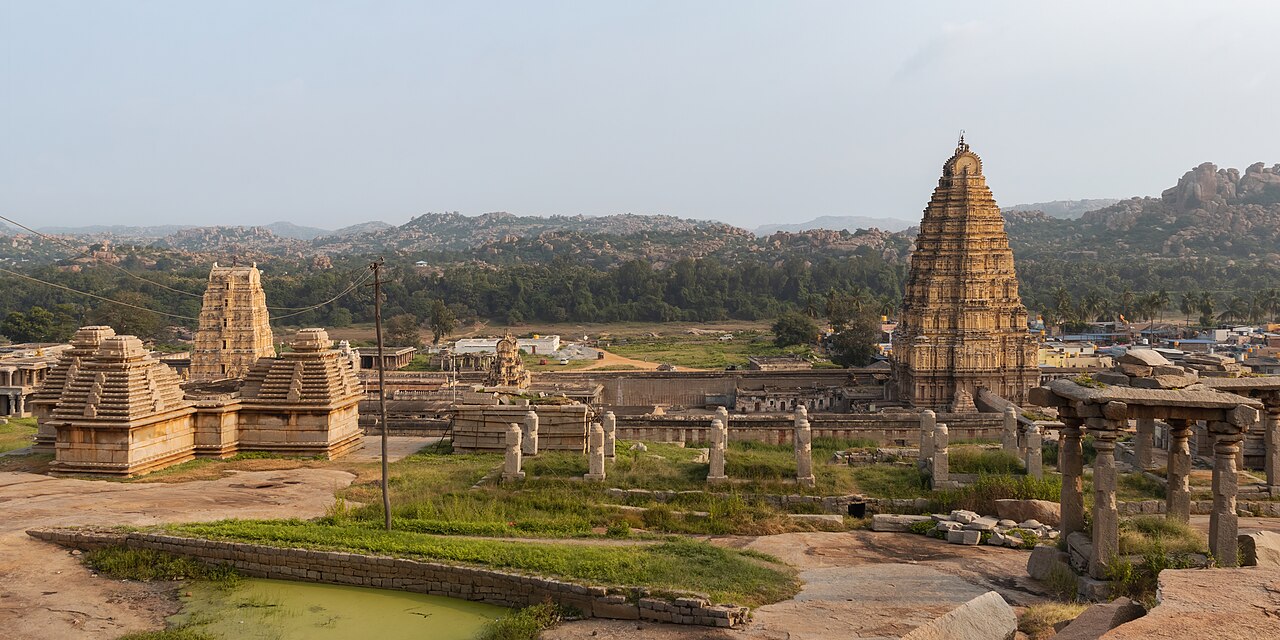
The Group of Monuments at Hampi (ಹಂಪಿ), inscribed by UNESCO in 1986, is the ruins of Vijayanagara — the capital city of the Vijayanagara Empire (1336–1565 CE), which was at its greatest extent one of the largest cities in the world (estimated population approximately 500,000–600,000, rivalling contemporary London, Paris, and Peking — the Portuguese traveller Domingo Paes, who visited approximately 1520 CE, described it as “the best-provided city in the world”) and the most prosperous Hindu kingdom in the Indian subcontinent, before its comprehensive destruction by the allied Deccan Sultanates following the Battle of Talikota (January 26, 1565 CE) — a destruction that continued for approximately six months and was described by contemporary chroniclers as total: the temples were defaced, the palace buildings burned, the aqueducts smashed, and the city abandoned. The UNESCO-inscribed area encompasses approximately 4,187 hectares of ruins, temples, and the boulder-strewn granite landscape of the Tungabhadra River valley — a geological terrain of massive rounded granite boulders and hills that makes the Hampi landscape visually unique among South Asian UNESCO sites and that determined the city planning of Vijayanagara (the naturally fortified boulder terrain formed the outer defensive walls of the empire’s capital, complemented by seven concentric rings of earthen and stone fortification walls, of which segments still survive). The principal monuments include: the Virupaksha Temple (the oldest continuously worshipped temple at Hampi, predating Vijayanagara itself — the 10th-century CE core temple with subsequent additions creating the 52-metre Galigopuram entrance tower); the Vittala Temple complex (approximately 1513 CE, the architectural masterwork of the Vijayanagara imperial style — the stone chariot shrine in its outer mandapa courtyard and the Musical Pillars that produce tonal sounds when tapped are its most famous features); and the Royal Enclosure and the Zenana Enclosure (the palace administration complex with the Lotus Mahal, the Elephant Stables, and the underground treasury).
Hampi’s ruins landscape and the Karnataka heritage corridor Sacred Centre · Royal Enclosure · Vittala Temple · Pattadakal · Badami — 0 to 150 km
The Hampi complex is conventionally divided into two principal zones: the Sacred Centre (the area around the Virupaksha Temple and the Hemakuta Hill temples — the religious core of Vijayanagara that is the oldest part of the site and the area where the living community of Hampi village, pilgrims, and sadhus currently concentrate) and the Royal Enclosure (the palace and administrative complex approximately 1.5 km east of the Virupaksha Temple, on the other side of the paved ceremonial road that was the main processional axis of Vijayanagara). The Vittala Temple complex (approximately 2.5 km east of the Virupaksha Temple, at the end of the main bazaar road — the bazaar colonnaded road itself, with its dual rows of intact pillared pavilions, is one of the most evocative spaces in the Hampi ruins) is the third major zone. The Vittala Temple’s stone chariot (a single block of granite carved in the form of a temple-chariot with working stone wheels — the wheels were originally functional, rotating on granite axles, though the ASI has now cemented them to prevent vandalism) is the most recognisable image of Hampi and has appeared on the back of the Indian 50-rupee note. The Musical Pillars of the Vittala Temple’s main mandapa (the 56 slender pillars of the outer colonnade, each composed of a central large pillar surrounded by a cluster of smaller pillars — when struck with the knuckle, the smaller pillars emit musical tones of different pitch, creating a scale; the geological reason is the specific density and resonance of the local granite variety) were subjected to testing by British colonial engineers in the 19th century who cut two pillars to determine whether hollow metal tubes or some other physical mechanism caused the sounds — the inside of the pillars proved solid stone, the tonal property being purely a function of the crystalline structure of the granite.
Pattadakal (UNESCO 1987, approximately 147 km north of Hampi by road via Hospet and Gadag) and Badami (approximately 125 km north of Hampi, the earlier Chalukya capital with spectacular 6th–7th century CE cave temples) together form the Karnataka Chalukya heritage triangle with Hampi — the sequence of Chalukya (Badami, 6th–8th century CE), mature Chalukya (Pattadakal, 8th century CE), and Vijayanagara (Hampi, 14th–16th century CE) represents the entire sweep of Karnataka Hindu heritage. The landscape around Hampi (the boulder terrain of the Tungabhadra Valley, with the river winding between granite outcrops covered in the ruins of ghats, temples, and water-management infrastructure) is itself part of the UNESCO Outstanding Universal Value — the visual relationship between the monuments and the extraordinary geological setting distinguishes Hampi from every other South Asian UNESCO site in terms of landscape integration.
Practical information
Hampi is near Hospet (Hosapete, Karnataka), approximately 350 km from Bangalore/Bengaluru and 420 km from Hyderabad. By train: Hosapete Junction railway station (13 km from Hampi) has direct trains from Bangalore (Hampi Express, overnight approximately 9 hours), Goa (approximately 7 hours), and Hyderabad. By bus from Bangalore (approximately 8–9 hours by overnight KSRTC bus, very frequent service). By flight: nearest airport is Hubli (approximately 160 km west) or Vidyanagar airport (the new Ballari airport, approximately 70 km east, with connections to Bangalore). Hampi village (at the Virupaksha Temple) is accessible from the Hosapete side of the Tungabhadra River; the Vittala Temple area and the farther monuments are across the river (coracle ferry service or road bridge depending on season). The Archaeological Survey of India manages the principal monuments with separate entry tickets. The site is open daily from sunrise to sunset; the Vittala Temple complex closes at 18:00. Heritage cycle or auto-rickshaw circuits are the standard mode of exploration — the site covers too large an area (approximately 4 km east-west) for walking between all zones. Best visiting season: October–February (maximum temperature 28–32°C, minimal rainfall; March–May can reach 40°C in the open boulder landscape). Avoid weekend peak visitor periods from Bangalore (Saturday–Sunday, when the site is heavily crowded). Accommodation at Hampi village and Virupapur Gaddi (the hippie enclave across the river) ranges from guesthouses to mid-range hotels; Hospet (13 km) offers better mid-range and business hotel options.
Frequently Asked Questions
What was the Vijayanagara Empire and why was it so important in South Indian history?
The Vijayanagara Empire (Sanskrit: “City of Victory”) was a Hindu empire founded in 1336 CE by two brothers, Harihara I and Bukka Raya I (formerly officers in the service of the Kampili kingdom, who converted to Islam under the Delhi Sultanate but reconverted to Hinduism with the encouragement of the sage Vidyaranya of the Sringeri Sharada Peetham monastery, and founded the new kingdom as an explicitly Hindu counter-power to the Muslim Sultanates of the Deccan) that ruled most of peninsular India south of the Krishna and Tungabhadra rivers for approximately 230 years (1336–1565 CE), with Hampi (Vijayanagara) as its capital. The empire’s significance in South Indian history rests on several specific historical functions: it was the major power that prevented the complete military domination of the Indian subcontinent by the Delhi Sultanate and its successor Deccan Sultanates in the 14th–15th centuries CE, maintaining the Hindu political and cultural tradition in South India at a time when it had been extinguished across most of North India; it was the principal patron of Telugu, Kannada, and Tamil literary and cultural production in the 15th–16th centuries CE (the “Vijayanagara period” is considered the classical age of Telugu and Kannada literature); it was the most important trading partner of the Portuguese Estado da India in Asia, supplying horses from Arabia and Persia (essential for the Vijayanagara cavalry in its wars with the Deccan Sultanates) in exchange for textiles, and creating the commercial relationship that produced the extensive Portuguese accounts of the city (Domingo Paes 1520, Fernão Nunes 1535–1537) that are the most detailed contemporary European descriptions of any city in medieval Asia. At its demographic peak (approximately 1510–1565 CE, the reigns of Krishna Deva Raya, the greatest of the Vijayanagara emperors, and his successors), the city of Vijayanagara is estimated at approximately 500,000–600,000 inhabitants — one of the ten largest cities in the world at that time — spread across a planned urban area of approximately 650 km² enclosed within seven concentric rings of fortification walls. The destruction at the Battle of Talikota (January 26, 1565 CE) — in which the Vijayanagara army of approximately 600,000 foot soldiers and 100,000 cavalry was defeated by the allied forces of four Deccan Sultanates (Bijapur, Ahmadnagar, Bidar, and Golconda, who had temporarily set aside their mutual conflicts to eliminate the Hindu power that had consistently prevented their expansion southward) — was followed by a six-month systematic demolition of the city: the stone temples had their sculptures defaced (primarily the faces of divine figures, consistent with the iconoclastic practice of the Deccan Sultanates, though the structural architecture was largely spared); the palace buildings, which were of wood and brick, were burned; the aqueducts and water-management infrastructure that had supported the city’s population were deliberately destroyed; and the city was abandoned and looted by a population that fled south to establish successor Vijayanagara kingdoms at Penukonda, Chandragiri, and finally Vellore. The ruins of Hampi were never re-inhabited as a major urban centre and the jungle gradually covered the remains — a process documented in the colonial accounts from the late 18th century onward, when the ruins were encountered by British officers who were unable initially to believe that the enormous stone ruins had been a single city rather than a series of unconnected religious complexes.
What are the Musical Pillars of the Vittala Temple and how do they produce sound?
The Musical Pillars (also called the Singing Pillars or the Sa Re Ga Ma pillars) are 56 pillars in the outer ambulatory colonnade (Mukha Mandapa) of the Vittala Temple at Hampi (approximately 1513 CE, commissioned during the reign of Krishnadevaraya, the greatest of the Vijayanagara emperors), each composed of a central large load-bearing pillar surrounded by a cluster of seven to eight smaller attached pillars of varying diameters. When the smaller surrounding pillars are struck with the knuckle (not a hard blow — a light tap is sufficient), they emit clear musical tones of different pitch depending on their diameter: the smallest pillars produce the highest tones, the largest produce the lowest tones, creating an informal musical scale when the pillars of a single column cluster are tapped in sequence. The British colonial engineers who tested the pillars in the 19th century (the specific period and the engineers involved are variously documented — the widely cited account attributes the test to the Madras Railway chief engineer, who cut two pillars to determine whether hollow metal tubes inside the stone were producing the sound) found that the pillar interiors were solid granite throughout, confirming that the acoustic property is entirely a function of the material — the specific density, crystalline structure, and internal homogeneity of the local Hospet granite (a fine-grained granite with specific resonance characteristics) rather than any structural mechanism. The acoustic phenomenon is not unique to the Vittala Temple: similar resonant granite pillar clusters exist at other Vijayanagara-period temples (notably at the Tadpatri Chintala Venkataramana Temple in Andhra Pradesh and the Lepakshi Veerabhadra Temple, approximately 120 km north of Bangalore) and in Tamil Nadu Dravidian temples of the Nayak period (the Nayak rulers of Madurai and Thanjavur were successors to the Vijayanagara tradition). The Vittala Temple Musical Pillars are the most famous example because of the quality of the tones, the systematic arrangement (56 pillars, each cluster producing a slightly different scale), and the international fame of the Hampi UNESCO site. The Archaeological Survey of India now prohibits striking the pillars (signs at the site instruct visitors not to strike or touch the smaller pillars, to prevent the slow surface abrasion from millions of visitors’ knuckles that had begun to visibly erode the pillar surfaces by the 1990s); visitor demonstrations using a small mallet are conducted by licensed guides who demonstrate on a few designated pillars where the surface has been reinforced.
EXCERPT: Group of Monuments at Hampi, UNESCO-inscribed in 1986, is the ruins of Vijayanagara — a 14th–16th-century Hindu empire capital of 500,000 people destroyed in 1565 CE — the Vittala Temple stone chariot that appears on Indian currency, Musical Pillars in granite that ring like bells, all set in a extraordinary boulder landscape in Karnataka.
META: UNESCO World Heritage Sites near Group of Monuments at Hampi Karnataka India: Pattadakal 147 km north (UNESCO 1987), Churches and Convents of Goa 350 km west (UNESCO 1986), Elephanta Caves 600 km northwest (UNESCO 1987) — Karnataka UNESCO heritage corridor from Hampi through Pattadakal to Badami, Karnataka’s Chalukya-Vijayanagara stone temple sequence.
Sources
- S1 — UNESCO World Heritage Centre — Group of Monuments at Hampi (Ref. 241) — https://web.archive.org/web/20230601000000/https://whc.unesco.org/en/list/241/
- S2 — UNESCO World Heritage Centre — Statement of Outstanding Universal Value (Ref. 241) — https://whc.unesco.org/en/list/241/
Spotted an error? Write to editorial@culturalheritageonline.com and we correct it the same day.