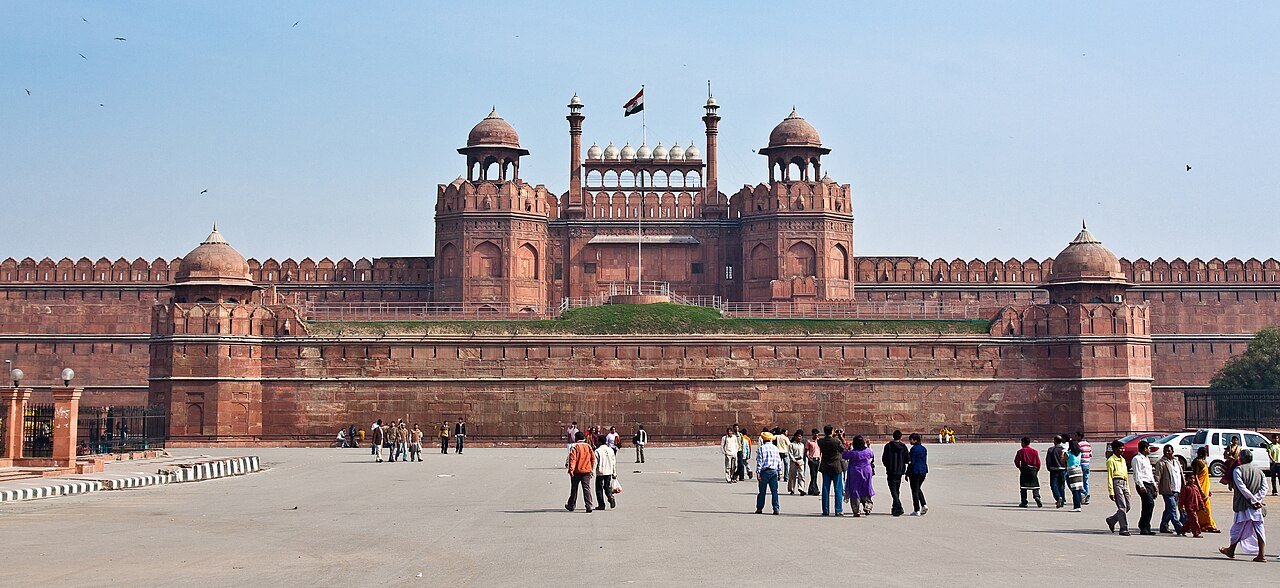
The Red Fort Complex (लाल क़िला, Lāl Qila, or Qila-i-Mubaarak “Auspicious Fort”), inscribed by UNESCO in 2007, is the principal palace-citadel of the Mughal emperor Shah Jahan’s capital city Shahjahanabad (the “Old Delhi” of modern Delhi) — an approximately 254-hectare fortified palace complex on the west bank of the Yamuna River in Delhi, enclosed within red sandstone walls approximately 33 m high on the river side and 18 m high on the city side, and containing the palace buildings, courts, mosques, and administrative structures built during the reign of Emperor Shah Jahan (r. 1628–1658 CE) after the Mughal court moved from Agra to the new capital of Shahjahanabad in 1648 CE. The Red Fort is both a physical monument of Mughal imperial architecture and a site of profound symbolic importance in Indian national history: it was from the Fort’s ramparts that the British colonial administration held its formal ceremonies; it was at the Fort where the Indian National Congress hoisted the Indian national flag for the first time on Indian soil in 1929 CE (during the Round Table Conference); and most significantly, it was from the Fort’s Lahori Gate ramparts that Prime Minister Jawaharlal Nehru addressed the Indian nation on 15 August 1947 CE, the day of India’s independence from British rule — an address that has been repeated by every Indian Prime Minister on Independence Day since, making the Red Fort’s ramparts the symbolic site of India’s independence declaration and the most politically charged heritage monument in the country.
The Red Fort palace complex and Old Delhi’s Mughal heritage landscape Lahori Gate · Diwan-i-Am · Rang Mahal · Jama Masjid — 0 to 0.5 km
The Red Fort complex is entered through the Lahori Gate (the principal western gate, named for the road to Lahore that began here, the same gate from whose ramparts the Independence Day address is delivered annually) through a covered market street (Chatta Chowk, “Covered Bazaar”, originally a shopping arcade for the harem women who could not go to the bazaars outside the Fort, now a tourist market) into the main ceremonial court. The principal surviving palace buildings include: the Diwan-i-Am (Hall of Public Audience, the most important of the Fort’s courts in political terms — a large marble-pillared pavilion approximately 60 m × 27 m where the emperor received petitions from the public, presiding from a marble throne alcove decorated with pietra dura panels of European Renaissance floral motifs combined with Mughal floral designs — the panels, removed by the British after 1857 and restored in the 20th century, are the most technically intricate pietra dura work in the Fort complex); the Rang Mahal (Palace of Colours, the principal residence of the imperial ladies, its original mirrored and painted decoration (rangrang, painted, hence the name) now largely stripped by looters in the 18th and 19th centuries, but the central marble basin on a lotus-flower base that was originally supplied by the Nahr-i-Bihisht “River of Paradise” channel still surviving); the Khas Mahal (the emperor’s private palace, three connected pavilions for prayer, sleeping, and audience, on the Yamuna-facing terrace — the Tasbih Khana prayer room, Khwabgah sleeping chamber, and Tosh Khana robe chamber, now empty but with their architectural proportions intact); the Diwan-i-Khas (Hall of Private Audience, the building most associated with Shah Jahan’s artistic patronage, with the marble walls originally decorated with the finest pietra dura work in the Fort; the famous Persian couplet “If there is a paradise on Earth, it is here, it is here, it is here” inscribed in gold on the arch of the Diwan-i-Khas, repeated at the Shalimar Gardens in Kashmir, is attributed to Shah Jahan’s court poet Amir Khusrow); and the Moti Masjid (Pearl Mosque, built by Emperor Aurangzeb 1659–1660 CE, in pure white marble, the only addition to the Red Fort from after Shah Jahan’s reign, a small three-domed mosque within the palace compound for the emperor’s private use). The Hayat Bakhsh Bagh (Life-giving Garden, the formal garden in the northern section of the Fort complex, with a central red sandstone pavilion surrounded by two water channels in the traditional chahar bagh four-quadrant layout) retains the bones of Shah Jahan’s original garden design, though the plantings have changed from the original Mughal jasmine and rose to modern municipal plantings.
The Jama Masjid (Masjid-i-Jahan-Numa, “World-Revealing Mosque”, approximately 500 m west of the Red Fort on a raised platform visible from the Fort’s Lahori Gate, commissioned by Shah Jahan and built 1644–1656 CE, the largest mosque in India with a courtyard capable of holding 25,000 worshippers simultaneously) is the most important architectural complement to the Red Fort in the Shahjahanabad townscape — together the Fort and the Jama Masjid defined the two poles of the Mughal capital, with the palace on the river to the east and the Friday congregational mosque to the west, connected by the main commercial street of Chandni Chowk (Moonlight Square, originally a royal market with a central reflecting pool and silver merchants on both sides). The Old Delhi neighbourhood surrounding the Red Fort (Shahjahanabad, the original Mughal capital now a densely populated old city quarter of Delhi) retains significant 17th–19th century architecture in the residential and commercial streets north of Chandni Chowk — the spice market (Khari Baoli), the electrical goods market (Bhagirath Place), and the old mohallas (neighbourhood quarters) of the traditional craftsmen are all within walking distance of the Red Fort.
Practical information
The Red Fort is located in Old Delhi (Purani Dilli), accessible by Delhi Metro (Chandni Chowk Station on the Yellow Line, 5 minutes walk to Lahori Gate). By road, the Fort is approximately 5 km from Connaught Place and 15 km from New Delhi railway station in typical traffic. The Fort is open Tuesday–Sunday 09:30–16:30 (closed Mondays). Admission fee (foreign visitors): standard ASI monument fees. The sound-and-light show (Bharat Mata, evenings Tuesday–Sunday) is held in the main court of the Fort and narrates Indian history from the Mughal period through independence — highly recommended as a complement to the daytime visit. Photography is permitted throughout. The Red Fort Museum within the complex (in the Mumtaz Mahal, the southernmost of the six main palace buildings) contains a collection of Mughal-era objects found in the Fort during excavations and preservation works, including carved marble architectural fragments and glazed tile panels. The Independence Day access to the Fort’s Lahori Gate ramparts is restricted to invited guests and security personnel — general visitors do not have access on 15 August but the national televised address (visible from the public space outside the Fort) is an extraordinary event. Best visiting season: October–February (mild temperatures 10–25°C, clear Delhi skies). Delhi’s summer (April–June: up to 45°C) and monsoon (July–September: high humidity) are physically challenging for extended monument visits; the Fort has limited shade on its outer lawns. Combine with Jama Masjid (15-minute walk west), Chandni Chowk (the bazaar street outside the Fort’s western wall, for street food and traditional Old Delhi atmosphere), and — by Metro — the Humayun’s Tomb and Qutb Minar UNESCO sites in South Delhi.
Frequently Asked Questions
What happened to the Red Fort during and after the 1857 Indian Rebellion?
The Red Fort was the principal arena of the 1857 Indian Rebellion’s Delhi campaign — the most consequential event in the Fort’s post-Mughal history and the episode that caused the most lasting damage to its architectural fabric. When the Sepoy Rebellion began at Meerut on 10 May 1857 CE, the rebel soldiers marched to Delhi and proclaimed the last Mughal emperor, Bahadur Shah Zafar II (بهادر شاہ ظفر, r. 1837–1857 CE, then 82 years old, a distinguished Urdu poet but a ruler with minimal real power, pensioned by the British East India Company), as their leader and the symbolic head of the rebellion against British rule. Bahadur Shah Zafar, despite initially refusing the rebel soldiers’ demands, became the nominal figurehead of the Delhi phase of the rebellion from May to September 1857. British forces besieged Delhi for approximately four months (June–September 1857), entering the city through Kashmiri Gate (blown open by a British engineering party in a famous act of heroism that killed most of the party) on 14 September 1857 and reaching the Red Fort on 15 September. The British looting of the Red Fort following its capture was systematic and severe: marble panels from the Diwan-i-Khas (the pietra dura panels depicting birds, flowers, and animals that Shah Jahan’s craftsmen had produced over decades) were removed and shipped to England (several panels are now in the Victoria and Albert Museum, London); the Rang Mahal’s mirrors and painted decoration were stripped; silver-inlaid gates were melted down; and the Fort’s gardens were cleared to create open space for the British military cantonment. The three sons of Bahadur Shah Zafar were captured and publicly executed by the British officer William Hodson at the Khooni Darwaza (Bloody Gate, approximately 1 km south of the Fort); Bahadur Shah Zafar himself was tried before a British military tribunal in the Red Fort and sentenced to exile, dying in Rangoon (Yangon, Burma/Myanmar) in 1862 CE — the last Mughal emperor died in colonial exile in a city that had been no part of any Mughal territory.
What was the Peacock Throne and what happened to it?
The Peacock Throne (تخت طاووس, Takht-e Tavus) was the most elaborate imperial throne in world history — a jewelled gold and enamel throne built for Emperor Shah Jahan by the court goldsmith Bebadal Khan between 1628 and 1635 CE (seven years of construction), valued by the Mughal court chronicle at approximately 10 million gold mohurs (a value that historians estimate as equivalent to several billion USD in modern terms, based on the gold and gem content documented in the Padshahnama). The throne took the form of a large couch (khat) of gold encrusted with diamonds, rubies, emeralds, and pearls, with a canopy supported by twelve pillars topped by gold peacocks (their tails spread in display, each tail feather inlaid with gems), the canopy’s underside covered in gem-encrusted gold, and the throne backed by two jewelled golden palm trees. The Koh-i-Noor diamond (the “Mountain of Light”) was among the gems set in the throne. The Peacock Throne was kept in the Diwan-i-Khas of the Red Fort after Shah Jahan moved the court to Shahjahanabad in 1648 CE, and it was looted from the Red Fort by the Persian Emperor Nadir Shah during the 1739 CE sack of Delhi — after his military victory over the Mughal Emperor Muhammad Shah at the Battle of Karnal, Nadir Shah entered Delhi and was present in the Red Fort for approximately 57 days, during which he removed virtually all portable wealth including the Peacock Throne and the Koh-i-Noor. The Peacock Throne was transported to Persia and kept in Tehran; it was dismantled after Nadir Shah’s assassination in 1747 CE, its gems redistributed among Nadir Shah’s successors and the treasure-seeking factions of the subsequent Afghan and Persian civil wars. No part of the original Peacock Throne survives intact — subsequent Persian “Peacock Thrones” in Tehran (including the throne used for the coronation of the Pahlavi shahs) were new constructions inspired by the Mughal original rather than the original itself. The empty marble throne niche in the Red Fort’s Diwan-i-Khas (its pietra dura decoration partially intact) marks where the Peacock Throne once stood.
How does the Red Fort relate to the other Mughal UNESCO sites in Delhi?
Delhi contains four UNESCO World Heritage components within the city boundaries or immediately adjacent: the Red Fort Complex (UNESCO 2007), Humayun’s Tomb (UNESCO 1993), Qutb Minar and its Monuments (UNESCO 1993), and the Lotus Temple (not UNESCO inscribed) — a concentration of monumental heritage spanning from the 12th century CE (the Qutb Minar’s first construction phase, 1193 CE) through the 20th century (New Delhi’s planned capital by Edwin Lutyens and Herbert Baker, not UNESCO inscribed but under discussion). The Red Fort is the most recent and the largest of the Delhi UNESCO inscriptions; the spatial and temporal relationship between the three inscribed Mughal sites reveals the development of the Mughal capital city concept over 350 years. Humayun’s Tomb (1565–1572 CE, in the Nizamuddin neighbourhood approximately 6 km south of the Red Fort, at Humayun’s Tomb Metro station on the Violet Line) is the first great Mughal mausoleum in India and the direct prototype for the Taj Mahal — the double-dome in red sandstone and white marble, the raised platform garden (chahar bagh) enclosure, and the octagonal plan are the architectural elements that Shah Jahan’s architects studied and refined for the Taj Mahal commission 70 years later. The Qutb Minar (1193–1368 CE, approximately 15 km south of the Red Fort, at Qutb Minar Metro station on the Yellow Line) predates the Mughal period entirely — the 73-metre minaret built by the first Delhi Sultanate ruler Qutb ud-Din Aibak and his successors, and the surrounding complex of the Quwwat ul-Islam mosque (the first mosque built on Indian soil after the Muslim conquest, using columns from 27 demolished Hindu and Jain temples — still visible in the hypostyle prayer hall with their distinctly Hindu carved surfaces), form the earliest layer of Islamic architecture in India. The three Delhi UNESCO sites together form a circuit through the entire history of Delhi’s Islamic architectural heritage from the 12th century Delhi Sultanate (Qutb Minar), through the Mughal founding generation (Humayun’s Tomb), to the Mughal imperial zenith (Red Fort).
EXCERPT: The Red Fort Complex, UNESCO-inscribed in 2007, is the Mughal imperial palace-citadel in Old Delhi — red sandstone walls 33 metres high, the Diwan-i-Khas where the Peacock Throne stood (looted by Nadir Shah 1739), the Lahori Gate ramparts from which Nehru declared Indian independence on 15 August 1947 — 500 m from the Jama Masjid and 6 km north of Humayun’s Tomb (UNESCO 1993).
META: UNESCO World Heritage Sites near Red Fort Delhi India: Humayun’s Tomb 6 km south (UNESCO 1993), Qutb Minar 15 km south (UNESCO 1993), Agra Fort and Taj Mahal 200 km south (UNESCO 1983) — Delhi UNESCO heritage trail from Red Fort (Mughal capital) to Humayun’s Tomb (Mughal prototype) to Qutb Minar (Delhi Sultanate founding).
Sources
- S1 — UNESCO World Heritage Centre — Red Fort Complex (Ref. 231) — https://web.archive.org/web/20230601000000/https://whc.unesco.org/en/list/231/
- S2 — UNESCO World Heritage Centre — Statement of Outstanding Universal Value (Ref. 231) — https://whc.unesco.org/en/list/231/
Spotted an error? Write to editorial@culturalheritageonline.com and we correct it the same day.