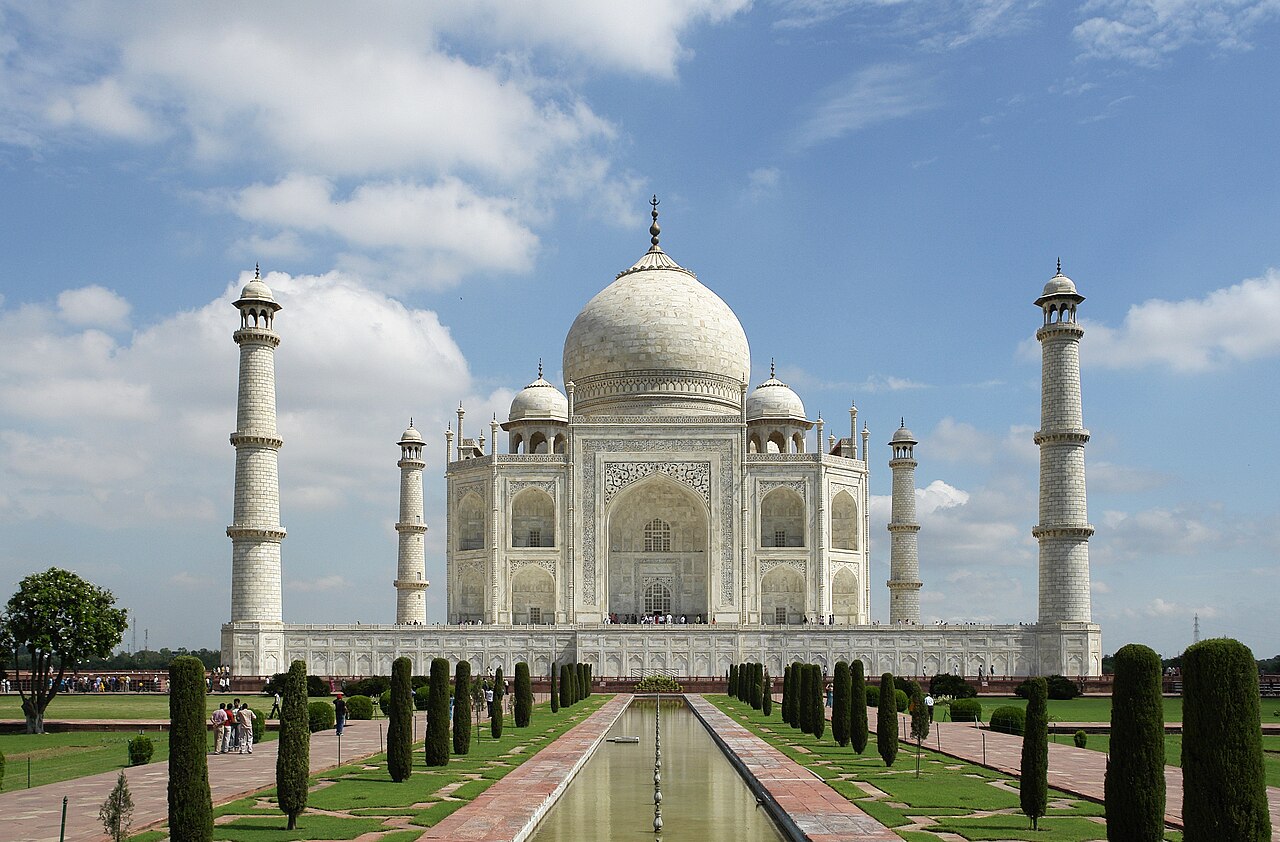
The Taj Mahal (تاج محل, “Crown of the Palace”), inscribed by UNESCO in 1983, is the white marble mausoleum built 1631–1648 CE on the south bank of the Yamuna River at Agra, Uttar Pradesh, India — commissioned by the Mughal Emperor Shah Jahan (شاه جهان, r. 1628–1658 CE) as the tomb for his third and favourite wife, Arjumand Banu Begum, known posthumously as Mumtaz Mahal (ممتاز محل, “Jewel of the Palace”, died 1631 CE in childbirth), and widely regarded as the finest single architectural achievement of the Mughal Empire (1526–1857 CE) and the most perfect example of Mughal architecture — an architectural tradition synthesising Persian, Central Asian, Timurid, and Indian architectural vocabularies, applied here to a scale and in a material (white Makrana marble from the Makrana quarries of Rajasthan) that had no precedent in Mughal or South Asian building tradition. The Taj Mahal inscription encompasses the entire Taj Mahal complex (approximately 17 hectares): the domed central mausoleum, the reflecting pool (hauz-i-kausar, approximately 160 m long, aligned on the north-south axis of the complex), the flanking mosque and guest house (identical structures in red sandstone flanking the white marble mausoleum on the east and west sides), the gatehouse (Darwaza-i Rauza, the main entrance, in red sandstone with white marble inlay, approximately 30 m in height), and the charbagh garden (a formal Mughal garden in the Persian four-quadrant tradition, approximately 300 m × 300 m, with water channels along both axes and cypress trees at the quadrant boundaries). The complex’s Outstanding Universal Value rests not only on the mausoleum’s exceptional aesthetic quality but on its physical embodiment of a specific moment in the Mughal architectural tradition: the generation after the completion of the first great Mughal tomb (Humayun’s Tomb, Delhi, 1565–1572 CE) and the development of the pietra dura stone inlay technique that reached its apex at the Taj Mahal — the white marble exterior surfaces of the Taj Mahal are covered with intricate inlay patterns in semi-precious stones (carnelian, lapis lazuli, turquoise, jasper, onyx, and over 40 other stone types) in a technique requiring individual craftsmen to cut and fit each stone fragment into a precisely shaped recess in the marble.
The Agra UNESCO ensemble and the Mughal triangle heritage circuit Agra Fort · Fatehpur Sikri · Mathura — 0 to 40 km
The Taj Mahal complex is most powerfully experienced at the moment of entering through the main gatehouse (Darwaza-i Rauza) — the first sight of the mausoleum through the gatehouse arch framing the reflecting pool axis is one of the most studied architectural sequences in the world. The gatehouse’s proportions (the arch opening is precisely calculated so that the mausoleum appears exactly the same height as the arch when viewed from the prescribed approach position at the gateway threshold) demonstrate the mathematical precision of the Mughal court architect Ustad Ahmad Lahauri (أستاد احمد لاهوري, attributed, along with Ismail Khan Rumi for the dome design, among the principal architects of the complex). The central dome (approximately 73 m from ground to finial, a teardrop-shaped onion dome in the Persian Timurid tradition, flanked by four matching chhatri (kiosk) domes at the corners of the drum) appears to change colour with the light — the white Makrana marble has a translucent quality that makes the dome appear gold at sunrise, blue-white in midday sun, and softly luminescent in full moon night light, a quality the Mughal chronicler Abd al-Hamid Lahori described in the Padshahnama as “a cloud of light”. The mausoleum’s interior (open to visitors in the main chamber) contains the cenotaph chamber: two cenotaphs on a raised octagonal marble plinth (Shah Jahan’s cenotaph was added after his death in 1666 CE — he was interred beside Mumtaz Mahal by his son Aurangzeb), surrounded by an octagonal marble jali (perforated screen) fence, with the actual burials in a crypt chamber directly below at ground level (not accessible to visitors). The Yamuna River side of the Taj Mahal (accessible by a gate on the northern terrace) reveals the perspective from the river — the octagonal moonlight garden (Mahtab Bagh, “Moonlight Garden”, approximately 600 m × 300 m, on the opposite Yamuna bank, excavated in the 1990s by the Archaeological Survey of India and partly restored) was designed to provide a viewing platform for the mausoleum by moonlight from across the river.
Agra Fort (approximately 2.5 km west of the Taj Mahal along the Yamuna, accessible by road, rickshaw, or the riverside walking path — 35–45 minutes on foot) is the Mughal imperial fortress that served as the seat of the Mughal court before the capital moved to Shahjahanabad (Delhi) in 1648 CE. The Fort and the Taj Mahal together constitute Agra’s UNESCO heritage — the Fort inscribed in 1983 simultaneously with the Taj Mahal. From the eastern terrace of Agra Fort (specifically from the Musamman Burj tower, the octagonal tower at the river bend in the Fort’s eastern wall from which Shah Jahan is said to have spent his last years in captivity looking at the Taj Mahal across the Yamuna — he was imprisoned by his son Aurangzeb in 1658 CE and died in 1666 CE), the Taj Mahal’s central dome is visible 2.5 km away across the Yamuna bend. Fatehpur Sikri (approximately 40 km southwest of Agra by road, UNESCO inscribed 1986, the abandoned Mughal capital built by Emperor Akbar in 1569–1585 CE in red sandstone on a rocky outcrop) is the most architecturally innovative monument in the Mughal World Heritage series — the city was built and then abandoned within a generation (Akbar moved the court back to Agra in 1585 CE, possibly due to water supply problems in the new city) and never reoccupied, preserving its 16th-century spatial structure intact with the Panch Mahal (five-storey pavilion), the Diwan-i-Khas (Hall of Private Audience, with a unique central column supporting a lotus-flower capital throne platform), and the Buland Darwaza (the great gateway to the Jama Masjid, 54 m in height, the largest gateway in the world at its construction).
Practical information
The Taj Mahal is located in Agra, approximately 200 km south of Delhi by road (2.5–3 hours) or 2 hours by express train from Delhi’s Hazrat Nizamuddin Station to Agra Cantt Station (trains Gatimaan Express, Shatabdi Express; booking required in advance). The Taj Mahal is open daily 06:00–18:30 (last entry 17:30), closed on Fridays except for noon prayer (Jumma namaz) when the mausoleum is briefly closed to non-Muslim visitors. Admission fee (foreign visitors): substantially higher than domestic visitors, with an additional fee to enter the mausoleum interior; a combined Taj Mahal + Agra Fort ticket is available at a small discount. The Taj Mahal is among the most visited monuments in the world — daily visitor numbers typically exceed 20,000–30,000 (with peaks on weekends and festivals). The best times for photography are: sunrise (the eastern face of the mausoleum catches the first light; tickets are available for a pre-opening session from approximately 05:30, sold separately and limited in number) and late afternoon (the western face catches the sunset golden light). The Taj Mahal Archaeological Area is a vehicle-free zone of 500 m radius around the monument — visitors are dropped by road transport and enter on foot or by electric vehicle (tuk-tuk). Agra is also within day-trip distance of Fatehpur Sikri (40 km, 45 minutes by road), the Keoladeo National Park in Bharatpur (55 km, 1 hour, a UNESCO inscribed bird sanctuary with the largest concentration of nesting water birds in Asia during the winter migration season). Air-conditioned accommodation of all quality levels is available in Agra, with the best views of the Taj Mahal from the Yamuna side available from hotel rooftops directly across the river.
Frequently Asked Questions
Who designed the Taj Mahal and how long did it take to build?
The Taj Mahal’s construction took approximately 22 years (1631–1653 CE for the main complex; the outer enclosure and caravanserai were completed approximately in 1658 CE) and required a workforce estimated at approximately 20,000 workers at peak periods — including skilled craftsmen from across the Mughal empire and from Persia, Central Asia, and the Ottoman empire, who contributed specialised techniques in stone carving, pietra dura inlay, and gold calligraphy. The principal designer is most frequently identified as Ustad Ahmad Lahauri (أستاد احمد لاهوري), a Lahore-born architect who appears in Mughal court records as the emperor’s chief architect during the period of the Taj Mahal’s construction; a Persian language manuscript of around 1640 CE found in the 19th century (the “Badshahnama” supplement) attributes the design to Lahauri specifically. The dome is separately attributed to Ismail Khan Rumi (a Turkish dome specialist from the Ottoman architectural tradition, brought to Agra specifically for the dome design — the Taj Mahal’s double-shell dome system, with an inner dome and an outer shell approximately 7 m taller, is the most sophisticated in the Mughal tradition and derives from the Ottoman double-shell dome technique developed at the Selimiye Mosque in Edirne). The calligraphic inscriptions (Quranic verses in thuluth script, approximately 10 cm in height, scaling to approximately 14 cm at the top of the panels to compensate optically for the distance from the viewing level) were designed by Abd ul-Haq (a Perso-Iranian calligrapher brought from Shiraz), who signed his work “A slave of the threshold” — the single signed artistic element in the entire complex. The total cost of the Taj Mahal has been variously estimated using historical Mughal cost records (the Mughal court kept detailed financial accounts in the treasury registers): contemporary estimates of 40 million rupees (Mughal silver rupees of the 1630–1640 period, which in terms of silver content alone converts to approximately USD 700 million at 2023 silver prices, though the purchasing power equivalent in construction labour terms would be significantly higher).
What is pietra dura and why is it so prominent at the Taj Mahal?
Pietra dura (Italian, “hard stone”, also called parchin kari in Mughal Persia and India) is the decorative technique of inlaying precisely cut semi-precious stone pieces into recesses cut into marble or stone surfaces to create polychrome geometric or naturalistic patterns — a technique developed in Florentine workshops in the late 16th century CE (where it was used primarily for tabletops and cabinet doors) that was introduced to the Mughal imperial court approximately in the period of Emperor Akbar and reached its fullest monumental expression at the Taj Mahal. The Taj Mahal’s pietra dura decoration distinguishes it categorically from the earlier Mughal marble architecture (including the marble structures of Agra Fort and Akbar’s tomb at Sikandra, where marble inlay was used but the range of stones and the density of coverage was smaller): the mausoleum’s exterior surfaces are covered with floral scrollwork patterns combining white Makrana marble with approximately 40 different stone types, including lapis lazuli (from Badakhshan in Afghanistan, deep blue), carnelian (from Gujarat, translucent red-orange), jasper (from Punjab, opaque dark green), turquoise (from Iran, light blue), onyx (black and white banded), red chalcedony, and malachite. The most concentrated pietra dura surfaces are on the interior wall surfaces of the mausoleum chamber: the cenotaph platform and surrounding jali screen are covered in dense floral arabesque patterns where the individual inlaid stone pieces (some as small as 1 mm in dimension) are cut to exactly follow the curved contour of each petal and leaf, fitting into precisely shaped recesses without gaps or mortar. The technique required both a cutter and a setter working in sequence: the cutter shaped each stone fragment to the required profile using diamond-edged cutting tools and abrasives (the diamond abrasive cutting technique for hard stones was a Mughal Indian specialisation; Venetian and Florentine craftsmen used similar but slightly different diamond-saw methods), and the setter hammered each shaped piece into the marble recess, which was shaped to receive it. The number of individual stone pieces in the Taj Mahal complex’s pietra dura decoration has not been precisely counted; estimates range from several million to tens of millions. The tradition is still practiced in Agra (the city has a significant concentration of marble inlay workshops producing miniature pietra dura objects for the tourist market) and at the Agra School of Marble Inlay, though the quality and scale of the Mughal imperial workshop production has not been replicated.
Why was the Taj Mahal built and what was the historical relationship between Shah Jahan and Mumtaz Mahal?
The Taj Mahal was built as the expression of grief and love — a combination unique in the corpus of great funerary architecture, where the patron’s emotional motivation is as well documented as the structure itself. Shah Jahan (Khurram, Prince Khurram before his accession, r. as emperor 1628–1658 CE) and Mumtaz Mahal (Arjumand Banu Begum) were married in 1612 CE (she was his second wife, his third in chronological order of marriage; Shah Jahan had four legal wives but Mumtaz Mahal was his constant companion and political confidante in a way documented as unusual even by the standards of Mughal imperial polygamy). Mumtaz Mahal accompanied Shah Jahan on military campaigns (unusual for imperial wives), bore him 14 children in 19 years (7 survived childhood), managed the imperial seal (indicating her political involvement in court decisions), and interceded with the emperor on behalf of petitioners in a role documented in the Mughal court chronicles. She died in June 1631 CE in Burhanpur (in present Madhya Pradesh) while giving birth to their 14th child during a military campaign — the Mughal chronicles record that Shah Jahan was present at her death and that he did not eat or drink for two days and remained in seclusion for eight days. The Mughal court chronicle Qazwini’s biography (1636 CE) records that Shah Jahan emerged from his seclusion with his black beard turned white — a grief narrative of disputed literal truth but of great cultural power in the Mughal historical consciousness. The Padshahnama (the official court chronicle of Shah Jahan’s reign, illustrated with miniature paintings now mostly in the Royal Library Windsor Castle) describes the emperor’s specific directive that the tomb be “an eternal wonder for the world” — a standard Mughal imperial rhetoric of immortality through architecture, but also an expression of personal commitment to Mumtaz Mahal’s memory that resulted in the greatest single commission in Mughal architectural history. Shah Jahan died in January 1666 CE in the Musamman Burj tower of Agra Fort, having been imprisoned there since 1658 CE by his son Aurangzeb (who seized the Mughal throne while Shah Jahan was seriously ill, and confined him rather than executing him, allowing him to view the Taj Mahal from across the Yamuna from his prison apartments). Shah Jahan is buried beside Mumtaz Mahal in the Taj Mahal crypt — his cenotaph (added by Aurangzeb after his death) is the only asymmetrical element in the otherwise perfectly bilateral composition of the mausoleum, placed beside rather than over Mumtaz Mahal’s central cenotaph.
EXCERPT: The Taj Mahal, UNESCO-inscribed in 1983, is the white marble mausoleum built 1631–1648 CE at Agra by Mughal Emperor Shah Jahan for his wife Mumtaz Mahal — pietra dura inlay in 40+ stone types, a 73-metre teardrop dome that shifts colour from gold at sunrise to luminescent white by moonlight, 200 km south of Delhi and 2.5 km from Agra Fort (UNESCO 1983), 40 km east of Fatehpur Sikri (UNESCO 1986).
META: UNESCO World Heritage Sites near Taj Mahal Agra India: Agra Fort 2.5 km west (UNESCO 1983), Fatehpur Sikri 40 km west (UNESCO 1986), Keoladeo National Park Bharatpur 55 km east (UNESCO 1985) — Uttar Pradesh UNESCO heritage triangle Agra-Fatehpur Sikri-Bharatpur, 200 km south of Delhi.
Sources
- S1 — UNESCO World Heritage Centre — Taj Mahal (Ref. 252) — https://web.archive.org/web/20230601000000/https://whc.unesco.org/en/list/252/
- S2 — UNESCO World Heritage Centre — Statement of Outstanding Universal Value (Ref. 252) — https://whc.unesco.org/en/list/252/
Spotted an error? Write to editorial@culturalheritageonline.com and we correct it the same day.