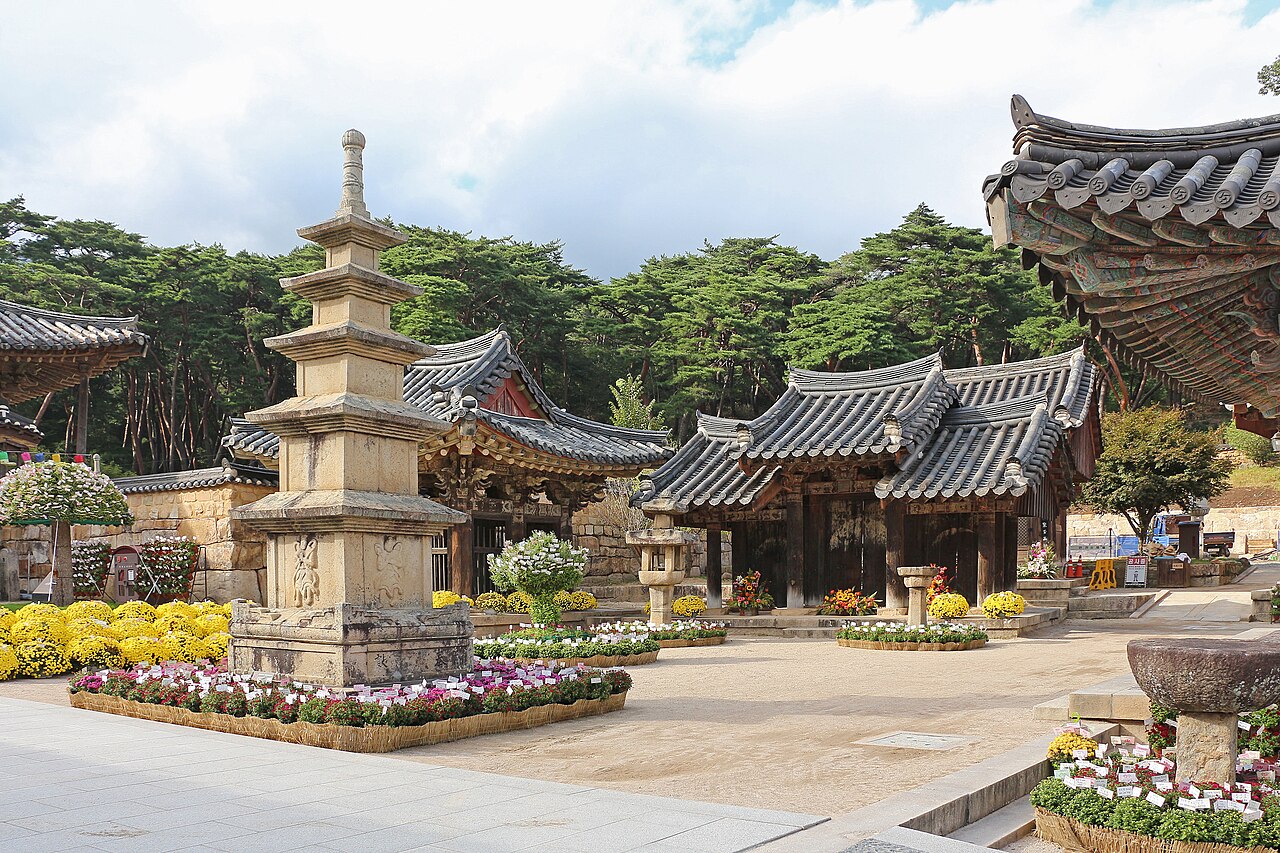
The Sansa, Buddhist Mountain Monasteries in Korea, inscribed by UNESCO in 2018, protect seven Buddhist mountain monasteries — Tongdosa (통도사, South Gyeongsang Province), Buseoksa (부석사, North Gyeongsang Province), Beopjusa (법주사, North Chungcheong Province), Magoksa (마곡사, South Chungcheong Province), Seonamsa (선암사, South Jeolla Province), Daeheungsa (대흥사, South Jeolla Province), and Bongjeongsa (봉정사, North Gyeongsang Province) — that represent the living architectural, landscape, and ritual tradition of Korean Buddhist mountain monasteries from the Three Kingdoms period (7th century CE) through the present, operating today as functioning religious institutions with active monastic communities. The inscription’s Outstanding Universal Value rests on the Sansa’s demonstration of the distinctly Korean form of Buddhist monastery architecture and spatial organisation: unlike Chinese Buddhist monasteries (which are typically urban or peri-urban and axially structured in the Chinese palace-compound tradition) and Japanese Buddhist temples (which are often integrated into urban or suburban landscapes), Korean Sansa are situated in mountain valleys at elevations of 100–800 m above sea level, approached by processional paths through forested gorges, and organised as accumulations of buildings developed organically over centuries around a core ritual building (주불전, jubuilding, the main hall), without a fixed axial plan — producing the characteristic Sansa landscape of multiple wooden buildings at varying levels, connected by stone paths, set against forested mountain ridges and mountain-spring water.
The seven Sansa dispersed across South Korea’s mountain ranges Tongdosa South Gyeongsang · Buseoksa North Gyeongsang · Beopjusa Chungcheong — 40 to 300 km
Tongdosa (통도사, “Temple of Passing Through the Truth”), founded circa 646 CE by the monk Jajang (자장율사, 590–658 CE, the Unified Silla monk who studied at Tang dynasty Chang’an and returned with Buddhist relics and texts that provided the doctrinal foundation for Silla state Buddhism) on Mount Yeongchuksan in South Gyeongsang Province, is the largest of the seven inscribed Sansa and is known as the “Triple Gem Monastery of the Buddha” (불보사찰, bulbosachal) — a designation referring to the fact that Tongdosa’s main hall (대웅전, Daeungjeon) contains no Buddha statue (the only major Korean Buddhist temple hall without an image), because the building’s reliquary (사리탑, sariatap, containing Baekje-period Buddhist relics brought from Tang China by Jajang) is itself considered to be the Buddha’s presence, rendering a separate statue redundant. The Tongdosa approach path through the Yeongchuksan valley (a pine-forested gorge with the creek of Tongdosa-cheon running alongside, the approach path stone-paved for approximately 1.5 km) is considered the finest Sansa approach landscape among the seven — the combination of ancient pines (some specimens exceeding 400 years in age), creek sounds, stone lanterns, and the gradual revelation of the first monastery buildings as the approach path curves is the defining sensory experience of the Korean Buddhist pilgrimage tradition. Tongdosa is located approximately 40 km west of Busan (accessible from Tongdosa Station on the Gyeongbu Line in 40 minutes from Busan Station, then 20-minute bus to the monastery), making it the most conveniently accessible of the seven Sansa for international visitors arriving through Busan Gimhae Airport. Approximately 70 km north of Tongdosa (approximately 1.5 hours by bus from Tongdosa to Yeongju via Gyeongju), Buseoksa (부석사, “Floating Stone Temple”), founded in 676 CE by the monk Uisang (의상대사, 625–702 CE, the founder of the Hwaeom School of Korean Buddhism, who had studied in Tang China alongside the Japanese monk Dōshō and whose philosophical synthesis of Hwaeom metaphysics produced the Korean Buddhist school most widely practiced in the Unified Silla period) on Mount Bonghwangsan in North Gyeongsang Province, possesses the oldest surviving wooden building in Korea — the Muryangsujeon (무량수전, “Hall of Infinite Life”, National Treasure No. 18, built circa 1376 CE on foundations of the Goryeo period) — and a view from its elevated terrace (the Anyang-ru pavilion) across the North Gyeongsang agricultural plains to the distant mountains that is considered the classic landscape view of Korean Buddhist mountain monastery siting.
Beopjusa (법주사, “Temple Where Dharma Abides”), founded circa 553 CE by the monk Uisin (의신, returning from India according to tradition) on Mount Songnisan in North Chungcheong Province, contains the largest wooden multi-storey pagoda in East Asia — the Palsangjeon (팔상전, “Hall of Eight Phases”, built in its current form in 1626 CE on the 7th-century CE foundation, 22.7 m in height across five stories, the only surviving five-storey wooden pagoda in Korea) — and is the most accessible Sansa from Seoul (approximately 2 hours by bus from Seoul Nambu Terminal to Songnisan, then bus to Beopjusa). The Songnisan National Park forest surrounding Beopjusa (the approach path crosses a bridge over the Samgakcheon stream and passes through a 200-year-old fir forest, 1 km) is one of the finest national park forest environments in central Korea. Magoksa (마곡사, “Magok Temple”), in South Chungcheong Province (approximately 15 km from Gongju, near the Baekje Historic Areas UNESCO inscription), is the Sansa with the most direct geographic proximity to another UNESCO inscription: it is approximately 15 km east of the Gongju component of the Baekje Historic Areas, making a combined Baekje sites + Magoksa itinerary practical from a Gongju base. Seonamsa (선암사) and Daeheungsa (대흥사) are both in South Jeolla Province in the far southwest of South Korea, most accessible from Gwangju or Suncheon. Bongjeongsa (봉정사, “Phoenix Perch Temple”), founded circa 672 CE in Andong, North Gyeongsang Province, is geographically the closest Sansa to Hahoe village and Byeongsan Seowon — making it the most integrated Sansa in a multi-UNESCO heritage circuit, combinable in a single Andong-area day with Hahoe village (approximately 40 km) and Dosan Seowon (approximately 25 km).
Practical information
The seven Sansa are distributed across five Korean provinces and require separate visits; a comprehensive circuit of all seven requires at minimum 5–7 days. All seven monasteries are active religious institutions with resident monastic communities; visiting hours are typically sunrise to sunset (individual monasteries have posted hours at their entrances), and visitors should behave respectfully in ceremonial spaces. Admission fees apply at most Sansa (the sanchal entrance fee, or “national park entrance fee” for monasteries inside national parks such as Beopjusa/Songnisan and Bongjeongsa/Hahwangsan). The most visitor-friendly Sansa for international visitors: (1) Tongdosa — best access from Busan, English-language information panels at main hall, the Tongdosa Museum (separately ticketed, adjacent to the monastery) contains the largest collection of Buddhist art in Korea after the National Museum. (2) Beopjusa — easiest from Seoul (2 hours), the Songnisan mountain environment adds hiking appeal. (3) Buseoksa — most architecturally significant (oldest wooden building in Korea), best combined with Andong (Hahoe/Dosan) and Gyeongju visit. Temple stay programmes (템플스테이, templestay) — overnight stays in the monastery following the monastic schedule (morning bell at 4 AM, chanting services, walking meditation, vegetarian meals) — are available at all seven Sansa and are among the most distinctive cultural immersion experiences in South Korea; advance booking through the Korean Temple Stay programme website (templestay.com) is required.
Frequently Asked Questions
Why are Korean Sansa located in mountain valleys rather than cities, and how does this shape their architecture?
The Korean Buddhist tradition’s characteristic preference for mountain locations (산중불교, “mountain Buddhism”) is a specific adaptation of Buddhism to the Korean cultural and political landscape of the Joseon dynasty (1392–1897 CE) — a state whose official Confucian ideology systematically reduced the political and social status of Buddhism from its privileged position in the preceding Goryeo dynasty (918–1392 CE, when Buddhist monasteries had been the primary educational, artistic, and diplomatic institutions of the Korean state). The Joseon state implemented several measures to reduce Buddhist institutional power: monks were prohibited from entering the capital Hanyang (Seoul) until 1895 CE; monasteries were relocated from urban centres to mountain areas by royal decree in the early Joseon period; and the Joseon court converted Buddhist temple lands to Confucian institutional use. The result of this deliberate marginalisation was the “mountain retreat” of Korean Buddhism — the Sansa, already located in mountain valleys for the aesthetic and contemplative reasons that Korean Buddhist monks from the Silla period had articulated (mountain water for purity, mountain air for meditation, mountain distance from urban political entanglement), became even more thoroughly mountain-integrated during the Joseon period, developing an architectural tradition of buildings organically adapted to sloping mountain terrain. Architecturally, the mountain location produces the characteristic Sansa features: irregular, non-axial building placement (buildings are sited on the natural terraces and slopes of the mountain, not on a levelled artificial platform as in Chinese temple plans), multiple retaining walls (돌담, stone dry-wall terraces that create the levels on which individual buildings stand), approach paths that wind through forest and cross bridges (the bridge crossing — haetalgyo, “liberation bridge” — as the ritual boundary between the secular world below and the sacred space above is a standard Korean Buddhist monastery spatial sequence), and the close integration of specific geological features (cliffs, boulders, mountain streams) into the monastery’s sacred geography. The piled accumulation of buildings over centuries — new halls, shrines, bell towers, and monks’ quarters added across 1,000+ years of occupation without demolishing earlier structures, producing a layered landscape of buildings from different periods occupying different terraces — gives the major Sansa their characteristic complexity and visual richness.
What makes the Buseoksa Muryangsujeon Hall significant architecturally?
The Muryangsujeon (무량수전, “Hall of Infinite Life”) at Buseoksa is the oldest surviving wooden building in Korea and one of the oldest surviving timber-frame buildings in East Asia — a Goryeo-period reconstruction (the current building is dated by its main beam inscription to 1376 CE, during the reign of King U of Goryeo, though Korean dendrochronological analysis and stylistic assessment indicate that the building may incorporate timber elements from an earlier 13th-century construction on the same foundations) of the main hall of a monastery founded by the monk Uisang in 676 CE. The Muryangsujeon’s architectural significance lies in its demonstration of the “multi-bay gongpo” bracket system (다포계, dapo style) — a structural system of interlocking wooden bracket clusters (포, po) supporting the roof eaves at multiple points along the beam between each column, rather than only above the columns themselves, which distributes the roof load more evenly and allows the wide overhanging eaves characteristic of Goryeo and early Joseon Korean architecture. The building’s proportional system (the façade of three bays in width, two bays in depth, with the eave height approximately equal to the wall height, producing the balanced horizontal proportion that is the hallmark of Goryeo-period monastic architecture) has been studied as a candidate for the proportional canon of Korean Buddhist hall design. The Amitabha Buddha statue inside (국보 제45호, National Treasure No. 45, clay-core lacquer Buddha of the Goryeo period, 1.82 m seated height, the only surviving major Korean Buddhist statue of this material and period in its original hall), combined with the wooden building’s interior space (the original painted beam and rafter decoration partially preserved), constitutes one of the most complete surviving Buddhist devotional environments of the medieval Korean period. The most photographed element of Buseoksa is not the Muryangsujeon interior but the view from the Anyang-ru pavilion at the front of the terrace — a wooden pavilion on the edge of the terrace whose open front frames a view across the tiled roofs of the monastery’s lower buildings to the agricultural plain of North Gyeongsang stretching to the southern horizon, with the Baegundae cliff face rising behind the building to the north. This view, described in Joseon-period travel literature as a “hundred-li view” (백리뷰), is the canonical landscape image of the Buseoksa monastery and is reproduced in virtually all Korean heritage tourism literature about Sansa.
What is a Temple Stay and how does participating in one enhance understanding of Sansa culture?
The Temple Stay programme (템플스테이, Templestay) is a structured overnight cultural immersion experience offered by Korean Buddhist monasteries (including all seven UNESCO-inscribed Sansa and approximately 200 additional monasteries nationwide) that allows non-monastic visitors to participate in the daily schedule of a functioning Buddhist monastery, including the early-morning ceremonies, meditation sessions, vegetarian meals, and manual work practice that structure monastic life. The programme was originally created in 2002 by the Jogye Order of Korean Buddhism (대한불교조계종, the dominant Korean Buddhist denomination, whose headquarters is the Jogyesa Temple in central Seoul) in preparation for the 2002 FIFA World Cup, to offer international visitors an authentic Korean cultural experience beyond palace visits and folk villages; the response was unexpectedly strong, and the programme was expanded into a permanent national initiative with standardised quality controls (safety, hygiene, English-language programming) and a central booking platform (templestay.com). A standard two-day/one-night Temple Stay follows a schedule beginning with arrival at the monastery in the late afternoon (3–4 PM), orientation to monastic rules (no alcohol, vegetarian food, early bedtime, respectful dress), the evening ceremony (저녁예불, sunset bell chanting in the main hall, approximately 7 PM), dinner (발우공양, baru gongyang, the formal monastic bowl-meal ceremony in which food is served in a set of four nesting lacquer bowls and consumed in prescribed silence with a ceremonial post-meal cleaning ritual), lights-out at 9 PM, and the 3–4 AM rising for the morning ceremony (새벽예불, the predawn bell, drum, wooden gong, and conch-horn sequence that marks the daily awakening of the monastery, followed by chanting service in the main hall). The central experiential value of a Temple Stay at a Sansa specifically — as opposed to an urban temple — is the sensory environment: the predawn ceremony at Tongdosa, with the pine forest invisible in darkness and the monastery’s wooden bell tower reverberating across the mountain valley; the morning walking meditation at Buseoksa on the terrace overlooking the Gyeongsang plain as the sunrise begins; the vegetarian breakfast silence at Beopjusa with the Songnisan mountain fir forest visible through the refectory windows — these experiences integrate the Sansa’s architectural and landscape significance with the ritual time of the monastic day in a way that no daylight-only visitor experience can replicate.
Sources
- S1 — UNESCO World Heritage Centre — Sansa, Buddhist Mountain Monasteries in Korea (Ref. 1562) — https://web.archive.org/web/20230601000000/https://whc.unesco.org/en/list/1562/
- S2 — UNESCO World Heritage Centre — Statement of Outstanding Universal Value (Ref. 1562) — https://whc.unesco.org/en/list/1562/
Spotted an error? Write to editorial@culturalheritageonline.com and we correct it the same day.