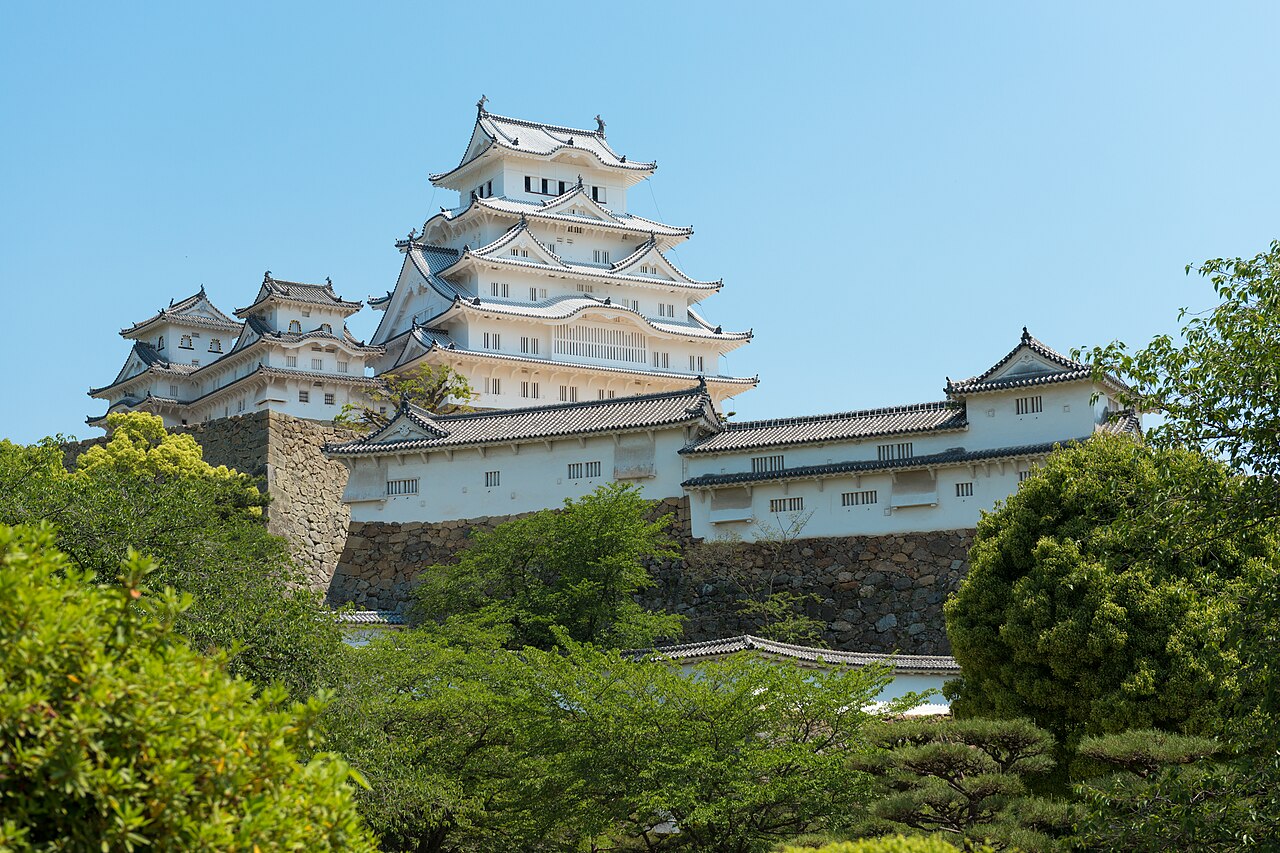
Himeji Castle, inscribed by UNESCO in 1993, is the largest and best-preserved feudal castle complex in Japan: 83 buildings across interlocking baileys, clad in white plaster to resist fire, unburned and untaken across four centuries of Japanese history. The complex stands on a hill 45 metres above Himeji City in Hyogo Prefecture, 30 minutes west of Osaka by Shinkansen. Three separate gate sequences, each designed to trap attackers in a killzone covered from multiple angles, must be passed in succession to reach the main tower.
The Kansai corridor east Kyoto · Nara · Ikaruga — 50 to 80 km
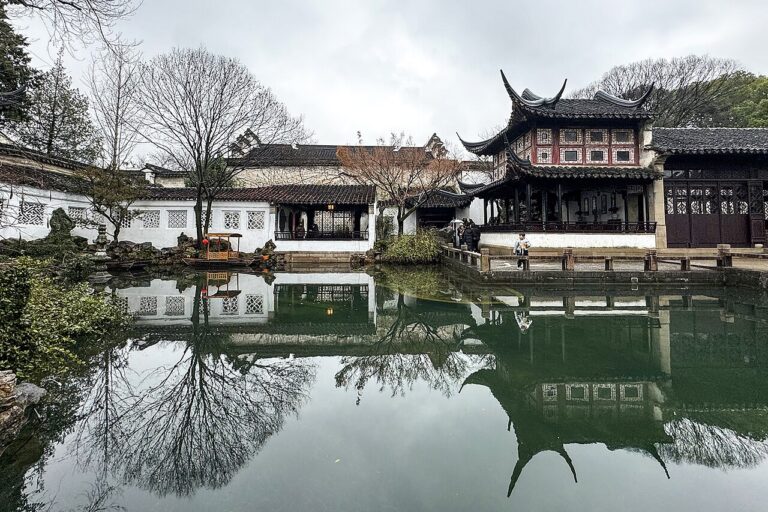
Fifty kilometres east of Himeji by JR Shinkansen, the 17 properties of the Historic Monuments of Ancient Kyoto span a millennium of Buddhist and Shinto construction across Kyoto City, Uji, and Otsu. Kyoto served as Japan’s imperial capital from 794 to 1869 CE, and the UNESCO inscription covers the full arc of that tenure: the Byodoin Phoenix Hall in Uji, completed in 1053 CE during the Heian cultural peak, whose roof terminals modelled the bird on Japan’s 10-yen coin; the Kinkaku-ji Gold Pavilion, rebuilt in 1955 after a monk burned the 14th-century original, now covering its upper floors entirely in gold leaf; and Nijo Castle, built in 1603 for the first Tokugawa shogun’s visit to Kyoto, its corridors fitted with iron-clamped “nightingale floors” that squeak under footstep pressure to alert guards. The Fushimi Inari Shrine, adjacent to the JR Inari Station 5 minutes from Kyoto Station, lines 4 kilometres of mountain path with 10,000 vermillion torii gates donated by businesses since the Meiji period. A Shinkansen day trip from Himeji to Kyoto (35 minutes, Hikari or Nozomi) allows a temple morning before returning; the contrast between the gilded pastoral spaces of Kinkaku-ji and Himeji’s white military architecture illuminates the two dominant preoccupations of the Edo period’s ruling class within a single day.
Sixty kilometres east-northeast of Himeji, the Historic Monuments of Ancient Nara preserve the pre-Kyoto period as Japan’s first permanent capital. When the court moved to Heijo-kyo (present-day Nara) in 710 CE, it modelled the city plan on Tang China’s capital Chang’an, with broad avenues, administrative quarters, and eight state-sponsored temple complexes built simultaneously. Only Todai-ji retained enough of its original scale to justify comparison with the founding ambition: the 752 CE dedication ceremony for its Great Buddha was attended by 10,000 monks from 60 countries and cost enough metal to reduce Japan’s copper supply for a decade. The Daibutsuden housing the 15-metre bronze statue is the largest wooden building in the world at two-thirds the original floor plan after two fires; even rebuilt at reduced scale, it measures 57 metres wide and 49 metres high. Kasuga Taisha, within the same deer park, burns 3,000 lanterns on February 3 and August 14-15 in the Mantoro festival, which has continued without interruption since 1136 CE. From Himeji, Nara is reached via JR Shinkansen to Shin-Osaka or Kyoto and Kintetsu or JR Nara Line onward.
Eighty kilometres east of Himeji in Ikaruga, Nara Prefecture, the Buddhist Monuments in the Horyu-ji Area hold the world’s oldest surviving wooden buildings. The West Precinct was completed in the early 8th century following a fire that destroyed Prince Shotoku’s original 607 CE foundation; the existing Five-Storey Pagoda, built on a central pillar resting independently in a pit, has absorbed the lateral forces of earthquakes for over 1,300 years without structural failure. This “shinbashira” principle — a free-standing central column that allows surrounding floors to sway without transmitting shock — was adopted by engineers designing Tokyo Skytree in 2012. The Yumedono (Hall of Dreams) held its principal Kannon statue sealed in a wooden box for over 1,000 years; when American art historian Ernest Fenollosa persuaded the monks to open it in 1884, the wrapping cloth dissolved on contact with air. Horyu-ji is reached from Himeji by Shinkansen to Shin-Osaka and JR Yamatoji Line south to JR Horyuji Station (approximately 65 minutes total).
One hundred kilometres south of Himeji, accessible via Kintetsu to Yoshino or JR to Wakayama and local services, the Sacred Sites and Pilgrimage Routes in the Kii Mountain Range encompass the largest single UNESCO inscription in Japan by area. The three Grand Shrines of Kumano — Hongu Taisha, Nachi Taisha, and Hayatama Taisha — were linked by pilgrimage road from the 10th century; Emperor Gotoba completed the Kumano journey 32 times between 1190 and 1221 CE. Nachi Taisha stands directly above Nachi Falls, which drops 133 metres unbroken and is itself enshrined as a deity. Mount Koya in the inscription’s northern sector holds the Okunoin cemetery, where 200,000 stone markers surround the mausoleum of the founder Kukai, believed by Shingon adherents to be in eternal meditation since 835 CE and brought a formal meal twice daily by monks. The Kumano Kodo trail network was jointly designated with Spain’s Camino de Santiago as the world’s only dual World Heritage pilgrimage route in 2014.
West along the Sanyo coast and into Kyushu Hiroshima · Shimane · Nagasaki — 220 to 570 km
Two hundred twenty kilometres west by Sanyo Shinkansen, the pair of Hiroshima UNESCO inscriptions sit on the same ferry-and-rail connection. Itsukushima Shrine on Miyajima Island was built over a tidal channel to preserve the island’s sacred ground; its 16-metre O-torii gate stands 200 metres offshore and has been rebuilt eight times over 800 years, most recently in 1875. At high water the gate appears to float; at low tide it can be walked to across exposed sand. The shrine was expanded and ornamented in 1168 CE under the patronage of Taira no Kiyomori. Across the water in Hiroshima City, the Peace Memorial — the ruin of the 1915 Industrial Promotion Hall that stood directly below the atomic detonation of 6 August 1945 — was inscribed in 1996 and preserved specifically as it stood, dome collapsed and skeletal, by Hiroshima City Council resolution. The Peace Memorial Museum in the surrounding park documents the human consequences with artefacts from the immediate aftermath; the site requires a minimum of 2 hours to engage seriously. The two properties are connected by JR Sanyo Line and JR ferry from Miyajimaguchi Station in 25 minutes total, making them a natural pairing for a single day or overnight stay.
Four hundred kilometres west in Oda City, Shimane Prefecture, the Iwami Ginzan Silver Mine and its Cultural Landscape was the most productive silver source in the world in the 1580s, supplying an estimated one-third of global output at peak extraction. Unlike most mining inscriptions, Iwami Ginzan was accepted by UNESCO for its preserved operational landscape: 700 shafts in the mountain, valley processing foundations below, and the port-route town of Tomogaura intact above the estuary that shipped the refined silver to Hakata and Sakai for onward trade with Portuguese and Dutch merchants. At its peak, the area supported 200,000 people and 53 active religious sites. The mine’s output financed the Tokugawa state’s consolidation of power after 1600 CE and represents one of the points where premodern Japan was directly integrated into global early-modern trade routes. From Himeji, the mine is reached by Shinkansen to Hiroshima (55 minutes) and limited express to Oda City (80 minutes), with a 15-minute bus to the Omori Ginzan historic district.
Five hundred seventy kilometres west into Kyushu, the Hidden Christian Sites in the Nagasaki Region preserve a practice that was illegal for 250 years. After the Tokugawa government banned Christianity in 1597 and executed 26 missionaries and converts in Nagasaki, the surviving communities moved to remote coastal villages and maintained the faith in secret, adapting Buddhist rituals and Shinto festivals as cover while passing prayers and sacraments orally in the local dialect. The 12 inscribed properties include 10 churches or church ruins, the village site of Hara Castle where 37,000 hidden Christians died in the 1638 Shimabara Rebellion, and the Ooura Cathedral in Nagasaki — the only Western-style building in Japan designated a National Treasure, completed in 1865 and the first Western-rite Gothic church in the country. It was at Ooura in 1865 that a group of Urakami villagers told a French priest they had maintained secret Christianity for seven generations, an event the Vatican documented as the “discovery of hidden Christians.” From Himeji, Nagasaki is reached by Shinkansen to Hakata (70 minutes) and limited express Kamome to Nagasaki (2 hours).
Practical information
Himeji is a direct stop on the JR Sanyo Shinkansen; Nozomi, Hikari, and Sakura services all call here. From Osaka: approximately 30–40 minutes. From Kyoto: approximately 45–55 minutes. From Tokyo: approximately 3 hours. The castle is a 15-minute walk north of JR Himeji Station along a straight pedestrian avenue. The complex opens at 9:00 and closes at 17:00 (16:00 in winter), with last entry one hour before closing. Shoes must be removed before entering the main tower, which has steep interior staircases to the sixth floor. The castle grounds are compact enough to cover in 2–3 hours including the secondary structures and the Koko-en landscaped garden on the western side. The site is most photogenic in early morning or late afternoon when the light rakes across the white plaster; cherry-blossom season (late March to early April) surrounds the castle with approximately 1,000 trees in simultaneous bloom. A JR Kansai Wide Area Pass covers Shinkansen travel to Himeji and return from Kyoto or Osaka.
Frequently Asked Questions
Why has Himeji Castle survived intact when most Japanese castles were destroyed?
Himeji Castle’s survival combines deliberate design, strategic timing, and documented luck. The current main tower and defensive complex were completed in 1609 under Ikeda Terumasa following Tokugawa Ieyasu’s victory at Sekigahara; the subsequent 250 years of Edo-period stability left the structure without military need and without military siege. During the Meiji reforms of the 1870s, many Japanese castles were demolished as symbols of feudal authority or sold to military garrisons; Himeji’s garrison commander argued successfully for its retention as a functioning base, and the castle was used by the Imperial Japanese Army through 1945. American firebombing raids hit Himeji City in June 1945, destroying large portions of the city, but the castle was not struck. A popular story holds that the castle’s white plaster walls appeared to dim during the raid, misleading navigators; the accuracy of this account is disputed by historians, but the outcome — the castle standing undamaged amid ruins on the morning of July 4, 1945 — is documented in American aerial reconnaissance photographs. The white plastered exterior was originally designed for fire resistance rather than aesthetics: the stone base and plaster-coated wooden walls were intended to deny fire a surface to grip. Modern earthquake-resistant concrete underpinning was installed between 1956 and 1964 during the Showa restoration, and a major exterior restoration completed in 2015 renewed the plaster coating to its original white.
What is the best way to visit Himeji and Hiroshima in a single itinerary?
The Sanyo Shinkansen makes this a straightforward west-to-east or east-to-west progression. From Osaka or Kyoto, a morning Shinkansen to Himeji (30–50 minutes) allows 2–3 hours at the castle before continuing west to Hiroshima (approximately 55 minutes from Himeji by Hikari). From Hiroshima Station, the JR Sanyo Line to Miyajimaguchi (25 minutes) and JR ferry to Miyajima (10 minutes) reaches Itsukushima Shrine; the round trip takes 2–3 hours depending on tide timing. The Peace Memorial Museum and Park in central Hiroshima requires a minimum of 2 hours and closes at 18:00 (19:00 in summer). A full day allows both Himeji and Miyajima with a brief pass through the Peace Memorial Park, though most visitors prefer to overnight in Hiroshima to give the Museum adequate time and to see Itsukushima at both high and low water. JR Pass holders can complete the Himeji–Hiroshima–Osaka round trip within a JR Kansai-Hiroshima Area Pass (4 days), which also covers Miyajimaguchi ferry and the JR Sanyo Line segments.
How does Himeji Castle’s defensive architecture compare with its European contemporaries?
Himeji Castle was completed in 1609, the same decade as the construction of Fort Bourtange in the Netherlands (1593) and during the period when European military engineers were developing the trace italienne — the low-profile, angled-bastion system designed to absorb cannon fire. Japanese castle engineering evolved along a parallel but distinct path. European trace italienne design concentrated defensive fire outward from corner bastions, creating overlapping fields of fire along the curtain walls. Himeji’s system concentrated defensive fire inward: the attacker who breached the outermost gate was immediately funnelled into a confined corridor covered by loopholes in the next wall above. The approach path to Himeji’s main tower doubles back on itself three times, each turn exposing attackers to lateral fire they cannot predict. The castle’s walls contain three types of loophole in a mixture reflecting the Sengoku-period transition from bows to firearms: circular ports for muskets, triangular ports for arrows, and rectangular openings for dropping stones. The Shinkansen between Himeji and Japan’s major cities covers the same journey that took the Tokugawa army several weeks of march in 1600; the castle’s scale and engineering remain most legible in person, where the wall heights and the disorienting approach path can be experienced rather than read about.
Sources
- S1 — UNESCO World Heritage Centre — Himeji-jo (Ref. 661) — https://web.archive.org/web/20230601000000/https://whc.unesco.org/en/list/661/
- S2 — UNESCO World Heritage Centre — Statement of Outstanding Universal Value (Ref. 661) — https://whc.unesco.org/en/list/661/
Spotted an error? Write to editorial@culturalheritageonline.com and we correct it the same day.