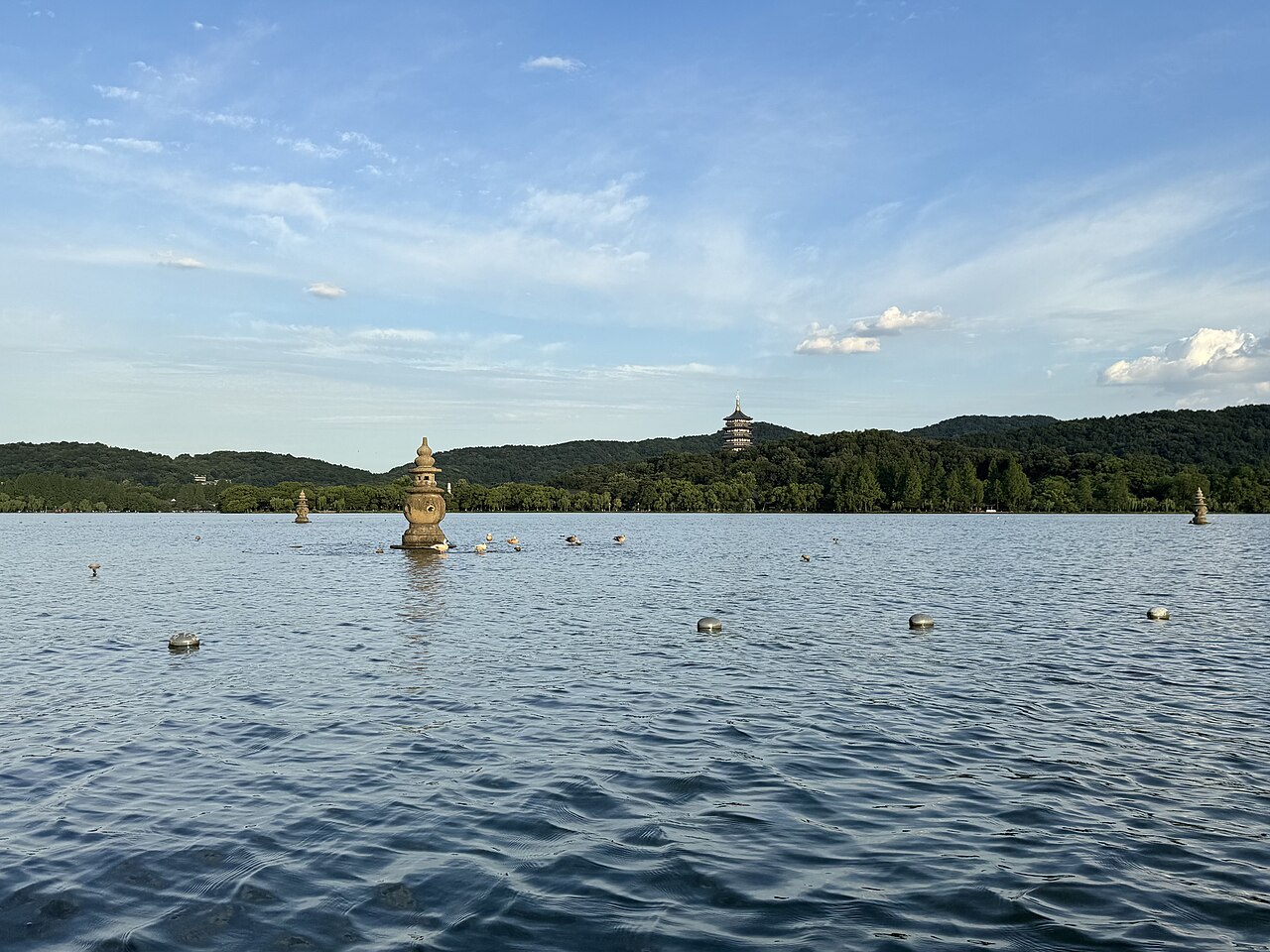
The West Lake Cultural Landscape of Hangzhou, inscribed by UNESCO in 2011, is the defining example of Chinese landscape design as cultural practice: a 5.6-square-kilometre lake on the western edge of Hangzhou City in Zhejiang Province whose natural basin was progressively shaped by Su Dongpo (Tang-Song poet-prefect, served 822–824 CE and 1089–1091 CE), Bai Juyi, and imperial and civic patronage over more than 1,000 years into a composition of lake, causeways, islands, pavilions, pagodas, and botanical plantings that became the archetype of the “borrowed landscape” (jie jing) aesthetic — the principle that a designed landscape should frame, reference, and incorporate the natural and built environment beyond its boundaries rather than enclose a separate world. The inscription covers 3,323 hectares of lake, causeway, and surrounding hillside, containing more than 100 historic structures including temples, towers, memorial halls, gardens, and academies, and three artificial islands (Xiaoying Zhou, Huxin Ting, and Ruan Gong Dun) created by successive dredging operations from the Tang through Qing periods. The West Lake’s Outstanding Universal Value rests on its sustained influence across East Asian garden and landscape design: more than 30 gardens in Japan, Korea, Europe, and North America have been documented as having been directly designed with reference to West Lake’s composition, and the visual vocabulary developed at West Lake (the misty-morning willow causeway, the moonlit pavilion reflected on still water, the pagoda silhouette at sunset) formed the pictorial convention system of classical Chinese landscape painting from the Song period through the 20th century.
Zhejiang and the Yangtze Delta heritage zone Classical Gardens of Suzhou · Ancient Villages Xidi Hongcun · Grand Canal Hangzhou — 90 to 250 km
Ninety Kilometres northwest of West Lake by HSR (approximately 35 minutes from Hangzhou East Station to Suzhou Station on the Shanghai-Hangzhou HSR, or approximately 25 minutes on the Shanghai-Hangzhou HSR to Suzhou North), the Classical Gardens of Suzhou (inscribed 1997, extended 2000) are the most directly related UNESCO site to the West Lake Cultural Landscape in terms of garden design philosophy and historical influence. Both the Suzhou classical gardens and the West Lake landscape operate within the same “borrowed scenery” (jie jing) aesthetic tradition — but at different scales and with different relationships to water: the Suzhou gardens are enclosed private scholar’s gardens (0.5–5 hectares) that manipulate a small water body and rockery into an apparent landscape of greater depth and variety through carefully calibrated viewpoints, while the West Lake is a civic public landscape (5.6 km²) that manipulates an existing natural lake and its surrounding hillsides into a composed cultural landscape using causeways, islands, plantings, and strategic architectural placement. The historical connection between Suzhou and Hangzhou is also commercial and administrative: both cities flourished under the Southern Song dynasty (1127–1279 CE), when Hangzhou (then called Lin’an) was the imperial capital after the Jin dynasty’s conquest of the northern Yellow River heartland — the famous Song proverb “above there is paradise, below there is Suzhou and Hangzhou” (上有天堂,下有蘇杭) documents the two cities’ parallel reputations for refined urban culture, silk production, and landscape beauty within the same cultural moment. From West Lake, Suzhou is reached by HSR (approximately 35 minutes to Suzhou from Hangzhou East, with the Humble Administrator’s Garden and the Master of the Nets Garden both accessible by taxi from Suzhou Station).
One Hundred and Fifty Kilometres southwest of West Lake by road and HSR (approximately 1.5 hours from Hangzhou East to Huizhou/Huangshan Station on the Hangzhou-Huangshan HSR, opened 2018), the Ancient Villages of Xidi and Hongcun (inscribed 2000) in Anhui Province represent the other dimension of the “classical literati landscape” tradition that the West Lake Cultural Landscape documents at the public civic scale. While the West Lake was the site of elite cultural production (Song poetry, landscape painting, Chan Buddhist contemplation) for the imperial-era urban educated class, the Huizhou merchant villages of Xidi and Hongcun were the site of the same cultural values expressed in private family architecture: the Huizhou merchant families who built the white-walled, black-tiled, courtyard-plan residential complexes of Xidi and Hongcun were simultaneously the financial patrons of Hangzhou’s commercial culture and the consumers of the West Lake’s leisure landscape. The Huizhou area’s distinctive cultural heritage — its architecture, painting (Xin’an School), medical practice (Huizhou medicine), and Neo-Confucian philosophy (the Huizhou Neo-Confucian community that produced the philosopher Zhu Xi in 1130 CE, and whose Mount Wuyi Academy is documented at the Mount Wuyi inscription) — constitutes the southern Yangtze cultural zone whose aesthetic values both the West Lake landscape and the Suzhou classical gardens served and reflected. From West Lake, Xidi and Hongcun are reached by the Hangzhou-Huangshan HSR (approximately 1.5 hours to Huangshan Station) and then coach (approximately 1 hour).
Sixty Kilometres north of West Lake by road (approximately 30 minutes from Hangzhou by expressway to Jiaxing, where the most visible surviving section of the Grand Canal crosses the city centre), the Grand Canal (大運河, Da Yunhe, inscribed 2014 as the “Grand Canal” serial UNESCO heritage inscription) is the most significant hydraulic engineering project in pre-modern Chinese history and directly connected to Hangzhou’s role as the Southern Song imperial capital: the southern terminal of the Grand Canal — the Hangzhou section of the Jiangnan Canal — was the economic artery through which the Southern Song’s grain supply, silk production, ceramic output, and commercial exchange flowed northward from the Yangtze Delta to the Yellow River administrative heartland. The Hangzhou section of the Grand Canal (the section within the current West Lake Cultural Landscape inscription boundary, extending from the Gongchen Bridge north of the West Lake through the city centre to the Jiangnan section) is one of the included heritage components of the 2014 Grand Canal inscription. From West Lake, the Hangzhou Canal area is walkable from Gongchen Bridge (approximately 3 km north of West Lake’s eastern shore, accessible by metro Line 1 to Fengqi Road Station). For a broader Grand Canal experience, Suzhou’s Panmen Gate area (Suzhou’s historic canal gateway, the only surviving combined water and land gate in China, originally constructed in 514 BCE, rebuilt in the Song period) and the Grand Canal Museum in Beijing’s Tongzhou District are the recommended companion visits.
Within the West Lake Cultural Landscape, the inscription covers the lake and its immediate cultural environment in three zones: the lake itself, the causeway-and-island system (the Su Causeway and the Bai Causeway crossing the lake, and the three artificial islands in the lake’s south section), and the surrounding hillside heritage zone containing the Lingyin Temple (Lingyin Si, 326 CE foundation, the largest Buddhist temple complex in Zhejiang, with the Feilai Feng rock-cut Buddhist sculptures, 5th–14th century, carved into the limestone cliff face opposite the temple entrance), the Liuhe Pagoda (六和塔, Liu He Ta, 970 CE, rebuilt 1153 CE, the dominant landmark on the Qiantang River south of West Lake), and a series of Qing-dynasty Ten Scenic Views pavilions and viewing platforms. The lake’s public spaces (the Su Causeway 2.8-kilometre path, the Bai Causeway 1-kilometre path, the Xiaoyingzhou island circuit) are entirely free to enter. Individual temples, museums, and gardens within the inscription area charge admission. The Leifeng Pagoda (雷峯塔, the pagoda on the southern shore of the lake, rebuilt 2002 on the ruins of a 975 CE pagoda whose sudden collapse in 1924 destroyed the original structure) and the China National Silk Museum (Zhongguo Sichou Bowuguan, adjacent to the southern shore of West Lake) are the two most visited paid attractions within the inscription area.
The Yangtze coast and the Eastern China cultural corridor Fujian Tulou Xiamen · Shanghai · Mount Huangshan — 200 to 400 km
Two Hundred and Fifty Kilometres south of West Lake by HSR (approximately 1.5 hours from Hangzhou East to Wenzhou South on the Hangzhou-Fuzhou HSR, then approximately 2 hours from Wenzhou South to Xiamen North), the Fujian Tulou (inscribed 2008) represent the mountain interior counterpart to West Lake’s coastal lake landscape: where West Lake is the emblematic image of the cultivated Yangtze Delta Buddhist-Confucian landscape, the Fujian Tulou are the emblematic image of the Hakka frontier community’s fortified mountain agricultural landscape. The coastal Fujian Expressway route connecting Hangzhou to Xiamen passes through the major port cities of the Minnan cultural zone — Wenzhou, Fuzhou (provincial capital), Quanzhou (medieval maritime trade hub, inscribed 2021 as “Quanzhou: Emporium of the World in Song-Yuan China”), Zhangzhou (gateway to the Fujian Tulou) and Xiamen — making the Zhejiang-Fujian coastal corridor one of the most heritage-dense maritime itineraries in East Asia. From Hangzhou, the Fujian Tulou at Yongding are reached by HSR (approximately 3.5 hours from Hangzhou East to Xiamen North via the Hangzhou-Fuzhou HSR) and then coach (approximately 2 hours from Xiamen to Yongding).
Practical information
The West Lake Cultural Landscape of Hangzhou covers the lake and surrounding hillsides within Hangzhou City, Zhejiang Province, approximately 1.5 hours by HSR from Shanghai Hongqiao Station (Hangzhou East Station, approximately 170 km). Hangzhou Xiaoshan International Airport (HGH) serves major domestic and international routes; Hangzhou East Station is on the Shanghai-Hangzhou-Ningbo HSR (approximately 1 hour to Shanghai), the Hangzhou-Fuzhou HSR (approximately 1.5 hours to Wenzhou, 3 hours to Fuzhou), and the Hangzhou-Huangshan HSR (approximately 1.5 hours to Huangshan). The West Lake is accessible from Hangzhou East Station by Metro Line 1 (approximately 30 minutes to Longxiangqiao Station, the closest station to the east shore of the lake) or by taxi (approximately 25 minutes depending on traffic). All public lake areas (Su Causeway, Bai Causeway, Broken Bridge, Xiaoying Zhou island circuit by free boat from the Huagang park pier) are free to enter; individual temple and museum admissions are 20–80 CNY per site. The Lingyin Temple and Feilai Feng area (approximately 4 km northwest of the West Lake’s western shore, accessible by Bus 7 from the lake’s western shore) charge combined admission and deserve 2–3 hours. The best visiting times are early morning (7:00–9:00 am, before tour groups arrive at the Broken Bridge and Su Causeway) in spring (March–April, osmanthus and peach blossom on the causeways) and autumn (September–October, osmanthus flowering, the West Lake’s most celebrated seasonal scent). Summer (June–August) is hot and humid with high visitor numbers; winter (December–February) provides clear misty-morning lake views with few crowds.
Frequently Asked Questions
Who was Su Dongpo and what is his connection to the West Lake landscape?
Su Dongpo (蘇東坡, 1037–1101 CE, also known as Su Shi, the “Eastern Slope” being his literary pen name derived from his ownership of a hillside farm plot during a period of political exile) was one of the most celebrated figures in Chinese literary and cultural history — simultaneously the foremost Song-period poet, the most famous calligrapher of his generation, a significant painter in the scholar-painting tradition, a Buddhist lay practitioner, a culinary innovator (Dongpo pork, hongshao rou, is still associated with his name), and one of the most effective civil administrators of the Northern Song period. Su Dongpo served as Prefect of Hangzhou twice — first 1071–1074 CE, briefly, and then 1089–1091 CE, during which he undertook the major hydraulic improvement of the West Lake that created the Su Causeway. By the 1080s, the West Lake had silted to a fraction of its original depth through centuries of accumulated aquatic plant growth (principally water hyacinth and caltrop, which the local population harvested for food and building material); Su Dongpo’s 1089–1090 CE dredging project removed approximately 150,000 cart-loads of silt from the lake bed, depositing the silt along a north-south causeway alignment to create the elevated walkway that now bears his name — the Su Causeway (Sudi, 苏堤). The causeway’s six arched stone bridges allow water circulation between the lake’s western and eastern sections, preventing the silt accumulation that the earlier undivided lake experienced. The Su Causeway’s creation transformed the West Lake from a silting agricultural water resource into a civic landscape available for popular recreational use — the “Six Bridges and Willow” (Liu Qiao Yan Liu) scenic view, with the willows planted along the causeway’s edges in the tradition Su Dongpo established, became one of the Ten Traditional West Lake Scenic Views and remains the most photographed single view at the lake. Su Dongpo’s administrative act of creating the Su Causeway is one of the primary reasons the UNESCO inscription frames the West Lake as a “Cultural Landscape” rather than a natural site: it documents the sustained human creative contribution to a natural basin’s transformation into a cultural landscape over more than 1,000 years.
What are the Ten Traditional Scenic Views of the West Lake and how were they established?
The Ten Traditional Scenic Views of the West Lake (西湖十景, Xihu Shi Jing) are a set of named landscape compositions selected during the Southern Song dynasty (1127–1279 CE) by the imperial court at Lin’an (Hangzhou) as the canonical sequence of West Lake experiences — each view specifying a time of day, season, or weather condition paired with a specific location: “Spring Dawn at Sudi” (Su Causeway at dawn in spring), “Qu Yuan Winds of Lotus” (the lotus paddies at Quyuan in summer wind), “Autumn Moon over Peaceful Lake” (the Xiaoyingzhou island complex reflected by moonlight), “Remnant Snow at Broken Bridge” (the Broken Bridge on the Bai Causeway with snow), “Sunset at Lei Feng Pagoda” (the Leifeng Pagoda at dusk, south shore), “Twin Peaks Piercing the Clouds” (the dual peaks of Nanfeng and Beifeng in the hillside zone on misty days), “Three Pools Mirroring the Moon” (the three stone pagodas on the Xiaoyingzhou island, with paper cutouts over their openings creating moon-reflections on the water surface), “Watching Fish at Flower Harbour” (the carp pool at Huagang Park), “Evening Bell from Nanping Hill” (the Jingci Temple bell at the south shore), and “Wind in Pines at Hupao Spring” (the spring-fed pool at Hupao Tiger Spring Temple, west hillside). The Ten Views system was established as a framework for literary and pictorial engagement with the landscape: Song, Ming, and Qing poets, painters, and travel writers organised their West Lake accounts around the Ten Views sequence, treating the named compositions as templates for aesthetic experience rather than as fixed viewpoints. The system was extended in the Qing period (with the Qianlong Emperor adding a competing “New Ten Views” during his 1751–1784 inspection tours of Hangzhou, each visit producing a new composition named and inscribed) and again in 2007 (when the Hangzhou government added a “Third Ten Views” list through public voting). The UNESCO inscription’s value statement cites the Ten Views system as evidence of the West Lake’s exceptional cultural influence: the same landscape compositions have generated uninterrupted poetic and pictorial engagement across more than 800 years and three dynasties — an unprecedented continuity of aesthetic practice linked to a specific physical landscape.
How did the West Lake landscape influence garden design in Japan, Korea, and Europe?
The West Lake’s influence on Japanese garden design is the most comprehensively documented case of Chinese landscape aesthetics’ trans-cultural transmission: at least 15 Japanese gardens explicitly reference West Lake compositions, with the most significant being the Kenroku-en garden in Kanazawa (completed 1819, whose lake-causeway-island composition directly parallels the West Lake’s Xiaoyingzhou island arrangement), the Koraku-en in Okayama (1700, with an artificial lake representing the West Lake and an earthen dam representing the Su Causeway), and the Nishi Honganji’s Hiunkaku Pavilion garden in Kyoto (17th century, which replicates the Su Causeway moonlit view at a 1:10 scale). The transmission pathway was primarily through the accounts of Japanese Buddhist monks who visited China on study pilgrimages: the monk Eisai (1141–1215 CE, who introduced Rinzai Zen and tea cultivation to Japan from Hangzhou’s Tian Tong Monastery and Mount Wuyi) and Dōgen (1200–1253 CE, founder of Sōtō Zen, who studied at Hangzhou’s Jingci Temple, overlooking West Lake, 1223–1227 CE) were among the transmitters of Hangzhou’s cultural aesthetics — including its landscape values — into the Japanese Zen Buddhist monastic tradition. In Korea, the West Lake tradition’s influence is visible in the Anapji Pond complex at Gyeongju (Silla kingdom, 674 CE, whose island-and-causeway composition is an early East Asian adaptation of the West Lake type) and the Gyeonghoeru Pavilion within the Gyeongbokgung Palace in Seoul (1395, Joseon dynasty, whose island pavilion arrangement references the Xiaoyingzhou island composition). In Europe, the direct influence of West Lake on garden design is most clearly documented in the Jardín de Monforte in Valencia (1881, whose lake-and-willow-causeway composition references the West Lake through the 18th-century European Chinoiserie garden tradition) and the China Garden in the Botanical Garden of Gothenburg, Sweden (opened 1999, designed with direct reference to the West Lake’s Ten Views scenic system). The UNESCO inscription’s transnational influence citation covers 36 East Asian parks and gardens in 10 countries identified as having direct design references to the West Lake composition.
Sources
- S1 — UNESCO World Heritage Centre — West Lake Cultural Landscape of Hangzhou (Ref. 1334) — https://web.archive.org/web/20230601000000/https://whc.unesco.org/en/list/1334/
- S2 — UNESCO World Heritage Centre — Statement of Outstanding Universal Value (Ref. 1334) — https://whc.unesco.org/en/list/1334/
Spotted an error? Write to editorial@culturalheritageonline.com and we correct it the same day.