The Ancient Villages in Southern Anhui — Xidi and Hongcun, inscribed by UNESCO in 2000, are two remarkably complete surviving examples of the Huizhou (Anhui) vernacular merchant village tradition that flourished in the mountain valleys of the Huangshan area during the Ming and Qing dynasties (14th–20th centuries): Xidi Village (originally Xi Di, “West Courier Station”) in Yi County, Anhui Province, a 1.62-square-kilometre village of 124 surviving historic structures (ancestral halls, memorial archways, courtyard residences) founded by the Hu clan in the Song period but built primarily in the Ming Hongzhi to Qing Qianlong reigns (1488–1795 CE), and Hongcun Village (“Red Village”) in Yixian County, 11 kilometres from Xidi, a 19.11-hectare village of 158 surviving historic structures whose water management system — a 2.2-kilometre artificial canal network connecting a spring source to the village’s central Moon Lake (Yuezao, “Moon Pond”) and South Lake (Nanhu) — is the most elaborate surviving example of Ming-period village water engineering in China. Both villages represent the Huizhou mercantile culture of the 16th–18th centuries — when the Huizhou merchants (Huishang, 徽商), specialising in salt distribution, timber, silk, and ink-making, were one of China’s two dominant merchant groups (with the Shanxi merchants), and the wealth generated by their national trade was reinvested in village architecture, Confucian academies, and ancestral hall complexes in their home region of southern Anhui.
The southern Anhui highland and the Yangtze Delta connection Huangshan · Grand Canal Suzhou · West Lake Hangzhou — 50 to 250 km
Fifty kilometres north of Xidi and Hongcun by road (approximately 1 hour from Yi County via the G3 Expressway to Huangshan Scenic Area entrance in Huizhou District), the Huangshan (Yellow Mountain) inscription (inscribed 1990) in Anhui Province is the most directly related UNESCO site to the Xidi-Hongcun villages — both belong to the same Huizhou cultural region, separated by the mountain range that gives the prefecture its name. Huangshan (the mountain) defined the visual landscape within which the Huizhou merchant villages developed: the characteristic “black tile, white wall” Huizhou architecture (grey fired-clay tiles, lime-washed plaster walls, upswept wall-parapets called mafenqiang or “horse-head walls” that projected above the roofline to prevent fire spread between densely clustered buildings) was designed for a landscape of mountain valleys and narrow river corridors where wood-framed courtyard houses crowded into the available flat ground between slopes. The Huizhou landscape painting tradition — the Xin’an painting school (Xin’an huapai) of the 17th century, whose masters Hongren, Zha Shibiao, Sun Yi, and Wang Zhirui painted the granite pinnacles and cloud-sea valleys of Huangshan in a deliberately spare compositional style that influenced all subsequent Chinese landscape aesthetics — emerged from the same merchant-patronage culture that built Xidi and Hongcun. From Xidi and Hongcun, Huangshan’s main cable car access point (Yungu Temple, east cable car, lower station) is approximately 1 hour by road.
Two hundred kilometres northeast of Xidi and Hongcun by high-speed rail (approximately 1.5 hours from Huangshan North Station to Suzhou Station via Nanjing South on the Shanghai-Kunming HSR), the Classical Gardens of Suzhou (inscribed 1997, extended 2000) are the urban counterpart to Xidi and Hongcun’s rural village expression of the same Jiangnan merchant culture. The Huizhou merchants who built the Xidi and Hongcun villages maintained their principal commercial operations in Suzhou, Yangzhou, and Hangzhou — the major commercial cities of the Yangtze Delta — returning to their home villages only for festivals and in old age. Many Huizhou merchants who became wealthy in the Suzhou salt and silk trade used their accumulated capital to build elaborate ancestral halls and courtyard residences in their home villages of southern Anhui, creating the architectural heritage that the Xidi-Hongcun inscription protects. The Suzhou garden tradition and the Xidi-Hongcun village tradition are products of different expressions of the same mercantile wealth: the Suzhou garden was the retired official’s urban retreat (designed for philosophical self-cultivation in a private urban landscape), while the Xidi-Hongcun ancestral hall and courtyard house were the merchant family’s rural demonstration of Confucian filial virtue (designed for ancestral veneration and clan solidarity in the home village). From Huangshan North Station, Suzhou is reached by HSR in approximately 1.5 hours via Nanjing South.
One hundred fifty kilometres east of Xidi and Hongcun by high-speed rail (approximately 1 hour from Huangshan North to Hangzhou East on the Hefei-Fuzhou HSR), the West Lake Cultural Landscape of Hangzhou (inscribed 2011) is the market city where the Huizhou silk and salt merchants conducted their most important Zhejiang operations. Hangzhou was the capital of the Southern Song dynasty (1127–1279 CE) and the primary silk weaving and export centre for the Yangtze Delta — the same silk industry whose profits the Huizhou merchants channelled through their trading networks. The Huizhou merchant presence in Hangzhou is documented in several surviving architectural elements: the Hu Xueyan Former Residence (completed 1872), the palatial compound of the Qing financier Hu Xueyan (1823–1885 CE), a Huizhou merchant who rose to become the dominant financial figure of the Self-Strengthening Movement era, is built in a hybrid Huizhou-Suzhou garden style that reflects the Huizhou merchant’s characteristic synthesis of their home architectural tradition with the urban garden aesthetic of their commercial host city. From Huangshan North Station, Hangzhou East is reached by HSR in approximately 1 hour.
Two hundred kilometres northwest of Xidi and Hongcun by high-speed rail (approximately 1.5 hours from Huangshan North to Wuyishan North on the Hefei-Fuzhou HSR, then continuing to Nanjing South area), the Ancient City of Pingyao (inscribed 1997) in Shanxi Province is the other major surviving complete Chinese merchant village/town in the UNESCO system — comparable to Xidi and Hongcun as a documentation of the merchant culture of a specific regional trading community (the Shanxi merchants, Jin Shang) in the same Ming-Qing period. The comparison between Pingyao (Shanxi merchants) and Xidi-Hongcun (Huizhou merchants) is explicit in the Chinese historical scholarship on the two dominant merchant groups of the Ming-Qing period: the Shanxi merchants (headquartered at Pingyao) specialised in the northern trade corridor (Great Wall frontier provisioning, draft banking), while the Huizhou merchants (headquartered at Xidi, Hongcun, and other Yi County and Shexian villages) specialised in the southern trade corridor (Yangtze Delta silk, salt distribution in Jiangnan, ink-making in Anhui). Both groups withdrew their commercial profits into architecturally elaborate home villages rather than investing in urban real estate — a cultural decision that preserved the village fabric but concentrated the architectural heritage in geographically remote rural locations. From Huangshan North Station, the route to Pingyao is via HSR to Nanjing and then north to Taiyuan (approximately 5 hours total).
West toward Lushan and Jiangxi, south toward Zhejiang Lushan National Park · Mount Wuyi · Wulingyuan — 150 to 400 km
One hundred fifty kilometres west of Xidi and Hongcun by road (approximately 2.5 hours from Yi County via Wuyuan to Jiujiang in Jiangxi Province), the Lushan National Park (inscribed 1996) on the southern shore of Poyang Lake is the cultural mountain that anchors the western end of the southern Anhui heritage zone. The connection between Lushan and the Huizhou merchant villages is through the Confucian academy tradition: Zhu Xi, who re-established the White Deer Grotto Academy at Lushan in 1179 CE, was born in Youxi County, Fujian, but his family was originally from Wuyuan County, northeastern Jiangxi (now administratively within Huangshan City, Anhui, and the region that produced many of the Huizhou merchants whose villages are at Xidi and Hongcun). Wuyuan County is often called “the most beautiful village in China” for its surviving Huizhou architecture and spring rapeseed flower landscape, and is administratively and culturally continuous with the Yi County villages — making the entire southern Anhui zone (Huangshan, Wuyuan, Yi County) the geographic heartland of both the Huizhou merchant tradition and the Neo-Confucian intellectual tradition that the White Deer Grotto Academy at Lushan institutionalised. From Xidi and Hongcun, Lushan (Jiujiang City) is accessible by road via Wuyuan and north to Jiujiang (approximately 3.5 hours).
Two hundred sixty kilometres south of Xidi and Hongcun by high-speed rail (approximately 2 hours from Huangshan North to Wuyishan North on the Hefei-Fuzhou HSR), the Mount Wuyi (inscribed 1999) mixed natural and cultural site in Fujian Province represents the other end of the Neo-Confucian geographic axis: Zhu Xi’s two principal academic residences were Lushan (Jiangxi, northwest of the Huizhou villages) and Wuyi Mountain (Fujian, southeast). The Huizhou merchants who financed the Neo-Confucian academies in their home region were educated in the examination curriculum that Zhu Xi’s Wuyi and Lushan academies had shaped, making the biographical arc of the Huizhou merchant — born in a Yi County or Shexian Huizhou village, educated in the Neo-Confucian classics, departed at age 15–20 for commercial apprenticeship in the Yangtze Delta salt trade, returned in old age to build the ancestral hall and courtyard house that the village is famous for — a direct product of the intellectual tradition that Zhu Xi articulated at Wuyi and Lushan. From Huangshan North Station, Wuyishan North is reached in approximately 2 hours on the Hefei-Fuzhou HSR.
Three hundred kilometres east of Xidi and Hongcun by high-speed rail (approximately 2 hours from Huangshan North to Shanghai Hongqiao via Nanjing South), the city of Shanghai and its surrounding Yangtze Delta heritage cluster (Classical Gardens of Suzhou, Grand Canal, West Lake Hangzhou) represent the commercial destination that the Huizhou merchants of Xidi and Hongcun departed for at the beginning of their trading careers. The Bund waterfront of Shanghai (the 1920s international settlement’s financial district, not separately UNESCO-inscribed) and the surviving merchant banking houses of the former French Concession are the urban residue of the same commercial activity that the Xidi-Hongcun ancestral halls document in rural form — both are products of the same Chinese mercantile culture in its urban (commercial) and rural (domestic) expressions. From Huangshan North Station, Shanghai is reached by HSR via Nanjing South (approximately 2.5 hours).
Practical information
The Ancient Villages of Xidi and Hongcun are in Yi County (Yixian), Huangshan City, Anhui Province, approximately 60 kilometres by road from the Huangshan North high-speed rail station. The nearest HSR station is Huangshan North (黄山北站) on the Hefei-Fuzhou HSR (Hefu HSR) and the Shanghai-Hangzhou-Nanchang intercity rail system; from Huangshan North, tourist buses and hired cars reach Xidi (approximately 50 minutes) and Hongcun (approximately 45 minutes). From Shanghai Hongqiao, HSR to Huangshan North takes approximately 2 hours; from Hangzhou East, approximately 1 hour; from Nanjing South, approximately 1.5 hours. The two villages are 11 kilometres apart and efficiently combined in a single full day (morning Xidi, afternoon Hongcun, or vice versa) with a hired car or tourist taxi between them. Xidi admission: approximately ¥104 (2024 levels). Hongcun admission: approximately ¥104. Both villages are still inhabited by residents of the founding clans (Hu family at both) and commercial activity (shops, guesthouses) is permitted within the village boundaries. Hongcun’s South Lake (Nanhu) bridge and academy facade is the most photographed composition — best in early morning light (6:30–8:00 AM before tour groups arrive) or in the blue hour after sunset. Xidi’s Hu Wenguang Memorial Arch (胡文光牌坊, a 1578 Ming memorial archway of 8.12 metres height, one of the best-preserved mafenqiang-crowned stone archways in Anhui Province) is the village’s most significant single monument. Accommodation within or near both villages ranges from restored Huizhou courtyard guesthouses (converted former residences, basic facilities, atmospheric) to modern hotels in Yi County town. Best visiting seasons: late March–April (spring rapeseed flowers on the surrounding hillsides turn the valley yellow — the most photographed seasonal condition); October–November (autumn colour on hillsides, clearer light). The summer June–August brings peak visitor numbers; winter (December–February) offers occasional snow conditions with minimal crowds.
Frequently Asked Questions
What is the Huizhou merchant tradition and why did it produce such elaborate village architecture?
The Huizhou merchants (Huishang, 徽商) were one of China’s two dominant merchant groups of the Ming-Qing period (the other being the Shanxi merchants, Jin Shang) and are exceptional in Chinese commercial history for the specific cultural pattern they established: systematic withdrawal of commercial profits into architectural investment in their home villages rather than into urban commercial expansion or landed-estate acquisition. The Huizhou merchants originated in the eight counties of the historic Huizhou Prefecture (southeastern Anhui Province, the Huangshan mountain zone) — a geographically isolated highland area with insufficient arable land to support its population but with excellent access to the Yangtze River system via the Xin’an River (the main river draining the Huangshan highlands south toward Hangzhou). Huizhou’s geography forced its male population into trade from approximately the Song period: lacking land, the Huizhou family invested in commercial education (the Confucian merchant ideal, “study for 10 years then trade,” was a Huizhou cultural norm), and each generation’s young men departed at age 15–20 for the Yangtze Delta cities to begin as salt, silk, or timber traders’ apprentices. The most successful Huizhou merchants — particularly those who obtained salt distribution licences (yanyin) from the Qing government for the Lianghuai salt zone, the most profitable salt licence in China — accumulated wealth comparable to the largest pre-industrial fortunes in the world. The reinvestment of this wealth into ancestral hall construction, memorial archway (pailou) erection, and scholar’s courtyard residence building at the home village was not commercial logic (the villages generated no return on investment) but Confucian-filial logic: the merchant’s wealth was displayed in the form most respected by the Confucian value system (ancestor veneration through architectural commemoration), and the quality of the ancestral hall was a visible indicator of the family’s moral worth rather than its commercial productivity. The result was that the 16th–18th century prosperity of the Huizhou salt trade was converted into stone, tile, and carved wood ancestral halls that have survived for 400 years after the commercial conditions that created them have completely disappeared.
What are the horse-head walls (mafenqiang) of Huizhou architecture and what is their function?
The horse-head wall (mafenqiang, 马头墙, also called “stepped gable wall” or “fire-proof wall”) is the most visually distinctive element of Huizhou vernacular architecture — the stepped, upswept wall parapet that projects 0.5–2 metres above the roofline of the courtyard house, creating the silhouette of multiple horse heads against the Huangshan mountain skyline that has become the visual signature of the southern Anhui village landscape. The functional rationale for the mafenqiang is fire management: the Huizhou villages consist of densely clustered wooden-frame courtyard houses whose tiled roofs would form a continuous fire-spread surface in a conflagration. The horse-head wall’s upswept extension above the roofline creates a physical barrier between adjacent buildings that interrupts horizontal fire spread — the wall projects high enough and far enough beyond the building’s side to prevent direct flame contact between the roof surfaces of adjacent structures. The aesthetic logic is equally deliberate: the five traditional forms of mafenqiang (yiyin, eryin, sanyin, siyin, wuyin — “one arc, two arcs, three arcs, four arcs, five arcs”) correspond to the social rank of the owner, with higher and more elaborately curved walls indicating greater prestige. Xidi and Hongcun’s streetscapes, with their alternating white plaster walls and upswept black-tile mafenqiang at different heights and curvatures (corresponding to the different family ranks within the clan village), create the characteristic Huizhou street vista — a white-and-black geometric composition whose visual rhythm is the product of fire-management engineering elevated into status display. The mafenqiang tradition has been adapted into contemporary Chinese architecture as a regional identity marker, appearing on government buildings, hotels, and tourist infrastructure across Anhui Province in a simplified modern form that retains the stepped profile but eliminates the constructive logic of the fire wall.
How was Hongcun’s water management system designed and built?
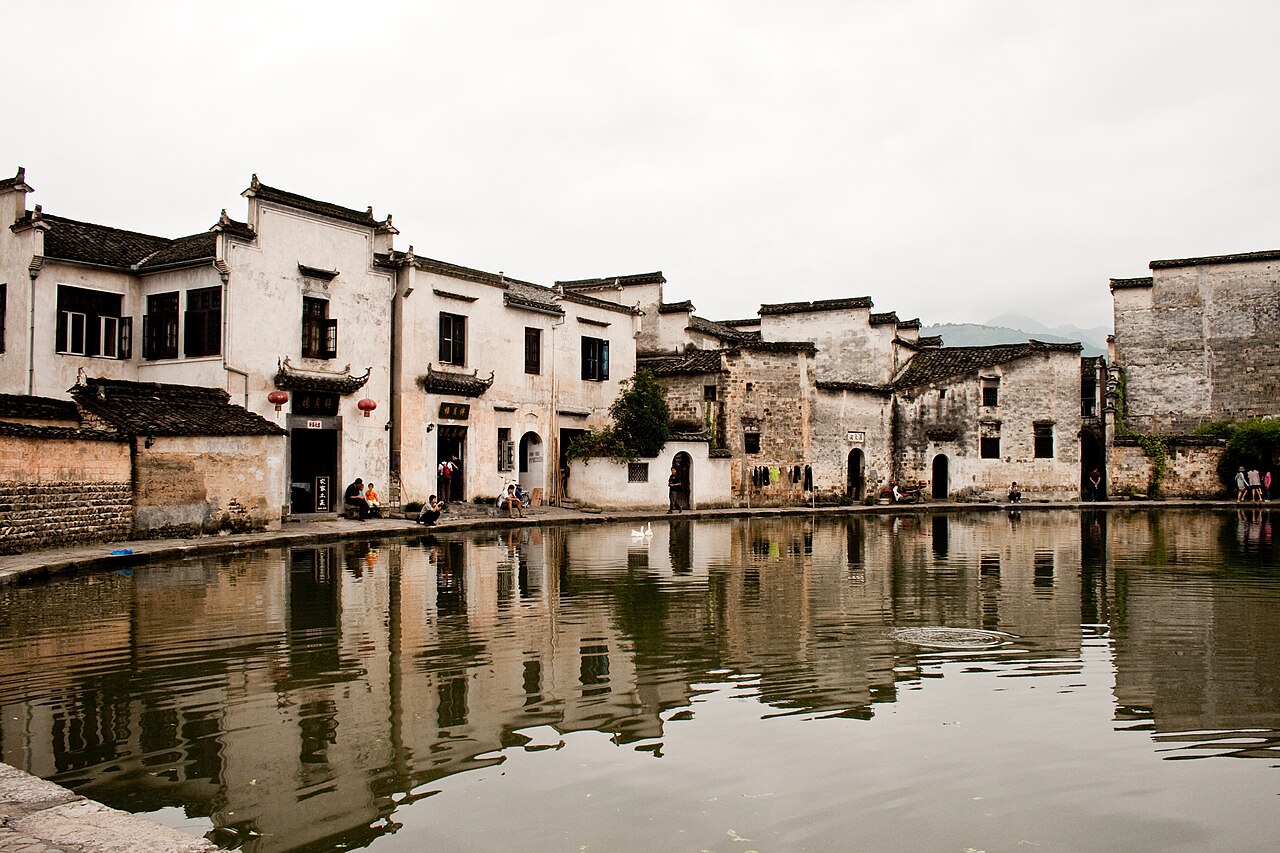
Hongcun’s artificial water management system — a 2.2-kilometre canal network feeding the central Moon Lake (Yuezao, 0.25 hectares) and the South Lake (Nanhu, 2.43 hectares) — was designed by the village patriarch Wang Cheng in 1403 CE (Ming Yongle period) and completed over a 30-year period by successive generations of the Wang family’s clan engineering. The system’s design concept was simultaneously practical and cosmological: practical in that it provided a reliable domestic water source for the dense village population (estimated 300–500 people in the 15th century), fire-suppression water access for the tightly clustered wooden buildings, and an irrigation source for the village’s kitchen gardens; cosmological in that the village’s plan was designed to replicate the shape of a water buffalo (niu, the zodiac symbol of the founding family’s protective deity), with the Moon Lake representing the buffalo’s stomach and the South Lake representing the buffalo’s body. The engineering required diverting a spring (Jiquan, “Auspicious Spring”) 2.2 kilometres north of the village through a stone-lined canal that entered the village via the Moon Lake’s north inlet, circulated through a network of internal channels (crossing each household’s kitchen doorstep so that domestic waste water flowed away from the canal), and collected in the South Lake at the village’s southern boundary before draining through a floodgate into the paddy fields below the village. The system’s most admired feature is the Moon Lake itself — a crescent-shaped pool in the centre of the village surrounded by the backs of the principal clan buildings, whose reflections in the still water create the most photographed composition at Hongcun. The Moon Lake and South Lake function as a settling basin sequence: the Moon Lake receives the spring water and allows sediment to settle, then discharges clear water into the South Lake, which provides the fire-suppression reservoir. The system has been maintained continuously since 1403 CE and is still the village’s primary domestic water source for residents who maintain traditional water-use practices.
Sources
- S1 — UNESCO World Heritage Centre — Ancient Villages in Southern Anhui – Xidi and Hongcun (Ref. 1002) — https://web.archive.org/web/20230601000000/https://whc.unesco.org/en/list/1002/
- S2 — UNESCO World Heritage Centre — Statement of Outstanding Universal Value (Ref. 1002) — https://whc.unesco.org/en/list/1002/
Spotted an error? Write to editorial@culturalheritageonline.com and we correct it the same day.