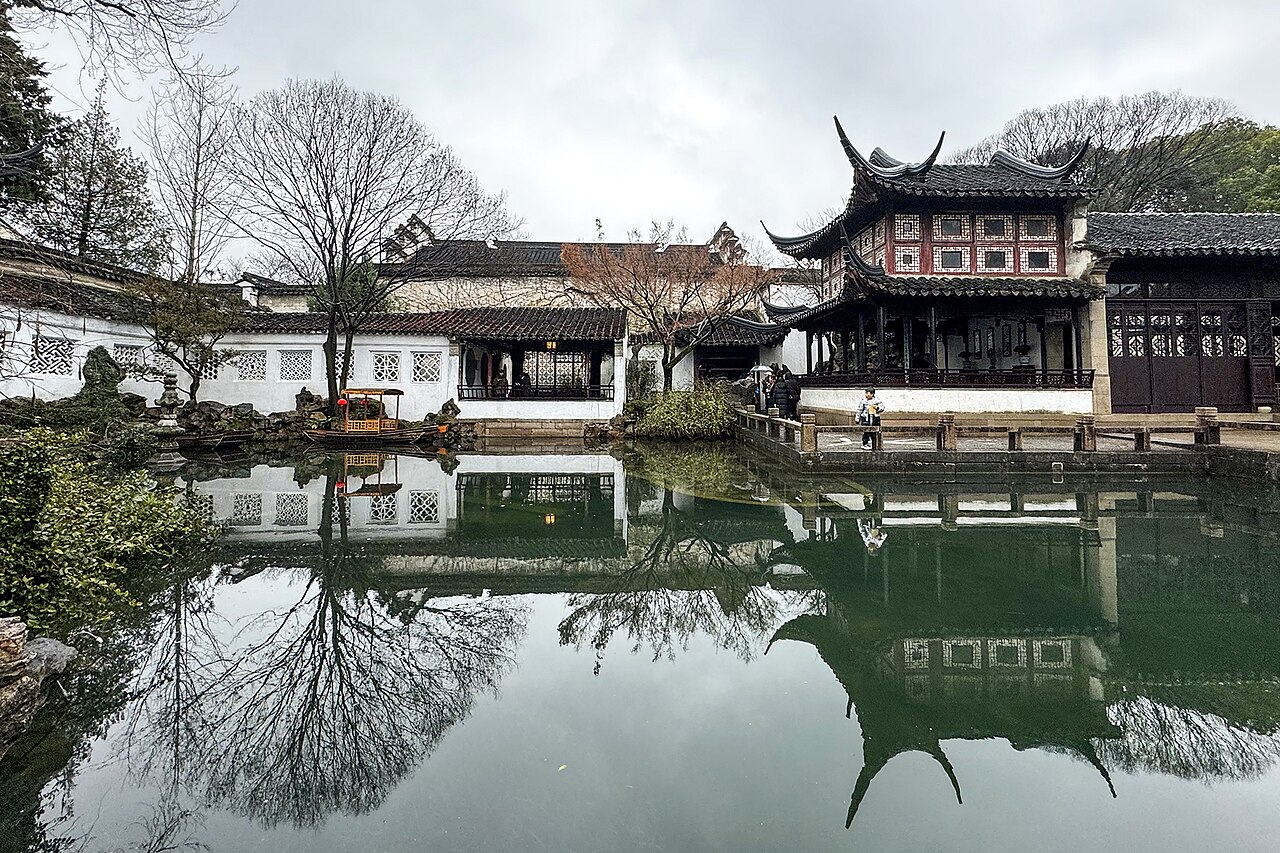
The Classical Gardens of Suzhou, inscribed by UNESCO in 1997 (extended 2000), represent the peak of the Chinese literati garden aesthetic as articulated by Ming and Qing dynasty retired officials in China’s most prosperous commercial city: nine protected garden complexes within a 15-kilometre radius of Suzhou’s Old Town (Gusu District) — including the Humble Administrator’s Garden (Zhuozhengyuan, 5.2 hectares, the largest, begun 1509), the Lingering Garden (Liuyuan, 2.3 hectares, 16th century), the Master of Nets Garden (Wangshiyuan, 0.54 hectares, the smallest major example, begun 1140, rebuilt 1765), and the Garden of the Lion Grove (Shizilin, 14th century) — all built on the principle of recreating idealized natural landscape within the walls of an urban compound through the strategic arrangement of water, rock, plants, and architecture in asymmetric compositions designed to create the sensation of infinite depth in a bounded space. The Suzhou gardens are not decorative extensions of palace architecture but spatial philosophies: each was designed by its owner as a private retreat embodying Neo-Confucian ideals of self-cultivation through engagement with the natural world, making them the built expression of the same intellectual tradition that Zhu Xi’s White Deer Grotto Academy at Lushan institutionalised in its academic form.
The Yangtze Delta heritage corridor West Lake Hangzhou · Grand Canal · Nanjing Ming Tombs — 100 to 200 km
One hundred kilometres southwest of Suzhou by high-speed rail (approximately 40 minutes from Suzhou Station to Hangzhou East on the Shanghai-Hangzhou HSR), the West Lake Cultural Landscape of Hangzhou (inscribed 2011) is the other defining landscape of the Yangtze Delta cultural tradition and the principal scenic counterpoint to Suzhou’s walled-garden aesthetic. Where Suzhou’s gardens are private, bounded, and miniaturised — recreating mountains, lakes, and forests within walls of 0.5–5 hectares — Hangzhou’s West Lake is public, panoramic, and at 5.6 square kilometres a natural lake incorporated into the urban fabric of the city. The aesthetic relationship between the two is philosophical: the Suzhou garden tradition arose partly from the desire of officials and scholars forced to live in urban Suzhou (a commercial centre too profitable to leave) to recreate the mountain-and-water scenery of natural landscapes including West Lake, which was visible from Suzhou only through poetry and painting. The Su Causeway at West Lake — built by the Song administrator Su Dongpo (1037–1101 CE) and named for him — runs 2.8 kilometres across the lake and is the most visited single element of the West Lake landscape; Su Dongpo’s administrative period at Hangzhou (1071–1074 and 1089–1091) produced both the Su Causeway and the famous poem comparing West Lake to the beauty Xi Zi, which was the literary statement that defined West Lake’s aesthetic identity for all subsequent Chinese culture. From Suzhou, West Lake is reached by high-speed rail to Hangzhou East and then subway Line 1 to Longjing Road (total approximately 1.5 hours).
One hundred twenty kilometres north of Suzhou by high-speed rail (approximately 30 minutes from Suzhou Station to Shanghai Hongqiao, then 45 minutes to Nanjing South on the Shanghai-Nanjing HSR), the Imperial Tombs of the Ming and Qing Dynasties (inscribed 2000, extended 2003) at Nanjing include the Xiaoling Mausoleum of the Hongwu Emperor (Zhu Yuanzhang, r. 1368–1398 CE) at the foot of Purple Mountain — the founding emperor of the Ming dynasty, who chose Nanjing (120 km west of Suzhou) as his capital before his successors moved to Beijing. The Ming Xiaoling Mausoleum (construction 1381–1405) is the largest imperial mausoleum in China, its Sacred Way (the 800-metre approach avenue lined with pairs of stone animal and human figures) setting the template for all subsequent Ming and Qing imperial tomb approaches including the Ming Tombs at Changling (Beijing) and the Qing Eastern and Western Tombs in Hebei Province. The Suzhou garden connection to Nanjing is through the same official class: the men who built Suzhou’s largest gardens — including Wang Xianchen, the former censor who built the Humble Administrator’s Garden after retiring from the Hongzhi court in 1509 — were products of the same Neo-Confucian examination system that the Ming Hongwu Emperor had systematised with the Yongle expansion of the Palace Examination in the early 15th century. From Suzhou to the Xiaoling Mausoleum at Nanjing, high-speed rail takes approximately 1.5 hours (Suzhou to Nanjing South, then subway to Zhongshan Ling).
One hundred sixty kilometres north of Suzhou by Grand Canal and road (approximately 2.5 hours by bus or 1.5 hours by HSR via Wuxi and Changzhou), the Grand Canal of China (inscribed 2014) links Suzhou directly through its most historically significant section. The Grand Canal passes through the heart of Suzhou’s Old Town via the Shantang Canal (Shantang Jie), the Pingjiang Road canal, and the outer moat system — all still operational as navigable waterways — making Suzhou one of the most physically intact Grand Canal cities in China. The canal’s Suzhou section carries the commercial logic that made the Suzhou gardens possible: the city was the largest textile (silk and cotton) manufacturing centre in Ming-Qing China, the junction where the Yangtze River’s goods moved onto the canal for transport to Beijing, and the tax collection point for the Jiangnan region’s extraordinary agricultural surplus. The garden owners who built the Humble Administrator’s Garden, the Lingering Garden, and the Master of Nets Garden were largely retired officials (censors, county magistrates, circuit inspectors) who had accumulated wealth in the tax and trade administration of a city whose economic productivity depended entirely on the Grand Canal as its transport infrastructure. Visiting Suzhou’s canal streetscapes (Shantang Jie, Pingjiang Lu) alongside the gardens reveals the commercial wealth whose surplus the garden tradition expressed. The closest Grand Canal section outside Suzhou is at Yangzhou, 150 km north (accessible by HSR in approximately 1 hour from Suzhou via Zhenjiang), where the canal’s historic administrative headquarters (Yangzhou was the Grand Canal’s southern inspection bureau city in the Qing period) are documented in the Slender West Lake park and the Ge Garden.
Fifty kilometres west of Suzhou by high-speed rail (approximately 20 minutes from Suzhou Station to Wuxi Station), the city of Wuxi contains the Taihu Lake shoreline gardens — Xihui Park, the Garden of Plum Blossoms — that represent the same Yangtze Delta private garden tradition as Suzhou in a less visited and therefore less crowded form. While not separately UNESCO-inscribed, Wuxi’s garden culture is historically intertwined with Suzhou’s: both cities are on the southern shore of Taihu Lake, both were within the Suzhou prefectural administration for most of the Ming-Qing period, and many Wuxi merchant families maintained secondary garden properties in Suzhou. The Taihu Lake itself — the third largest freshwater lake in China (2,250 square kilometres), immediately southwest of Suzhou — supplies the limestone rockery material (Taihu stones, taihu shi) that is the primary landscape element in all Suzhou gardens: the perforated, water-eroded limestone boulders that form the garden rock compositions were quarried from Taihu’s bed and shores and are now protected from commercial extraction, making historic gardens’ rock collections irreplaceable. From Suzhou, Wuxi and Taihu Lake’s shoreline are accessible by HSR in 20 minutes or by local bus along the shore road in approximately 1 hour.
Beyond the Yangtze Delta: north toward the canal corridor and south toward Hangzhou Bay Ancient Capital Nanjing · Huangshan Anhui · Shanghai waterfront — 100 to 250 km
Two hundred fifty kilometres southwest of Suzhou by high-speed rail (approximately 1.5 hours via Hangzhou and Huangshan North), the Huangshan (Yellow Mountain) inscription (inscribed 1990) in Anhui Province documents the granite pinnacle landscape that was the primary subject of the most influential Chinese painting tradition of the 17th century — the Huangshan school (Xin’an huapai), whose painters Hongren, Shitao, Kuncan, and Zhu Da created the aesthetic framework through which Chinese landscape painting moved away from the Song-Yuan naturalistic tradition toward the more abstract compositional arrangements that influenced not only subsequent Chinese ink painting but ultimately, through Western collectors’ contact with Chinese scroll painting, the development of Western abstract landscape aesthetics. The Suzhou gardens and the Huangshan painting school are products of the same intellectual moment: both emerged from the trauma of the Ming-Qing dynastic transition (1644), which produced in the garden-building context (Suzhou) a retreat into privately controlled miniature landscapes that reimagined the natural world as a philosophical space, and in the painting context (Huangshan) an art that made the mountain landscape itself a subject of melancholy abstraction rather than descriptive naturalism. From Suzhou to Huangshan North Station is approximately 2 hours by high-speed rail (via Hangzhou).
Two hundred kilometres northwest of Suzhou by high-speed rail (approximately 1 hour from Suzhou to Shanghai Hongqiao, then 1 hour to Yangzhou or Zhenjiang), the Historic Centre of Yangzhou — while not UNESCO-inscribed — is the formal administrative hub of the Grand Canal’s most prosperous section and the historic market where Suzhou’s silk goods entered the national distribution system. Yangzhou’s Slender West Lake (Shouxihu) garden complex, developed primarily in the Qing period (18th century) by Huizhou salt merchants who competed with the Suzhou official class for garden design prestige, represents the most directly comparable garden tradition to Suzhou in the Yangtze Delta region. The comparative garden visit — Suzhou’s scholar-official literati aesthetic versus Yangzhou’s salt-merchant commercial baroque — is one of the most revealing cultural contrasts in the Chinese garden tradition, both accessible from Shanghai’s high-speed rail hub within 1–1.5 hours. From Suzhou, the most efficient route to Yangzhou is via Shanghai Hongqiao (30 minutes) then HSR to Yangzhou East (45 minutes).
One hundred sixty kilometres south of Suzhou by high-speed rail (approximately 1 hour from Suzhou to Hangzhou East, then 40 minutes via local transport to Shaoxing), the city of Shaoxing in Zhejiang Province — historically part of the same Jiangnan cultural region as Suzhou, connected by the same Grand Canal feeder canal system — contains the Shen Garden (Shen Yuan), a Song-dynasty garden of 13th century origin associated with the poet Lu You (1125–1210 CE), and the Orchid Pavilion (Lanting), the site of the famous 353 CE calligraphy gathering where Wang Xizhi composed the Preface to the Orchid Pavilion Gathering (Lanting Xu) — the most celebrated example of Chinese running-script calligraphy and the foundational document of the Chinese calligraphy aesthetic tradition. The Orchid Pavilion site (rebuilt multiple times, current pavilion Qing period) is not UNESCO-inscribed but is one of the three or four most significant cultural sites in Chinese art history, functioning as the origin point of the literati’s self-understanding as calligrapher-scholars that produced the same garden-building culture visible in Suzhou. From Suzhou, Shaoxing is reached by HSR to Shaoxing North (approximately 1 hour).
Practical information
The Classical Gardens of Suzhou are distributed across the Gusu District (Old Town) and adjacent areas of Suzhou City, Jiangsu Province. The nearest high-speed rail stations are Suzhou Station (on the Shanghai-Nanjing HSR) and Suzhou North Station (on the Shanghai-Nanjing HSR), both within 5 kilometres of the Old Town. From Shanghai Hongqiao, HSR to Suzhou takes approximately 30 minutes; from Nanjing South, approximately 1.5 hours; from Hangzhou East, approximately 40 minutes. The four most-visited gardens — the Humble Administrator’s Garden, the Lingering Garden, the Master of Nets Garden, and the Garden of the Lion Grove — are all within walking distance of Suzhou’s pedestrianised historical centre; the Shantang Street (Shantang Jie) canal walkway connects them to the main tourist circuit. Ticket prices (2024 levels): Humble Administrator’s Garden ¥90 (peak) or ¥70 (off-peak); Lingering Garden ¥55; Master of Nets Garden ¥40; Lion Grove Garden ¥40; combined Garden Pass covering multiple gardens available. The Master of Nets Garden offers evening cultural performances (Suzhou Pingtan storytelling, Kunqu opera) on a ticketed basis, typically in spring and autumn seasons. Full coverage of the four principal gardens requires 2 full days; combining with Suzhou’s Silk Museum, the Suzhou Museum (I.M. Pei, 2006), and the Pingjiang Road canal streetscape requires 3 days. Best visiting seasons: March–May (spring flowers — wisteria, crabapple, peony, iris — in full bloom in gardens; Humble Administrator’s Garden’s azaleas and peonies in April are particularly celebrated) and October–November (autumn chrysanthemums, clearer air, smaller crowds). Summer (June–August) is extremely hot and humid; the gardens are most visited at this season — arrive at opening (7:30 AM) to see the morning mist on the ponds before the crowds arrive.
Frequently Asked Questions
What is the design principle of the Chinese literati garden and why is Suzhou its highest expression?
The Chinese literati garden (wenrenyuan, 文人园) is a private garden designed by or for educated officials (wenren) as a space for philosophical self-cultivation — a bounded landscape that, through the strategic placement of water, rock, plants, and pavilions, recreates the experience of being in a natural mountain-and-water landscape while remaining within the walls of an urban compound. The design principles were codified in the Manual of Garden Design (Yuanye, 园冶) by Ji Cheng (1631), the only surviving Chinese garden design treatise, which describes the key technique as “borrowing scenery” (jiejing, 借景) — the visual incorporation of distant views, sky reflections, and neighbouring trees into the garden’s compositions through calculated framing by windows, gates, and walls. The result is a spatial system based on deliberate illusion: a garden of 0.5 hectares appears larger than it is because no single view reveals the full extent; each step produces a new composition; the borrowed sky in the pond reflects clouds that extend the garden vertically beyond its walls. Suzhou became the peak expression of this tradition for three reasons. First, the city’s material resources: Suzhou’s silk and textile trade made it the wealthiest city in the Yangtze Delta from the 10th to 19th centuries, providing the capital for elaborate garden construction and the skilled craftsmen (stone carvers, carpenter-architects, plant specialists) needed to execute it. Second, the physical availability of Taihu stones — the perforated limestone rockery material without which a classical Chinese garden cannot be built — from the immediate vicinity of the lake shore. Third, the social context: Suzhou was the city where the largest number of retired officials chose to settle (its climate, food, silk goods, and cultural life made it the preferred retirement destination for the entire Chinese official class from the Song period onward), concentrating the garden-building clientele and the design culture in one location. The result was a tradition of approximately 200 private gardens constructed in Suzhou between the 10th and 20th centuries, of which the nine UNESCO-inscribed examples are the best preserved.
What is Kunqu opera and what is its connection to Suzhou’s gardens?
Kunqu opera (Kunqu, 昆曲) is the oldest surviving form of Chinese musical theatre, originating in Kunshan County adjacent to Suzhou in the 14th century as a combination of the local melodic singing tradition (kunshan qiang) with the spoken literary drama form (zaju) inherited from the Yuan period. Kunqu reached its artistic peak in the Ming-Qing transition period (16th–17th centuries) with the composition of the Peony Pavilion (Mudan Ting) by Tang Xianzu (1598) — a 55-scene opera of 4 hours (full performance) regarded as the masterpiece of Chinese musical theatre for the same reasons that the Classical Gardens are regarded as the masterpiece of Chinese garden design: both are products of the same Ming literati culture, the same Jiangnan region, and the same aesthetic of melancholy beauty applied to the experience of time, loss, and impermanence. The Kunqu tradition and the garden tradition are physically linked: private garden performances in the pavilions and covered walkways of Suzhou’s scholar-gardens were the primary performance venue for Kunqu opera in the Ming-Qing period, when the patron-class that owned the gardens also employed Kunqu troupes for domestic performances. Several of the UNESCO-inscribed gardens — particularly the Master of Nets Garden and the Humble Administrator’s Garden’s Yuanxiang Hall — retain performance spaces designed for intimate garden-scale opera. UNESCO inscribed Kunqu as one of the first Masterpieces of the Oral and Intangible Heritage of Humanity in 2001, making Suzhou the only Chinese city to hold both a cultural landscape inscription (Classical Gardens, 1997/2000) and an intangible heritage inscription (Kunqu, 2001) for aspects of the same Ming-Qing official culture.
How does the Humble Administrator’s Garden work spatially and what makes it the most celebrated of the Suzhou gardens?
The Humble Administrator’s Garden (Zhuozhengyuan, 拙政园) at 5.2 hectares is the largest of the Suzhou gardens and organises its space around a central water body (approximately 1.2 hectares of pond and canal) that occupies roughly one-third of the total area, with the built elements — pavilions, covered walkways (lang), halls, rock compositions — arranged at the water’s edge to be experienced both directly and through their reflections. The garden is divided into three sections by its ownership history (east, central, and west gardens corresponding to different historical periods and owners) but is most celebrated for the central section built in the 16th century by Wang Xianchen, a former censor who began construction after retiring from the court in 1509. The central section’s key spatial device is the covered walkway system: a 700-metre circuit of covered corridors connecting all pavilions, which allows the visitor to experience the garden in all weather while moving between framed views of the pond compositions. The most famous single composition is the view from the Distant Fragrance Hall (Yuanxiang Tang) looking south across the central pond to the pavilions on the opposite shore — a 100-metre vista that appears to contain the entire garden but actually reveals only its central axis, with the lateral extensions hidden by planted tree masses on both shores. The garden’s name, often translated as “Humble Administrator’s Garden,” comes from a phrase in the Western Jin writer Pan Yue’s (247–300 CE) “An Account of Leisure” (Xianzhuan): “planting trees and selling vegetables is also a way of administering [humble affairs]” — Wang Xianchen’s ironic reference to his own retirement from court administration to garden management. The garden was purchased and rebuilt by different owners five times between 1509 and 1949, explaining the stylistic diversity between its eastern (Qing-period), central (Ming-period core), and western (17th century, most intimate in scale) sections.
Sources
- S1 — UNESCO World Heritage Centre — Classical Gardens of Suzhou (Ref. 813) — https://web.archive.org/web/20230601000000/https://whc.unesco.org/en/list/813/
- S2 — UNESCO World Heritage Centre — Statement of Outstanding Universal Value (Ref. 813) — https://whc.unesco.org/en/list/813/
Spotted an error? Write to editorial@culturalheritageonline.com and we correct it the same day.