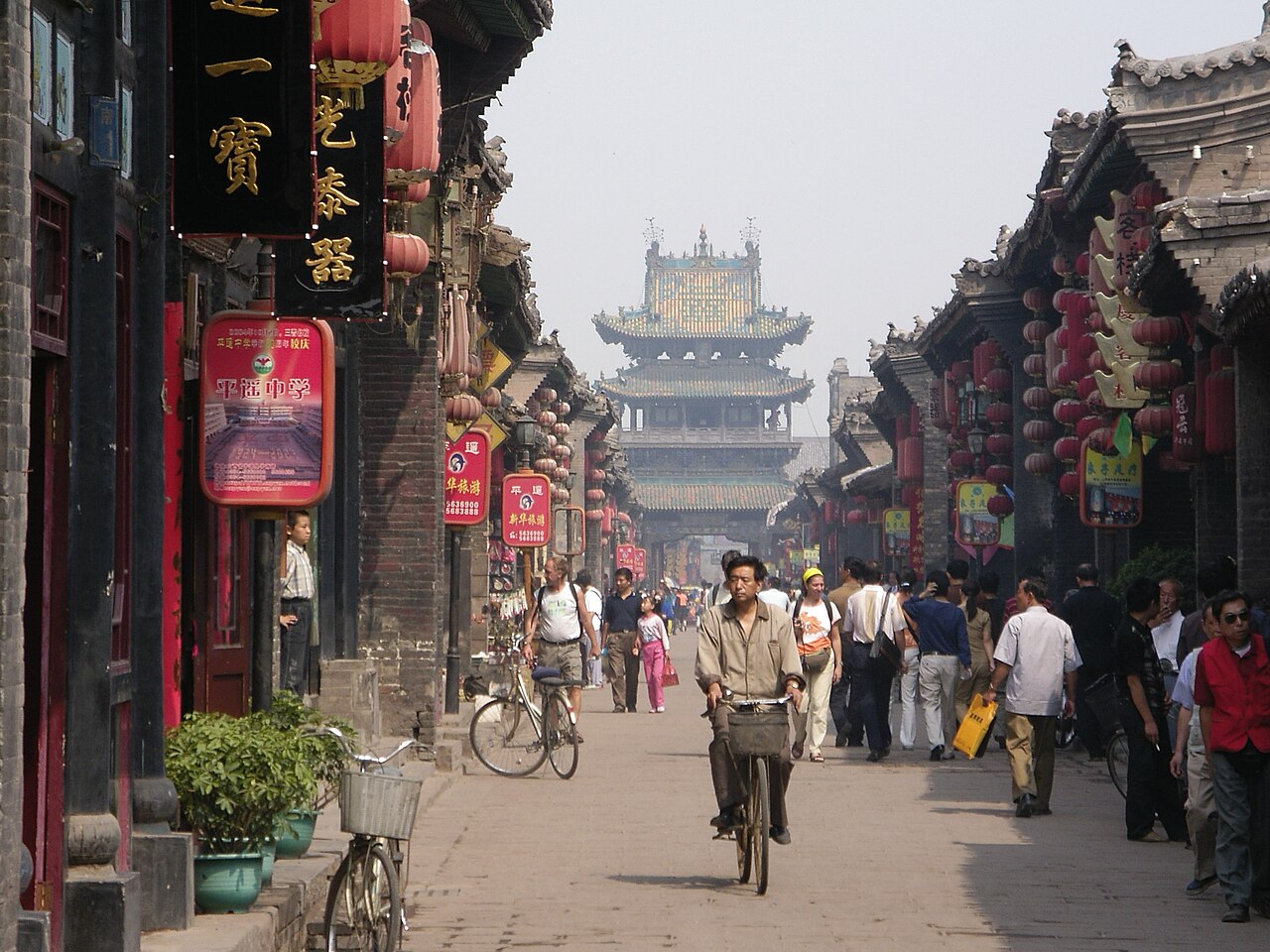
The Ancient City of Pingyao, inscribed by UNESCO in 1997, is the best-preserved example of a Ming-Qing dynasty Chinese city remaining in China: a complete walled town of 2.25 square kilometres in Jinzhong City, Shanxi Province, whose 6,163-metre perimeter wall (built 1370, repaired to its current form 1564–1567), 3,797 traditional courtyard residences (minguo-era architectural fabric, many dating from the 17th–19th centuries), 104 government-listed cultural relics, and two major temple complexes — the City God Temple and the Confucian Temple — survived the 20th century without significant demolition or modern infill because Pingyao was economically bypassed after the commercial decline of its Shanxi banking houses in the 1930s. The city was the centre of China’s first national banking network: the Rishengchang Exchange House (日升昌), established in 1823, issued the first national draft bills (piaohao) exchangeable across China’s major commercial cities and made Pingyao the hub of a financial system that at its peak in the 1880s managed approximately 30–50% of China’s total monetary supply.
Shanxi Province: the valley of Buddhist caves and sacred mountains Mount Wutai · Yungang Grottoes · Hanging Temple — 150 to 300 km
One hundred fifty kilometres northeast of Pingyao by road (approximately 2.5 hours via the Changzhi-Taiyuan Expressway to Yangquan and northeast to Wutai County), Mount Wutai (inscribed 2009) in northern Shanxi is the highest of the Four Sacred Buddhist Mountains of China and the home of the largest surviving concentration of Tang-dynasty wooden temple architecture in China. The five flat-topped peaks (wutai = “five terraces”) at elevations of 2,728–3,061 metres above sea level house 53 active Buddhist monasteries, the oldest of which — the Nanchan Temple (782 CE) and the Foguang Temple (857 CE) — are the only surviving Tang-period wooden halls in China (all others were destroyed in the Buddhist persecution of 845 CE and not yet rebuilt when Pingyao’s financial network was consolidating in the Ming period). The geographical connection between Pingyao and Wutai is the Shanxi trade route: the Qing-period Shanxi merchants (晋商, Jin Shang) whose Pingyao banking houses financed national trade were the primary donors to the Wutai monasteries’ endowments and construction campaigns, making the financial capital at Pingyao and the sacred mountain at Wutai the two poles of the same regional merchant elite’s material culture. From Pingyao, Mount Wutai is accessible by high-speed rail to Taiyuan North and then by bus via Xinzhou (approximately 3.5 hours total).
Two hundred eighty kilometres north of Pingyao by high-speed rail (approximately 1.5 hours from Pingyao Ancient City Station to Datong North on the Datong-Xi’an HSR via Taiyuan), the Yungang Grottoes (inscribed 2001) in Datong City are the earliest monumental Buddhist cave sculpture complex in China — commissioned by the Northern Wei dynasty emperors beginning in 460 CE as an explicit imperial statement of Buddhist devotion, carved by craftsmen who had recently arrived from Central Asia via the Silk Road. The 252 grottoes at Yungang contain approximately 51,000 individual statues, the most significant being the five Tan Yao caves (caves 16–20) cut directly in the reign of Emperor Wencheng (r. 452–465 CE) as representations of five emperors — each Buddha portrait is officially a portrait of the reigning or recent Wei emperor, making Yungang the earliest surviving example of emperor-as-Buddha iconography in Chinese art. The Northern Wei court’s establishment of the Yungang project in 460 CE was contemporaneous with the court’s patronage of the Longmen Grottoes site at Luoyang (which became active only after the Wei capital moved south in 494 CE), meaning that Yungang documents the first phase and Longmen the second phase of the same imperial sculpture programme — the two sites together constitute the complete record of the Northern Wei Buddhist sculpture school. From Pingyao (Pingyao Ancient City Station), Datong is reached in approximately 1.5 hours on the Datong-Xi’an HSR via Taiyuan.
Two hundred fifty kilometres north of Pingyao by road (approximately 3.5 hours to the Hanging Temple area near Hunyuan County, Datong), the Xuankong Temple (Hanging Temple) at Mount Hengshan — built into a cliff face 75 metres above the valley floor on the vertical wall of Jinlong Gorge — is not itself UNESCO-inscribed but represents the physical and religious context of the same Northern Wei imperial patronage that produced the Yungang Grottoes. The Hanging Temple was founded in 491 CE (Northern Wei), making it contemporary with Yungang’s main carving phase, and is the only surviving temple complex in China that simultaneously enshrines Buddhist, Daoist, and Confucian figures within the same compound — reflecting the Three Teachings (Sanjiao) syncretic approach that the Northern Wei court adopted in the same period as the Yungang imperial Buddha portraits. The physical drama of the Hanging Temple’s cantilever construction — each hall projecting from the cliff on wooden brackets inserted into drilled rock sockets — prefigures the engineering ambition of the Yungang cave interior spaces, where the same artisans who worked the cliff stone built the carved vaulted interiors. From Pingyao, the Hanging Temple is most efficiently combined with a Yungang Grottoes visit (Datong area), approximately 30 km from Datong city centre.
One hundred twenty kilometres south of Pingyao by high-speed rail (approximately 35 minutes from Pingyao to Linfen or the Shanxi-Henan border zone), the cave temple tradition that begins at Yungang continues south through Shanxi to Longmen Grottoes (Luoyang, Henan, inscribed 2000) approximately 400 km south — accessible from Pingyao in approximately 3 hours by high-speed rail (Pingyao → Taiyuan South → Zhengzhou East → Luoyang Longmen). The Longmen Grottoes document the continuation of the Northern Wei imperial sculpture programme after the capital moved from Datong to Luoyang in 494 CE: the Guyang Cave (495–575 CE) contains the earliest Longmen inscriptions in the Wei stele calligraphy style whose formal elegance became the template for all subsequent Chinese monumental calligraphy. The Tang dynasty added the most famous single composition at Longmen: the Fengxian Temple complex (672–675 CE), commissioned by Empress Wu Zetian, containing the Vairocana Buddha and eight attendant figures carved into an open-air niche 17.14 metres tall — the largest Buddhist sculpture at Longmen, whose face is traditionally said to bear the Empress’s own likeness. The Pingyao–Yungang–Longmen axis traces the Northern Wei–Tang Buddhist sculpture tradition across 1,000 years (460–672 CE) and 550 kilometres of Chinese territory, all accessible on the same high-speed rail corridor.
East to Beijing and northeast to the Great Wall corridor Forbidden City · Ming Tombs · Zhoukoudian — 550 to 650 km
Five hundred fifty kilometres east of Pingyao by high-speed rail (approximately 3 hours from Pingyao Ancient City Station via Taiyuan and Shijiazhuang to Beijing West), the Imperial Palaces of the Ming and Qing Dynasties — the Forbidden City (inscribed 1987) in central Beijing — are the administrative capital whose Shanxi Merchant trade networks funded and sustained. The Shanxi bankers (Jin Shang) based in Pingyao maintained their most important Beijing branch office (京号, jing hao) in the Xuanwu district of the Qing capital, handling the imperial government’s financial needs — tax remittances from provincial treasuries, military payroll transfers, and currency exchange for foreign missions — in exactly the same administrative geography as the Forbidden City’s Board of Revenue (Hubu). The Rishengchang Exchange House (founded Pingyao 1823) operated 35 branches across 23 Chinese cities plus Russian border posts; its Beijing office managed the imperial government’s most sensitive financial transactions. Visiting the Forbidden City after Pingyao makes the supply-chain logic visible: the imperial court consumed, the provincial merchants produced, and the Pingyao banking network transferred value between the two poles of the Qing economy. From Pingyao to Beijing West Station, high-speed rail runs approximately 3 hours (direct trains or via Taiyuan/Shijiazhuang).
Six hundred kilometres east of Pingyao by high-speed rail (approximately 3.5 hours from Pingyao to Ming Tombs area, Changping district, Beijing), the Imperial Tombs of the Ming and Qing Dynasties (inscribed 2000, extended 2003 and 2004) include the Ming Tombs at Changling (the largest, tomb of the Yongle Emperor, construction 1409–1427) — the same Yongle Emperor whose reign (1402–1424) financed the Forbidden City’s construction and the Wudang Mountains’ Daoist temple complex simultaneously. The Ming Tombs site at the foot of Tianshou Mountain in Changping is 50 kilometres northwest of Beijing and accessible by subway (Line 13 to Dongzhimen, then bus), making it the most accessible major UNESCO site from the Beijing Forbidden City for visitors who have come east from Pingyao. The thirteen Ming Tombs (Changling, Xiaoling not included at this location, Yongling, Maoling, Daoling, Jingling, Yuling, Maoling, Tailing, Kangling, Yongling, Zhaoling, Dingling, Qingling, Siling) cover the complete sequence of Ming imperial burials from 1409 to 1644; the Dingling underground palace (Wanli Emperor, 1620) is the only Ming tomb with its underground chamber excavated and opened to visitors. From Pingyao to the Ming Tombs, high-speed rail plus subway plus bus from Beijing takes approximately 4 hours total.
Six hundred kilometres east of Pingyao by road via Shijiazhuang (accessible from Beijing in an additional 45-minute subway ride from Beijing West), the Peking Man Site at Zhoukoudian (inscribed 1987) in Fangshan district south of Beijing documents the hominin occupation of the North China Plain between approximately 700,000 and 230,000 years ago (Homo erectus pekinensis, “Peking Man”) and between 30,000 and 10,000 years ago (Upper Cave Man, anatomically modern Homo sapiens). The Zhoukoudian fossils discovered between 1923 and 1937 (excavated under the leadership of Johan Gunnar Andersson, Davidson Black, and Pei Wenzhong) included the remains of approximately 40–50 individual Homo erectus individuals, with fossil craniums, mandibles, teeth, and postcranial bones — the largest collection of Homo erectus fossils from a single site in Asia. The current site museum (rebuilt 2014) houses replica fossils (the originals were lost in December 1941 during the attempted evacuation to the United States at the start of the Pacific War and have not been recovered) and documents the palaeolithic archaeology of the Zhoukoudian caves. From Pingyao, Zhoukoudian is reached by high-speed rail to Beijing West and then by local transport to Fangshan (total approximately 3.5 hours).
Six hundred kilometres northeast of Pingyao by road (approximately 5 hours from Pingyao to the Jinshanling or Mutianyu sections of the Great Wall), the Great Wall of China (inscribed 1987) in the Yanshan Mountain zone north of Beijing includes the most visited and best-restored sections of the Ming Great Wall (1368–1644). The Shanxi Merchant connection to the Great Wall is direct and under-studied: the Shanxi military garrison towns (晋商重镇, the nine frontier garrison towns, Jiuzhen, including Datong and Taiyuan) along the inner and outer Great Wall lines in Shanxi and Hebei were the primary market towns where Shanxi merchants provisioned the Ming and Qing military frontier. The Pingyao banking houses issued pay certificates exchangeable at Datong and other frontier garrisons, meaning that the military supply chain of the Great Wall’s garrison force in Shanxi was partly administered through Pingyao’s financial system. The Jinshanling section (Hebei Province, 125 km northeast of Beijing), the Mutianyu section (Huairou District, 73 km north of Beijing), and the Simatai section (144 km northeast of Beijing) are the three most architecturally complete Ming Wall sections accessible from Beijing as day trips; from Pingyao, any section requires a Beijing overnight, making it a 2-day extension from Pingyao to the Wall. From Pingyao, the Badaling section (most visited, fully restored, 75 km northwest of Beijing) is reached by high-speed rail to Beijing North and then by HSR to Badaling on the Badaling HSR (total approximately 3.5 hours).
Practical information
The Ancient City of Pingyao is in Jinzhong City, central Shanxi Province. The nearest high-speed rail station is Pingyao Ancient City Station (平遥古城站) on the Datong-Xi’an HSR, approximately 2 kilometres east of the city’s eastern gate (served by bus and taxi, approximately 10 minutes). Direct high-speed trains connect Pingyao to Taiyuan North (approximately 25 minutes), Datong North (approximately 1.5 hours), Xi’an North (approximately 2.5 hours), and Beijing West (approximately 3 hours). The walled city is entered through six main gates (the South Gate, Yingxun Gate, is the largest and most photographed); once inside, the main commercial streets of Mingqing Street (South Street) and West Street form the primary tourist circuit. The Rishengchang Exchange House Museum (日升昌票号博物馆) on West Street is the primary attraction documenting the Shanxi banking tradition — a 3,724 square-metre compound of 24 courtyard houses that functioned as the headquarters of China’s first national commercial bank (1823–1914). The County Yamen (Pingyao County Government Office), in continuous official use from 1346 to 1952, is one of the best-preserved Chinese magistrate office complexes in China and is interpreted at the museum level with period furnishings. The City God Temple (Chenghuang Miao) complex on Chenghuang Temple Street is the largest and most complete City God Temple in Shanxi Province. Full coverage of the walled city requires a minimum of 2 full days. The best seasons for visiting are April–May (mild temperatures, spring light on the grey-brick architecture) and September–October (autumn clarity, fewer visitors than the summer peak); winter brings excellent low-season conditions and snow-on-tile photography without crowds.
Frequently Asked Questions
What was the Shanxi banking system and why did Pingyao become its centre?
The Shanxi banking system (晋商票号, Jin Shang piaohao, “Shanxi Merchant draft firms”) was China’s first nationwide financial network, operating from approximately 1823 to 1913 and handling the remittance, deposit, and currency-exchange needs of the Qing government and its major commercial cities. The network originated in Pingyao because the city was already the centre of a regional trade diaspora: Shanxi merchants (Jin Shang) had been the dominant long-distance traders in northern China since the Ming dynasty, specialising in the military supply trade along the Great Wall frontier and in the salt distribution monopoly (yanshang) licensed by the Qing government for Shandong, Shanxi, and Hebei provinces. The physical location of Pingyao — in the Fen River valley of central Shanxi, at the junction of the north-south road from Beijing to Xi’an and the east-west road from Shanxi to Shandong — made it a natural hub for commercial flows in all four directions. The Rishengchang draft house was established in 1823 by Lei Lutai, the general manager of a Pingyao dye-and-colour merchant (颜料庄) who recognised that the physical transport of silver (the Qing payment currency) between cities was slower, more expensive, and more dangerous than a paper-based remittance system. The draft bill (piaohao) system allowed a merchant in Shandong to deposit silver at a Rishengchang branch and collect it in Xi’an or Beijing through a system of coded receipts verified by the network’s private cipher system — the world’s first large-scale commercial banking system based on paper instruments rather than physical metal. By 1890, 22 major Shanxi draft firms in Pingyao and nearby Qi County and Taigu were managing approximately one-third of China’s total monetary supply through 400+ branches in 35 cities. The system collapsed when the 1911 Republican Revolution ended the Qing government contracts and the subsequent warlord period disrupted the provincial financial system the piaohao had depended on; the Rishengchang closed its last branch in 1914.
How did Pingyao survive the demolition campaigns of the 20th century?
Pingyao’s survival as a complete Ming-Qing walled city is largely the product of economic failure rather than deliberate preservation policy. When the Shanxi banking system collapsed in the 1910s and the Beijing-Hankou Railway (built 1905) bypassed Pingyao in favour of Taiyuan as the regional rail hub, Pingyao lost both its financial prominence and its railway access simultaneously. The city’s population and commercial activity declined sharply from its Qing-period peak (estimated 100,000+ population in the 1880s) to a smaller agricultural market town. Without significant economic activity, there was no pressure to demolish and rebuild the commercial core; without railway access, there was limited material investment in modern construction. The result was a city that entered the 1950s with its Ming wall, its Qing courtyard architecture, and its street plan essentially unchanged from the 19th century — not because anyone chose to preserve it, but because no one had the resources or motivation to replace it. During the Cultural Revolution (1966–1976), Pingyao’s buildings were used as granaries and warehouses rather than demolished, which damaged interiors but protected structures. The UNESCO inscription campaign in 1986–1997 (China’s nomination was accepted in 1997) was partly inspired by an article in the Guangming Daily newspaper in 1986 by the urban planning scholar Ruan Yisan, who documented Pingyao as one of the last complete traditional Chinese cities and argued for its urgent protection. The 1997 UNESCO inscription brought national funding for wall restoration and the tourism economy that now supports the walled city’s conservation — a case where international recognition created the economic incentive that replaced the commercial economy the piaohao had previously provided.
What is the architecture of Pingyao’s courtyard houses and how does it differ from Beijing’s hutong courtyards?
Pingyao’s residential architecture consists predominantly of the northern Chinese siheyuan (四合院) courtyard house type — a rectangular compound with a single main gate, interior courtyard, main hall (zhengfang) on the north side facing south, wing rooms (xiangfang) on east and west, and an outer gate building (daomen) facing the street. The Pingyao examples differ from Beijing’s famous hutong siheyuan in scale, ornament style, and construction material: Pingyao’s courtyard houses are built primarily of locally-quarried sandstone and dark grey fired brick, with carved brick gateway facades, whereas Beijing’s hutong houses use red brick with ceramic-tile roofwork and wooden-panel gates. The Pingyao merchant house style includes characteristically high compound walls (3–4 metres, compared to Beijing’s lower walls), a two-storey main hall with carved wooden second-floor railings, and gate structures (dixia dao, underground road passages through the compound block) that allowed access between multiple adjacent compounds owned by the same family — a spatial organisation suited to the piaohao banking houses, which required security for silver storage and private passage between accounting rooms and family quarters. The most elaborate surviving example is the Wang Family Compound (Wangjia Dayuan) in Lingshi County 40 kilometres south of Pingyao — a 150-courtyard complex of 2,078 rooms built from 1700 to 1793 by the Wang banking family, classified as one of the largest surviving traditional Chinese private residential complexes and typically visited as a day trip from Pingyao to see the full elaboration of the Shanxi merchant residential aesthetic at its most ambitious scale.
Sources
- S1 — UNESCO World Heritage Centre — Ancient City of Ping Yao (Ref. 812) — https://web.archive.org/web/20230601000000/https://whc.unesco.org/en/list/812/
- S2 — UNESCO World Heritage Centre — Statement of Outstanding Universal Value (Ref. 812) — https://whc.unesco.org/en/list/812/
Spotted an error? Write to editorial@culturalheritageonline.com and we correct it the same day.