
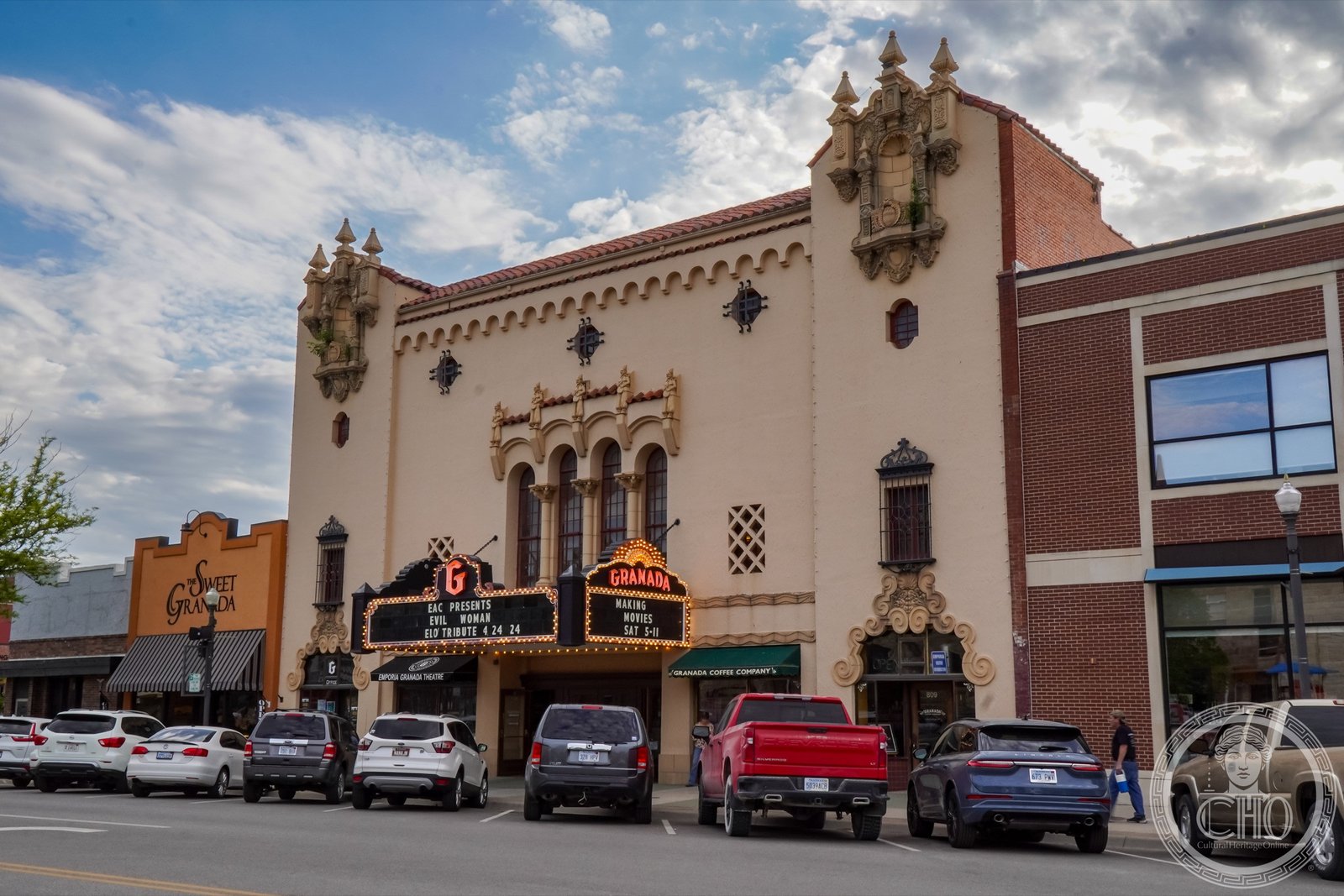
Listed on the National Register of Historic Places, the Granada Theatre on Commercial Street in Emporia, Kansas, brought Art Deco cinema to the Flint Hills region — a building whose ornamental ambition exceeded what might be expected from a town of Emporia’s size, reflecting the cultural investment that small-city audiences demanded from the movie palace era.
At a glance
Emporia, Kansas sits at the eastern edge of the Flint Hills, the last great expanse of tallgrass prairie in North America — a landscape of extraordinary ecological and visual character that extends for roughly 200 miles from the Kansas-Oklahoma border north to Nebraska. The Flint Hills’ resistance to the plow (the shallow rocky soil over chert and limestone defeats conventional farming) preserved the prairie ecosystem that the rest of the Great Plains lost to agriculture in the nineteenth century, and the region’s ranching economy gave Emporia its commercial base. The city is known outside Kansas primarily through the journalism of William Allen White, whose Emporia Gazette became nationally prominent in the early twentieth century through White’s editorials on tolerance, democracy, and the virtues of small-city civic life. The Granada Theatre, built in the same decade that White was at the height of his national influence, stands as a product of the Emporia civic culture he articulated: a city that took its cultural institutions seriously enough to build a movie palace whose Art Deco ornament would have been at home in cities ten times Emporia’s size.
Key facts
- Built: c.1929
- Style: Art Deco
- Location: Commercial Street, downtown Emporia
- County: Lyon County, Kansas
- Status: National Register of Historic Places
- GPS: 38.4040° N, −96.1817° W
History
Emporia in 1929 had a population of roughly 14,000 people — a small city by national standards, but one with an educational and civic infrastructure out of proportion to its size. The Kansas State Teachers College (now Emporia State University) had been established there in 1863, and the presence of a teachers’ college gave Emporia a different cultural character than the purely agricultural and ranching towns of the surrounding region. The railroad connections that had made Emporia a commercial center for southeastern Kansas also provided the economic base for the downtown Commercial Street development that the Granada represented.
The movie palace of the late 1920s was a democratizing institution in a specific sense: it offered everyone who could afford a ticket access to an environment of luxury and escape that had previously been available only to the wealthy. The Granada’s Art Deco ornament — the geometric vocabulary, the decorative program at the facade, the interior that aspired to a grandeur beyond the everyday — was the physical expression of this democratizing ambition. That this ambition was realized in Emporia, Kansas, rather than exclusively in Chicago or New York, is part of what makes the great small-city movie palaces of the Art Deco era historically significant.
The building’s National Register listing acknowledges its architectural integrity and its role in Emporia’s commercial history. The history of small-city movie palaces in the late twentieth century is often a history of closure, decline, and demolition; the Granada’s survival as a recognized historic resource represents a preservation outcome that many comparable buildings did not achieve.
What you see
The Granada’s Commercial Street facade is an Art Deco composition whose scale announces the ambition of the late-1920s movie palace project: a building designed to be the most visually prominent structure on its block, its decorative program concentrated at the entrance and upper facade to signal the cinema’s identity to pedestrians on the street. The horizontal banding, geometric ornament, and vertical name display are the standard vocabulary of the era, executed here with a consistency of design that the NRHP listing recognizes as architecturally significant.
Commercial Street in downtown Emporia is the commercial spine of a county seat that has maintained more of its late-nineteenth and early-twentieth-century built fabric than many comparable Kansas cities. The Granada sits within this streetscape as a mid-century addition to a commercial district whose earliest buildings predate it by decades — a layering of architectural periods that is the characteristic condition of American main streets that have survived the urban renewal pressures of the postwar era.
Practical information
- NRHP visit: the building’s exterior and streetscape position are accessible to any visitor on Commercial Street; interior access depends on current operations — check local listings for events
- Flint Hills exploration: pair a visit to the Granada with drives through the Tallgrass Prairie National Preserve (approximately 50 miles northwest near Strong City) for the full Emporia/Flint Hills experience
- Time needed: allow a morning or afternoon for downtown Emporia plus a drive into the Flint Hills
Getting there
Emporia is approximately 50 miles south of Topeka and 110 miles southwest of Kansas City via Interstate 35 (Kansas Turnpike); the highway’s Emporia exit gives direct access to Commercial Street. Kansas City International Airport (MCI) is the nearest major airport, approximately 115 miles northeast via I-35; Wichita Eisenhower National Airport (ICT) is approximately 90 miles southwest. Amtrak’s Southwest Chief (Chicago–Los Angeles) stops at the Emporia station on Merchant Street, which is within walking distance of Commercial Street and the Granada.
Nearby
- Tallgrass Prairie National Preserve — one of the last intact tallgrass prairie ecosystems in North America; a National Park Service unit near Strong City, Kansas, approximately 50 miles northwest of Emporia; the Spring Hill Ranch (1881) and a historic bison herd within the preserve
- William Allen White House (Red Rocks) — the National Historic Landmark home of the Emporia Gazette editor whose editorials made Emporia’s name nationally known; at 927 Exchange Street in Emporia’s residential district
- Emporia State University — the former Kansas State Teachers College (established 1863), one of the oldest public universities in Kansas; campus buildings and the university library with historical collections on the Flint Hills region
- Cottonwood Falls, Kansas — the Chase County Courthouse (1873), a French Second Empire limestone building that is one of the most photographed courthouses on the Great Plains; approximately 55 miles northwest in the heart of the Flint Hills
Sources
- National Register of Historic Places — Granada Theatre, Lyon County KS (NRHP #85000693)
- Kansas Historical Society — commercial architecture surveys, Lyon County
- Lyon County Historical Society — Emporia commercial and cultural history
- Emporia State University — regional history collections
- Wikimedia Commons — building image
Find it on the map
See this place and what’s around it →Record researched and written by Luigi De Marchi for Cultural Heritage Online, 2026.
📷 Become a Cultural Heritage Online photographer
Share your photos of places: they stay published under your name as the author. The more they're seen, the more you get noticed — and soon a contest will reward the most appreciated photos.
Log in or sign up free to add a photoIs this page about you?
This page is read by travellers and heritage enthusiasts who find it on Google. Tell us how you are connected to this place and we will take it from there.