
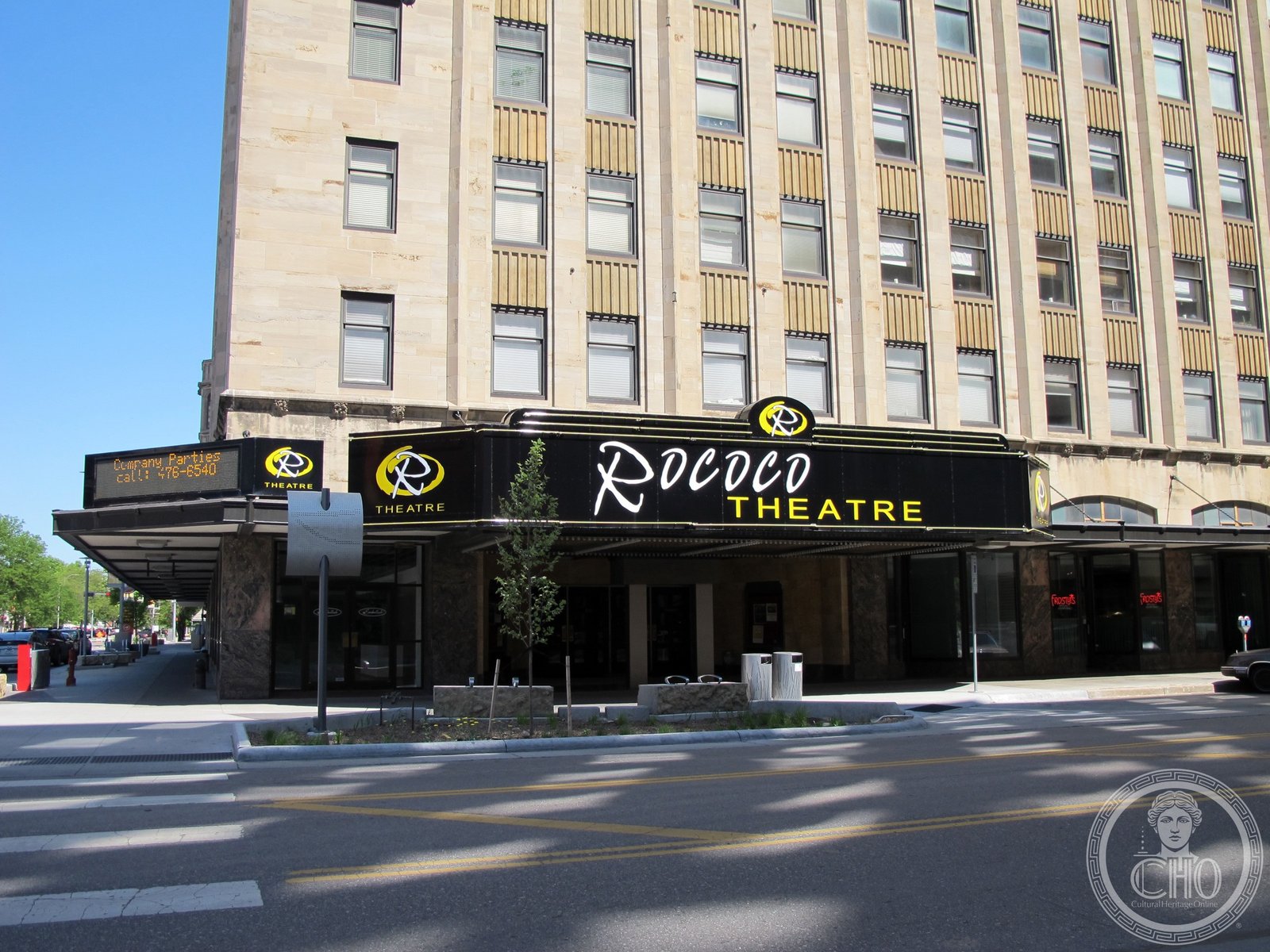
Built in 1930 as the Stuart Theatre and later renamed the Rococo, this Art Deco cinema on North 13th Street anchors the intersection of Lincoln’s downtown entertainment district and the University of Nebraska campus corridor.
At a glance
The theater that stands at 140 North 13th Street in downtown Lincoln opened in 1930 as the Stuart Theatre, part of the chain of movie houses that organized American urban entertainment in the early sound era. Its Art Deco detailing placed it squarely in the visual vocabulary of the period: the geometric ornament above the entrance, the vertical emphasis of the facade, the polished materials of the lobby. It served Lincoln’s downtown population for decades, operating as a first-run cinema through the golden age of the medium, then adapting to the changing landscape of urban entertainment. The building eventually passed through several phases of programming and ownership before becoming the Rococo Theatre, now operating as a live music and events venue that uses the original auditorium’s sight lines and acoustic properties to advantage. Lincoln’s downtown — anchored by the nearby Nebraska State Capitol and the University of Nebraska campus — continues to evolve around this block of North 13th Street.
Key facts
- Built: 1930
- Original name: Stuart Theatre
- Current name: Rococo Theatre
- Style: Art Deco
- Address: 140 North 13th Street, Lincoln, Nebraska 68508
- Current use: Live music and events venue
- GPS: 40.8127° N, −96.7007° W
History
Lincoln in 1930 was a state capital and university city with a commercial downtown concentrated along O Street and the numbered avenues running north. The opening of the Stuart Theatre in this district coincided with the consolidation of the American movie business following the transition to sound film in 1927. Theaters built in this period were business investments as much as architectural statements: the Art Deco vocabulary — a language that read as modern, prosperous, and entertaining — was practically the default for cinemas of this scale and ambition.
The Stuart operated as a mainstream cinema for several decades, serving the downtown Lincoln audience that would have combined students from the nearby University of Nebraska campus, state government employees, and the general city population. The pattern of its later history — gradual decline as multiplex competition drew audiences outward, eventual conversion to a live entertainment format — follows a common trajectory for urban single-screen houses of its vintage. The renaming as the Rococo Theatre signaled the transition toward a broader programming slate, and the building has since hosted rock, jazz, comedy, and community events in a room whose proportions and acoustic character suit live performance well.
The Nebraska State Capitol, completed in 1932 several blocks to the south, is the building that defines Lincoln’s Art Deco architectural identity; the Rococo Theatre’s more modest commercial Deco represents the other end of the spectrum — the everyday vocabulary of the style applied to neighborhood-scale entertainment.
What you see
The Rococo’s entrance on North 13th Street presents a characteristic 1930 movie-house facade: geometric ornament concentrated above the entrance canopy, vertical lines drawing the eye upward from the marquee, materials chosen for their light-reflective properties and contemporary associations. The entrance vestibule retains the proportions of the original design, with the ticket booth placement and the transition from street to auditorium following the spatial sequence that characterized the period’s theater design. The auditorium inside is a modified shoebox with a balcony, the original raked floor providing good sight lines from the main floor to a stage that was added when the building transitioned to live performance use.
Standing on North 13th Street before a show, the building reads as a downtown anchor — modest by the standards of metropolitan picture palaces, but correct in its proportions and consistent in its detailing, the product of a professional architectural culture that had built hundreds of these houses across the American Midwest in the preceding decade.
Practical information
- Events: live music, comedy, and community events; check the Rococo Theatre calendar
- Tickets: available online and at the venue
- Parking: city parking garages on 11th and 13th Streets; metered street parking on O Street
- Time needed: allow time for the event plus a walk through the Haymarket District one block west
Getting there
Lincoln Airport (LNK) is approximately 4 miles northwest; direct connections serve Denver, Chicago, and Dallas. The Lincoln Amtrak station at 201 North Seventh Street is roughly a 10-minute walk west of the theater. The University of Nebraska campus begins two blocks north of the theater on 13th Street; the Nebraska State Capitol is a 10-minute walk south. Interstate 80 runs just south of downtown Lincoln, with several exits providing access to the 13th Street corridor.
Nearby
- Nebraska State Capitol (1932) — Bertram Goodhue’s Art Deco tower rising above the plains, approximately 8 blocks south; the dome supports Lee Lawrie’s “Sower” figure visible from the theater entrance
- Haymarket District — renovated 1880s railroad warehouse district one block west, now a concentration of restaurants, galleries, and the Saturday Lincoln Farmers Market
- Sheldon Museum of Art — University of Nebraska collection in a Philip Johnson building, 3 blocks north on 12th Street
- Pinnacle Bank Arena — 15,000-seat concert and sports venue, 4 blocks west near the Haymarket
Sources
- Rococo Theatre, Lincoln — venue history and programming
- Nebraska State Historical Society — Lincoln theater and entertainment history
- Lincoln Journal Star — archival coverage of Stuart Theatre and later operations
- Nebraska Historic Buildings Survey — downtown Lincoln architectural documentation
- Wikimedia Commons — building image
Find it on the map
See this place and what’s around it →Record researched and written by Luigi De Marchi for Cultural Heritage Online, 2026.
📷 Become a Cultural Heritage Online photographer
Share your photos of places: they stay published under your name as the author. The more they're seen, the more you get noticed — and soon a contest will reward the most appreciated photos.
Log in or sign up free to add a photoIs this page about you?
This page is read by travellers and heritage enthusiasts who find it on Google. Tell us how you are connected to this place and we will take it from there.