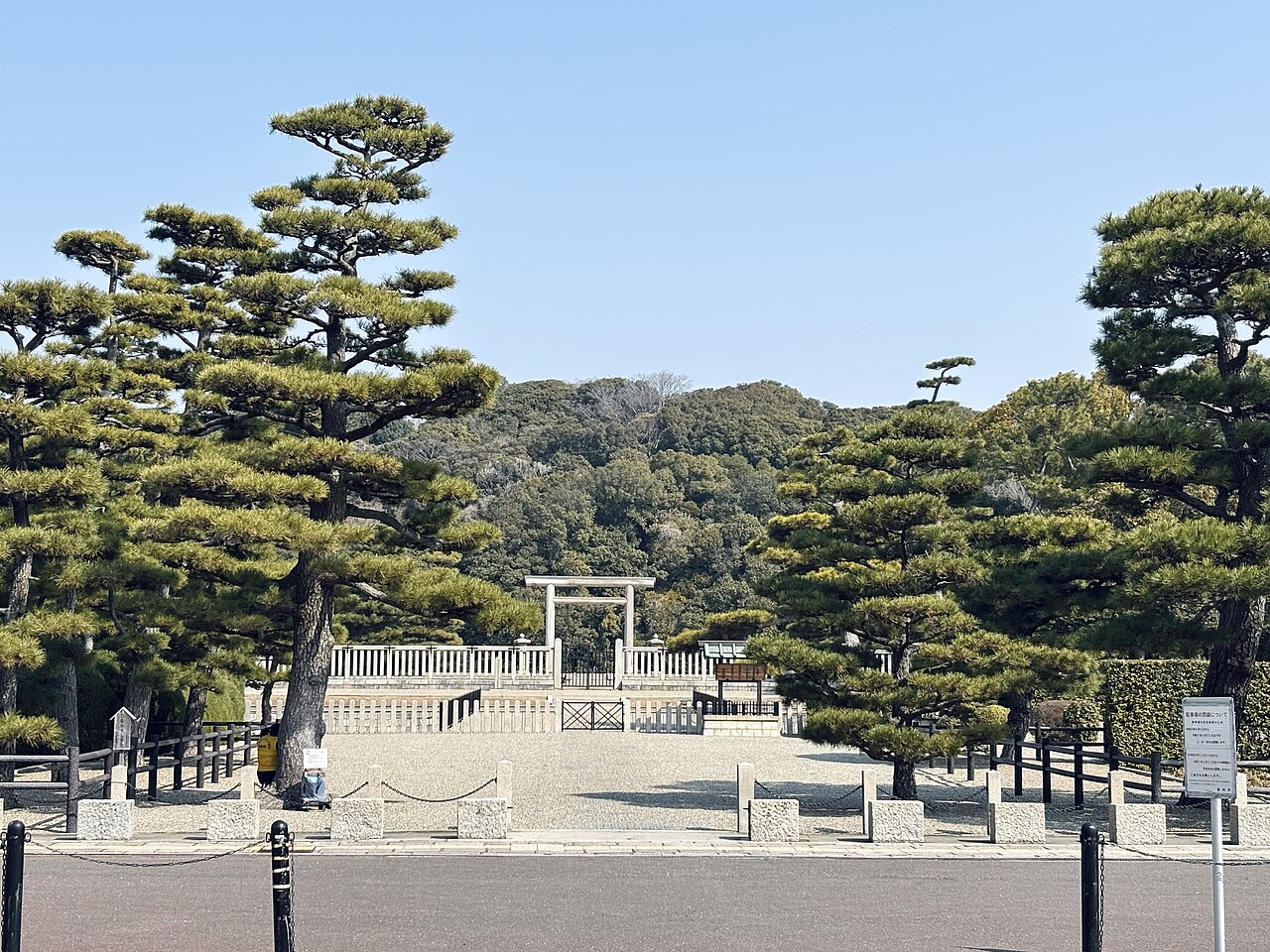
The Mozu-Furuichi Kofun Group: Mounded Tombs of Ancient Japan, inscribed by UNESCO in 2019, comprises 49 burial mounds in Sakai and Habikino Cities in Osaka Prefecture. The largest component — the Daisen Kofun, attributed to Emperor Nintoku (died c. 427 CE) — is a keyhole-shaped earthwork of 486 metres length surrounded by three concentric moats: by total enclosed area (including moats) it is the largest burial structure in the world, covering more ground than the Great Pyramid of Giza or the Mausoleum at Halicarnassus. The 49 mounds span three centuries (4th–6th century CE) and represent the burial tradition of the Yamato imperial court — the political precursor to the modern Japanese imperial house.
The Osaka-Nara corridor and ancient Japan Nara · Kyoto · Himeji — 30 to 90 km
Thirty kilometres east of the Mozu-Furuichi cluster by local JR from Sakai to Nara (approximately 90 minutes via Osaka and Kintetsu connections), the Historic Monuments of Ancient Nara document the period 710–784 CE when the imperial court that the Mozu-Furuichi kofun builders served moved to a permanent capital for the first time. The Yamato court that built the Daisen Kofun operated without a fixed capital — the imperial court relocated at each emperor’s death, following a purification custom. The establishment of Nara’s permanent city plan in 710 CE, modelled directly on China’s Tang capital Chang’an, represents a political and urban transformation that directly superseded the kofun tradition: the new Buddhist state ideology of the Nara period explicitly rejected the ancestral tumulus burial custom in favour of smaller Buddhist-style burials. The Todai-ji Great Buddha Hall (752 CE) in Nara — the world’s largest wooden building — was built approximately 300 years after the Daisen Kofun and represents the cultural programme that replaced the kofun tradition as the organizing principle of Japanese imperial identity. From the Mozu kofun area in Sakai, Nara is reached by JR Hanwa Line to Tennoji and Kintetsu to Nara (approximately 75 minutes).
Fifty kilometres north of the Mozu-Furuichi kofun by JR from Sakai to Osaka and Kobe (approximately 45 minutes), the urban Kansai corridor connects the ancient burial grounds of southern Osaka with the historic port infrastructure of Kobe. Kobe’s Kitano Ijinkan foreign settlement district (not a UNESCO site but a designated Japanese heritage area) represents the 19th-century Western-commercial-presence landscape that contrasts with the 5th-century imperial-burial landscape of the Mozu kofun directly south. The Osaka Bay geography — the Yamato plain’s rivers draining to the sea at the bay that both the ancient Yamato court and the Meiji-period commercial port used — provides the physical continuity between the kofun period and the modern city. From the Mozu kofun, central Osaka is reached by Nankai Line to Namba or JR to Osaka Station (approximately 30 minutes).
Sixty kilometres northeast of the Mozu-Furuichi kofun by Kintetsu from Osaka-Namba to Kyoto (approximately 40 minutes), the Historic Monuments of Ancient Kyoto document the court culture that the Yamato imperial tradition initiated at Nara and then transferred to Kyoto in 794 CE. The Mozu-Furuichi kofun builders — the 5th–6th-century Yamato court — were the direct institutional predecessors of the Nara court (710 CE), the Kyoto court (794 CE), and through 1,200 years of institutional continuity, the modern imperial house that remains in Tokyo. The Kinkaku-ji (Golden Pavilion, built 1397), Ryoan-ji (rock garden, late 15th century), and Nijo Castle (Tokugawa, 1603) in the Kyoto UNESCO inscription represent successive layers of the same imperial and shogunal tradition that the Daisen Kofun initiated. The UNESCO inscription at Mozu-Furuichi provides the 4th–6th-century foundation layer for the Kyoto-Nara sequence of imperial cultural production — together, the three Kansai inscriptions document 1,600 years of Japanese imperial culture in continuous sequence. From the kofun, Kyoto is reached by Kintetsu from Osaka (approximately 40 minutes).
Ninety kilometres west of the Mozu-Furuichi kofun by JR from Osaka to Himeji (approximately 50 minutes), Himeji Castle provides the feudal military counterpart to the imperial burial tradition of the kofun. The Himeji complex, completed in 1609 by Tokugawa vassal Ikeda Terumasa, represents the 17th-century institutionalization of samurai authority over the same Yamato plain geography that the 5th-century kofun builders commanded as imperial lords. The transition from keyhole burial mounds to white-plastered castles as the dominant expression of political authority took approximately 1,200 years (400–1600 CE) and involved the intercession of Buddhism, Chinese court culture, and the military feudalism of the Kamakura and Muromachi periods. From the Mozu kofun, Himeji is reached by JR Yamatoji Line from Sakai to Osaka and Shinkansen or JR Kobe Line to Himeji (approximately 60–80 minutes).
Connections to Horyu-ji and the Buddhist monuments Horyu-ji · Asuka — 40 to 50 km
Forty kilometres southeast of the Mozu-Furuichi kofun by JR from Tennoji to JR Horyuji (approximately 35 minutes), the Buddhist Monuments in the Horyu-ji Area in Ikaruga hold the world’s oldest surviving wooden buildings. Prince Shotoku founded the Horyu-ji complex in 607 CE, approximately 180 years after the Daisen Kofun was completed — a period during which the Yamato court progressively adopted Buddhism as the state religion, shifting the imperial identity from the ancestral-veneration tradition that the kofun represented to the Buddhist accumulation of merit through temple construction. The transition from kofun to temple as the primary expression of imperial religious authority is physically visible in the Nara-Osaka landscape: the kofun of Mozu-Furuichi (400–600 CE) and the Buddhist temples of Horyu-ji (607 CE) and Nara (710–752 CE) are separated by decades and 50 kilometres in the same Yamato plain. From the Mozu kofun, Horyu-ji is reached by JR to Tennoji and JR Yamatoji Line to JR Horyuji Station (approximately 50 minutes).
Practical information
The Mozu-Furuichi Kofun Group spans two cities — Sakai City (Mozu Kofun) and Habikino/Fujiidera Cities (Furuichi Kofun). The Daisen Kofun (Nintoku’s Tomb) in Sakai is the primary visitor site: it is managed by the Imperial Household Agency as a living imperial mausoleum and is not open to the interior or the mound surface for general visitors — the viewing point is from the earthwork approach (haisho) and the outer moat perimeter path. The Nintoku Mausoleum Museum (Sakai City Museum of the Kofun Period) adjacent to the site presents the excavated Haniwa terracotta figures (dozens of clay cylinders and human/animal figurines that originally ringed the mound) and the historical context of the burial tradition. From Osaka, the Daisen Kofun in Sakai is reached by Nankai-Koya Line from Namba to Mozu Station (approximately 30 minutes) — the mound is 10 minutes on foot from Mozu Station. The Furuichi Kofun cluster in Habikino is reached by Kintetsu Minami-Osaka Line from Osaka-Abenobashi to Furuichi Station (approximately 30 minutes); the Tsukuriyama Kofun (Ojin’s Tomb, the second-largest mound) is 5 minutes from Furuichi Station. A bicycle is the most practical way to cover multiple kofun in the Furuichi cluster, which includes 26 inscribed mounds within a 5-kilometre radius. Guided tours are available through the Sakai City Tourism Association; English-language materials are limited at site information points.
Frequently Asked Questions
Why is the Daisen Kofun considered the world’s largest burial mound?
The Daisen Kofun’s claim to being the largest burial structure in the world is based on total enclosed area, including its three concentric moats: the complete site covers approximately 46.4 hectares (464,000 square metres). By comparison, the Great Pyramid of Giza covers approximately 5.3 hectares (the pyramid footprint alone); the Mausoleum at Halicarnassus, one of the Seven Wonders of the Ancient World, approximately 4 hectares. However, the comparison depends on what is measured: if measured by mound height or mound volume, the Great Pyramid (138 metres high, approximately 2.6 million cubic metres of stone) vastly exceeds the Daisen Kofun (approximately 35 metres high, approximately 1.5 million cubic metres of earth). The “world’s largest” claim for the Daisen Kofun is specifically about ground area with moats included, which is the most relevant measure for a Japanese kofun whose ritual significance included the surrounding water and the approach causeway — the moats were not incidental features but part of the sacred precinct. The keyhole (zenpo-koen-fun) shape — a square base attached to a circular mound — is unique to the Japanese burial tradition and has no exact parallel in any other funerary tradition worldwide; the shape’s meaning is not documented in contemporary sources and remains a subject of scholarly debate.
Who is buried in the Daisen Kofun?
The Daisen Kofun is officially designated as the mausoleum of Emperor Nintoku (Nintoku Tenno), the 16th emperor of Japan according to the traditional imperial succession as recorded in the Nihon Shoki (compiled 720 CE). Emperor Nintoku is traditionally dated to the late 4th–early 5th century CE; his reign years in the Nihon Shoki are given as 313–399 CE, but the Nihon Shoki’s early chronology is generally recognized as unreliable — the Daisen Kofun’s archaeological dating to approximately 400–430 CE puts the tomb’s construction approximately 30 years after the Nihon Shoki’s stated death date. The historical Nintoku is almost entirely unknown outside the Nihon Shoki; the Daisen attribution is traditional rather than archaeologically confirmed. The Imperial Household Agency, which administers the mausoleum, does not permit archaeological excavation of the interior — the mound has not been scientifically excavated, and the burial contents are unknown. Occasional accidental discoveries (bronze mirrors, iron swords, terracotta Haniwa fragments) from erosion events and adjacent construction have been documented since the Meiji period, but no systematic excavation has been authorized. UNESCO’s inscription in 2019 was negotiated under an understanding that the inscription’s Outstanding Universal Value derived from the visible landscape of the mounds rather than from their archaeological content, and the management framework does not require excavation access.
What are the Haniwa terracotta figures and why are they significant?
Haniwa are unglazed terracotta sculptures — cylinders, human figures, animals, houses, and boats — that were placed in rows around the perimeter of kofun burial mounds during the Kofun period (approximately 250–600 CE). The term “Haniwa” means “clay circle,” referring to the cylindrical base that all Haniwa share — the earliest examples (3rd century CE) are simple cylinders; by the 5th–6th century, figurative Haniwa in human and animal form had developed into fully three-dimensional sculptures with individual faces and costumes. The Mozu-Furuichi mounds are among the most prolific known sources of Haniwa: tens of thousands of Haniwa were placed around the Daisen Kofun and the surrounding secondary mounds, and examples have been excavated from the eroded mound surfaces since the Edo period. The Haniwa’s ritual function is not documented in contemporary Japanese sources — they are inferred to have served as a ritual enclosure (protecting the mound from spirit intrusion or retaining the deceased’s spirit) based on comparison with Chinese burial figurine traditions and Korean tumulus Haniwa-like objects. Haniwa are the earliest Japanese sculptural tradition documented in surviving examples and are displayed in every Japanese national and prefectural museum collection; the Sakai City Museum adjacent to the Daisen Kofun holds the largest single-site collection.
Sources
- S1 — UNESCO World Heritage Centre — Mozu-Furuichi Kofun Group: Mounded Tombs of Ancient Japan (Ref. 1593) — https://web.archive.org/web/20230601000000/https://whc.unesco.org/en/list/1593/
- S2 — UNESCO World Heritage Centre — Statement of Outstanding Universal Value (Ref. 1593) — https://whc.unesco.org/en/list/1593/
Spotted an error? Write to editorial@culturalheritageonline.com and we correct it the same day.