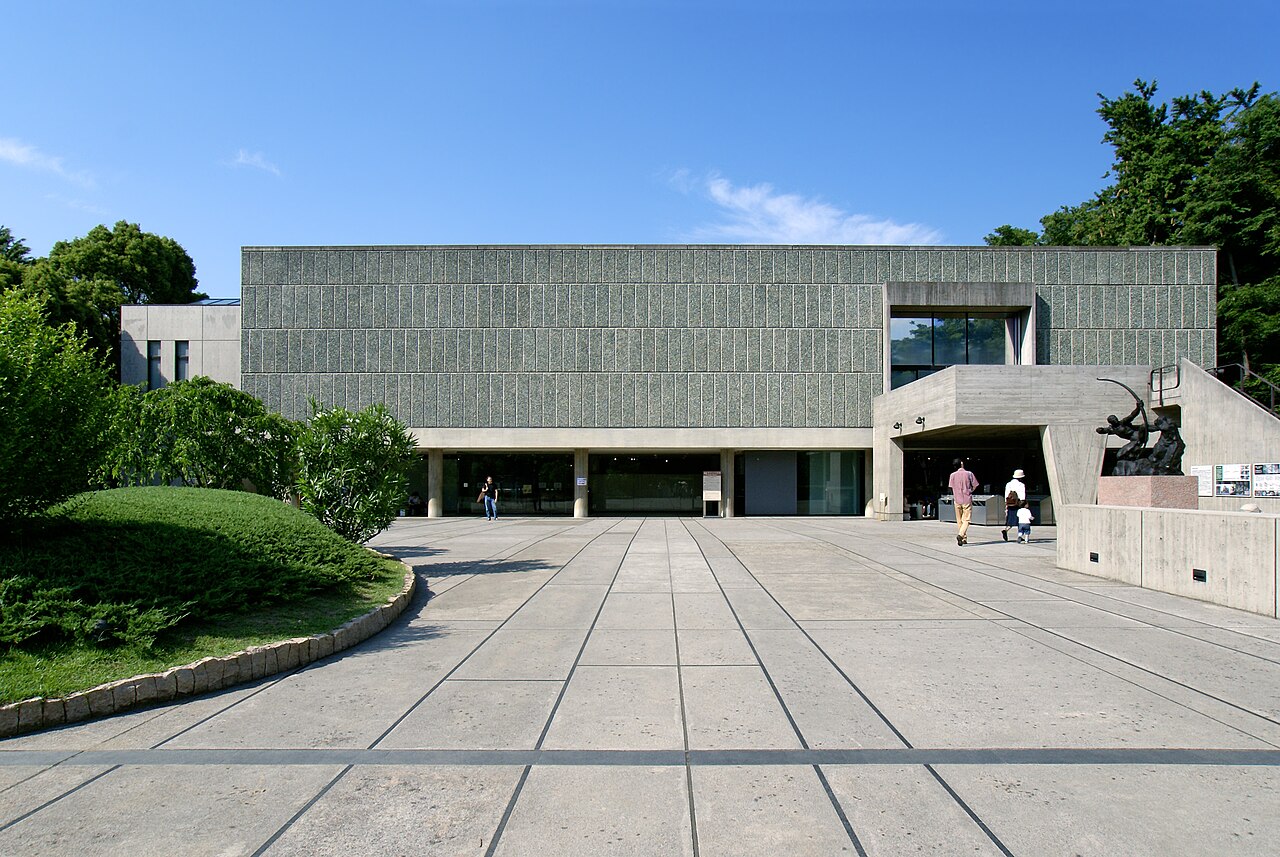
The National Museum of Western Art in Ueno Park, Tokyo, designed by Le Corbusier and completed in 1959, is Japan’s contribution to the transnational UNESCO inscription “The Architectural Work of Le Corbusier, an Outstanding Contribution to the Modern Movement” — a serial property of 17 buildings in 7 countries (France, Switzerland, Belgium, Germany, Argentina, India, and Japan) inscribed in 2016. The NMWA is the only example of Le Corbusier’s “Musée à croissance illimitée” (Unlimited Growth Museum) concept that was built to completion: a spiral building expanding outward from a central top-lit hall, allowing the museum to grow without architectural disruption. The building was the product of a 1950s diplomatic agreement through which France returned Japanese art held in the Matsutaka Collection, which had been seized or impounded after World War II.
The Ueno museum district and the Tokyo heritage circuit Tokyo · Nikko · Tomioka — 0 to 140 km
Zero kilometres from the NMWA — in the same Ueno Park — the Tokyo National Museum houses the world’s largest collection of Japanese art (approximately 110,000 objects), the National Museum of Nature and Science presents natural history from the Japanese archipelago’s geological origin to the present, and the Ueno Zoological Gardens hold the Giant Pandas on permanent loan from China. The NMWA’s position within this cultural campus makes Ueno Park the densest concentration of museum floor space per hectare in Japan — and the only Tokyo location where a UNESCO-inscribed architecture faces a non-inscribed competing museum that substantially outperforms it in visitor numbers (the Tokyo National Museum receives 1.5 million visitors per year; the NMWA approximately 700,000). The NMWA’s permanent collection includes Auguste Rodin’s bronze sculptures in the approach garden — The Gates of Hell, The Thinker, The Burghers of Calais — the largest outdoor Rodin collection in Asia, acquired from France along with the Matsutaka Collection. The park is 5 minutes on foot from JR Ueno Station and 30 minutes from Tokyo Station by JR Keihin-Tohoku Line.
Ninety minutes north of Tokyo by Tobu Nikko Limited Express from Asakusa Station (direct, approximately 2 hours) or by JR to Utsunomiya and local connection, the Shrines and Temples of Nikko in Tochigi Prefecture provide the most frequently paired day trip from Tokyo with the NMWA — the two inscriptions representing the opposite aesthetic poles of Japan’s cultural production: Le Corbusier’s stripped concrete rationalism and the Toshogu Shrine’s 17th-century maximum ornament (2.5 million sheets of gold leaf, 508 carved figures on the Yomeimon Gate alone). Both sites are inscribed under different UNESCO criteria: the NMWA under criterion i (masterpiece of human creative genius) and criterion ii (cultural exchange); Nikko under criteria i, iv, and vi (artistic achievement, architectural typology, and association with Tokugawa Ieyasu’s deification). The conceptual distance between the two buildings — one designed to eliminate ornament in pursuit of pure function and light, the other designed to eliminate all visible structure under maximum ornament — represents the full range of architectural possibility between the 17th and 20th centuries. From the NMWA at Ueno, Nikko is reached by Tobu Nikko Limited Express from Asakusa (approximately 2 hours).
One hundred forty kilometres northwest of Tokyo by JR from Ueno to Takasaki (80 minutes) and Joshin Dentetsu to Joshu-Tomioka (30 minutes), the Tomioka Silk Mill and Related Industrial Heritage in Gunma Prefecture was the key node in the Meiji government’s first industrial technology transfer — the same modernization programme that produced Japan’s first Western-style national museum (the NMWA’s institutional predecessor, the 1882 Ueno Exhibition Hall, opened in the same Ueno Park where Le Corbusier’s building now stands). The Meiji government’s simultaneous investments in industrial technology transfer (Tomioka Silk Mill, 1872) and cultural institution building (Ueno exhibitions, 1872–1882) were part of a single civilizational programme of Western practice adoption. The UNESCO inscriptions of the Tomioka Silk Mill (2014) and the NMWA (2016) capture two different dimensions of this programme: the industrial and the cultural modernization of the same Meiji state, 140 kilometres apart in the same administrative region of the new national capital.
Connections to Kansai and the ancient capitals Kyoto · Nara · Himeji — 450 to 550 km
Four hundred fifty kilometres southwest by Tokaido Shinkansen (approximately 2 hours 20 minutes from Tokyo Station to Kyoto), the Historic Monuments of Ancient Kyoto provide the deepest historical context for the NMWA’s institutional origin. The Matsutaka Collection, whose return from France produced the diplomatic condition for the NMWA’s construction, was assembled by Kojiro Matsutaka — a Meiji shipping magnate and art collector — primarily in Paris between 1916 and 1929. Matsutaka’s collecting ambition, enabled by the industrial wealth generated by the Meiji modernization that the Tomioka mill documented, was to create a Western art museum in Tokyo equivalent to the great European national collections. The Kyoto National Museum — established by the Meiji government in 1897 in the same national museum-building programme that created the Tokyo National Museum — holds the Japanese artistic counterpart to Matsutaka’s Western collection: the Buddhist sculptures, lacquerware, and paintings from Kyoto’s UNESCO-inscribed temples. The combined national museum system — Kyoto (Japanese art, Meiji 1897), Tokyo (Japanese art, Meiji 1882), and Tokyo NMWA (Western art, 1959) — represents the institutional architecture of Japan’s cultural self-presentation to the world. From the NMWA, Kyoto is reached by Tokaido Shinkansen from Tokyo Station (2 hours 20 minutes).
Five hundred kilometres southwest by Shinkansen to Osaka and local connection, the Mozu-Furuichi Kofun Group in Osaka Prefecture — the burial mounds of Japan’s 4th–6th-century emperors — represents the institutional power that preceded the imperial museum tradition by 1,500 years. The Daisen Kofun (attributed to Emperor Nintoku, died c. 427 CE) is the largest burial mound in the world by total land area: 485 metres long with three surrounding moats, it is larger than the Great Pyramid of Giza by ground coverage. The NMWA collection begins with 14th-century European painting; the Mozu-Furuichi Kofun inscription represents the same imperial authority that the Meiji state invoked in building Japan’s national museums in the 1880s — the Meiji restoration explicitly claimed to restore the authority of the imperial line that built the Nintoku tomb 1,500 years earlier. From the NMWA, the Mozu-Furuichi site in Sakai, Osaka is reached by Shinkansen from Tokyo to Shin-Osaka and local JR (approximately 3 hours).
Practical information
The National Museum of Western Art is in Ueno Park, 5 minutes on foot from JR Ueno Station (Keihin-Tohoku, Yamanote, and Joban Lines) and 10 minutes from Tokyo Metro Ueno or Nezu Station. The museum opens at 9:30 and closes at 17:30 (to 20:00 on Fridays and Saturdays); closed Mondays (and the following Tuesday if Monday is a holiday). The permanent collection — including the Rodin sculptures, impressionist and post-impressionist paintings, and medieval and Renaissance works — is displayed in the Le Corbusier building’s ground and upper floors. The spiral plan allows visitors to move from the central entrance hall outward through the collection without retracing steps; the building’s top-lit central nave is the most architecturally distinctive interior space in the complex. Le Corbusier himself visited Tokyo twice during construction (1955 and 1959) and is documented approving the site’s orientation and the contractors’ execution. The building has been modified over time — the 19 Prefabricated Units wing added in 1979 by Japanese architects Kunio Maekawa and Junzo Sakakura (both former Le Corbusier apprentices) nearly doubled the museum’s floor area — but the 1959 original building remains intact as the UNESCO-inscribed component. A detailed self-guided architectural tour of the building’s Le Corbusier elements (brise-soleil, pilotis, ramp, roof garden) is available from the museum’s information desk.
Frequently Asked Questions
Why is a Tokyo museum part of a multinational Le Corbusier inscription rather than Japan’s own cultural inscriptions?
The NMWA is inscribed as part of the transnational Le Corbusier inscription — which spans 7 countries and 17 buildings — because its Outstanding Universal Value derives from its position within Le Corbusier’s oeuvre and within the history of modern architecture globally, rather than from its significance within Japanese architectural history specifically. The UNESCO inscription criteria under which it was listed (criteria i and ii: masterpiece of human creative genius, and representation of cultural exchange) reflect Le Corbusier’s global significance as the most influential architect of the 20th century and the NMWA’s unique position as the only completed example of the “Unlimited Growth Museum” typology. Japan has 25 other UNESCO inscriptions (cultural and natural); the NMWA is the only one primarily valued for its connection to a non-Japanese cultural figure. The transnational nomination strategy — proposed by France and co-submitted with the other 6 countries — was itself an innovative use of the serial property mechanism to recognize work that transcended national boundaries. The nomination process required Japan to demonstrate that the NMWA building met international conservation standards for Le Corbusier’s original design intent, which required negotiations with the museum administration about limits on future modifications to the UNESCO-inscribed original wing.
What is the Matsutaka Collection and how did it produce the NMWA?
The Matsutaka Collection was assembled by Kojiro Matsutaka (1865–1950), president of Kawasaki Shipbuilding (now Kawasaki Heavy Industries), primarily between 1916 and 1929 through purchases in Paris and London. Matsutaka spent an estimated 3 million French francs on approximately 10,000 artworks, including paintings by Monet, Renoir, Cézanne, Van Gogh, and Picasso; sculptures by Rodin (the largest Rodin collection outside France), Maillol, and Bourdelle; and graphic works spanning 14th–20th-century European art. His intention was to establish a museum in Japan that would allow Japanese artists to study original Western art rather than reproductions. The 1929 global economic depression destroyed the Matsutaka financial group; the collection’s Paris component was seized by the French government as enemy alien property during World War II and held at the Louvre from 1945. Japanese post-war diplomatic efforts to recover the collection resulted in a 1959 agreement under which France returned approximately 400 works (a fraction of the original Paris holdings) to Japan on the condition that they be housed in a purpose-built public museum. France proposed Le Corbusier as the architect; the Japanese government accepted. The NMWA was designed in 1955, built between 1957 and 1959, and opened in June 1959 — three months before Le Corbusier died in August 1965 (the museum was among his last completed works).
What can visitors see in the NMWA’s permanent collection?
The permanent collection consists of approximately 4,500 works spanning European art from the 14th through the 20th centuries, with particular strengths in French impressionism and post-impressionism, Rodin sculpture, and Northern European Renaissance and Baroque painting. The collection’s most-visited works include Monet’s Water Lilies (one of four known panel versions), a large-scale Rubens (Cephalus and Procris, c. 1616), Van Gogh’s Still Life with Twelve Sunflowers (a version distinct from the well-known Munich and London versions), and the approach garden Rodin bronzes. The building itself is part of the museum experience: the reinforced concrete pilotis supporting the raised first floor above an open ground-level space, the ramps in place of stairs connecting the levels, the brise-soleil (sun shading devices) on the southern facade, and the top-lit nave of the main gallery demonstrate the five points of Le Corbusier’s architectural grammar simultaneously. The museum’s collection of Rodin drawings and maquettes — donated by the Rodin Museum in Paris as part of the Matsutaka Collection repatriation — is one of the largest outside France. Temporary exhibitions are held in the 1979 addition; the permanent collection in the 1959 original building is displayed year-round. Entry to the permanent collection is paid; children under 18 are free.
Sources
- S1 — UNESCO World Heritage Centre — The Architectural Work of Le Corbusier, an Outstanding Contribution to the Modern Movement (Ref. 1321) — https://web.archive.org/web/20230601000000/https://whc.unesco.org/en/list/1321/
- S2 — UNESCO World Heritage Centre — Statement of Outstanding Universal Value (Ref. 1321) — https://whc.unesco.org/en/list/1321/
Spotted an error? Write to editorial@culturalheritageonline.com and we correct it the same day.