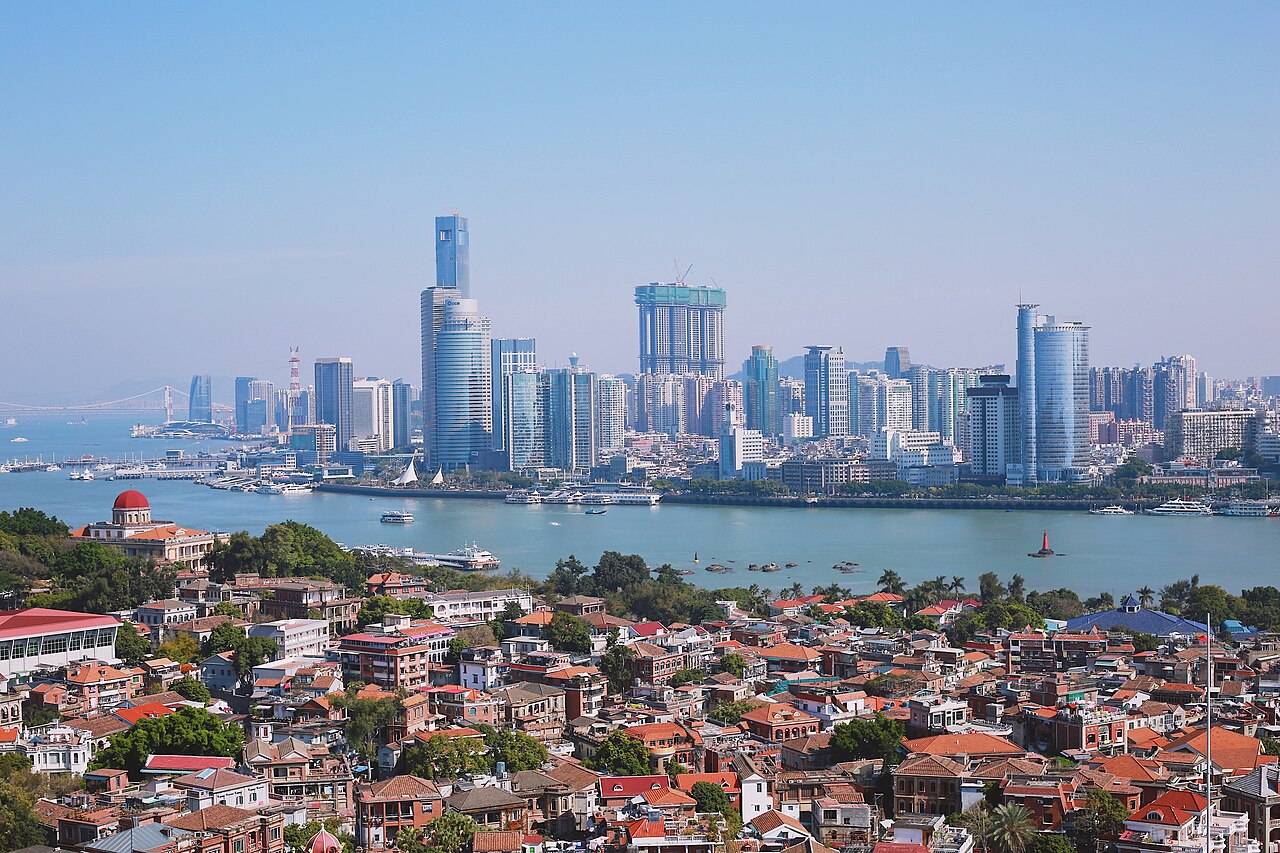
Kulangsu (Gulangyu Island), inscribed as UNESCO World Heritage in 2017, is an island of 1.88 square kilometres lying 600 metres offshore from Xiamen in Fujian Province, accessible by ferry in approximately 6 minutes. The island was designated an International Settlement under a multilateral agreement of 1903 involving 13 nations; the UNESCO inscription covers 931 historical buildings that document the mixing of Chinese courtyard-house spatial organisation with European Baroque, Neoclassical, Art Nouveau and South-East Asian veranda-colonial architectural vocabularies between the 1840s and 1940s. At the peak of the concession period in the early 20th century, the island’s resident population of approximately 15,000 owned roughly one piano for every 50 inhabitants, a concentration generated by European missionary music education programmes; the Gulangyu Piano Museum currently houses more than 100 historic instruments.
Inland Fujian and the Hakka homeland: Fujian Tulou Yongding tulou cluster 200 km northwest of Xiamen, 3h bus from Xiamen or 1h HSR to Longyan then 1h bus
The Fujian Tulou, inscribed as UNESCO World Heritage in 2008, are concentrated in three county clusters — Yongding, Nanjing and Hua’an — in the mountainous interior of Fujian Province, approximately 200 kilometres northwest of Xiamen. The most visited cluster, in Yongding County, is reachable from Xiamen by direct bus in approximately 3 hours from Huli or Jimei bus stations, or by high-speed rail from Xiamen North to Longyan (approximately 1 hour) followed by a 1-hour bus connection to Yongding County town. The inscription covers 46 earthen communal fortresses (tulou) representing the full typological range: the round yuanlou (circular tulou), of which the Zhencheng Lou (1912, 4 storeys, outer diameter 73 metres) and the Chuxi Tulou Cluster are the most photographed, and the rectangular fanglou, of which Tianyi Lou in the Nanjing cluster is among the oldest surviving examples, dated by documentary sources to 1308 CE. The thematic relationship between Gulangyu and the Fujian Tulou is both geographical and architectural. Both are products of Fujian’s two distinct cultural communities — the Hakka speakers of the inland mountain valleys, who built the tulou as defensive communal clan buildings, and the Minnan speakers of the coastal lowlands, who built Gulangyu’s hybrid treaty-port villas — and both building traditions reflect the same historical condition of sustained contact between Chinese communities and external forces, producing radically different architectural responses shaped by geography and power relations. The tulou builders faced bandit raids and inter-clan conflicts in the mountain interior; the Gulangyu builders negotiated foreign concessions on a coastal island 600 metres from a treaty port. The round tulou’s centripetal organisation (all family units facing inward to a communal courtyard, single external entrance) and Gulangyu’s outward-facing veranda architecture (facades oriented to the street and sea, decoration drawn from foreign vocabularies) represent the two spatial logics of Fujian’s engagement with the world over the same five centuries. The Tianloukeng tulou cluster, 60 kilometres northwest of Yongding town, displays five tulou (one square, three round, one oval) in a tight valley visible from a single hillside viewpoint that has made it the most reproduced image of the inscription; the viewpoint is accessible on foot from the village below in approximately 20 minutes. Overnight accommodation in or adjacent to a tulou is available at multiple heritage guesthouses in both the Yongding and Nanjing clusters, typically priced between 150 and 400 CNY per night.
Coastal and HSR circuits: West Lake Hangzhou, Historic Centre of Macao and Kaiping Diaolou West Lake Hangzhou 700 km north / 4.5h HSR from Xiamen North; Historic Centre of Macao 550 km west / 4.5h HSR via Guangzhou; Kaiping Diaolou 500 km west / 4h bus via Guangdong
The West Lake Cultural Landscape of Hangzhou, inscribed as UNESCO World Heritage in 2011, is approximately 700 kilometres north of Xiamen and reachable in approximately 4.5 hours by high-speed rail from Xiamen North to Hangzhou East. The West Lake inscription covers 3,323 hectares around a freshwater lake that measures 3.3 kilometres east to west and 3.2 kilometres north to south; it documents 1,000 years of integration between natural topography, hydraulic engineering (the Su Causeway, first built by Su Shi during his governorship of 1089–1091 CE, and the Bai Causeway, attributed to the poet-administrator Bai Juyi during his tenure of 822–824 CE), built pavilions, island shrines and pagodas into a composed aesthetic landscape that subsequently influenced garden design in Japan, Korea and Vietnam. The three principal islands in the lake — Xiao Yingzhou (constructed by dredging in 1607), Ruan Gong Dun and Huanbi Islet — were created from lake sediment during successive dredging campaigns and support garden pavilions in the classical Chinese style; the total land area of the three islands is less than 20 hectares. The most photographed view on the lake is the “Three Pools Mirroring the Moon” (San Tan Yin Yue) configuration on the south side of Xiao Yingzhou island: three stone towers projecting from the water surface with round openings that produce reflections on the lake surface during the Mid-Autumn Festival. Access within the West Lake scenic area is predominantly on foot, by bicycle or by electric boat; the perimeter cycling circuit of the lake is approximately 15 kilometres. The Xiamen–Hangzhou high-speed rail connection places West Lake within comfortable day-trip range of Xiamen, or Hangzhou can be incorporated as an overnight stop in a Fujian–Zhejiang circuit combining Gulangyu, the Tulou clusters and West Lake.
The Historic Centre of Macao, inscribed as UNESCO World Heritage in 2005, is approximately 550 kilometres west-southwest of Xiamen and reachable in approximately 4.5 hours by high-speed rail from Xiamen North to Guangzhounan, then by intercity rail or ferry to Macao (approximately 1 further hour). The Macao inscription covers 25 historic buildings and 8 public squares documenting 442 years of Portuguese colonial presence (1557–1999). Key monuments include the ruins of the Jesuit Church of St. Paul (Ba Cai), of which only the carved stone façade (1602) survived the fire of 1835; the Guia Fortress (1622) and attached lighthouse (1865, the first modern lighthouse on the South China coast); the Moorish Barracks (1874, Neoclassical façade with Moorish arched interior, now a government building); and the A-Ma Temple, a Taoist goddess-of-the-sea shrine dated to 1488 CE that predates the Portuguese arrival by 65 years. The architectural contrast between Macao and Gulangyu is instructive: in Macao, Portuguese Baroque and Neoclassical forms are the dominant architectural language in the Historic Centre, with Chinese spatial and decorative traditions embedded within a European urban framework; in Gulangyu, the reverse is true — Chinese courtyard-house organisation underlies most residential buildings, with European and Southeast Asian decorative vocabularies applied to facades. The Kaiping Diaolou and Villages in Guangdong Province, inscribed as UNESCO World Heritage in 2007, are approximately 500 kilometres west of Xiamen, reachable via Guangzhou (approximately 3.5 hours by HSR from Xiamen) and then by bus to Kaiping (approximately 1.5 hours from Guangzhou). The 1,833 surviving fortified residential towers in four village clusters (Zili, Jinjiangli, Sanmenli and Majianglong) were built between the 1880s and 1940s by Cantonese-speaking overseas emigrants returning from North America, Southeast Asia and Australia, and decorated with European, North American, Islamic and Southeast Asian architectural elements drawn from the builders’ emigrant experience. The parallel between Kaiping and Kulangsu is precise: both record the same historical phenomenon of Chinese emigrant communities building self-presentations of cosmopolitan identity in their home regions using foreign architectural languages, separated by approximately 50 kilometres of Guangdong coastline and by the social difference between a foreign-operated treaty-port island and privately owned emigrant villages.
Practical information
Gulangyu Island is accessible by two ferry services from Xiamen: a public ferry (approximately 6 minutes, CNY 8 one-way) from Lunchang Ferry Terminal on Xiamen’s Lujiang waterfront, and a tourist ferry (approximately 20 minutes, CNY 35 one-way) from the international cruise terminal at Wutong. Motorised vehicles are prohibited on the island; transport within Gulangyu is on foot or by electric cart for accessibility needs. The island can be walked across in approximately 30 minutes. Peak visitor numbers on weekends and public holidays are substantial — the island receives approximately 10 million visitors annually — and overnight stays are strongly recommended for visitors who want to experience the island outside of daytime crowds; the ferry from the public terminal runs 24 hours, allowing early morning arrival before the day-tripper crowds. The inscribed 931 historic buildings are spread across the entire island but the highest concentration of significant monuments is in the central and western districts around Sunlight Rock (Riguang Yan), the island’s 92.7-metre summit viewpoint, and the Shuzhuang Garden (1913). The Gulangyu Piano Museum is in a 1905 colonial villa and opens daily; entry is approximately CNY 50. Spring (March to May) and autumn (October to November) provide the most comfortable temperatures; Fujian summers are hot and humid. Xiamen is served by Xiamen Gaoqi International Airport with direct flights from most major Chinese cities and several international destinations.
Frequently Asked Questions
What is Amoy Deco, and how does it differ from European Art Nouveau on Gulangyu?
Amoy Deco is the name given by architectural historians to a hybrid residential building style that developed in Xiamen (historically romanised as “Amoy” from its Minnan pronunciation) and on Gulangyu Island approximately between the 1910s and the 1940s. The style combines the Chinese Fujian courtyard-house spatial organisation — an inward-facing plan with rooms arranged around one or more open lightwells — with exterior facades decorated in a mixture of European Baroque and Art Deco moulding patterns, Southeast Asian tropical veranda colonnades, and Minnan-tradition decorative elements including coloured ceramic tile revetment, stone carvings in local grey granite and roof ridge ornaments in cut-and-paste ceramic (jian nian). The European Art Nouveau buildings on Gulangyu, by contrast, were designed by European architects working in the concession and follow Western spatial conventions: double-loaded corridor floor plans, rooms with individual external windows rather than a central lightwell, and structural systems based on masonry wall construction or early reinforced concrete rather than the timber post-and-beam frame that underlies Amoy Deco buildings. The defining characteristic that distinguishes Amoy Deco from both its European and Chinese sources is the veranda: a deep ground-floor colonnade running across the full width of the street facade, providing shade and covered exterior circulation that addresses the subtropical Fujian climate while also referencing the European colonial veranda tradition encountered by Fujian emigrants in Singapore, Malaysia and Indonesia. The UNESCO inscription specifically identifies the mixing of Amoy Deco, European and Southeast Asian veranda-colonial styles as the primary Outstanding Universal Value of Kulangsu as a document of the International Settlement period rather than of any individual building type.
How did 13 nations come to operate a joint concession on an island 600 metres from the Chinese mainland?
The Kulangsu International Settlement was established by a Land Regulations agreement of 1 January 1902, effective from 1903, among the treaty powers with commercial interests in Xiamen: Britain, the United States, Japan, Germany, France, the Netherlands, Spain, Portugal, Denmark, Norway, Sweden, Belgium and Austria-Hungary. The settlement emerged from the existing practice of treaty-port concessions established by the unequal treaties imposed on the Qing dynasty following the First Opium War (Treaty of Nanking, 1842) and the Second Opium War (Treaties of Tientsin, 1858). Xiamen itself had been opened as one of the five original treaty ports in 1842; Gulangyu Island, already housing European merchant residences and missionary institutions, was designated the foreign residential district. The distinctive feature of the Kulangsu International Settlement compared to other Chinese treaty-port concessions (such as the Shanghai International Settlement or the Tianjin concessions) was its joint multinational administration: rather than dividing the island into separate national concession zones, the 13 powers operated a single Municipal Council (the Kulangsu Municipal Council, known in Chinese as the Gong Bu Ju) with representatives appointed by each power. This joint administration was practical given the island’s small size (1.88 sq km) and relatively small population; dividing it into 13 national zones would have been impractical. The joint council administered the island’s infrastructure, public order and building regulations until 1942, when Japanese occupation forces (Japan had already withdrawn from the joint council following the outbreak of the Sino-Japanese War in 1937) assumed sole control; Chinese administration was restored in 1945 after Japan’s defeat, and the settlement status was formally terminated in 1949.
Why does Gulangyu have so many pianos, and what happened to the musical tradition after 1949?
The piano concentration on Gulangyu developed through the coincidence of three factors in the late 19th and early 20th centuries. First, European and American Protestant missionary organisations established schools on the island from the 1840s onward, including the Anglo-Chinese College (founded 1898) and several mission primary schools; musical education, centred on the European piano and organ tradition, was a standard element of missionary pedagogy designed to make Western cultural and religious practices accessible to Chinese students. Second, Gulangyu’s treaty-port population — comprising merchants, missionaries, officials and their families from 13 nations — maintained the cultural practices of their home countries, of which piano ownership and domestic music-making were routine upper-middle-class habits in the Europe of the 1880s–1930s. Third, and critically, the Chinese elite and professional families who lived on Gulangyu — doctors, lawyers, compradors and merchants who had achieved prosperity through participation in the treaty-port economy — adopted piano ownership as a mark of cosmopolitan status, initially through exposure to the missionary schools and subsequently as a self-reproducing cultural tradition. By the early 20th century, Gulangyu had produced several internationally recognised Chinese concert pianists, including Yin Chengzong (born 1941 on Gulangyu, later notable for performing the Yellow River Concerto during the Cultural Revolution and emigrating to the United States in 1983) and Lin Junqing, who studied under Arthur Rubinstein’s teacher. After 1949, the cultural and educational institutions of the International Settlement were absorbed into the People’s Republic educational system; the piano tradition continued partly through the institutional momentum of established music teaching and partly because several of Gulangyu’s musically trained families remained on the island through the early People’s Republic decades. The Cultural Revolution (1966–1976) suppressed private piano practice and destroyed some instruments but did not eliminate the tradition entirely; the post-1978 reform era saw a revival of the island’s musical identity, formalised in the Piano Museum (opened 2000) and the annual Gulangyu International Piano Festival.
Sources
- S1 — UNESCO World Heritage Centre — Kulangsu, a Historic International Settlement (Ref. 1541) — https://web.archive.org/web/20230601000000/https://whc.unesco.org/en/list/1541/
- S2 — Xiamen Gulangyu World Cultural Heritage Center — https://whc.unesco.org/en/list/1541/
- S3 — Kuhn, Dieter. <em>The Age of Confucian Rule: The Song Transformation of China</em>. Harvard University Press, 2009. ISBN: 978-0-674-03661-1.
Spotted an error? Write to editorial@culturalheritageonline.com and we correct it the same day.