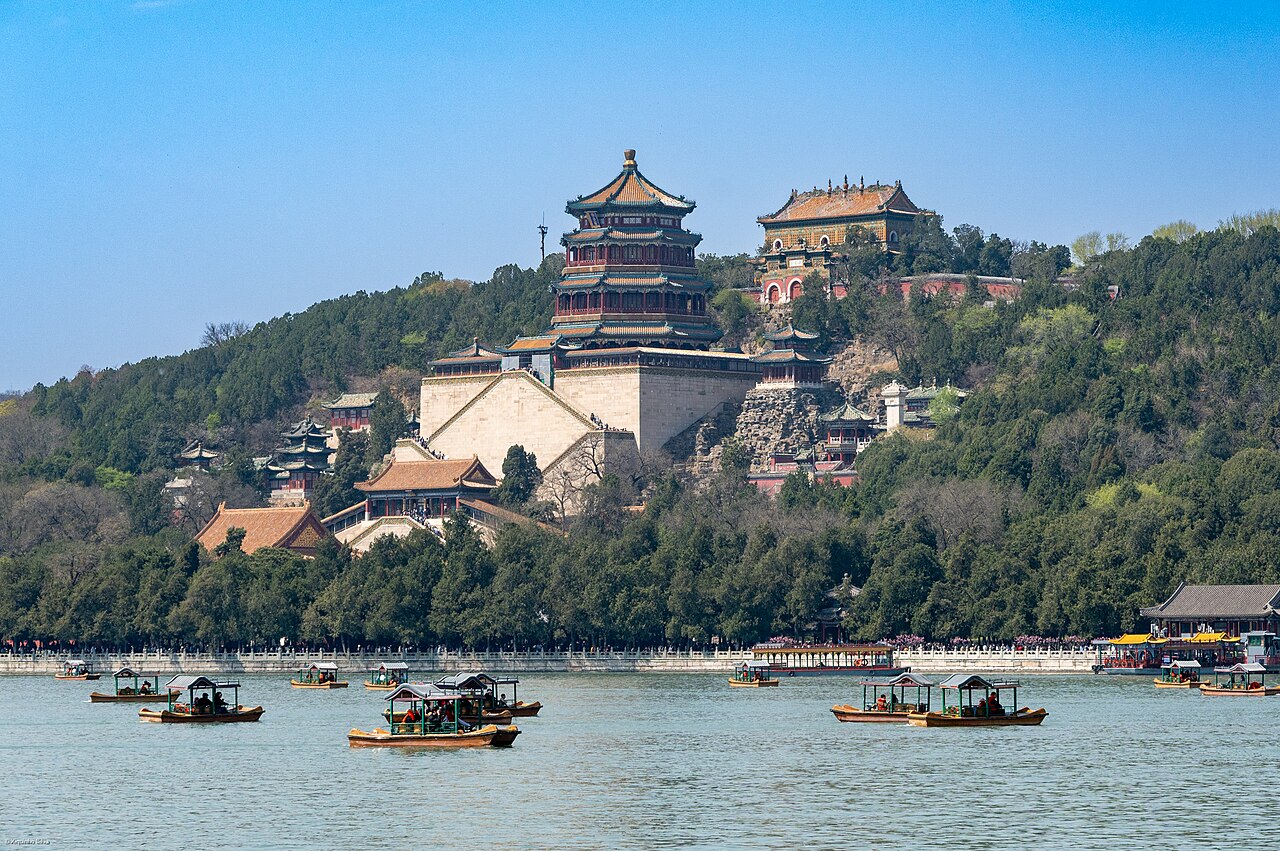
The Summer Palace in Beijing was inscribed as a UNESCO World Heritage Site in 1998. The 2.9-square-kilometre complex was commissioned by the Qing Emperor Qianlong between 1750 and 1764, substantially rebuilt by the Empress Dowager Cixi between 1888 and 1895 using 30 million taels of silver reallocated from the naval modernisation budget, and burned twice by foreign troops—first in 1860 by British and French forces during the Second Opium War, and again in 1900 during the Boxer Rebellion—before each reconstruction. Kunming Lake accounts for three-quarters of the 294-hectare grounds; the 728-metre Long Corridor connecting the lake-shore buildings is the longest painted corridor in any Chinese classical garden.
Central Beijing: two UNESCO inscriptions 15–20 kilometres southeast 15–20 km, 30–40 minutes by metro
The Forbidden City (Imperial Palace), 15 kilometres southeast of the Summer Palace, is reachable in approximately 30 minutes by Metro Line 4 south from Beigongmen station (the Summer Palace north gate stop) to Xidan, changing to Line 1 east to Tiananmen West. The Forbidden City and associated buildings were inscribed as the Imperial Palaces of the Ming and Qing Dynasties in 1987, in a joint inscription that also covers the Imperial Palace of the Qing Dynasty in Shenyang. The Beijing complex covers 72 hectares within a 9.74-kilometre perimeter wall and a 52-metre-wide moat; it contains 980 surviving buildings with approximately 8,700 rooms. Construction was carried out under the Yongle Emperor between 1406 and 1420 CE using a workforce reported in Ming-period records at one million labourers and 100,000 skilled artisans; the principal building materials—purple-red Jingde hardwood from Sichuan and Yunnan, and large-format golden paving bricks from Suzhou—were transported to Beijing over distances of more than 1,000 kilometres. The complex served as the seat of 24 emperors across the Ming and Qing dynasties until 1912, when the last Qing emperor Puyi abdicated; Puyi was permitted to continue living in the inner court until 1924, when a republican general expelled him. The Palace Museum, which now occupies the complex, holds a permanent collection of approximately 1.8 million objects, of which about 50,000 are on public display at any given time. A full visit requires four to six hours; the central axis from Tiananmen Gate to the rear garden (Yuhua Yuan) is two kilometres long. The Meridian Gate (Wumen) at the south entrance is where the Qing emperors announced the lunar calendar each year and displayed military captives after victories; the Gate of Heavenly Purity (Qianqingmen) divides the outer ceremonial court from the residential inner court, entry to which was restricted to the emperor, his consorts and eunuchs during the imperial period.
The Temple of Heaven (Tiantan), 20 kilometres southeast of the Summer Palace and 6 kilometres south of the Forbidden City, is reachable by Metro Line 4 to Xuanwumen, then Line 5 south to Tiantan Dongmen (approximately 40 minutes from Beigongmen). Inscribed in 1998, the 267-hectare complex was built in 1420 CE under the same Yongle Emperor who constructed the Forbidden City; the two sites were planned as complementary elements of the imperial capital, with the Temple of Heaven oriented to the winter solstice sacrifice, at which the emperor performed as the intermediary between heaven and earth. The Hall of Prayer for Good Harvests (Qiniandian), the principal structure and the most reproduced image of Beijing in global photography, is a 38-metre-high circular timber hall on three concentric marble terraces; it was constructed without a single metal fastener, relying entirely on interlocking wooden members. The original hall was struck by lightning and burned to the ground in 1889; the current structure is a Qing-period reconstruction completed in 1890 using Burmese teak for the outer columns and Chinese fir for the inner columns. The Echo Wall (Huiyuanqiang), a 64-metre-diameter circular wall surrounding the Imperial Vault of Heaven, is engineered so that a sound whispered against one side of the interior surface travels the full circumference without audible attenuation; the effect, which depends on the smooth plastered surface and the precise circular geometry, is audible when visitor crowds are thin. The circular Circular Mound Altar (Yuanqiutan), where the emperor performed the winter solstice sacrifice on open ground under the sky, has a central stone whose acoustic properties cause sounds made on it to echo back from the surrounding rings of tiles at a slightly greater volume than the original sound.
The Ming Tombs (Shisanling), 45 kilometres north of the Summer Palace in Changping District, are included within the UNESCO inscription “Imperial Tombs of the Ming and Qing Dynasties,” which spans multiple sites across China inscribed in 2000 as an extension of the 1987 Ming Tombs inscription. The site contains 13 of the 16 Ming emperors; the three earliest Ming emperors are buried elsewhere. The Spirit Way (Shendao), a 7-kilometre ceremonial approach lined with 24 stone animals and 12 stone officials, leads from the southern gate to the tomb enclosures; the stone figures alternate between standing and kneeling in pairs. Of the 13 tomb enclosures, only Dingling (tomb of the Wanli Emperor, reigned 1572–1620) has been excavated; the 1956–1958 excavation retrieved over 3,000 objects from the burial chamber, but many organic materials—textiles, lacquer, paper—deteriorated rapidly on exposure and the excavation is cited in Chinese heritage literature as a cautionary example against further excavations without adequate conservation preparation. The Changling (tomb of the Yongle Emperor) has the largest surface complex and is the most frequently visited; its Ling’en Hall, with 60 Phoebe nanmu wooden columns each 12 metres tall and 1.17 metres in diameter, is among the best-preserved early Ming timber structures in China. By car from the Summer Palace, the Ming Tombs are approximately one hour via the Fourth Ring Road and the G7 expressway north; there is no direct metro connection, but tourist buses depart from Deshengmen.
Extended day trips: Great Wall and Peking Man Site 60–70 km, 1.5–2 hours by car or public transport
The Great Wall of China was inscribed as a UNESCO World Heritage Site in 1987. The Badaling section, 70 kilometres northwest of the Summer Palace in Yanqing District, is the most visited stretch and the most heavily restored; it follows a ridge at elevations between 1,000 and 1,015 metres with two parallel parapet walks and watchtowers every 300–500 metres. Construction of the Badaling section dates to 1504–1540 CE under the Ming Jiajing Emperor; the restored length open to visitors is approximately 3.7 kilometres. The average annual visitor count at Badaling exceeded 9 million before the COVID-19 pandemic, making it the most visited heritage site section on the Great Wall and one of the most visited individual sites in China. By car or taxi, Badaling takes 1 hour 30 minutes to 2 hours from central Beijing depending on traffic on the G6 expressway; the Beijing North–Badaling high-speed rail service (approximately 20 minutes from Beijing North station) was opened for the 2022 Winter Olympics, making public transport now faster than driving in normal conditions. Metro Line 4 connects the Summer Palace area to Beijing North station (Xizhimen) in approximately 15 minutes, making the combined Summer Palace–Badaling day a feasible single itinerary in summer when daylight allows. The Mutianyu section, 73 kilometres northeast of the Summer Palace, is preferred by many visitors for lower crowd density relative to Badaling while retaining a similarly high degree of Ming-period structural integrity; it requires a different approach route (via Huairou District) and is less conveniently reached by public transport than Badaling. The Juyongguan pass, 50 kilometres north and on the same G6 expressway corridor as Badaling, contains a marble platform (Yuntai, Cloud Terrace) built in 1342 CE with Buddhist relief carvings in six languages inside the gate tunnel—Chinese, Tibetan, Sanskrit, Tangut, Uyghur and Phags-pa script—representing the multilingual Buddhist administration of the Yuan period. Juyongguan is less crowded than Badaling and is reached on the same rail or road route, making it a practical addition or alternative for visitors with more time.
The Peking Man Site at Zhoukoudian, 60 kilometres southwest of the Summer Palace in Fangshan District, was inscribed in 1987 as the location of the most significant hominid fossil finds of the twentieth century. Excavations between 1921 and 1937 under the direction of the Swedish geologist Johan Gunnar Andersson and later the Canadian anatomist Davidson Black and the Chinese palaeontologist Pei Wenzhong produced fossils of Homo erectus pekinensis (Peking Man) from deposits dated to 200,000–700,000 years ago; the original fossils, which included skull caps, jawbones and isolated teeth representing at least 40 individuals, disappeared in December 1941 during their transfer to US custody for wartime safekeeping and have never been recovered. The current collections comprise post-1949 excavation finds and casts; the on-site museum reopened in 2014 after renovation and presents the stratigraphy of the cave system (Locality 1) and the evidence for fire use, lithic tool production and animal butchery at the site. A separate locality at the same site (Upper Cave) produced remains of Homo sapiens approximately 25,000–30,000 years old, with ornamental perforated shells and evidence of red ochre use. From the Summer Palace, Zhoukoudian requires approximately 1 hour 30 minutes by car via the Fifth Ring Road and the G4 expressway south; there is no convenient metro connection, and the site is typically reached by taxi or private car.
Practical information
The Summer Palace is in Haidian District, 15 kilometres northwest of the Forbidden City and 20 kilometres northwest of Tiananmen Square. Metro Line 4 serves the site at two stops: Beigongmen (North Palace Gate, closest to Suzhou Street and the commercial-style shopping area) and Xiyuan (West Garden Gate, closest to the long corridor and Kunming Lake). Journey time from Tiananmen West on Line 1, changing to Line 4 at Xuanwumen, is approximately 30 minutes. The complex is open year-round; peak season is April to October when all lake boats and corridor walks are operational. Summer (June to August) is hot and very crowded; the recommended arrival time is before 9:00 to enter before the peak crowd arrives at Beigongmen. Spring (April and May) is preferred for the combination of peach and willow blossom along the lake embankment with manageable visitor numbers. Winter visits (December to February) offer dramatically reduced crowds; Kunming Lake freezes in January and February and ice skates are available for rental on the frozen surface, a practice with documented Qing-dynasty antecedents.
A combined itinerary covering the Summer Palace and the Forbidden City in a single day is possible but tiring; a better structure is to assign each site a dedicated half-day, using the efficient Line 4 metro connection. The Ming Tombs and Great Wall are each full-day excursions; attempting more than one in a single day is not recommended. Badaling and the Ming Tombs are 25 kilometres apart along the G6/G7 corridor and have been combined in organised bus tours for decades, but the sites each warrant three to four hours and the logistics make a combined day rushed. Entry to the Summer Palace requires both a gate ticket (approximately 30 CNY) and a through-ticket (tong piao, approximately 60 CNY) for all interior attractions including the Garden of Virtue and Harmony; this distinction is marked in Chinese only at the gate, and many visitors discover it only after entering.
Frequently Asked Questions
Why did the Empress Dowager Cixi use naval funds to rebuild the Summer Palace?
The allocation of naval funds to the Summer Palace reconstruction is among the most frequently cited instances of Qing institutional dysfunction in the decade before the First Sino-Japanese War. The money in question came from a naval modernisation fund raised in the late 1880s under Li Hongzhang, the Chinese statesman responsible for the Beiyang Fleet, which was intended to purchase additional warships and upgrade the Dagu fort defences. The Qing court, which Cixi effectively controlled during the minority and later nominal reign of the Guangxu Emperor, diverted approximately 30 million taels from this fund between 1888 and 1895 to finance the reconstruction of the Summer Palace, which the Yiheyuan (Garden of Gardens) had been before its destruction by British and French troops in 1860. The specific allocation is documented in Qing-period memorial records and was publicly known within official circles; foreign observers including the British diplomat and sinologist Robert Hart commented on it. The concrete operational consequence became apparent in the Battle of the Yalu River in September 1894, when the Beiyang Fleet engaged the Japanese combined fleet during the First Sino-Japanese War: the Chinese ships were outgunned by Japanese vessels purchased with the modern funds the Beiyang programme had originally been designed to match. The fleet was destroyed at the Battle of Weihaiwei in February 1895; the subsequent Treaty of Shimonoseki ceded Taiwan and the Liaodong Peninsula to Japan and imposed an indemnity of 200 million taels—more than twice the annual Qing fiscal revenue. The Marble Boat (Shifang), a two-storey stone structure built on the lake at the Summer Palace site and incapable of navigation, is frequently cited as a symbol of the misallocation: Cixi reportedly remarked that the navy had funded a boat that would never sink. The remark may be apocryphal, but the structure’s existence as an ornamental garden feature built with funds designated for real naval vessels made it an irresistible emblem of the policy.
What did the British and French troops burn at the Summer Palace in 1860, and why?
The destruction in October 1860 was carried out at the Old Summer Palace (Yuanmingyuan), the adjacent complex 2 kilometres northeast of the current Summer Palace, rather than at the Qingyi Yuan (Clear Rippling Garden) that became the present Summer Palace. Both complexes were sacked; the Yuanmingyuan sustained the more complete and deliberate destruction. The burning was ordered by Lord Elgin, the British high commissioner, as a punitive response to the detention and torture of a British and French diplomatic party under Harry Parkes that had been sent to negotiate under a flag of truce in September 1860. Of the 39 members of the delegation, 20 died in captivity, some from beatings and others from exposure during imprisonment; their bodies, when returned, showed evidence of execution-style treatment. Lord Elgin initially considered destroying the Forbidden City as the seat of imperial power, but chose the Summer Palace instead on the grounds that the punishment would fall on the emperor personally (who used the Summer Palace as his primary residence) rather than on the civilian population of Beijing. The burning of the Yuanmingyuan lasted two days; approximately 200 European troops participated. The complex had been the primary Qing imperial residence since the Kangxi Emperor developed it in the 1690s and contained the most significant collection of European-style buildings (the Xiyanglou structures, designed by Jesuit missionaries including Giuseppe Castiglione) in China. The European-style marble ruins are still visible at the Yuanmingyuan site, which is now a public park adjacent to the Summer Palace; they are among the most photographed historical ruin sites in Beijing. The current Summer Palace (Yiheyuan) was rebuilt by Cixi at the site of the partially surviving Qingyi Yuan structure and stands 1.5 kilometres west of the ruined Yuanmingyuan.
How does the Summer Palace compare structurally to other imperial garden complexes in China?
The Summer Palace is the largest and best-preserved of the Qing-dynasty imperial garden complexes and represents the fullest realisation of the Chinese imperial garden concept, in which landscape engineering, architecture and literary-historical allusion are combined into a unified experiential programme. Its direct predecessors at the same Haidian site were gardens developed from the Jin dynasty (twelfth century) onward; the Qianlong Emperor’s 1750–1764 construction systematised the existing ponds and hills into the current Kunming Lake and Longevity Hill configuration. By area, the Summer Palace at 294 hectares is smaller than the Chengde Mountain Resort (Bishu Shanzhuang) in Hebei Province, inscribed as part of the “Mountain Resort and its Outlying Temples, Chengde” UNESCO property in 1994; the Chengde complex covers 564 hectares and was the Qing emperors’ summer capital rather than a garden retreat. The stylistic differences are significant: the Summer Palace prioritises a coherent visual composition centred on the lake–hill axis, with buildings serving as viewing platforms and spatial punctuation; Chengde reproduces regional landscape typologies (Tibetan, Mongolian, Han) across a larger area, reflecting its political function as a ceremonial space for receiving frontier delegations. The private Jiangnan garden tradition (represented by the Classical Gardens of Suzhou, inscribed 1997 and 2000) operates at a completely different scale—the Garden of the Humble Administrator in Suzhou covers 5.2 hectares—and achieves its spatial effects through enclosure and the strategic compression of perspective rather than through the panoramic composition that characterises the Summer Palace. The Summer Palace’s distinctive technique is the use of a 728-metre covered corridor to structure movement along the lake’s north shore; visitors follow the corridor’s sequence of views across Kunming Lake at different angles without getting wet in rain or sun, while the painted interior ceiling panels (approximately 14,000 individual paintings) constitute a separate art-historical programme of their own.
Sources
- S1 — UNESCO World Heritage Centre — Summer Palace, an Imperial Garden in Beijing (Ref. 880) — https://web.archive.org/web/20230601000000/https://whc.unesco.org/en/list/880/
- S2 — Summer Palace Administration Beijing — https://whc.unesco.org/en/list/880/
- S3 — Kuhn, Dieter. <em>The Age of Confucian Rule: The Song Transformation of China</em>. Harvard University Press, 2009. ISBN: 978-0-674-03661-1.
Spotted an error? Write to editorial@culturalheritageonline.com and we correct it the same day.