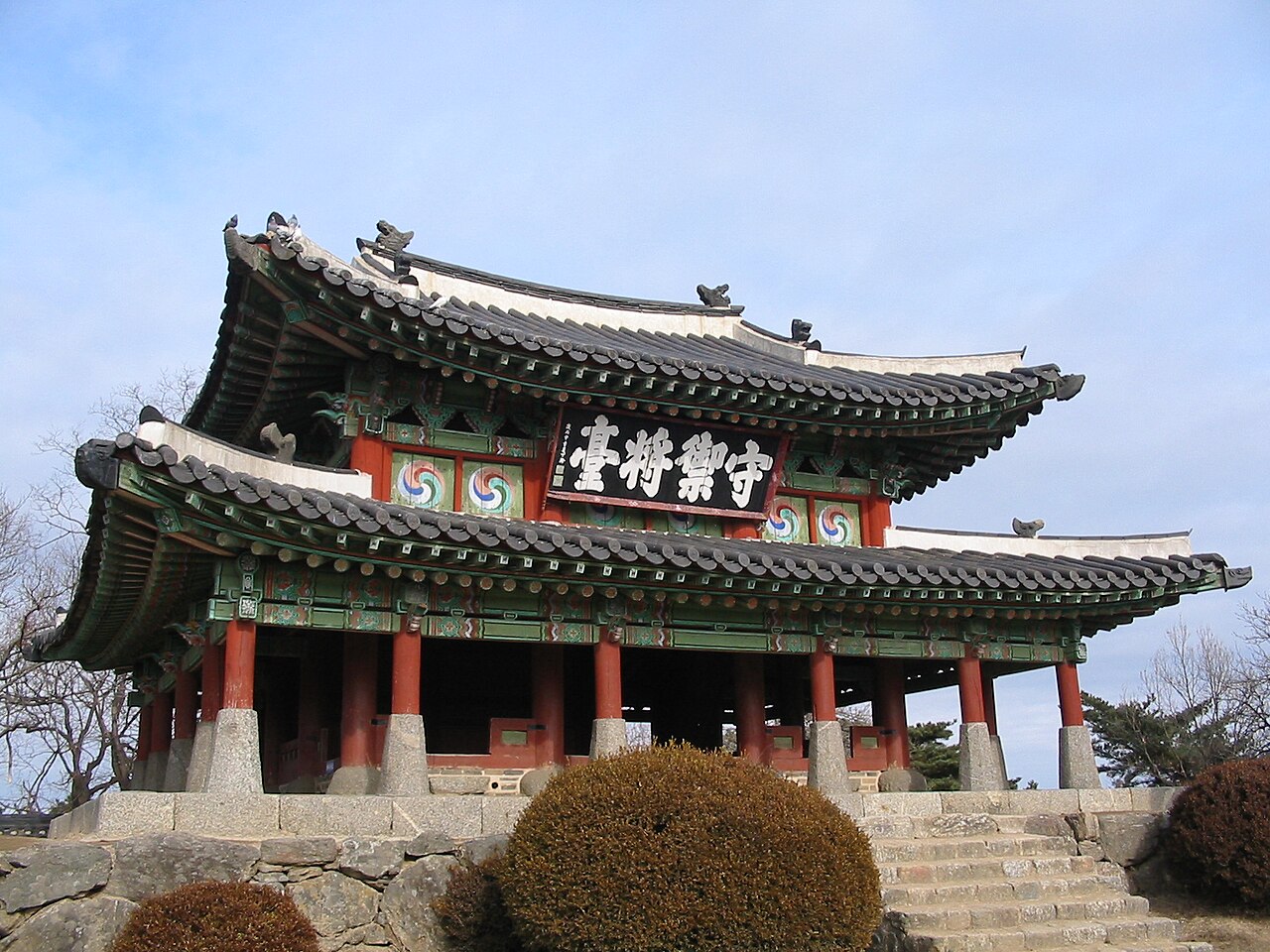
Namhansanseong (UNESCO, 2014) is a mountain fortress 25 kilometres southeast of Seoul, rebuilt from 1624 following the Japanese invasions of 1592–98 that destroyed earlier fortifications on the same site. The perimeter wall runs 11.7 kilometres along the ridge of Cheongnyangsan mountain and encloses a town of approximately 4,000 residents. In January 1637, King Injo held the fortress against the Qing (Manchu) army for 45 days before descending to Samjeon Ferry to perform a formal surrender ceremony — one of the most documented military capitulations in Korean historical records.
Seoul’s inscribed sites within one hour of the fortress 25–40 km from Namhansanseong to central Seoul; 1h by metro + bus
Namhansanseong is accessible from Seoul by metro Line 8 to Sanseong station, then a local bus (Route 9 or the shuttle bus) up the mountain — total journey from central Seoul approximately one hour. The fortress sits at elevations between 350 and 522 metres and the interior town retains civilian functions; it is not a museum compound but a living administrative district with restaurants, guesthouses, and a small commercial centre. The four main gates — Janggyeongmun (east), Jeoganmun (west), Jisangmun (south), Seonammun (north) — are original 17th-century structures rebuilt after the 1624 reconstruction order and repaired multiple times through the Joseon period.
Changdeokgung Palace Complex (UNESCO, 1997) is 25 kilometres northwest of Namhansanseong and reachable by metro Line 8 from Sanseong to Jamsil, then Line 2 toward Wangshipni and Line 3 to Anguk — total journey about one hour. Changdeokgung’s significance to Namhansanseong is direct: King Injo was resident at Changdeokgung when Qing forces invaded in December 1636, and he retreated to Namhansanseong specifically because it was the most defensible fortified position within a day’s march of the capital. The siege of Namhansanseong and the subsequent surrender at Samjeon became defining trauma in Joseon political memory; Korean historical novels and films about the episode have been produced in every decade since the 1970s, most recently the 2017 film The Fortress directed by Hwang Dong-hyuk.
Jongmyo Shrine (UNESCO, 1995) is in the Jongno district of central Seoul, reachable from Namhansanseong by the same metro route used for Changdeokgung — about one hour via Lines 8 and 3 to Jongno 3-ga. The shrine was established by Taejo in 1395 as the mandatory ritual anchor of the Joseon capital and was burned during the Japanese invasions of 1592, rebuilt in 1608, and extended periodically through 1836. The 19-chamber main hall (Jeongjeon) stores tablets for 19 kings and 30 queens; a second hall (Yeongnyeongjeon) stores 16 additional royal couples. The Jongmyo Jerye ceremony, performed on the first Sunday of May with 64 musicians and 64 dancers, is listed on the UNESCO intangible list. Both Changdeokgung and Jongmyo are conveniently visited in the same half-day given their 300-metre separation.
The Joseon Royal Tombs (UNESCO, 2009) have several clusters within 20–40 kilometres of Namhansanseong. The Heolleung and Illeung cluster in Seocho district — tombs of King Taejong and Queen Wongyeong, and of King Sunjong — is approximately 15 kilometres northwest of Namhansanseong and reachable by metro in 45 minutes. The Taereung and Gangneung cluster in Nowon district (15 km northeast of central Seoul) is accessible from Namhansanseong in about one hour fifteen minutes by metro. The Donggureung cluster in Guri (9 tombs) is 40 kilometres northeast of the fortress by road, approximately 80 minutes by metro and bus. The tomb sites share the same 1,000 KRW entrance fee and Tuesday-closure schedule.
The Buddhist monks who built the walls, and the Suwon connection 40 km from Namhansanseong to Suwon by express bus or metro
One of the most documented aspects of Namhansanseong’s construction is the use of Buddhist monk-soldiers (seungbyeong) as both the construction labour force and the garrison. The monk-soldier tradition in Korea had developed during the Goryeo period and was formalised during the Joseon-era Japanese invasions, when monk units under the monk-general Seoshan Hyujeong played a significant role in resistance. After the invasions, the Joseon government incorporated monk-soldiers permanently into fortress maintenance rosters. At Namhansanseong, they were assigned to specific wall sections and gate towers and given permanent barracks inside the compound. Nine small Buddhist temples were built within the fortress walls to house the garrison monks; three survive — Manghaeamsa, Cheongnyangsa, and Janggyeongsa. The arrangement of military obligation and religious practice in a single enclosed space is unusual and is among the features the UNESCO inscription specifically identifies as giving the fortress “outstanding universal value” as a multi-function mountain fortress type.
Hwaseong Fortress in Suwon (UNESCO, 1997) is 40 kilometres southwest of Namhansanseong, reachable by express bus from the Namhansanseong area (Seongnam or Hanam terminal) to Suwon in about 50 minutes, or by metro Line 8 south to Moran station and Line 1 to Suwon (approximately one hour twenty minutes). The two fortresses make a natural comparative pair: Namhansanseong is a mountain ridge fortress designed for prolonged siege defence, built over decades from local stone; Hwaseong is a flat-terrain perimeter fortress designed for offensive capability and rapid royal transit, built in two and a half years using pre-planned engineering methods from the Hwaseong Seongyeok Uigwe manual. Hwaseong’s gate structures are more ornate and its walls incorporate watchtowers at regular calculated intervals; Namhansanseong’s wall follows the ridge terrain and its towers are positioned by topography rather than formula. The contrast in design philosophy is visible to a non-specialist within an hour of walking either site.
The Gochang, Hwasun, and Ganghwa Dolmen Sites (UNESCO, 2000) are farther afield — the Ganghwa component is 70 kilometres west of Seoul — but represent a useful addition for visitors extending their stay. Hwasun, in South Jeolla Province, contains dolmens dating from the 1st millennium BCE within a river valley setting; Gochang adds a concentration of over 400 dolmens in a hillside arrangement. Both are accessible from Seoul by express bus (Hwasun: 3 hours from Central City terminal) and are most practical as an overnight addition to a Seoul-based itinerary rather than a day trip.
Namhansanseong Provincial Park, which surrounds and includes the fortress, covers 36.4 square kilometres and provides marked hiking trails connecting the fortress walls to the Cheongnyangsan ridgeline. The full perimeter walk of 11.7 kilometres takes three to four hours at a moderate pace on an uneven granite path. The north gate sector offers direct sightlines toward central Seoul on clear days. The fortress interior town has a cluster of restaurants near the south gate serving makgeolli (rice wine) and mountain vegetable dishes that have become associated with day-hike culture in the Seoul metropolitan area.
Practical information
Namhansanseong Provincial Park is open year-round with no entrance fee; the fortress walls are permanently accessible. The four main gates are lit until 22:00. Spring (April–May) and autumn (October–November) are the peak hiking seasons; summer weekends bring significant domestic visitor crowds on the perimeter trail. The interior town has guesthouses and restaurants but no large hotels. The metro Line 8 Sanseong station exit connects to shuttle buses (fee: approximately 1,200 KRW) that reach the south gate area; the same bus route continues past the gate into the interior. For Suwon Hwaseong, the Suwon station area is well served by national train services (Mugunghwa and KTX to Gyeongju pass through Suwon); the fortress perimeter walk from Paldalmun south gate takes two to three hours and includes the original gate architecture, watchtowers, and a partially restored water gate. Seoul’s T-money card covers metro and local bus to both sites.
Frequently Asked Questions
How long does it take to walk the full Namhansanseong perimeter and what is the trail difficulty?
The full perimeter trail covering the 11.7-kilometre fortress wall takes between three and four hours at a moderate walking pace, depending on stops at the four main gates and the intervals along the wall with views toward Seoul. The trail follows the wall itself — visitors walk on a path immediately adjacent to or on top of the rampart in places — and the surface is granite flagstone and compacted earth. Elevation change within the circuit is approximately 170 metres between the lowest interior point and the highest rampart section near the emergency defence wall (Bongammun area, 522 metres). The trail is well-signed in Korean and English and is wide enough for two people side-by-side at nearly all points. It is not technical and does not require hiking boots, though trail shoes are preferable to flat shoes. The most demanding section is the northeast arc between Janggyeongmun (east gate) and the Seonammun (north gate), where the ridge is steepest. Most visitors combine a partial trail walk with the interior town — entering by bus to the south gate area, walking the east wall to the east gate, having lunch in the town, and taking the bus back — which reduces the walking to about 5 kilometres and ninety minutes. Full circumnavigation is most commonly done anticlockwise (west gate to north gate to east gate to south gate) so that the Seoul view sector falls mid-hike.
What happened during the 1637 Manchu siege and where is the surrender site?
The Second Manchu Invasion (Byeongja horan in Korean) began in December 1636 when Qing forces under Hong Taiji crossed the frozen Yalu River and reached the Seoul area within days. King Injo had intended to retreat to Ganghwa Island, the traditional refuge during invasions, but Qing cavalry moved faster than anticipated and cut off the coastal route. Injo retreated instead to Namhansanseong, arriving on 14 January 1637 with approximately 13,800 soldiers and civilian officials. The fortress was not designed for extended occupation — provisions were calculated to last 45 days — and by early February supplies had run critically low. The relief army attempting to break the Qing encirclement was defeated at Gwanggyosan. On 30 January 1637 (Korean lunar calendar: the 24th day of the 12th month of 1636), Injo descended from the south gate in person and performed the samgobugul — nine prostrations with three head-knockings on the ground — before the Qing emperor’s representative at Samjeon Ferry on the Han River. The surrender site, Samjeondo, is 8 kilometres west of Namhansanseong near the current Jamsil Bridge area. A stone monument erected there in 1639 by Qing order recording the Manchu victory was toppled in 1895 during the anti-Qing reforms and rebuilt by Korean historians in 1913; the stele now stands in the Seoul Museum of History. A reproduction stands at the approximate original location in Songpa district.
What is the fastest way to reach Namhansanseong and Hwaseong Fortress in the same day from central Seoul?
The most efficient same-day circuit starts with Namhansanseong in the morning (less crowded) and Hwaseong in the afternoon. From central Seoul, take metro Line 8 south to Sanseong station (approximately 40 minutes from City Hall) and the shuttle bus up to the south gate. Allow two hours for a partial wall walk and the interior town. Return to Sanseong station by bus, take Line 8 south to Moran station, transfer to Line 1 to Suwon (approximately 45 minutes from Moran). Arrive at Suwon Hwaseong by early afternoon — the Paldalmun south gate is 10 minutes’ walk from Suwon station. Allow two hours for the gate circuit and the main watchtower sectors. Total travel time in transit is approximately two and a half hours; total walking is roughly 5–7 kilometres across both sites. The itinerary works best on weekdays when shuttle buses to Namhansanseong run on schedule; on weekend afternoons in autumn the return shuttle from the fortress can have waiting times of 15–20 minutes. Seoul’s T-money card covers all metro and bus segments. Lunch at the fortress town is practical; Suwon’s commercial district near the station has restaurants if the mid-afternoon arrival at Hwaseong falls after the fortress-town lunch hour.
Sources
- S1 — UNESCO World Heritage Centre — Namhansanseong (Ref. 1439) — https://web.archive.org/web/20230601000000/https://whc.unesco.org/en/list/1439/
- S2 — Gyeonggi Cultural Foundation Namhansanseong — https://whc.unesco.org/en/list/1439/
- S3 — Seth, Michael J. <em>A History of Korea: From Antiquity to the Present</em>. Rowman & Littlefield, 2010. ISBN: 978-0-8248-3563-7.
Spotted an error? Write to editorial@culturalheritageonline.com and we correct it the same day.