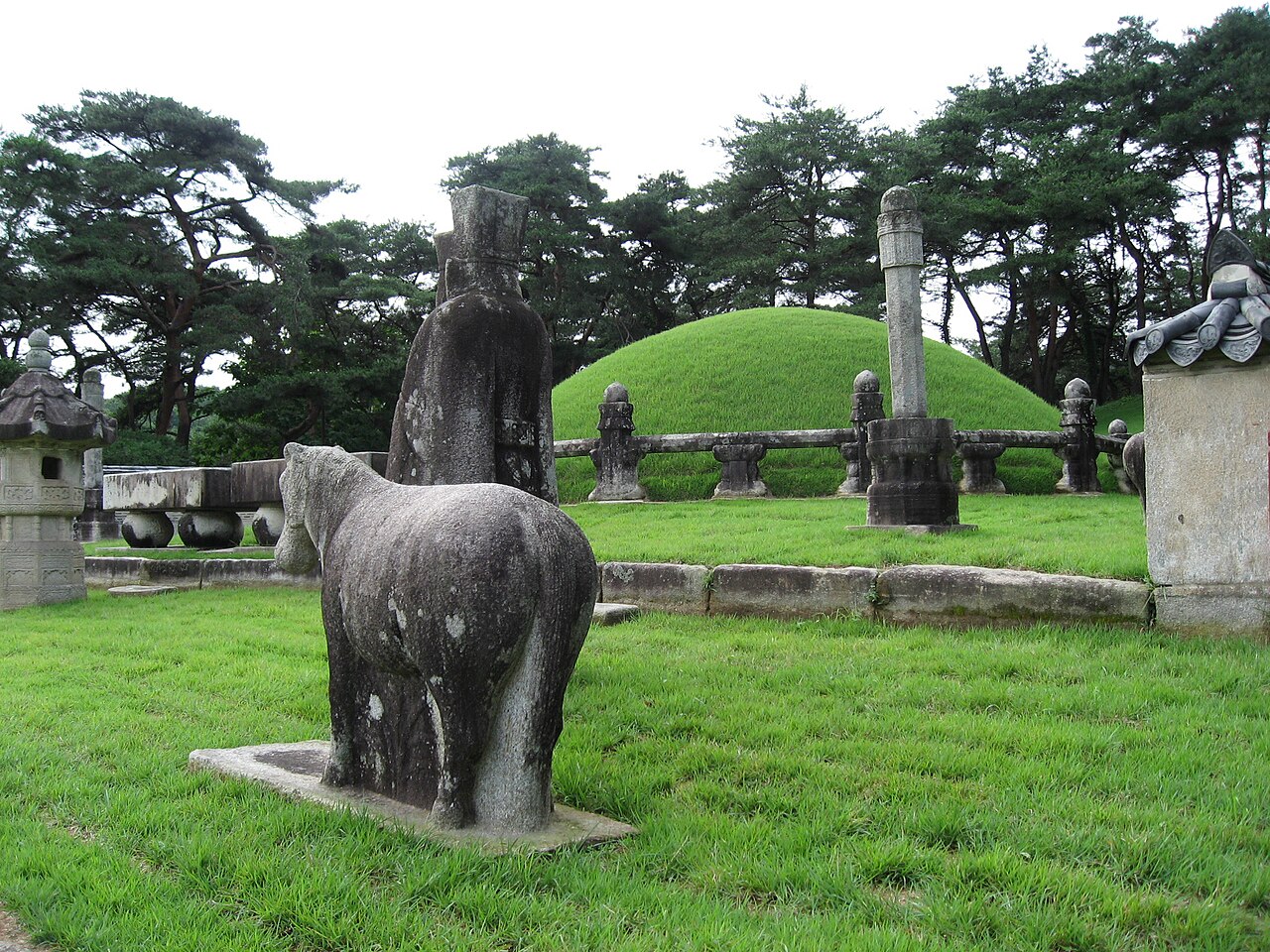
The Royal Tombs of the Joseon Dynasty (UNESCO, 2009) consist of 40 tombs distributed across 18 clusters in and around Seoul and Gyeonggi Province, covering 519 years of the dynasty that ruled Korea from 1392 to 1910. Each tomb follows a geomantic siting formula — backed by a hill, fronted by water, oriented to collect solar heat — recorded in a standardised construction manual that was followed without interruption for five centuries. The smallest cluster contains a single tomb; the largest, Donggureung in Guri City, holds nine royal graves across a forested hillside 30 kilometres east of Seoul.
Seoul’s inscribed palaces and shrines within metro reach 10–35 minutes by Seoul Metro from the city-centre tomb clusters
Three of the eighteen tomb clusters lie inside Seoul’s administrative boundary, and two more are reachable within thirty minutes by metro from central Seoul. Taereung and Gangneung (the tombs of Queen Munjeong and King Hyojong respectively) sit 15 kilometres northeast of central Seoul in Nowon district, accessible by metro Line 6 to Taereung station. The site is enclosed within the Korea National Sports Promotion Foundation grounds, which kept the forested buffer zone from urban development during the twentieth century — an accident of administrative overlap that preserved the tomb landscape more completely than many other clusters. The grass burial mound (bonbun) and stone guardian figures at Gangneung follow the canonical five-element arrangement: mound, stone figures, altar table, pavilion, and gate — the same sequence appearing at every Joseon royal tomb from 1408 onward.
Changdeokgung Palace Complex (UNESCO, 1997) is within thirty minutes by metro from the Taereung cluster and within twenty minutes from the central Seoul cluster near Seooreung. Changdeokgung is 45 hectares and was the preferred royal residence for 270 years after the main Gyeongbokgung was destroyed during the Imjin War of 1592–98. King Injo retreated to Changdeokgung during the Manchu invasion of 1636 — the same conflict that forced the surrender later commemorated at Namhansanseong. The rear garden, Huwon (32 hectares), was a royal-only space for four centuries; access required a court rank of at least the third tier. Today guided tours of Huwon run at fixed times and are limited to 100 visitors per session; unrestricted access is available only on designated open days.
Jongmyo Shrine (UNESCO, 1995) is 300 metres east of Changdeokgung, connected by a short walk through the Gahoe-dong neighbourhood or directly by metro to Jongno 3-ga. The Jeongjeon main hall stores the spirit tablets of nineteen Joseon kings and thirty queens across a 109-metre-long single-storey wooden structure — one of the longest wooden ritual buildings in East Asia. Each chamber holds the tablets of one royal couple, and the hall was extended as the dynasty continued; the seventh chamber was added in 1546 and the nineteenth in 1836. A second hall, Yeongnyeongjeon (Hall of Eternal Peace), stores tablets of kings and queens considered less central to the dynastic succession. The Jongmyo Jerye ceremony, performed on the first Sunday of May, involves 64 musicians, 64 dancers, and ritual foods specific to each season.
Hwaseong Fortress in Suwon (UNESCO, 1997) is 40 kilometres south of central Seoul and reachable by metro Line 1 to Suwon station in approximately one hour from the city centre, or forty minutes from the southern tomb clusters near Heolleung. King Jeongjo built Hwaseong between 1794 and 1796 partly as a declaration of political intent: his father, Prince Sado, had been executed by royal order and was initially buried at the nearby Yangju site; Jeongjo relocated the grave to Hwaseong — upgrading it to royal tomb status — as a filial act and as a way of establishing a power base outside Seoul. The fortress wall, 5.7 kilometres in perimeter, incorporates 48 structures including watchtowers, command posts, floodgates, and emergency barracks. The complete construction process is recorded in the Hwaseong Seongyeok Uigwe, a document that allowed near-complete reconstruction of war-damaged sections after 1975.
Outlying clusters and the tomb buried in secret 30–60 km from central Seoul by metro or bus
The Donggureung cluster in Guri City, 30 kilometres east of Seoul by metro Line 8 to Amsa-dong then bus, holds the tombs of nine kings and queens including Taejo, the dynasty’s founder, who died in 1408. Taejo’s tomb is the site’s oldest structure and sets the baseline canonical layout that all subsequent Joseon tombs follow. The cluster’s nine bonbun (burial mounds) are spread across a pine and oak hillside that still looks largely as it did in Joseon-era paintings of the site. One of the tombs, Sureung, was so hastily and informally constructed that its occupant — Queen Dangyeong, divorced by Jungjong in 1506 — was buried without the full ritual apparatus; the absence of stone guardian figures was a deliberate insult reflecting her status at death.
The Seooreung cluster in Goyang City, 26 kilometres west of central Seoul, contains five royal tombs including those of Yejong and Deokjong. Deokjong’s is unusual: he died in 1457 before taking the throne, and his son Seongjong, who became king instead, retroactively elevated his father to royal status — meaning Deokjong’s tomb was built after his death rather than planned during his reign, which is reflected in its more compact layout compared to sitting rulers’ tombs. The cluster is accessible by metro Line 3 to Daehwa station and a fifteen-minute bus ride.
The Gwangneung cluster near Namyangju City, 38 kilometres northeast of Seoul, contains the tombs of King Sejo and Queen Yun. Sejo seized power from his young nephew Danjong in 1455 in a palace coup, had Danjong executed in 1457, and buried him in a remote location without royal ceremony. Danjong’s tomb was eventually designated royal (Jangneung) in 1698, 241 years after his death, when his rehabilitation was formally decreed. The Gwangneung forest surrounding Sejo’s tomb is one of the most biodiverse temperate forest patches in Korea and is managed as a UNESCO Biosphere Reserve independently of the tomb inscription.
The Hongyureung cluster in Namyangju, 34 kilometres northeast of Seoul, holds the tombs of Emperor Gojong and Empress Myeongseong — the last of the Joseon royal line inscribed in the group. Myeongseong was assassinated by Japanese agents at Gyeongbokgung Palace in 1895; her body was burned in the palace grounds, and only a small portion of her remains was recovered for burial. The tomb marker identifies her officially, though the historical evidence for the burial content is contested in academic literature. The cluster is reachable in about one hour from central Seoul by metro Line 4 and a shuttle bus.
Practical information
Most tomb clusters are open Tuesday through Sunday, closed Monday, with hours varying by season (typically 09:00–18:00 in summer, closing at 17:00 between November and February). Entrance fees are 1,000 KRW per adult at most clusters. The Donggureung cluster is the most popular for independent visitors as it contains the most tombs in a walkable area and has an on-site interpretation centre with English signage. Changdeokgung and Jongmyo are in the same walking zone and efficiently visited together; the Huwon tour requires a separate time-limited ticket booked in advance online or at the gate. Suwon Hwaseong is the longest single-site to walk fully (5.7 km perimeter); the fortress walls are the attraction, not an interior structure, so good footwear is essential. Seoul’s T-money transit card covers metro and bus connections to all clusters. There is no single dedicated tourist pass covering all tomb sites; a general Seoul sightseeing pass may not include outlying clusters in Goyang or Namyangju.
Frequently Asked Questions
Which Joseon royal tomb clusters are easiest to reach from central Seoul without a car?
The three most accessible clusters without a car are Taereung–Gangneung, Seooreung, and Donggureung. Taereung and Gangneung sit in Nowon-gu, accessible by metro Line 6 to Taereung station and a short walk — the combined journey from central Seoul (City Hall area) takes about forty minutes. Seooreung in Goyang is accessible by metro Line 3 to Daehwa terminus and a fifteen-minute bus ride; total journey from central Seoul approximately one hour. Donggureung in Guri requires metro Line 5 to Macheon station and a connecting bus; approximately fifty minutes from central Seoul. The cluster near Heolleung and Illeung in southern Seoul (Seocho district) is walkable from metro Line 3 Maebong station and contains the tombs of Queen Inmok and King Taejong — closer to the city than any other cluster. Clusters in more distant Namyangju (Hongyureung, Gwangneung) take sixty to ninety minutes by metro and bus, which makes them worthwhile additions only if you have more than two days in Seoul. The Korea Tourism Organization website lists bus numbers and metro transfers for each cluster; these change occasionally, so checking live transit apps (Naver Map or Kakao Map, both available in English) is more reliable than printed guides.
What does geomantic siting mean in practice for Joseon royal tombs?
Geomantic siting — pungsu in Korean, fengshui in the Chinese tradition it derives from — dictates that an auspicious burial site must have a hill rising behind it (the guardian mountain), subsidiary ridges flanking both sides (the Azure Dragon on the left, the White Tiger on the right), an open prospect in front for solar exposure, and ideally a watercourse crossing the foreground. These topographic requirements meant that selecting a site for each royal tomb involved months of survey by a specialist court geomancer. The Donggureung cluster was chosen by Taejo himself before his death in 1408, reportedly after a personal survey of the terrain around Seoul; subsequent kings expanded the cluster to nine tombs partly because the site had already been validated by royal selection and partly because aggregating tombs reduced the number of sites requiring separate management. The geomantic logic was not purely symbolic: south-facing slopes at mid-elevation in the Seoul basin do warm earlier in spring and drain more readily after rain than north-facing or valley-bottom sites, so the formula had practical advantages for preservation even if the theory behind it was cosmological rather than hydrological. The Joseon court had explicit prohibitions against building within the geomantic buffer zone around each tomb, which is why many tomb clusters retain forested landscapes more than five centuries old.
How much time should I budget to see Changdeokgung, Jongmyo, and a tomb cluster in one day?
A tight but manageable one-day circuit covers Changdeokgung’s main palace grounds (90 minutes), Huwon rear garden if the time-limited tour is pre-booked (90 minutes, tours at 10:00 and 14:00 in spring and autumn), Jongmyo Shrine (60 minutes), and either the Taereung cluster or the Heolleung–Illeung cluster as an afternoon addition. The main risk is the Huwon tour availability: slots fill during spring blossom season (late March to early May) and autumn colour (late October to mid-November) and must be booked online at least several days in advance at the Cultural Heritage Administration of Korea ticketing site. Without Huwon, Changdeokgung and Jongmyo together take about two and a half hours including transit between them. The Heolleung–Illeung cluster in Seocho district is the most compact of the tomb groups accessible by metro and adds about two hours including travel. If Hwaseong Fortress in Suwon is on the itinerary, it requires a separate half-day minimum and should not be combined with the palace–shrine circuit in a single day.
Sources
- S1 — UNESCO World Heritage Centre — Royal Tombs of the Joseon Dynasty (Ref. 1319) — https://web.archive.org/web/20230601000000/https://whc.unesco.org/en/list/1319/
- S2 — Korea Heritage Service Royal Palaces and Tombs — https://whc.unesco.org/en/list/1319/
- S3 — Seth, Michael J. <em>A History of Korea: From Antiquity to the Present</em>. Rowman & Littlefield, 2010. ISBN: 978-0-8248-3563-7.
Spotted an error? Write to editorial@culturalheritageonline.com and we correct it the same day.