
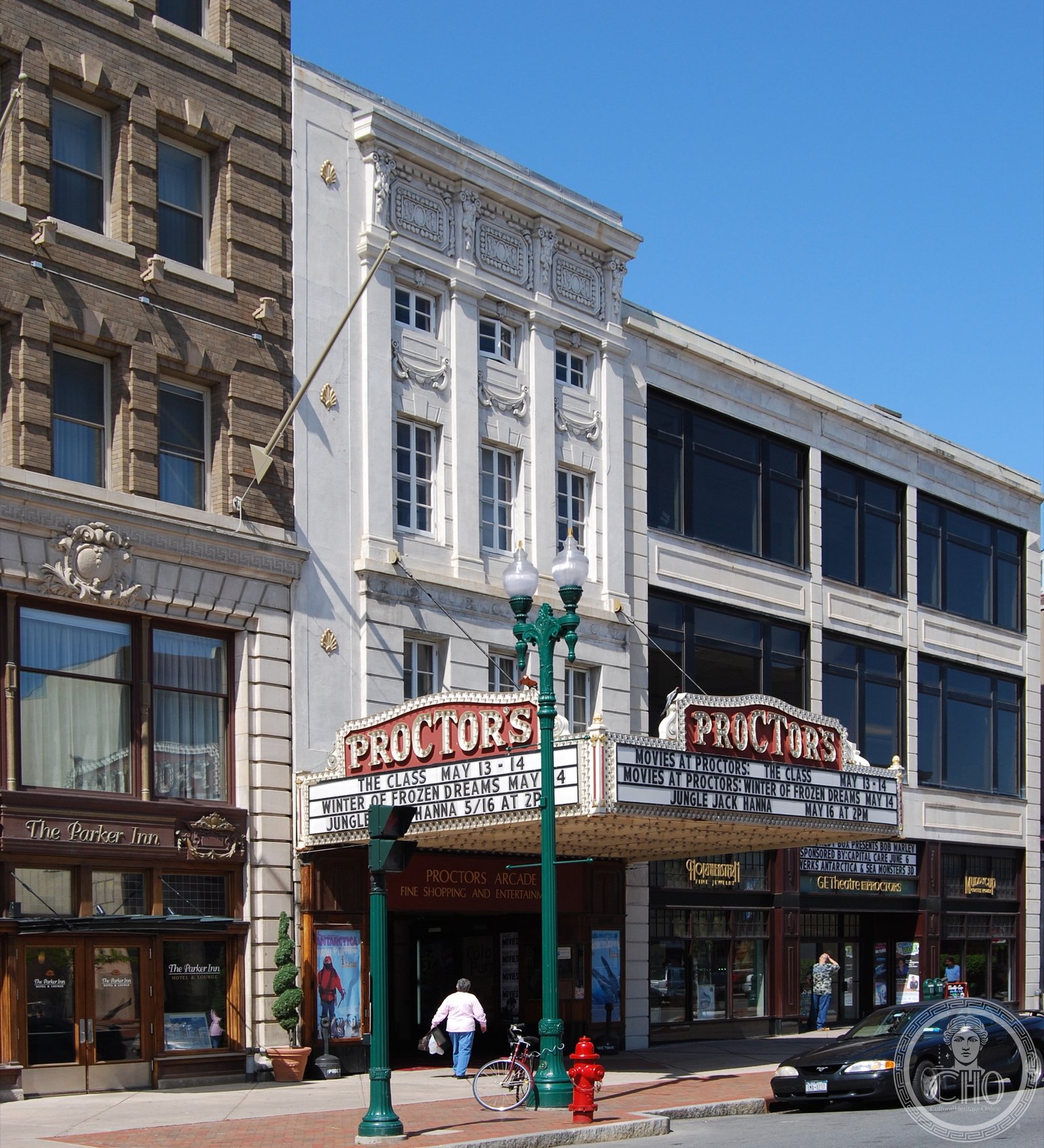
Proctors Theatre (1926), Schenectady
Proctors Theatre on State Street in Schenectady is one of the great survivors of the vaudeville and movie palace era—a 1926 Thomas Lamb design that anchors the downtown of the city where General Electric was born and where American electrical industry defined the 20th century, now operating as the region’s major performing arts center.
At a glance
Proctors Theatre at 432 State Street in Schenectady, New York opened in 1926 as part of the F.F. Proctor vaudeville circuit, designed by the prolific theater architect Thomas Lamb whose name appears on dozens of the great American entertainment palaces of the 1910s and 1920s. The theater served the entertainment needs of the workers and families of a city whose economy was anchored by General Electric’s massive manufacturing complex on the Erie Canal—Schenectady was one of the great company towns of the electrical age, and Proctors served its large working-class and middle-class audience with programming that ranged from vaudeville to first-run film to live performance. After decades of decline and a near-demolition in the 1970s, Proctors underwent a comprehensive restoration and expansion and now operates as one of the most active performing arts centers in upstate New York, hosting Broadway tours, concerts, operas, and the Capital Region’s film culture.
Key facts
- Address: 432 State Street, Schenectady, NY 12305
- GPS: 42.8172° N, 73.9502° W
- Built: 1926
- Architect: Thomas Lamb
- Style: Art Deco / Italian Renaissance
- Status: Active performing arts center
- NRHP: Listed on National Register of Historic Places
History
Frederick Freeman Proctor built his vaudeville circuit from a chain of theaters in upstate New York in the late 19th century, eventually controlling one of the dominant vaudeville chains in the Northeast before the consolidation of the entertainment industry into national circuits in the 1920s. The Proctor’s circuit became part of the Radio-Keith-Orpheum merger that created RKO in 1928, but individual theaters retained the Proctor’s branding in the markets where the name had established customer loyalty. Schenectady was one of Proctor’s most important markets.
Schenectady in 1926 was a company town of unusual prosperity. General Electric had moved its manufacturing complex to the city in 1887, drawn by the Erie Canal connections and cheap land, and by the 1920s employed tens of thousands of workers in the electrical equipment and appliance factories that made Schenectady one of the most important industrial cities in the country. Charles Steinmetz and Irving Langmuir worked in Schenectady’s GE Research Laboratory, which generated some of the most significant inventions of the electrical age. The Proctors Theatre served the cultural needs of this large, relatively well-paid industrial workforce, competing with the other entertainment venues that lined State Street for the leisure spending of GE’s workers and their families.
The theater faced closure in the 1970s as the GE workforce declined and downtown Schenectady struggled with the same forces that were hollowing out industrial city centers across the Northeast. A preservation campaign prevented demolition, and a restoration program eventually transformed Proctors from a threatened landmark into a regional performing arts institution. The current Proctors complex includes the original 1926 auditorium plus the adjacent GE Theatre (a smaller performance space) and the Bow Tie Cinema, making it the cultural anchor of Schenectady’s downtown revitalization effort.
What you see
The State Street facade by Thomas Lamb presents the vertical composition that characterized the major urban theater exteriors of the 1920s: a full-block elevation with the theater’s identifying signage rising above a cornice decorated with classical molding and terracotta ornament in the Italian Renaissance manner. The scale of the facade communicates the theater’s importance in the street composition of downtown Schenectady, where the Proctors building stands as one of the largest commercial structures on State Street.
Thomas Lamb’s interiors typically combined Italian Baroque decorative programs with the atmospheric lighting that made the 1920s movie palace such a distinctive and influential building type. Proctors’ auditorium has been extensively restored, with plasterwork in the boxes and ceiling reflecting the scale and ornamental ambition of the original 1926 design. The performing arts configuration of the current theater places the stage at the proscenium and the audience in a raked orchestra and balcony arrangement that maintains the proportions of the original auditorium.
Practical information
- Proctors programs Broadway tours, concerts, opera, comedy, and film across the main theater and its auxiliary spaces; check proctors.org for the season calendar.
- Located on State Street in downtown Schenectady, walkable from the Schenectady Amtrak/train station and the Erie Boulevard commercial strip.
- Fully accessible; ADA seating in the main auditorium and GE Theatre.
- The Proctors complex includes a restaurant and bar that opens before performances; arrive early for the full house experience.
Getting there
Proctors Theatre is at 432 State Street in downtown Schenectady, New York. Schenectady is served by Amtrak (Empire Service line connecting New York Penn Station and Albany-Rensselaer); the Schenectady station is within walking distance of the theater. From Albany, Schenectady is 15 miles west via I-890; drive time is 20 minutes. Albany International Airport (ALB) is 12 miles east of Schenectady via I-890 and I-87. New York City is 160 miles south via I-87 (New York State Thruway); drive time is approximately 2.5 hours. Parking in the Proctors garage on Erie Boulevard and on-street parking on State Street.
Nearby
- General Electric Plant Site / Mohawk Harbor (1 mile north): the former GE manufacturing complex that once employed 40,000 people has been partially redeveloped as a mixed-use waterfront district; the scale of the former plant is visible in the industrial buildings that remain along the Mohawk River.
- Schenectady Museum and Suits-Bueche Planetarium (2 miles north): the museum focuses on the history of GE and the electrical industry that made Schenectady significant, with collections documenting the inventions of Steinmetz, Langmuir, and their colleagues.
- Stockade Historic District (0.5 miles north): the neighborhood of 17th and 18th-century Dutch and English buildings that constitutes Schenectady’s oldest residential area; one of the best-preserved colonial neighborhoods in New York State.
- Albany (15 miles east): New York’s capital city holds the New York State Museum, the Empire State Plaza, and the Albany Institute of History and Art; the Egg performing arts center on the Plaza is an important complement to Proctors in the Capital Region’s performing arts infrastructure.
Sources
- Proctors Theatre, proctors.org — venue history and programming
- National Register of Historic Places, Schenectady Downtown Historic District
- Cinema Treasures, “Proctor’s Theatre, Schenectady” database entry
- Schenectady County Historical Society archives
Find it on the map
See this place and what’s around it →📷 Diventa un fotografo di Cultural Heritage Online
Condividi le tue foto dei luoghi: restano pubblicate con la tua firma come autore. Più vengono viste, più ti fai conoscere — e presto un concorso premierà le foto più apprezzate.
Accedi o registrati gratis per aggiungere una fotoDo you manage this place?
This page is read by travellers and heritage enthusiasts who find it on Google. Keep it accurate — and make it work for you. Free for non-profit heritage institutions.