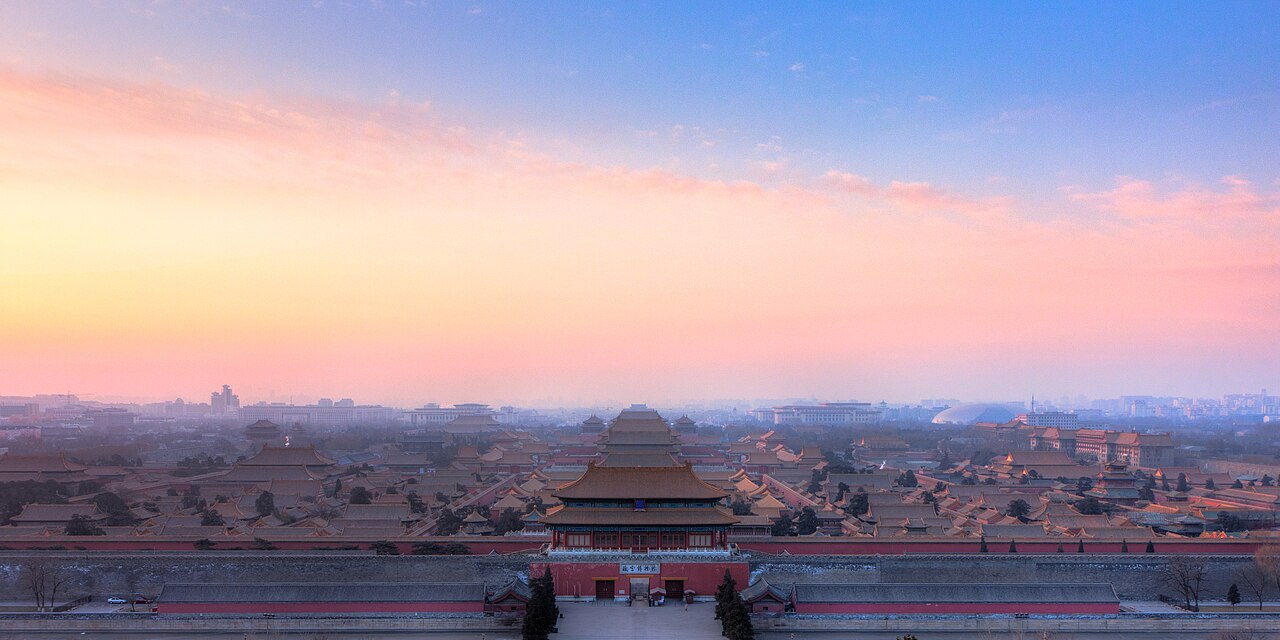
The Forbidden City is a 72-hectare imperial palace complex in the centre of Beijing, built between 1406 and 1420 under Emperor Yongle using one million workers and 100,000 artisans, and serving as the seat of Chinese imperial power for 491 years across 24 emperors. UNESCO inscribed it in 1987 as the Imperial Palace of the Ming and Qing Dynasties; today the Palace Museum it contains holds 1.8 million objects, the largest collection of ancient Chinese art in the world. Within 16 kilometres stand two further UNESCO World Heritage Sites — the Temple of Heaven to the south and the Summer Palace to the northwest.
Nine thousand nine hundred and ninety-nine rooms — and why the real count is 8,728 Central Beijing; Tiananmen metro Line 1
The traditional Chinese count of 9,999 rooms in the Forbidden City is a deliberate cosmological statement rather than an architectural measurement. According to Chinese imperial cosmology, the celestial palace of the Jade Emperor — the supreme deity of the Heavenly Court — contains exactly 10,000 rooms. For a mortal emperor to build a palace with 10,000 rooms would constitute an act of hubris amounting to sacrilege; 9,999 acknowledged the distinction between earthly and heavenly authority. A modern survey commissioned by the Palace Museum in the twentieth century counted 8,728 rooms by strict architectural definition — a room being a space enclosed by four columns. The apparent discrepancy arises from the traditional Chinese method of counting jian, the bays between columns, rather than fully enclosed rooms by Western definition.
The outer walls stand 10 metres high and are faced with fired brick; the surrounding moat is 52 metres wide and 6 metres deep. The palace is entered through a sequence of gates from south to north: Tiananmen Gate (Gate of Heavenly Peace, the public face of the complex shown on Chinese currency), Duanmen Gate, the Meridian Gate (Wu Men, the formal southern entrance to the palace itself), the Gate of Supreme Harmony (Taihemen), and then the sequence of great ceremonial halls — the Hall of Supreme Harmony (Taihedian), Hall of Central Harmony (Zhonghedian) and Hall of Preserving Harmony (Baohedian). This progression from south to north places the emperor physically at the centre of a cosmological arrangement in which the north is the position of heavenly authority and the south is the direction from which subjects approach.
Emperor Yongle chose Beijing as his capital in 1402 after defeating his nephew in the Jingnan civil war and relocating the court from Nanjing. Construction of the Forbidden City began in 1406 and was declared complete in 1420. The materials required were extraordinary: timber came from the tropical forests of Sichuan and Yunnan provinces (floated downriver and then hauled overland), marble from Fangshan District 70 kilometres southwest, and the yellow-glazed roof tiles — the colour reserved exclusively for imperial use — from kilns in Shandong Province. The floor tiles of polished stone in the main halls were manufactured in Suzhou over a four-year process involving multiple firings.
Non-residents who entered without authorisation were executed on the spot under Ming law. The prohibition extended beyond physical walls: the palace’s name, Zijin Cheng (Purple Forbidden City), combined the imperial colour purple, the North Star (Ziwei, the celestial emperor’s fixed point in the sky), and the character for “forbidden” — encoding the absolute exclusion of ordinary subjects into the building’s identity. In practice, thousands of eunuchs, servants, concubines and guards lived within the walls; at its peak the palace complex housed approximately 10,000 people. The last emperor, Puyi, was expelled in 1924. The Palace Museum opened to the public the following year, 1925.
The Temple of Heaven, Summer Palace and the axis of Beijing Temple of Heaven 4 km south; Summer Palace 12 km northwest
The Forbidden City stands at the centre of the central north-south axis of Beijing, a 7.8-kilometre urban spine that the Ming Dynasty engineered as a physical embodiment of imperial order. The axis runs from Yongding Gate (Yongdingmen) in the south, through Tiananmen Square, through the Forbidden City, through Jingshan Park (Coal Hill, an artificial mound built from earth excavated to create the palace moat) and continues north to the Drum Tower and Bell Tower. Each element on the axis served a specific ritual or administrative function; together they express the idea that the emperor, positioned at the geometric centre, mediated between earth and heaven. UNESCO’s inscription of the Forbidden City notes this urban-cosmological framework as one of the outstanding universal values of the site. The axis itself is currently under separate consideration for UNESCO inscription.
The Temple of Heaven, 4 kilometres southeast, is the closest of Beijing’s other World Heritage Sites to the Forbidden City. Built in 1406–1420 under Yongle — again, the same construction campaign as the Forbidden City — the Temple of Heaven served as the site of the most important state ritual in the Chinese imperial calendar: the emperor’s annual winter solstice sacrifice to Heaven, performed in secret after a three-day fast. The temple complex covers 273 hectares, more than three times the area of the Forbidden City. Its principal structure, the Hall of Prayer for Good Harvests (Qiniandian), stands 38 metres tall with a triple-tiered blue-glazed tile roof. The use of blue (rather than the imperial yellow of the Forbidden City) acknowledged that the Temple of Heaven was the domain of Heaven itself, not of the emperor.
The Summer Palace, 12 kilometres northwest, was the seasonal residence of the Qing Dynasty court from roughly May to October each year. Its origins lie in 1750, when the Qianlong Emperor ordered construction of the Qingyi Yuan (Clear Rippling Garden) as a birthday gift for his mother. The current structures date primarily from 1886–1895, when the Empress Dowager Cixi ordered reconstruction after the original complex was looted and burned by Anglo-French forces during the Second Opium War in 1860. The Shenyang Imperial Palace (Mukden Palace) in Liaoning Province was added to the Forbidden City’s UNESCO inscription as an extension in 2004; it predates the Beijing Forbidden City by approximately 20 years, having been built by Nurhaci and Hong Taiji as the seat of the early Manchu court before the Qing Dynasty conquered China and moved to Beijing.
The Palace Museum’s collection includes 1.8 million objects, of which approximately 1.5 million are classified as cultural relics. The ceramics collection alone numbers 340,000 pieces; the painting collection includes 53,000 works. During the Second Sino-Japanese War, 19,000 crates of the most important objects were secretly transported first to Nanjing, then through Chongqing, and ultimately to Taiwan in 1948–1949. Those objects now form the core collection of the National Palace Museum in Taipei. The Beijing and Taipei collections are therefore complementary halves of a single imperial collection separated by the Chinese Civil War.
Practical information
Forbidden City (Palace Museum): Open Tuesday–Sunday; closed Monday (except public holidays). Tickets ¥60 (peak season April–October), ¥40 (November–March). Timed entry tickets are mandatory and must be booked in advance via the Palace Museum official website (gugang.cn); tickets are not available at the gate. Visitors must present a passport or national ID at entry. Photography inside the main ceremonial halls is restricted. Allow 3–4 hours minimum for the main north-south axis; a full day for peripheral areas including the Imperial Garden and the two wings.
Getting there: Metro Line 1 to Tiananmen East or Tiananmen West stations; the northern exit (Shenwumen Gate) is accessible from Line 4, Gongwangfu area. The palace complex is pedestrian-only; no vehicle access.
Temple of Heaven: Metro Line 5, Tiantan Dongmen station. Open daily; ¥15 park entry, ¥30–35 for buildings. Arrive before 08:00 to see early morning tai chi and group exercises in the park.
Summer Palace: Metro Line 4, Xiyuan station (15-minute walk to East Gate). Open daily; ¥30 (low season) to ¥60 (peak). Allow 4–5 hours; the Long Corridor and Longevity Hill together require at least 2 hours.
Frequently Asked Questions
Why did the Forbidden City have so many eunuchs, and how many lived there?
Eunuchs served in the Forbidden City for the same reason they were employed across imperial courts from Ottoman Turkey to Tang China: they were trusted to live in close proximity to the imperial harem without posing a reproductive threat to the imperial bloodline. The legitimacy of dynastic succession depended entirely on knowing the paternity of the heir, which required strict control over access to the emperor’s concubines. Only male relatives, officials during formal audiences, and eunuchs were permitted in the inner palace. The number of eunuchs in the Forbidden City varied significantly across the Ming and Qing dynasties. Under the Ming, eunuch numbers grew dramatically: at the dynasty’s peak in the 15th and 16th centuries, estimates range from 10,000 to 100,000 eunuchs serving in palace and government roles across the empire, with several thousand stationed in the Forbidden City itself. Some Ming eunuchs acquired enormous political influence — Zheng He, who commanded the great maritime expeditions of 1405–1433, was a eunuch; Wang Zhen, who induced the Zhengtong Emperor to take command of an army in 1449 and was killed in the resulting military disaster, was another. The Qing Dynasty deliberately curtailed eunuch political power after inheriting the Ming palace. By 1912, when the Qing Dynasty collapsed, approximately 1,500 eunuchs remained in the Forbidden City. The last eunuchs were dismissed in 1923 when Puyi accused them of complicity in a fire that may have been set to cover theft from the imperial storehouses.
What happened to the Forbidden City’s collection during the Japanese occupation, and why are some objects now in Taiwan?
In 1931, following Japan’s seizure of Manchuria and anticipating a full-scale invasion, the Palace Museum began quietly identifying and crating the most important objects in its collection. By 1933, 19,557 crates containing 600,000 artefacts had been evacuated to Shanghai and then to Nanjing. When the Japanese army approached Nanjing in late 1937, the crates were split into three convoys and sent west into the Chinese interior — some to Chongqing, some to Guizhou, some to Sichuan. The convoys travelled by truck, by river boat and in some sections by human porters carrying the crates over mountain paths. Not a single crate was lost or damaged in transit. After Japan’s defeat in 1945, the objects were returned to Nanjing. In 1948–1949, as the Nationalist government lost the Chinese Civil War to the Communist Party, 2,972 crates — selected for containing the highest-quality objects — were loaded onto ships and transported to Taiwan. These objects formed the founding collection of the National Palace Museum in Taipei, which opened in 1965. The objects remaining in Beijing continued to be catalogued and are now displayed in the Palace Museum. The two museums have occasionally discussed cooperative exhibitions, but as of 2024 no formal object loans between the two institutions have taken place, reflecting the unresolved political relationship between mainland China and Taiwan.
Is the Forbidden City actually the world’s largest palace complex, and how does it compare to other royal palaces?
The Forbidden City’s claim to being the world’s largest palace complex is frequently repeated and broadly accurate by area, though the comparison depends on how “palace complex” is defined. The Forbidden City covers 72 hectares and contains 980 surviving buildings. By floor area of enclosed structures it is larger than Versailles (67,000 square metres of buildings in the main chateau and wings), the Vatican Apostolic Palace (55,000 square metres) and Buckingham Palace (77,000 square metres). The Papal Palace of Avignon and the Potala Palace in Lhasa are sometimes cited as comparable in scale; neither matches the Forbidden City’s total enclosed floor area. The Istana Nurul Iman in Brunei, completed in 1984, has approximately 200,000 square metres of floor space and is sometimes listed as the world’s largest residential palace by total interior area — but it is a 20th-century structure, not a historic palace complex. If the comparison is restricted to historic palaces, the Forbidden City’s 72 hectares and 980 buildings make it the largest surviving imperial palace complex in the world by most reasonable measures. The Royal Palace of Caserta in Italy covers a larger floor plate in its main building alone (approximately 48,000 square metres in the palace proper, with grounds of 3 square kilometres), but its main building is a single Baroque structure rather than a compound of hundreds of buildings. The Forbidden City’s combination of scale, survival, architectural integrity and documentary record is unmatched among imperial palace complexes anywhere in the world.
Sources
- S1 — UNESCO World Heritage Centre — Imperial Palaces of the Ming and Qing Dynasties in Beijing and Shenyang (listed 1987). https://whc.unesco.org/en/list/439/
- S2 — UNESCO World Heritage Centre — Temple of Heaven: an Imperial Sacrificial Altar in Beijing (listed 1998). https://whc.unesco.org/en/list/881/
- S3 — UNESCO World Heritage Centre — Summer Palace, an Imperial Garden in Beijing (listed 1998). https://whc.unesco.org/en/list/880/
- S4 — The Palace Museum, Beijing — official site. https://www.dpm.org.cn/
Spotted an error? Write to editorial@culturalheritageonline.com and we correct it the same day.