Nalanda Mahavihara operated as a residential monastic university in what is now Bihar, India, from approximately 450 CE until its destruction around 1200 CE — 750 years during which it housed up to 10,000 students and 2,000 teachers drawn from China, Tibet, Korea, Indonesia, and Persia, and accumulated a library of nine million manuscripts in a building the historical sources describe as eight storeys tall. The Chinese Buddhist monk Xuanzang spent six years studying there (641–645 CE) and left a detailed account that remains one of the primary documentary sources for early medieval India. The institution was burned by forces under the Afghan commander Bakhtiyar Khilji around 1193–1203 CE; surviving monks fled to Tibet carrying manuscripts that became the foundation of Tibetan Buddhist scholarship.
The University: Foundation, Scale, and Curriculum Nalanda district, Bihar, India — 95km south of Patna
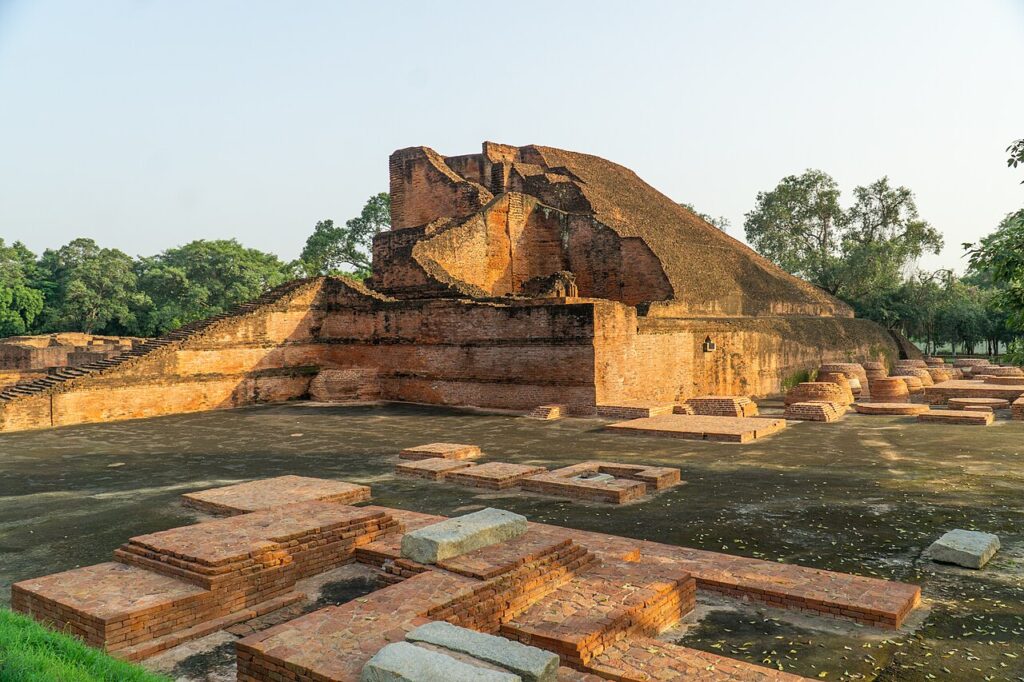
The Mahavihara (great monastery) at Nalanda was established during the Gupta dynasty in the fifth century CE, with inscriptional evidence pointing to patronage by Kumaragupta I (r. 415–455 CE) as the institution’s earliest phase. The site was already associated with Buddhist tradition before this: the Pali Canon records that the Buddha taught at a grove near Nalanda on multiple occasions, and the area is described as the birthplace of Shariputra, one of the Buddha’s principal disciples. The stupa at the excavated complex designated Temple 3 — the largest of the surviving structures, measuring approximately 31 metres in height in its final built form after multiple enlargements — is believed to mark Shariputra’s birthplace and contains earlier brick stupa phases visible in cross-section where the outer layers have been removed.
The institution grew substantially under the Pala dynasty (8th–12th centuries CE), which became its primary patron after the decline of Gupta power. At its height, Nalanda covered approximately 14 hectares of monastic buildings, temples, and lecture halls within the excavated area, and the wider campus was larger still — the unexcavated portions of the site extend beyond the current boundary. The student body at peak enrolment is reported at approximately 10,000, a figure that appears in multiple independent sources including Xuanzang’s account and the Tibetan historian Taranatha. The acceptance rate was reportedly low: oral examinations at the gate filtered out students deemed insufficiently prepared, and the teaching faculty numbered around 2,000, giving a student-to-teacher ratio better than most modern universities.
The curriculum was not limited to Buddhist theology. Nalanda offered systematic instruction in Vedic philosophy, logic, grammar (the Sanskrit grammarian tradition descended from Panini, whose work originated some 200 kilometres west), medicine (Ayurveda), astronomy, and mathematics. This breadth explains why scholars from outside the Buddhist world sought entry: the medical and logical training available at Nalanda had no institutional equivalent in the region. The library, called Dharmaganja (treasury of knowledge), occupied three buildings; the tallest, Ratnasagara (ocean of jewels), was reportedly nine million manuscripts deep. Xuanzang transported 657 texts back to China at the end of his stay, where he spent the remaining nineteen years of his life translating them from Sanskrit into Chinese — a project that fundamentally shaped Chinese Buddhist thought and, through the Chinese transmission to Korea and Japan, East Asian Buddhism as a whole.
Xuanzang himself is memorialised in the sixteenth-century Chinese novel “Journey to the West” as the character Tang Sanzang (also romanised as Tripitaka), the monk who travels to India to retrieve scriptures under the protection of the Monkey King. The novel is a fantastical elaboration of the historical pilgrimage; Xuanzang’s own account, “Great Tang Records on the Western Regions,” is a sober geographical and ethnographic survey that records the physical layout of Nalanda’s campus with enough precision to have assisted twentieth-century archaeologists in correlating excavated structures to historical descriptions.
The destruction of Nalanda is among the most consequential single acts of cultural destruction in the history of South Asia. Bakhtiyar Khilji, a Turkish-Afghan military commander operating under the Ghurid Sultanate during its expansion into Bengal and Bihar, reached Nalanda around 1193 CE (some sources place the attack in 1203 CE; the uncertainty reflects the scarcity of contemporary records from the period). His forces destroyed the monastery buildings and burned the library. The twelfth-century Tibetan historian Dharmasvamin, who visited the ruins a few decades after the attack, found a small number of elderly monks still living among the rubble and briefly teaching. The smoke from the burning library is described in some Tibetan sources as having been visible for three months, which, for nine million manuscripts dried to combustibility over centuries, is not implausible as an estimate rather than a metaphor.
Bodh Gaya and Paharpur: The Buddhist World’s Two Nearest UNESCO Sites Bodh Gaya 95km south; Paharpur 170km east via Bangladesh
Bodh Gaya, listed by UNESCO in 2002, is 95 kilometres south of Nalanda by road and is the site of the Buddha’s enlightenment — the point at which Siddhartha Gautama, seated beneath a Ficus religiosa (Bodhi tree), is held to have achieved liberation from the cycle of rebirth. This event is traditionally dated to the fifth or fourth century BCE, several centuries before Nalanda’s foundation, but the two sites are intimately connected: many of the scholars and students at Nalanda were themselves pilgrims who also visited Bodh Gaya, and Xuanzang’s account describes both in sequence. The Mahabodhi Temple at Bodh Gaya, in its current form dating primarily to the 5th–6th centuries CE with later restorations, is a 55-metre brick temple tower built over the seat of enlightenment. The current Bodhi tree in the temple courtyard is descended by cuttings from the original tree; a branch was reportedly taken to Sri Lanka in the third century BCE by Sanghamitra, daughter of the emperor Ashoka, and the Sri Lankan cutting provided the source for later replantings at Bodh Gaya when the original was damaged. The site receives millions of pilgrims annually and has a dense concentration of temples funded and built by Buddhist communities from across Asia — Tibetan, Japanese, Thai, Sri Lankan, Bhutanese, Chinese — making the surrounding town a compressed survey of contemporary Buddhist architectural traditions.
Rajgir, 15 kilometres south of Nalanda, is not a UNESCO World Heritage Site but is an important complement to both Nalanda and Bodh Gaya for any visitor interested in early Buddhist history. It was the capital of the Magadha kingdom during the Buddha’s lifetime and the site where he gave numerous sermons, including the Prajnaparamita (Perfection of Wisdom) sutras on Griddhakuta (Vulture Peak), a hill still identifiable within the valley. The First Buddhist Council was held at Rajgir in 483 BCE (approximately three months after the Buddha’s death), where the monks assembled to recite and codify his teachings before they diverged in transmission. The caves above Rajgir where the council met are accessible by a ropeway and on foot; the spot is marked by a Japanese-funded stupa built in the 1960s.
Paharpur Buddhist Vihara in Bangladesh, listed by UNESCO in 1985, is approximately 170 kilometres east of Nalanda — crossing the international border at Mahasthangarh or via Rajshahi — and represents the eastern extension of the same Pala dynasty monastic culture that patronised Nalanda. The Somapura Mahavihara at Paharpur was founded in the late eighth century CE, making it a younger institutional sibling of Nalanda. Its central cruciform temple rises from a monastery complex whose ground plan — a central shrine surrounded on four sides by monks’ cells arranged in a rectangular courtyard — follows a design type found from Bengal to Java, evidence of the Pala-era Buddhist network through which architectural and iconographic forms travelled with monks, manuscripts, and patrons. The ruins at Paharpur cover roughly 11 hectares and are better preserved in plan than in elevation; most walls survive only as foundations, but the regularity of the cell arrangement and the quality of the terracotta plaques recovered from the site make it one of the most important monastic sites in South Asia.
Practical information Nalanda, Bihar, India — road or rail from Patna or Gaya
Nalanda Mahavihara is approximately 95 kilometres southeast of Patna (the state capital of Bihar) and 95 kilometres northeast of Gaya, which is the railhead for Bodh Gaya. The nearest airport is Gaya International Airport (GAY), which has direct flights from Kolkata, Delhi, and Bangkok — it serves primarily Buddhist pilgrims and handles international charters from Thailand and Sri Lanka seasonally. Patna airport (PAT) has more frequent domestic connections. From Gaya, Nalanda and Bodh Gaya can be visited together in a two-day itinerary by road. The Archaeological Survey of India site at Nalanda is open daily except Fridays; entry is approximately INR 40 for Indian nationals and INR 600 for foreign nationals. The on-site museum holds bronze sculptures, terracotta figurines, and manuscript fragments recovered from the excavations. Accommodation near Nalanda is limited; most visitors base themselves in Rajgir (12 kilometres away, with hot springs and a wider range of guesthouses) or in Gaya (where Bodh Gaya’s substantial pilgrim infrastructure includes hotels in every price category).
Frequently Asked Questions
Who was Xuanzang, and why is his account of Nalanda important?
Xuanzang (also romanised as Hsuan-tsang or Hiuen Tsang) was a Chinese Buddhist monk born around 602 CE who undertook an unauthorised overland journey from Tang dynasty China to India in 629 CE, spending approximately sixteen years travelling before returning to Chang’an in 645 CE. He spent six of those years at Nalanda studying under Silabhadra, the abbot of the monastery and the foremost Buddhist scholar of the period, who was then in his late nineties. Xuanzang’s account of his travels, “Great Tang Records on the Western Regions” (Da Tang Xiyu Ji), compiled in 646 CE, is a systematic record of the geography, politics, religion, and customs of the lands he crossed — covering approximately 130 countries from Central Asia through India. For Nalanda specifically, he provides a description of the campus layout (eleven monasteries, six temples, eight halls with three stories), the admission process (oral examination at the gate), the curriculum, the library, the number of students and teachers, and the quality of the food provided free to students. These details have been used by archaeologists to correlate the excavated structures to historical buildings. Xuanzang returned to China with 657 Sanskrit texts and spent the rest of his life translating them; by the time of his death in 664 CE, he had completed 75 texts. His pilgrimage was fictionalised in the Ming dynasty novel “Journey to the West” (c. 1592), attributed to Wu Cheng’en, in which Xuanzang appears as the monk Tang Sanzang accompanied by the Monkey King Sun Wukong — one of the most widely read novels in East Asian history and the source of numerous film, television, and theatrical adaptations across China, Japan, and Southeast Asia.
What happened to Nalanda’s manuscripts and monks after the destruction?
The destruction of Nalanda around 1193–1203 CE was not a single event but part of a broader military campaign by Bakhtiyar Khilji through Bihar and Bengal, which also destroyed the monasteries at Vikramashila and Odantapuri. The loss of the library at Nalanda — nine million manuscripts by the figures reported in sources compiled within a century of the destruction — is described in later Tibetan historical writing with a grief that reflects the manuscripts’ importance to Buddhist scholarship across Asia. Some manuscripts were carried out by monks who fled ahead of the attack or during it; the primary refuge was Tibet, which had been in active intellectual exchange with Nalanda for centuries and had its own network of monasteries capable of preserving Sanskrit and translated texts. The Tibetan Buddhist canon (the Kangyur and Tengyur), translated from Sanskrit originals primarily between the 7th and 13th centuries CE, preserves texts whose Sanskrit originals were subsequently lost — including some that appear to have been in the Nalanda library. The diaspora of Nalanda scholars to Tibet, Nepal, and the surviving monasteries of South India (particularly in the Deccan) effectively transplanted the Nalanda intellectual tradition to new institutions, which is why Tibetan Buddhist philosophy, particularly in the Madhyamaka and Yogacara schools, preserves a depth and density of argument that traces directly to the Nalanda curriculum. The modern Nalanda University, re-established in 2014 by an act of the Indian Parliament on a campus approximately 12 kilometres from the historic site, represents an institutional attempt to revive the original university’s international character.
How does Nalanda compare to Bodh Gaya in terms of visitor experience?
Nalanda and Bodh Gaya are both in Bihar and approximately 95 kilometres from each other, but they offer very different experiences. Bodh Gaya is a living pilgrimage site: the Mahabodhi Temple is in constant use for prayer and ritual, the surrounding precinct houses dozens of active monasteries from Buddhist traditions across Asia, and the town sees millions of visitors per year — peaking between October and March, with large international delegations from Thailand, Japan, Sri Lanka, Taiwan, and Bhutan arriving for major Buddhist festivals. The Bodhi tree, the Diamond Throne, and the inner sanctum of the Mahabodhi Temple are accessible but often crowded during peak season. Nalanda, by contrast, is an archaeological site — a field of excavated ruins that conveys scale and planning but very little standing architecture above a few metres. Its value is intellectual and historical rather than devotional: walking through the excavated monastic cells, the stupa stages visible in Temple 3, and the outlines of the lecture hall complex produces a sense of the institution’s physical scale, but the experience requires some prior reading to be fully meaningful. The two are most rewarding visited in combination, with the ruins of the library and monastery at Nalanda providing context for the living tradition visible at Bodh Gaya. Rajgir, between them, adds the dimension of the Buddha’s own lifetime and the post-death events of the First Council, making the three sites together a coherent itinerary through early Buddhism’s foundation and institutional history.
Sources
- S1 — District Nalanda, Government of Bihar — History (Nalanda Mahavihara) — https://nalanda.nic.in/en/history/
- S2 — Incredible India, Ministry of Tourism, Government of India — Explore Nalanda — https://www.incredibleindia.gov.in/en/bihar/nalanda
Spotted an error? Write to the editors and we correct it the same day.