
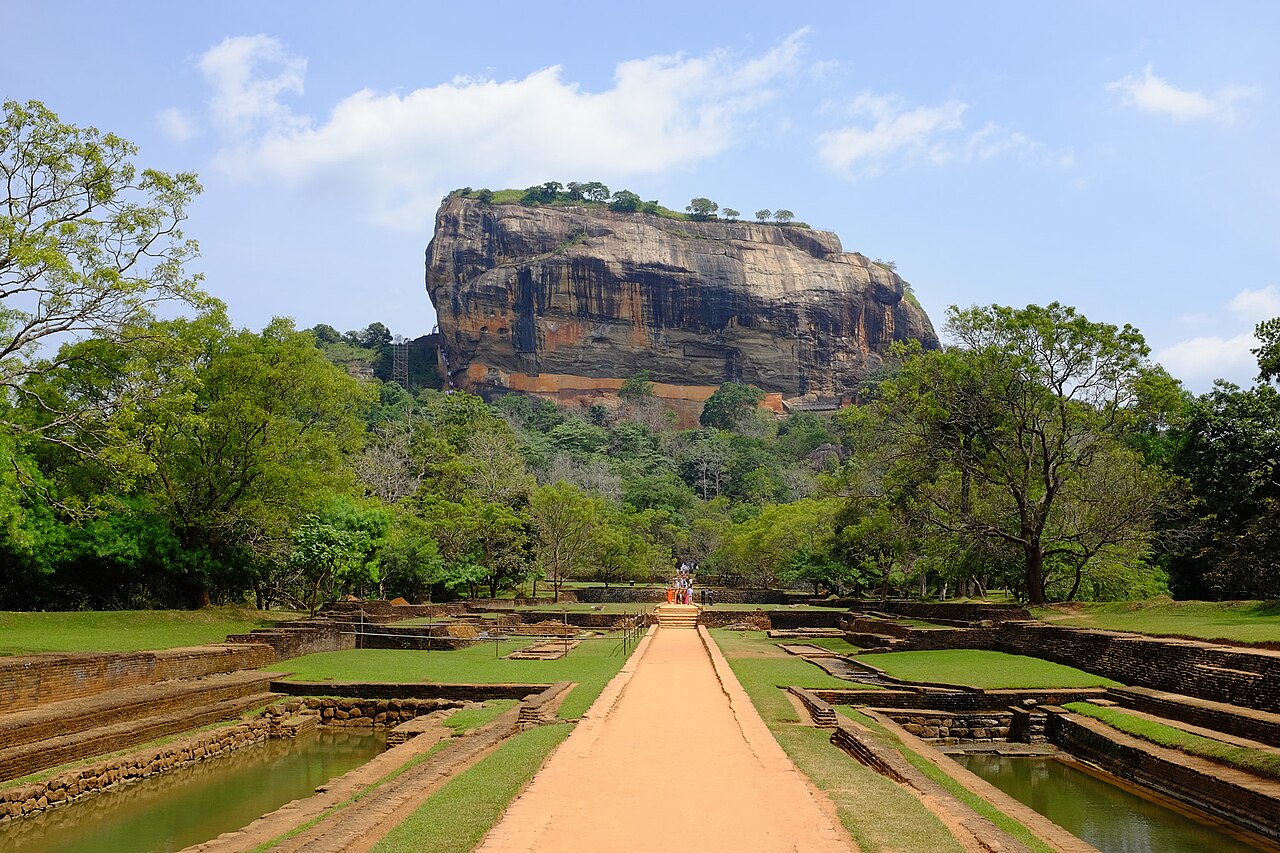
Sigiriya is a 200-metre granite inselberg in central Sri Lanka on which King Kashyapa I built a palace complex between 477 and 495 CE after killing his father to seize the throne. The site’s rock face preserves 22 surviving frescoes painted at an elevation of approximately 100 metres above ground, and the polished Mirror Wall below them carries over 600 Sinhala-language graffiti poems written by visitors between the 8th and 10th centuries — among the oldest surviving literary texts in the Sinhala language. Two UNESCO World Heritage Sites lie within 85 kilometres.
Sigiriya: The Rock Palace, the Frescoes and the Mirror Wall Rock summit and gardens — on-site
Sigiriya received UNESCO World Heritage status in 1982 under the inscription “Ancient City of Sigiriya.” The site was occupied as a Buddhist monastery from roughly the 3rd century BCE, but its most intensive construction phase was the brief eighteen-year reign of King Kashyapa I (477–495 CE). Kashyapa was the eldest son of King Dhatusena of Anuradhapura but was not the designated heir; the succession was to pass to his half-brother Moggallana, whose mother was of royal lineage. Kashyapa imprisoned his father and, according to both the Culavamsa chronicle and a version of events preserved in Chinese Buddhist pilgrimage records, caused him to be walled up alive. Moggallana fled to South India to raise an army, and Kashyapa, anticipating the return, built his fortified palace on the summit of the impregnable granite rock rather than in the traditional capital at Anuradhapura.
The inselberg rises approximately 200 metres above the surrounding flat plains of the Matale District. The palace on the summit covered the entire plateau of the rock — approximately 1.6 hectares — and included cisterns, brick-lined pools, audience halls, and residential quarters. The hydraulic engineering supporting the palace was extensive: channels cut into the rock face directed rainwater into storage cisterns, and the water gardens at the base of the rock used gravity pressure — the height difference between the summit cisterns and the garden fountains — to supply running water to the ornamental garden complex below.
The water gardens at the base of the rock occupy approximately 40,000 square metres and represent the oldest surviving example of symmetrical garden design in Asia. The gardens are divided into a series of courts: an entrance court, a water court with fountains, a boulder garden, and a terrace garden ascending toward the rock face. The gravity-fed fountains in the water court, fed from underground conduits connected to the cisterns, still operate during the rainy season — the only ancient fountain system anywhere in Asia that remains functional without modern engineering modification. Archaeological excavation has recovered the original ceramic pipes and channels intact beneath the garden surface.
Approximately 100 metres above the garden level, a sheltered alcove in the cliff face protects the surviving frescoes. Ancient accounts suggest that the original programme of paintings covered much of the north face of the rock over a distance of approximately 140 metres, depicting as many as 500 figures. Damage from weathering, moisture infiltration, and vandalism has reduced the surviving painted area to 22 individual images, clustered in a single alcove. The paintings depict women — bare-breasted, wearing jewellery, and holding flowers or vessels — surrounded by stylised clouds and lotus motifs. Scholarly interpretation divides between those who identify the women as apsaras (celestial beings) and those who identify them as members of Kashyapa’s court or wives. The pigments — red, yellow, and green ochres, with a dark outline — are mineral-based and have retained much of their colour over fifteen centuries. No equivalent concentration of ancient secular figure painting survives in South Asia.
Below the frescoes, a stretch of polished lime plaster known as the Mirror Wall was so highly burnished that it reflected the images above. Visitors from the 8th century onwards scratched poems and observations into the plaster; over 600 graffiti inscriptions have been recorded, dating from the 8th to the 10th century CE. They constitute a body of early Sinhala literary writing — lyric verses, responses to the painted women, observations on the beauty or eerie quality of the place — that predates most other surviving Sinhala literary texts. The inscriptions have been transcribed and published in Sinhala scholarly editions. New scratching on the Mirror Wall is a criminal offence under Sri Lankan heritage law.
The final approach to the summit passes through the Lion’s Paws: two enormous brick-and-plaster lion’s paws, each approximately 4 metres across, that flanked the base of the original summit stairway. The paws are all that survive of a full-scale lion sculpture whose open mouth formed the entrance to the final stairway. The lion’s body has collapsed completely. From the summit plateau, the views across the Matale plain extend to the Knuckles Mountain Range in the east and to Anuradhapura’s tank-dotted landscape to the northwest.
Anuradhapura and Polonnaruwa 85 km northwest and 60 km northeast by road
Anuradhapura lies 85 kilometres northwest of Sigiriya along the A9 highway and local roads, a drive of roughly 90 minutes to two hours. The city served as the first capital of Sri Lanka from 380 BCE to 1017 CE and contains ten UNESCO-protected monuments within its sacred precinct. The most substantial of these is the Ruwanwelisaya Stupa, built by King Dutugamunu between 161 and 137 BCE to enshrine relics of the Buddha; its dome measures 103 metres in diameter and the stupa currently stands 55 metres tall following partial restoration. The Jetavanaramaya, built in the 3rd century CE, originally reached 122 metres — the third tallest structure in the ancient world at the time of its construction — and was built using an estimated 93 million fired bricks.
The Sri Maha Bodhi at Anuradhapura adds a dimension unique among UNESCO World Heritage Sites: it is a living tree with a recorded planting date of 288 BCE, grown from a cutting of the Bodhi tree at Bodh Gaya under which Siddhartha Gautama is said to have attained enlightenment. At over 2,300 years old and with an unbroken historical record, it is the oldest historically documented tree in the world. The original Bodhi tree at Bodh Gaya was destroyed in the 7th century CE, so the Anuradhapura tree is also the oldest surviving member of the lineage. Visitors driving between Sigiriya and Anuradhapura can cover the distance as a half-day excursion.
Polonnaruwa, 60 kilometres northeast of Sigiriya, is the easier pairing for a single-day visit from Sigiriya, given the shorter road distance and flatter route. Polonnaruwa served as Sri Lanka’s second capital from 1017 to 1215 CE and reached its architectural peak under King Parakramabahu I (r. 1153–1186 CE), whose reign produced the Gal Vihara rock temple — four colossal Buddhist figures carved from a single granite face, including a 14-metre reclining parinirvana figure and a 7-metre standing figure. The same king consolidated or built an estimated 12,000 irrigation tanks across the dry zone, and his Parakrama Samudra reservoir, covering 22 square kilometres, is still in operational use today.
The town of Habarana, approximately 30 kilometres south of Sigiriya on the A6, functions as the logistical hub for visitors touring the Cultural Triangle. It lies roughly equidistant between Sigiriya, Polonnaruwa, and Anuradhapura, and accommodation ranging from budget guesthouses to mid-range lodge properties is concentrated there. From Habarana, all three UNESCO sites can be reached within 60 to 90 minutes, making it a practical base for covering the northern heritage cluster without changing accommodation between sites.
Practical information
Sigiriya is accessible year-round, though the climb is more comfortable in the dry season (December to April), when temperatures are slightly lower and the rock face is dry. From May to October, the southwest monsoon brings rain to the hill country, and the northwestern plains around Sigiriya receive rain particularly in October and November. The climb to the summit takes between 45 and 90 minutes depending on fitness and crowd density; during peak season (December to March), queues form at the spiral metal staircase between the Mirror Wall level and the Lion’s Paws. Starting early — at or just after the 07:00 opening — avoids both the crowds and the worst midday heat.
The nearest international airport is Bandaranaike International Airport (CMB) at Colombo, approximately 170 kilometres southwest; the journey by road takes three to four hours via the A1 and A6 highways. No direct rail service reaches Sigiriya; the nearest station is Habarana, on the Colombo–Batticaloa line, from which tuk-tuks and buses serve the final 30 kilometres. The Cultural Triangle Round Ticket, sold at site entrances and covering Sigiriya, Anuradhapura, Polonnaruwa, Dambulla, and Kandy, offers savings over individual entry fees. Sri Lanka requires an Electronic Travel Authorisation (ETA) visa for most nationalities, available online before departure at USD 20 for 30 days single entry. The local currency is the Sri Lankan Rupee (LKR); Sigiriya has no ATMs directly at the entrance, so cash should be drawn in Dambulla (12 kilometres south) or Habarana before arrival. Photography in the fresco alcove is permitted, but flash is prohibited to protect the pigments.
Frequently Asked Questions
Why did King Kashyapa I build a palace on top of an inaccessible rock rather than in the traditional capital?
The Culavamsa, the chronicle that provides the main historical account of Kashyapa’s reign, characterises the rock palace as a defensive response to his knowledge that his half-brother Moggallana had fled to South India and would eventually return with an army to avenge their father’s death. Kashyapa had seized power by a means — patricide, or at minimum the deliberate imprisonment and death of his father King Dhatusena — that left him without the ritual legitimacy that made Anuradhapura’s traditional palace compound defensible through political as much as military means. A palace on a 200-metre vertical rock with a single controlled access point was genuinely impregnable against the military technology of the 5th century CE, when siege engines capable of attacking fortified heights did not exist in the Sri Lankan military repertoire. The construction programme implies substantial state resources: the water gardens, the palace cisterns, the fresco programme, and the elaborate approach architecture all required centralised coordination and skilled artisans, suggesting that Kashyapa’s eighteen-year reign was economically productive despite its political instability. When Moggallana did return in 495 CE, Kashyapa descended from the rock to meet him on level ground — according to the chronicle, because his elephant turned away from battle — and was defeated. The decision to fight in the open rather than shelter in the rock fortress remains unexplained in the historical sources.
How many frescoes survive at Sigiriya, and what do they depict?
Twenty-two individual fresco figures survive in the sheltered alcove approximately 100 metres above ground on the north face of Sigiriya. The Culavamsa and other early descriptions suggest the original painted area covered a continuous stretch of approximately 140 metres along the cliff, with accounts referencing 500 or more individual figures. The surviving 22 are concentrated in a single alcove where an overhanging section of rock has protected them from direct rain and sun. All surviving figures depict women: shown from the waist up, bare-breasted in the aristocratic style of the period, wearing elaborate gold jewellery and headdresses, with skin tones ranging from golden to dark reddish-brown, and carrying flowers, bowls, or mirrors. The figures are surrounded by stylised representations of clouds and lotus blossoms, which some scholars read as indicating a celestial or semi-divine status (apsaras), while others argue they depict ladies of the court or wives of the king. The paintings are executed in a fresco technique using natural mineral pigments: red and yellow ochre, green from malachite or chlorite, and carbon black for outlines. The painted plaster surface has survived because the mineral pigments bonded chemically with the lime substrate. No comparable concentration of figure painting from the 5th century CE survives anywhere else in South Asia; the next largest comparable body of ancient secular painting in the region is at Ajanta in Maharashtra, India.
What is the Mirror Wall, and can visitors still read the inscriptions?
The Mirror Wall is a stretch of plastered wall approximately 80 metres long on the approach to the fresco alcove, finished with a burnished lime coating so smooth that it once reflected the images in the painted gallery above. The wall’s surface carries over 600 graffiti inscriptions scratched by visitors — mostly pilgrims, poets, or curiosity-seekers — from the 8th to 10th century CE, making them among the oldest surviving examples of written Sinhala. The inscriptions are mostly short lyric verses reacting to the painted women above: some express admiration, some melancholy, some philosophical reflections on impermanence and beauty. A few are in Old Sinhala script that has been partially deciphered, though the full corpus is not universally legible even to specialists. The inscriptions were first systematically recorded and published in the mid-20th century by the Sri Lankan epigraphist Senarat Paranavitana, whose transcriptions remain the standard reference. Visitors today walk past the Mirror Wall on a metal walkway that keeps them at arm’s length from the surface; new inscriptions or touching is forbidden under the Antiquities Ordinance of Sri Lanka and carries criminal penalties. The inscriptions are visible to the naked eye on close inspection but are not labelled or translated at the site; a site guide or the Sigiriya Museum (located at the base, recommended as a first stop) provides context for the most significant texts.


.jpeg)