
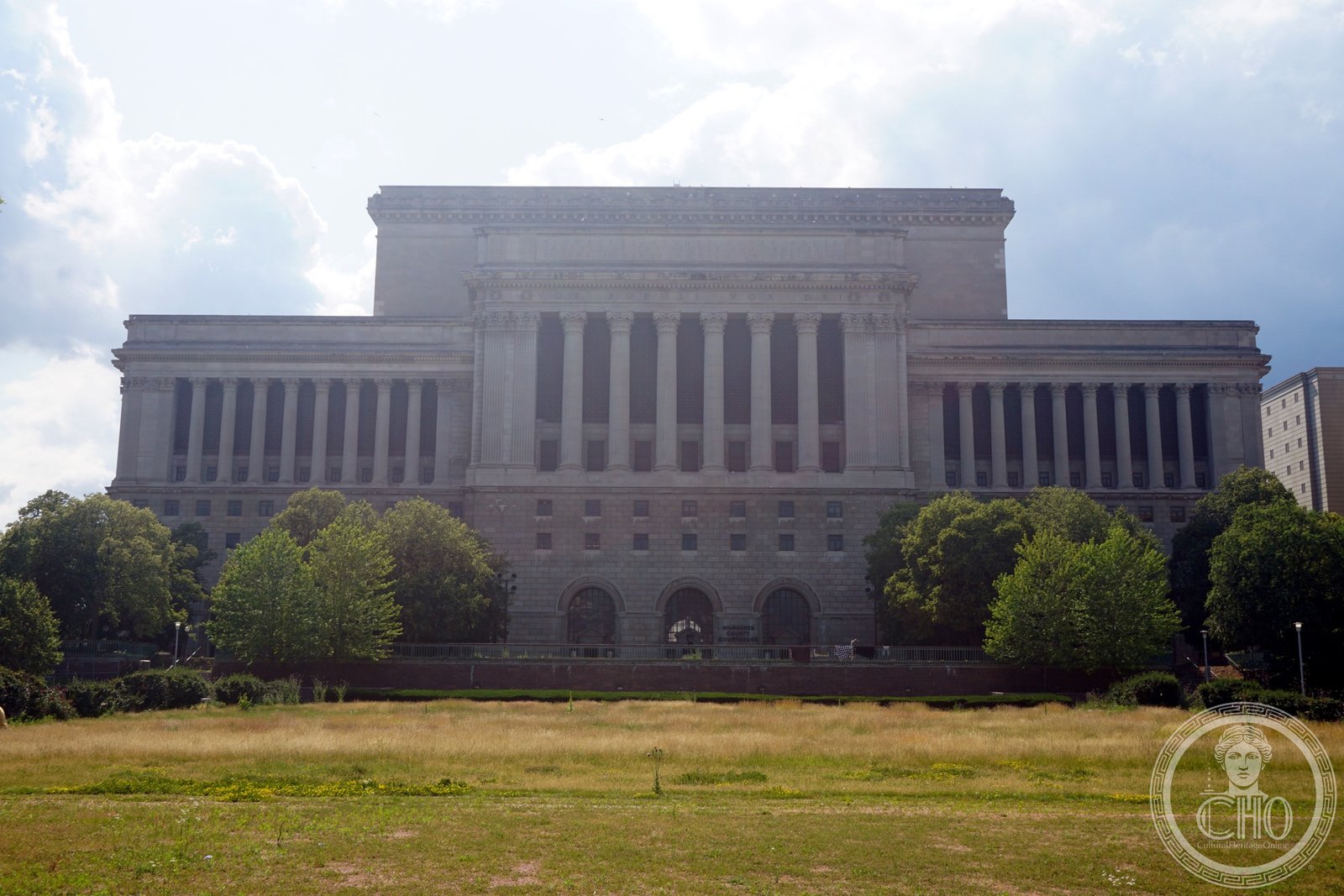
Completed in 1931 as Milwaukee County grew into one of the great manufacturing capitals of the Midwest, the County Courthouse rises above North 9th Street with the monumental authority of a civic institution designed to last — its Art Deco ornament embedded in the classical discipline of a building built for permanence.
At a glance
The Milwaukee County Courthouse stands as one of the finest examples of civic Art Deco architecture in the Upper Midwest. Completed in 1931 during a period when Milwaukee was among the ten largest cities in the United States and a national center of manufacturing, brewing, and labor organization, the courthouse reflects the confidence of a county government that expected its buildings to be permanent statements of institutional authority. Its exterior combines the monumental scale and classical discipline of Beaux-Arts civic architecture with the modernizing ornamental language of Art Deco, producing a building that reads as simultaneously traditional and contemporary — as appropriate for a courthouse as for any civic institution of the era. The building continues to serve as the active seat of Milwaukee County government.
Key facts
- Address: 901 North 9th Street, Milwaukee, WI 53233
- Completed: 1931
- Style: Art Deco Civic with classical influences
- Current use: Active Milwaukee County government seat; courtrooms and county offices
- Designation: National Register of Historic Places
History
Milwaukee in 1931 was at the height of its industrial power. The city’s breweries — Pabst, Schlitz, Miller — defined the nation’s beer culture; its factories produced everything from tractors to turbines; and its socialist municipal government had built a reputation for honest, efficient administration that attracted national attention. Milwaukee County had grown rapidly alongside the city, and the older courthouse facilities were no longer adequate. The county authorized a new building scaled to the administrative demands of a major American industrial county.
Construction proceeded through the late 1920s and early 1930s, with the building completed just as the Great Depression was deepening. The courthouse was built with the permanence and material quality characteristic of major civic construction of the era: granite cladding on the exterior, marble in the interior public spaces, and craftsmanship throughout that reflected the pride of a county government that saw itself as an institution of long duration. The building stands today as a record of Milwaukee’s interwar aspirations and the institutional confidence that the Depression would interrupt but not extinguish.
The courthouse has served continuously as the center of Milwaukee County government, adapted over decades to the changing demands of judicial and administrative use. Its designation on the National Register of Historic Places recognizes both its architectural significance and its role as a material record of the county’s institutional history.
What you see
The courthouse presents a monumental face to North 9th Street: a large-scale composition in granite, with the vertical emphasis and geometric ornamental program characteristic of Art Deco civic architecture. The classically derived proportions — base, shaft, and cornice clearly articulated — coexist with Art Deco detailing in the spandrel panels, entrance surrounds, and lobby interior. The building uses ornament to mark hierarchy: the entrance is the most elaborately decorated element, signaling the institution’s public face and the importance of civic ceremony.
Inside, the public corridors and courtroom floors retain much of their original character: terrazzo floors, marble wainscoting, bronze hardware, and plaster ornamentation in the decorative program of the period. The quality of materials and workmanship is consistent with the building’s civic ambitions — this is a courthouse built to serve not just the immediate present but the indefinite future of Milwaukee County government.
Practical information
- Access: The courthouse is open to the public during business hours as an active government facility; security screening required at entry
- Courtrooms: Some courtrooms may be observed when not in session; check with courthouse staff
- Civic Center context: The courthouse is part of Milwaukee’s civic center district, with City Hall and other government buildings nearby
Getting there
The Milwaukee County Courthouse is at 901 N 9th Street in downtown Milwaukee, six blocks west of the Milwaukee River and two blocks north of Wisconsin Avenue. Milwaukee Mitchell International Airport is seven miles south of downtown; the MCTS bus system provides frequent service to the civic center. From Chicago, Amtrak’s Hiawatha service connects Union Station to Milwaukee’s Intermodal Station in 90 minutes, with buses to downtown.
Nearby
- Milwaukee City Hall (1895) — one of the finest examples of Flemish Renaissance Revival architecture in America, with a distinctive clock tower visible across downtown; four blocks southeast of the courthouse
- Wisconsin Gas Building (1930) — a celebrated Art Deco skyscraper known for the gas-flame sign atop its tower, one of Milwaukee’s most recognized landmarks and a near-contemporary of the courthouse
- Milwaukee Art Museum — the Santiago Calatrava–designed Quadracci Pavilion (2001) on the Lake Michigan lakefront, with its kinetic brise-soleil, is one of the most photographed museum buildings in the United States; located 12 blocks east
- Pabst Mansion (1892) — the Victorian mansion of beer magnate Frederick Pabst, a Flemish Renaissance Revival landmark preserved as a house museum; a mile west on Wisconsin Avenue from the civic center district
Sources
- National Register of Historic Places, Milwaukee County Courthouse nomination
- Milwaukee County Historical Society records
- John Gurda, The Making of Milwaukee (2006, Milwaukee County Historical Society)
- Wisconsin Historical Society, architectural survey records
- Milwaukee Preservation Alliance documentation
Find it on the map
See this place and what’s around it →Record researched and written by Luigi De Marchi for Cultural Heritage Online, 2026.
📷 Become a Cultural Heritage Online photographer
Share your photos of places: they stay published under your name as the author. The more they're seen, the more you get noticed — and soon a contest will reward the most appreciated photos.
Log in or sign up free to add a photoIs this page about you?
This page is read by travellers and heritage enthusiasts who find it on Google. Tell us how you are connected to this place and we will take it from there.