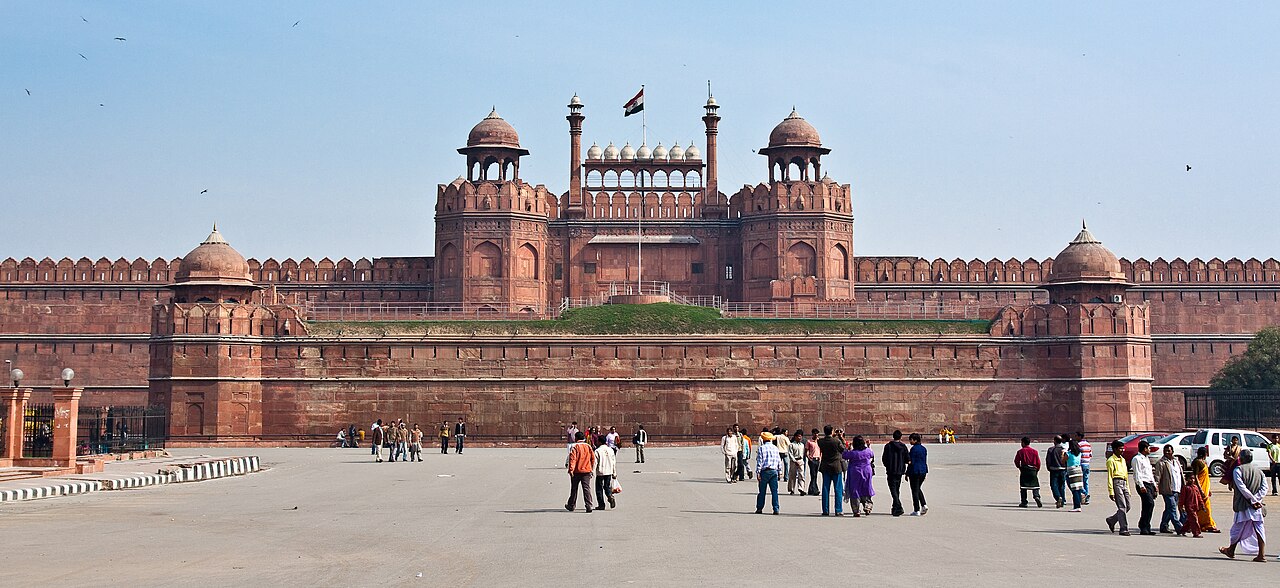
The Red Fort (Lal Qila) is a Mughal imperial fortified palace built by Emperor Shah Jahan between 1639 and 1648 CE on the western bank of the Yamuna River in what was then his new capital, Shahjahanabad, now known as Old Delhi. The complex covers approximately 255 acres enclosed by red sandstone walls standing between 21 and 33 metres high. UNESCO inscribed it as a World Heritage Site in 2007, along with nearby Humayun’s Tomb and the Qutb Minar.
Shah Jahan’s Shahjahanabad: Building an Imperial Capital Old Delhi, 12 km north of Humayun’s Tomb
When Emperor Shah Jahan decided to build a new Mughal capital in 1638, he chose a site on the Yamuna River north of the existing Mughal city of Delhi — the fortress of Shergarh, built by Sher Shah Suri in the early 16th century, lay nearby and served as one reference point for the layout. The new city, Shahjahanabad, was laid out with the Red Fort as its primary structure, positioned at the northeastern edge of the city with its main gate — the Lahori Gate — facing west toward the principal bazaar, Chandni Chowk.
Construction lasted from 1639 to 1648. The principal architect was Ustad Ahmad Lahauri, who is also credited with designing the Taj Mahal (completed 1653). The Red Fort shares with the Taj Mahal the use of white Makrana marble for interior palace structures contrasting with red Agra sandstone for the outer defensive works — a pairing that characterises the mature Shah Jahani architectural vocabulary. The fort’s name, Lal Qila, simply means “Red Fort” in Urdu and Hindi, a reference to the red sandstone outer walls, though the official Mughal name was Qila-i-Mubarak (Auspicious Fort).
The complex is organised along a north-south axis parallel to the river. From the Lahori Gate, the visitor passes through the Chatta Chowk — a covered bazaar that once sold royal goods — before entering the main forecourt. The principal buildings are arranged along the eastern riverfront wall: the Diwan-i-Aam, then the Diwan-i-Khas, then the royal apartments, all in a line with the river and its cooling breezes to the east.
The water supply system of the fort was sophisticated. The Nahar-i-Behisht (Stream of Paradise), an elevated aqueduct channel derived from the Western Yamuna Canal, ran through the principal royal apartments, feeding the marble fountain of the Rang Mahal, the bathhouse (hammam), and several smaller pools. The system maintained ambient temperature and humidity throughout the marble apartments — a functional necessity in Delhi’s extreme climate that also carried the symbolic resonance of a Quranic paradise garden.
Shah Jahan occupied the fort from 1648 until his son Aurangzeb deposed and imprisoned him in 1658. Aurangzeb held power from the fort until his death in 1707. Subsequent Mughal emperors used it as their primary residence through the 18th century, though Mughal political power contracted progressively after 1707 under pressure from the Marathas, Sikhs, and the expanding East India Company.
The 1857 Revolt and the Destruction of Two-Thirds of the Palace Old Delhi — Humayun’s Tomb 12 km south, Qutb Minar 20 km south
In May 1857, Indian soldiers (sepoys) of the Bengal Army who had mutinied at Meerut marched to Delhi and entered the Red Fort. The last Mughal emperor, Bahadur Shah Zafar II — then aged 82, a poet and calligrapher with no real political power — became the symbolic figurehead of what the Indian nationalist tradition calls the First War of Independence, and what British records called the Sepoy Mutiny. The Red Fort became one of the principal sites of confrontation over the following months.
British forces retook Delhi in September 1857 after a siege lasting several months. Bahadur Shah Zafar II surrendered. He was tried by a military commission, convicted of revolt and complicity in the murder of British officers, and exiled to Rangoon (present-day Yangon, Myanmar), where he died in 1862 at the age of 87. He was buried in Rangoon, not in Delhi, in an unmarked grave that was only rediscovered in 1991. His grave is now a shrine at the Shwe Dagon area of Yangon.
The British response to the suppression of the revolt at the Red Fort was to demolish approximately two-thirds of the existing palace buildings. Structures deemed useful for military purposes were converted: the principal royal apartments were turned into barracks and officers’ quarters, the Rang Mahal into officers’ accommodation, several pavilions into storage. Structures without clear military utility were demolished to create parade grounds, roads, and a military hospital. The gardens of the royal precinct were cleared. The Nahar-i-Behisht water channel, which had run through the apartments, was blocked.
What survives represents approximately one-third of the original Mughal complex. The Diwan-i-Aam, with its red sandstone colonnade and the carved marble throne alcove at the rear where the emperor received petitions, is intact. The Diwan-i-Khas, with its white marble columns inlaid with pietra dura floral patterns in semi-precious stones and the verse inscribed on its walls — “If there is paradise on earth, it is here, it is here, it is here” — survives largely complete. The verse, attributed to the poet Amir Khusrau, was applied to Shah Jahan’s buildings at both the Red Fort and the palaces at Agra and Lahore. The Rang Mahal, the principal harem palace, retains its marble lotus-shaped fountain pool, though the original inlaid marble floor has been partly replaced.
The fort was used as a British military cantonment until independence in 1947. On 15 August 1947, Prime Minister Jawaharlal Nehru raised the Indian national flag from the Lahori Gate of the Red Fort and delivered the “Tryst with Destiny” address. This ceremony has been repeated by every subsequent Prime Minister on Independence Day. The image of the Red Fort’s Lahori Gate appears on the Indian 500-rupee banknote. The fort passed from military to civilian administration after independence and is now managed by the Archaeological Survey of India.
Practical information
The Red Fort is in Old Delhi (Netaji Subhash Marg), directly accessible from Chandni Chowk Metro Station on the Yellow Line (approximately 200 metres walk). Entry for foreign nationals is ₹600; Indian nationals ₹35 (as of 2024). The Sound and Light Show runs in the evening (English and Hindi sessions, separate tickets). The fort is open Tuesday to Sunday, sunrise to sunset, closed Mondays.
Nearby UNESCO World Heritage Sites: Humayun’s Tomb is 12 km south (auto-rickshaw, taxi, or Metro to JLN Stadium). Qutb Minar is 20 km south (Metro Yellow Line to Qutb Minar Station). All three are manageable as a two-day Delhi UNESCO itinerary. The Chandni Chowk bazaar, immediately west of the Lahori Gate, is one of the oldest and largest wholesale markets in India. The Jama Masjid (1656 CE, commissioned by Shah Jahan, the largest mosque in India) is 800 metres southwest of the fort and is not itself UNESCO-inscribed but is directly associated with the same building programme.
Delhi’s peak visiting season is October to March. Summer (April to June) reaches 44–47°C in Old Delhi. Accommodation ranges from budget guesthouses in Paharganj (2 km west of the fort) to five-star hotels near Connaught Place (5 km south).
Frequently Asked Questions
What is the Diwan-i-Khas inscription and what does it mean?
The Diwan-i-Khas (Hall of Private Audience) at the Red Fort carries a Persian verse inscribed in gold on the friezes of its interior colonnades: “Agar firdaus bar ru-ye zamin ast, hamin ast, hamin ast, hamin ast” — “If there is paradise on earth, it is here, it is here, it is here.” The verse is attributed to the medieval Sufi poet Amir Khusrau (1253–1325 CE), a figure associated with the Chishti order in Delhi and celebrated as the father of qawwali music. The attribution to Khusrau has been questioned by some scholars, but it was firmly established in Mughal usage by Shah Jahan’s time. The same inscription appears in Shah Jahan’s private apartments at the Lahore Fort, at the Agra Fort, and in other royal Mughal buildings of the period — it became a standard declaration of the Mughal court’s self-understanding as the earthly realisation of paradise (firdaus). The Diwan-i-Khas was used for meetings with senior nobles, ambassadors, and confidential councils, as distinct from the Diwan-i-Aam where the emperor met the general public and received petitions. Its marble columns carry pietra dura inlay work — thin slices of semi-precious stone (carnelian, lapis lazuli, malachite) set into the white marble surface in stylised floral and vine patterns — similar in technique to, though less dense than, the inlay work on the Taj Mahal.
What happened to the Peacock Throne after the Red Fort fell?
The Peacock Throne (Takht-i-Taus) was the most celebrated object in the Mughal imperial treasury: a raised platform throne with two peacocks carved in gold set with emeralds, rubies, diamonds, and sapphires, commissioned by Shah Jahan and completed around 1635 CE — before the construction of the Red Fort itself. The throne was displayed in the Diwan-i-Khas and became one of the defining symbols of Mughal imperial power. In 1739, the Persian emperor Nadir Shah sacked Delhi. His forces looted the city, and the Peacock Throne was removed to Persia. Nadir Shah was assassinated in 1747, and the throne was broken up; its principal components and jewels were distributed, sold, or incorporated into the Iranian imperial regalia. No complete Peacock Throne survives. A throne in the Iranian crown jewels collection in Tehran (now in the Central Bank of Iran) is sometimes described as the Peacock Throne, but it was built in the late 18th century by Fath Ali Shah Qajar and incorporates some Mughal gems while being an entirely different structure. The alcove in the Diwan-i-Khas where the throne stood is still visible: a raised marble platform at the rear of the hall, now empty, with the paradise inscription on the friezes above it.
Why is Bahadur Shah Zafar’s grave in Yangon rather than Delhi?
Bahadur Shah Zafar II, the last Mughal emperor, was exiled to Rangoon (present-day Yangon, Myanmar) after the British suppression of the 1857 revolt. He had surrendered at the tomb of Humayun (a further link between the Red Fort and the nearby UNESCO site 12 km south, where he had sought refuge). He was tried by a military commission, convicted, and transported to Burma to prevent him becoming a focal point for further nationalist resistance within India, where his symbolic status as the legitimate Mughal heir would have remained powerful. He died in Rangoon on 7 November 1862 at the age of approximately 87, without having been permitted to return to India. He was a significant Urdu poet under the pen name “Zafar” (meaning victory — an ironic reversal in his case), and several of his ghazals remain part of the Urdu literary canon. He reportedly wrote: “How unlucky is Zafar! For his burial / not even two yards of land were to be had in the lane of the beloved.” The British buried him in Rangoon specifically to prevent his grave in India from becoming a place of nationalist pilgrimage. His grave was unmarked and its precise location was lost; it was rediscovered in 1991 during renovation work at the site of a dargah in Yangon and is now a shrine visited by Burmese Muslims and Indian visitors.