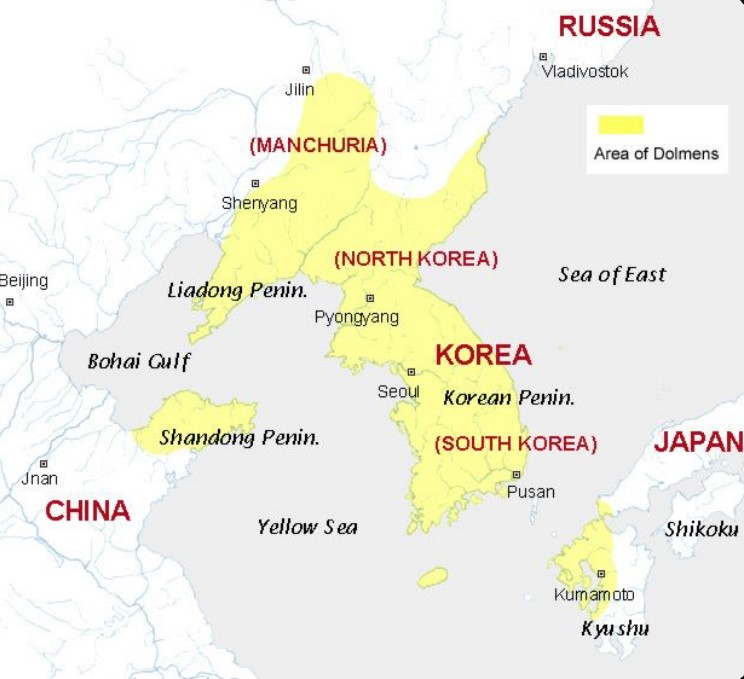
Korea contains approximately 40,000 dolmens — megalithic burial monuments from the Bronze Age — which represents 40 to 50 percent of all dolmens found anywhere in the world, more than any other country. Three clusters of these monuments, located in Gochang (North Jeolla province), Hwasun (South Jeolla province), and on Ganghwa Island west of Seoul, were collectively inscribed as UNESCO World Heritage in 2000. The inscription covers approximately 1,700 dolmens across the three sites, including capstones weighing up to 200 tonnes that were transported from quarries several kilometres away without the use of metal tools.
What Dolmens Are and Why Korea Has So Many Gochang and Hwasun, Jeolla Province, South Korea
A dolmen is a megalithic structure in which one or more large horizontal stones (capstones, also called table stones) are placed on top of two or more vertical standing stones (orthostats), creating a chamber or a covered structure. In Korea, dolmens functioned primarily as burial monuments: the body of the deceased was placed in a chamber beneath or beside the capstone, sometimes in a stone-lined pit cut into the ground below the structure. The stones were not dressed or shaped into architectural forms — they are largely unmodified natural rock, selected for size and flatness. The grave goods found in dolmen burials include polished stone daggers, red-burnished pottery, and, in elite burials, bronze daggers and ornaments. The presence of bronze items in some burials suggests that dolmen construction spanned the transition from the Neolithic period through the early Bronze Age, roughly between 2000 BCE and 400 BCE in Korean chronology.
Korea has two main types of dolmen. The northern type (more common in the northern part of the peninsula and in the Ganghwa cluster) has the capstone elevated on two upright orthostats in a table-like configuration, with a clearly visible burial chamber underneath. The southern type (dominant in Gochang and Hwasun) has the capstone resting directly on the ground or supported by small pebbles, with a stone-lined burial pit dug beneath it. In the southern type, the capstone is the visible element; the chamber is concealed below ground level. Southern-type capstones tend to be larger and heavier than northern-type examples, and the Hwasun site contains the largest known examples in Korea.
The Gochang cluster in North Jeolla province contains 447 dolmens concentrated on a hillside and plain in the Maesan area. They span a wide range of sizes, from small ground-level monuments to mid-sized table dolmens, and are considered by archaeologists to represent a continuous tradition of local burial practice over several centuries. The Hwasun cluster in South Jeolla province is the largest of the three sites with 596 dolmens, and includes the heaviest known capstones in Korea. Both Gochang and Hwasun sites are open-air monuments in rural agricultural landscapes, surrounded by rice paddies and low hills. The monuments are fenced but visible from paths at close range.
The global count matters for context: scholars estimate there are between 50,000 and 100,000 dolmens worldwide, distributed across western Europe (Brittany, Ireland, Britain, Scandinavia, Iberian peninsula), the Middle East (Jordan, Israel), and East Asia (Korea, Japan, parts of China). Korea’s concentration of approximately 40,000 in a territory of 100,000 km² is without parallel. The density in Gochang and Hwasun specifically — hundreds of monuments within a few square kilometres — suggests these were not random individual burial choices but the product of organised community funerary traditions maintained over generations.
Moving 200 Tonnes Without Metal: The Capstone Transport Problem Hwasun, South Jeolla / Ganghwa Island, Incheon, South Korea
The most technically challenging question surrounding the Gochang and Hwasun dolmens is not archaeological but engineering: how did Bronze Age communities move stones of 50 to 200 tonnes from quarry sources 5 to 20 kilometres away, without wheeled vehicles, without iron tools, and without animals larger than an ox? The Hwasun site contains capstones for which the nearest plausible quarry source has been identified at distances of 5 to 10 kilometres across terrain that includes stream crossings and moderate slopes. The heaviest estimated capstone at Hwasun, approximately 200 tonnes, would require — by analogy with experimental archaeology results — between 1,000 and 2,500 people working together.
Experimental archaeology projects conducted in Japan in the late 1990s and 2000s moved replica megaliths weighing up to 40 tonnes using teams of 150 to 220 people, hardwood log rollers, and braided rope harnesses. The blocks were shifted approximately 300 metres per day over flat terrain. The results demonstrated that the basic technique is feasible with the technology available to Bronze Age societies. Scaling from 40 tonnes to 200 tonnes multiplies the required workforce and the logistical complexity (coordinating large groups, sustaining food supply for the workers, managing the rolling surface over uneven ground) but does not require any technology or material unavailable in the Korean Bronze Age.
No direct evidence of the transport method survives at Gochang or Hwasun. No log rollers, rope fragments, or earthwork ramps have been excavated at the sites. The absence of evidence is expected given the organic materials involved and the time elapsed. What remains is the stones themselves, the quarry sources identified through petrographic analysis of the rock type, and the distance between them. The capstone transport problem at Hwasun remains one of the most striking examples of organised prehistoric labour in East Asia, comparable in scale to the logistics of moving the largest stones at Stonehenge (approximately 25 tonnes) or the Carnac alignments in Brittany.
Ganghwa Island, the third component of the inscription, is located in the estuary of the Han River approximately 60 kilometres west of Seoul. It contains 70 dolmens, predominantly of the northern table type, with large flat capstones elevated on tall orthostats. The most prominent example at Bugeun-ri has a capstone estimated at 50 to 70 tonnes, making it one of the largest northern-type dolmens in Korea. The Ganghwa dolmens are dated to approximately 1000 BCE. The island itself has a separate historical identity as a refuge site for the Goryeo dynasty during the Mongol invasions of the 13th century CE, but the dolmens predate all recorded Korean history by more than a millennium.
Practical information
The Gochang Dolmen Museum (Gochang-gun, North Jeolla) operates daily from 09:00 to 18:00 (closed Mondays) and provides archaeological context with scale models and excavation finds before visitors walk the outdoor dolmen field. The museum and dolmen site are approximately 3 kilometres from Gochang town centre; taxis and local buses cover the route. The Hwasun Dolmen Site is in the Hyosan-ri and Dasin-ri areas of Hwasun County; signage in Korean and English marks the individual monuments. Both Jeolla province sites require a full day if combined; Gochang to Hwasun is approximately 60 kilometres by road. Ganghwa Island is accessible by bridge from Gimpo on the mainland (approximately 90 minutes from central Seoul by bus from Sinchon terminal). The Bugeun-ri dolmen and the surrounding cluster are free to visit. No single transport link connects all three UNESCO sites in one day; the Gochang and Hwasun sites are best combined as a Jeolla itinerary, while Ganghwa works as a day trip from Seoul.
Frequently Asked Questions
Why does Korea have so many more dolmens than any other country?
The concentration of dolmens in the Korean peninsula is one of the more persistent puzzles in East Asian archaeology, and no single explanation has achieved scholarly consensus. Several factors are likely to have contributed. First, the Korean peninsula’s geography — a relatively compact territory with abundant granite and gneiss outcrops near the surface — provided a ready supply of large, flat stones that could be used as capstones without extensive quarrying. Second, the Korean Bronze Age burial tradition appears to have placed particular emphasis on monumental markers: the dolmen served simultaneously as a burial container, a territorial claim, and a status indicator for the deceased’s lineage. Communities that invested in visible monumental burial may have reinforced and elaborated the tradition over centuries in ways that produced the extreme concentrations seen at Gochang and Hwasun. Third, Korea’s agricultural communities of the Bronze Age were sufficiently organised — in terms of labour coordination and surplus food production — to support repeated episodes of large-scale monument construction. Comparative work in Europe suggests that dolmen-building cultures tended to develop in areas with established sedentary agriculture, where communities had both the labour and the continuity of place to justify permanent monumental burial. The decline of dolmen construction in Korea after approximately 300 BCE coincides roughly with the more widespread adoption of iron tools and different burial traditions, though the causal link is not fully established.
What were the grave goods placed in Korean dolmen burials, and what do they tell us about Bronze Age society?
Excavations of dolmen burials at Gochang, Hwasun, and elsewhere in Korea have recovered a consistent set of grave goods that reflect the material culture and social differentiation of the Korean Bronze Age. The most common finds are polished stone daggers (maenggeom or bipa-shaped daggers), characterised by a leaf-shaped blade with a midrib and a separately attached handle. These were functional weapons but also status objects — the labour required to grind and polish a stone dagger to a smooth, symmetrical finish was considerable, and their presence in burials suggests they belonged to individuals of some standing. Red-burnished pottery (mumun pottery), often associated with grain storage and food preparation, appears in both elite and ordinary burials. In higher-status burials — typically identifiable by larger capstones or more elaborate stone chamber construction — bronze daggers, bronze mirrors with geometric patterns (multiple-knobbed mirrors), and small bronze arrowheads appear alongside or in place of stone equivalents. The shift from polished stone to bronze in grave goods tracks the gradual introduction of bronze-working technology into the Korean peninsula, which arrived from the north (Manchurian and Siberian metallurgical traditions) rather than from China directly. The distribution of bronze grave goods across dolmen sites suggests that not all communities had equal access to metal, and that the dolmen clusters with more bronze-equipped burials may have been centres of trade or production.
How do the Ganghwa dolmens differ from the Gochang and Hwasun examples, and why are they included in the same UNESCO inscription?
The three components of the UNESCO inscription were selected to represent different aspects of the Korean dolmen tradition rather than a single uniform monument type. The Gochang and Hwasun sites demonstrate the southern-style dolmen in its highest density and largest scale — these are the world’s most concentrated dolmen landscapes and contain the largest known capstones. The Ganghwa examples represent the northern-style table dolmen, with elevated capstones on visible orthostats, in a geographically distinct setting on an island. Together the three sites document the full geographic range and typological variety of the Korean dolmen tradition across the peninsula. The Bugeun-ri dolmen on Ganghwa — with its capstone estimated at 50 to 70 tonnes resting on two upright stones at a height that allows an adult to stand beneath it — is among the most visually accessible dolmen monuments in Korea and illustrates the northern type’s architectural character in a way that the ground-level southern examples cannot. The UNESCO committee’s decision to create a multi-component inscription rather than selecting a single site reflects the fact that no single location captures both the scale (Hwasun), the density (Gochang), and the typological clarity (Ganghwa) of the Korean dolmen tradition. The three sites are also sufficiently separated geographically — Jeolla province in the south and Incheon in the northwest — to indicate that the dolmen-building tradition was not a single regional phenomenon but a practice distributed across the entire peninsula.