Himeji Castle is a complex of 83 buildings in Himeji city, Hyogo prefecture, western Japan, inscribed as a UNESCO World Heritage Site in 1993 — Japan’s first UNESCO inscription, shared that year only with Hōryū-ji. The main keep stands 46.4 metres tall, rises six floors externally and seven internally, and was constructed between 1601 and 1609 under the feudal lord Ikeda Terumasa. It is the most complete surviving feudal castle in Japan and has never been captured, destroyed by fire, or damaged by earthquake in more than four centuries of recorded history.
The White Heron Castle: Architecture, Materials and Defensive Logic Himeji city, Hyogo prefecture
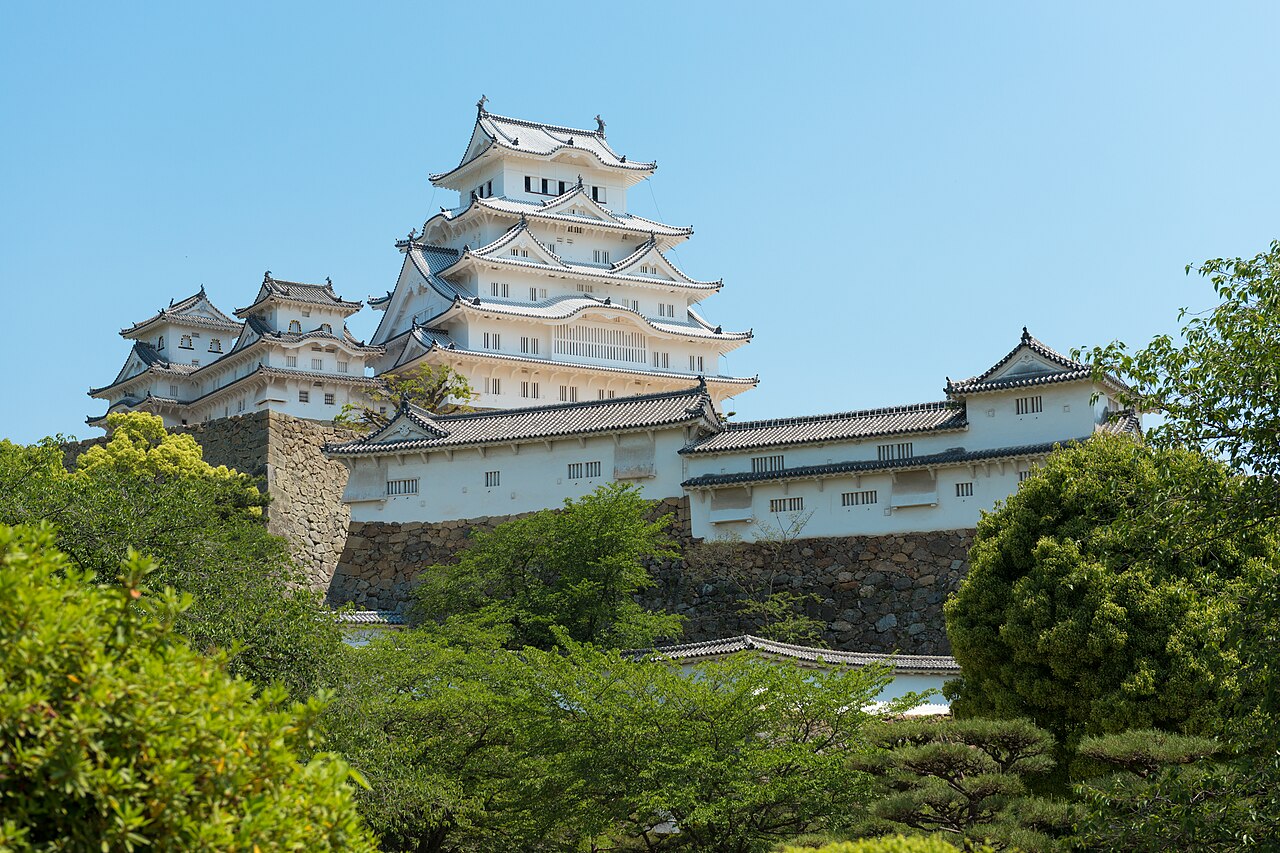
The name Shirasagi-jo — White Heron Castle — derives from the castle’s exterior finish: every exposed surface of wood and wall is coated with a thick layer of white plaster called shirakui, literally white mud. The coating was not decorative. White plaster is fire-resistant, and in a castle built from wood on a ridge above a city of wooden buildings, fire was the primary threat to survival. The white finish also reflects heat and, together with the tiered roofline ascending in stages above the valley, produces the visual impression of a large white bird spreading its wings. The effect is most pronounced in spring, when the castle is visible above the blossoming cherry trees of the surrounding gardens.
The main keep — the tenshukaku — is connected to three smaller subsidiary keeps by covered passages, forming an interconnected defensive system. Entering the complex requires passing through a sequence of gates, each positioned to channel attackers into a confined approach. The interior of the keep was designed specifically to disorient anyone who forced entry: corridors turn at unexpected angles, ceilings are low in strategic sections to force attackers to bend under beams, and the walls throughout the complex contain sama — small openings cut for arrows, muskets, and the dropping of stones. Defenders behind these openings remain concealed. Attackers in the corridors are exposed.
The structures visible today date from the rebuild of 1601–1609. Ikeda Terumasa received the domain from Tokugawa Ieyasu following the Battle of Sekigahara in 1600, in which Ikeda had fought on the Tokugawa side. The reconstruction was both a practical military project and a political statement: the scale and finish of the castle announced the consolidation of Tokugawa authority over western Japan. An earlier castle had occupied the ridge since at least the 14th century, and a fortification of the site is documented from the 1580s under Toyotomi Hideyoshi, but virtually nothing of those earlier structures survives in the present complex.
The defensive network extends beyond the main buildings. The complex includes multiple concentric enclosures — inner and outer baileys — connected by a path system that spirals and branches unpredictably. A visitor following the most direct-looking route through the site will pass through seven gates. The approach to the main keep, navigated correctly, takes approximately fifteen minutes on foot from the outer gate. Attackers unfamiliar with the layout would have found themselves in dead ends, under fire from concealed positions above.
Four Centuries of Survival: War, Demolition Orders and the Castle Sold for 23 Yen Western Honshū, 60 km west of Osaka
Himeji Castle has been the seat of 47 different feudal lords over its history. None of them took it by force. The castle changed hands by political transfer, inheritance, and administrative reassignment, never by siege or assault. This unbroken record of non-capture distinguishes it from virtually every other major castle in Japan.
The closest the castle came to destruction was not from military action but from a government auction. In 1873, the new Meiji government — having abolished the feudal domain system and with it the military purpose of feudal castles — issued orders that effectively put many castle properties up for sale or demolition. Castles were expensive to maintain and associated with the old order the government was replacing. Himeji Castle was auctioned and purchased for 23 yen 50 sen. In retrospect, this is frequently described as one of the most consequential cheap purchases in Japanese history: the castle was saved because a military unit moved in and used it as their base, making demolition impractical. The survival was bureaucratic accident rather than heritage consciousness.
The castle survived the Meiji Restoration, in which many major Japanese castles were demolished or burned in the anti-feudal upheaval. It survived the Second World War intact: the city of Himeji was bombed by Allied forces on the night of 3 July 1945, and incendiary bombs landed within the castle complex. Accounts differ on why they did not ignite — some attribute the castle’s survival to the fire-resistant plaster, others to the specific type of bomb used. The castle suffered no structural damage. The city around it was severely damaged.
The Great Hanshin earthquake of January 1995, measuring magnitude 7.2 and centred approximately 9 kilometres from Himeji, caused no structural damage to the castle either. This earthquake killed more than 6,400 people and destroyed large sections of Kobe and surrounding areas. Himeji Castle, built on the geology of a low ridge, stood without damage — a data point that continues to attract structural engineers interested in the seismic resilience of traditional Japanese timber construction techniques. A major restoration project completed in 2015 — known as the Heisei restoration — involved removing and repairing the roof tiles of the main keep and reapplying the white plaster to restore the original finish. The castle was partially closed during this work from 2010 to 2015.
Practical information
Himeji Castle is located approximately 15 minutes on foot from Himeji Station, which is served by the JR Sanyo Shinkansen (Nozomi and Hikari services from Osaka in approximately 20–30 minutes, from Kyoto in approximately 35–50 minutes). The castle grounds are open daily except the last Tuesday in December and 29–30 December; opening hours are generally 09:00–17:00 (last entry 16:00), with extended hours in summer. The main keep and attached buildings require a timed entry ticket. The surrounding Koko-en garden, a reconstructed Edo-period garden on the adjacent site of former samurai residences, requires a separate ticket. Spring visits in late March and early April coincide with cherry blossom season; the castle is one of the most photographed sakura locations in Japan and crowds are substantial. The city of Himeji itself offers limited additional UNESCO-linked heritage within the prefecture, but Osaka (60 km east) and Kyoto (90 km east) are within standard day-trip range for visitors using rail connections.
Frequently Asked Questions
Why is Himeji Castle called the White Heron Castle?
The name Shirasagi-jo — White Heron Castle — refers to the visual impression produced by the castle’s white plastered exterior and the ascending profile of its tiered roofline. Shirasagi is the Japanese term for the great egret (Ardea alba), a large white wading bird; the word is sometimes translated as “white heron” in English. The external white coating is produced by a material called shirakui, a white lime plaster applied in thick layers to all exposed wood surfaces and exterior walls throughout the complex. The primary function of this coating was fire-resistance: white plaster does not ignite easily, and in a complex built from timber, protection against fire attack was a central defensive requirement. The same plaster gives the castle’s surfaces a reflective, almost luminous quality in direct sunlight, and the stepped massing of the main keep and its three subsidiary keeps, rising in stages from the stone foundations to the highest roof ridge, produces the outline that prompted the name. The plaster finish requires periodic renewal; the most recent large-scale restoration of the main keep’s exterior plaster was completed in 2015 as part of the Heisei restoration project, after which the white surfaces appeared markedly brighter than they had in the preceding decades.
Has Himeji Castle ever been damaged in an earthquake?
The documented record shows no structural earthquake damage to Himeji Castle. The most significant test came in January 1995, when the Great Hanshin earthquake — measuring magnitude 7.2, with an epicentre approximately 9 kilometres from the castle — caused severe damage across the broader region, killing more than 6,400 people and destroying major sections of Kobe and Nishinomiya. Himeji Castle sustained no structural damage in this event. Structural engineers have studied the castle’s earthquake resilience as an example of traditional Japanese timber construction techniques: the buildings use a post-and-beam timber frame with mortise-and-tenon joinery and an absence of rigid diagonal bracing, which allows individual structural members to flex slightly under seismic loading rather than transferring stress rigidly through the frame. The stone foundation platforms (ishigaki) on which the buildings sit also provide some degree of base isolation. These characteristics are not unique to Himeji but are common to Japanese castle and temple construction of the period. The castle’s location on a low ridge above the Himeji plain, on relatively stable geology, may also have contributed to the lower seismic intensity experienced at the site compared to areas closer to the fault rupture.
What happened to Himeji Castle during World War II?
The city of Himeji was targeted by Allied bombing during the Second World War. On the night of 3 July 1945, B-29 Superfortress bombers of the United States Army Air Forces carried out an incendiary raid on the city. Himeji was a significant industrial target: the city contained munitions factories, a railroad junction, and other military-related infrastructure. The raid caused substantial damage to the city. Incendiary bombs landed within the castle complex during the attack. The main keep and the historic structures of the castle were not destroyed or structurally damaged. Accounts of why they survived vary. One version holds that the incendiary devices that fell within the castle grounds failed to ignite. Another attributes the survival to the fire-resistant properties of the white plaster coating applied to all external surfaces. A third suggests that the white exterior, visible from altitude in contrast to the burning city below, may have been mistaken for a clearly non-industrial structure and deliberately spared. None of these accounts has been definitively established from primary sources. The factual outcome is unambiguous: Himeji Castle emerged from the bombing of 1945 structurally intact, when much of the surrounding city did not.