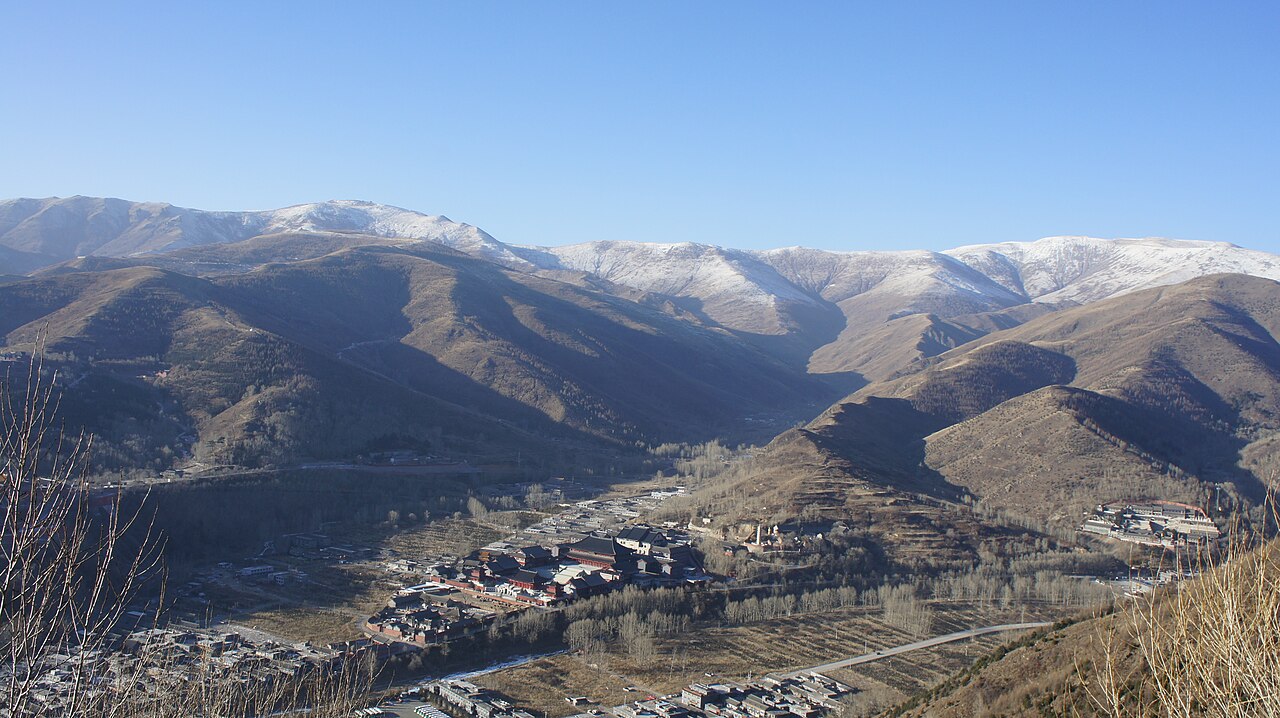
Mount Wutai (Five Terrace Mountain) in Xinzhou prefecture, Shanxi province, received UNESCO World Heritage designation in 2009. The site encompasses a group of five flat-topped peaks reaching 3,058 metres at the highest point (North Peak, Beitai Ding), with 53 surviving monasteries distributed across the mountain — spanning 1,500 years of Chinese Buddhist architectural history from the Eastern Han dynasty through the Qing. It is the only mountain among China’s four sacred Buddhist peaks recognised as holy by Mahayana Chinese, Tibetan, and Mongolian Buddhist traditions simultaneously. Two hundred kilometres east, near the city of Datong, the Yungang Grottoes offer a second UNESCO inscription within a single journey through northern Shanxi.
The Sacred Mountain of Manjushri and 1,500 Years of Buddhist Architecture Xinzhou Prefecture, Shanxi Province
Mount Wutai’s identification as the earthly residence of Manjushri (Wenshu Pusa), the Bodhisattva of Wisdom, is attested in Chinese Buddhist texts from the 1st century CE and in Indian Sanskrit sources that pre-date the Chinese reception of Buddhism. The mountain’s five flat-topped peaks, each accessible by pilgrimage trail, correspond in Buddhist cosmography to the five directions of space and the five forms of wisdom attributed to Manjushri. Pilgrims from China, Mongolia, Tibet, Japan, Korea, and Southeast Asia have documented their visits in inscriptions, travel diaries, and donated liturgical objects across the site’s history. The Tang dynasty (618–907 CE) produced the most intensive period of state-sponsored monastery construction on the mountain, under emperors who used Buddhist patronage as an instrument of political legitimacy. At the height of Tang patronage, approximately 200 monasteries occupied the mountain. Fifty-three survive in various states of preservation and continued use.
The architectural range within those 53 structures is unusual in Chinese heritage terms. The oldest surviving building is the main hall of Nanchan Temple, built in 782 CE — the oldest known surviving timber-frame building in China. The second-oldest is the east main hall of Foguang Temple, constructed in 857 CE. Both buildings use the characteristic Tang structural system: a massive overhanging roof supported by interlocking wooden brackets (dougong) that extend the roof plane far beyond the wall face, with large column spacing and a spatial volume inside the hall proportionally different from the more compressed Song and later buildings that dominate most Chinese Buddhist sites. The visual difference between a Tang-era hall and a Qing-era hall on the same mountain allows a direct comparison of how Chinese timber architecture evolved across those twelve centuries.
The Xiantong Temple, identified by tradition as the first Buddhist temple established on the mountain — founded, according to records, in 68 CE under the Eastern Han dynasty — has been rebuilt many times and its current structures are predominantly Ming and Qing. It remains the largest complex on the mountain by building count and courtyard area, with more than 400 rooms arranged in a sequence of axial courtyards running uphill from the entrance gate. The monastery is still occupied by an active monastic community. At the summit plateau, the Pusa Ding (Bodhisattva’s Crown) monastery sits on a natural terrace above the main settlement area; it was the residence of the Lama Imperial Envoys dispatched by the Qing court and carries Tibetan-influenced elements in its decorative programme — a physical record of the Qing emperors’ effort to express sovereignty over Tibetan Buddhism through patronage at Mount Wutai.
The Foguang Temple Discovery and the Survival of Tang Architecture Xinzhou Prefecture, Shanxi Province
By the early 20th century, the consensus among both Chinese and Japanese architectural historians was that no authentic Tang-dynasty timber buildings survived anywhere in China. Tang structures were known primarily through pictorial representations — stone carvings, silk paintings, and the wall murals in the Dunhuang cave complex in Gansu province. Japan, which had received Tang architectural forms via Buddhist cultural transmission in the 7th and 8th centuries, preserved several buildings from that period in Nara prefecture; Chinese scholars worked from Japanese buildings to reconstruct what Tang Chinese architecture had looked like, in a situation that Japanese scholars noted pointedly as a reversal of the historical flow of architectural influence.
In 1937, Liang Sicheng (1901–1972) and Lin Huiyin (1904–1955) — the founders of systematic Chinese architectural history as an academic discipline — followed a clue in a Dunhuang cave mural that appeared to depict a specific monastery complex on Mount Wutai. Travelling to the mountain during a period of active Japanese military activity in northern China, they located the Foguang Temple in the mountains east of the main Wutai settlement. Examination of the main hall’s structural members, including ink inscriptions on the underside of ceiling beams, established a construction date of 857 CE — making it the oldest surviving Tang timber building then known. The hall’s proportions, dougong bracket system, and spatial organisation matched the forms depicted in the Dunhuang murals that had directed the search.
The discovery was significant on multiple levels. It confirmed that Tang architectural forms had survived in China itself, not only in Japan. It validated the methodology of using pictorial sources to locate surviving buildings — a technique Liang and Lin’s Society for Research in Chinese Architecture applied systematically across northern China through the 1930s and 1940s. Liang Sicheng went on to become one of the most influential voices for the preservation of historic Chinese architecture in the mid-20th century, arguing against the demolition of Beijing’s city walls and gate towers in the 1950s — arguments he largely lost to the urban planning priorities of the new government. The Foguang Temple at Mount Wutai stands as the most important surviving evidence for the architectural form that Liang spent his career documenting. The Nanchan Temple hall, dating to 782 CE and located in a more remote valley on the mountain, was identified shortly after Foguang and predates it by 75 years.
The Yungang Grottoes, 200 kilometres east near Datong, represent a different register of the same Buddhist cultural history. Carved into sandstone cliffs between 460 and 525 CE under the Northern Wei dynasty, the 252 cave temples at Yungang contain the earliest large-scale Buddhist stone sculpture in China. The Northern Wei carved Yungang while simultaneously patronising the earliest phases of construction at Mount Wutai; the two sites together map the beginning of Chinese Buddhist material culture in the north.
Practical information
Mount Wutai is in Xinzhou prefecture, Shanxi province. The nearest major city is Taiyuan, Shanxi’s provincial capital, served by Taiyuan Wusu International Airport and high-speed rail connections to Beijing (approximately 2 hours), Xi’an, and Zhengzhou. From Taiyuan, the mountain is approximately 230 kilometres by road (3 to 3.5 hours); direct buses operate from Taiyuan’s long-distance bus station. The scenic area has its own entrance fee; individual monastery complexes may charge additional admission. The Nanchan Temple is located in a separate valley from the main settlement area and requires additional travel by road from the central plateau. The Foguang Temple is also off the main plateau, approximately 30 kilometres from the central area; it sees far fewer visitors than the plateau monasteries and is best reached by hired vehicle. Accommodation is available in the central settlement area (Taihuai Town) ranging from basic guesthouses to larger hotels; monastery guesthouses can occasionally be arranged through local agencies. The area is at altitude: summer temperatures on the plateau are significantly lower than the surrounding plains, and the mountain receives substantial snowfall from October through April. The Yungang Grottoes near Datong are accessible by high-speed rail from Taiyuan (approximately 1.5 hours to Datong) and by taxi or bus from Datong station.
Frequently Asked Questions
Why is Mount Wutai the only Chinese sacred mountain recognised by three Buddhist traditions?
China’s four sacred Buddhist mountains — Wutai, Emei, Jiuhua, and Putuo — are each associated with a specific Bodhisattva and draw pilgrims primarily from Chinese Mahayana Buddhism. Mount Wutai’s additional recognition by Tibetan and Mongolian Buddhist communities derives from the particular status of Manjushri in the Vajrayana (Tibetan Buddhist) tradition, where Manjushri is a central figure in tantric practice and his iconography appears throughout Tibetan liturgical art and monastic training. Tibetan pilgrimage to Mount Wutai is documented from the Tang dynasty (618–907 CE), when Tibetan and Chinese diplomatic and religious contacts were at a high point. The Qing dynasty (1644–1912) deliberately amplified this multi-tradition character as a political strategy: the Manchu emperors, who ruled both Chinese and Tibetan-Mongolian Buddhist subjects, patronised Mount Wutai as a symbol of imperial authority over both communities. Qing emperors visited the mountain and funded construction of Tibetan-style buildings within the existing Chinese monastery complex; the Pusa Ding monastery became a residence for the Lama envoys stationed there under imperial appointment. The Dalai Lamas and Panchen Lamas also visited or sent representatives. For Mongolian Buddhists, who practise a form of Tibetan Buddhism, Wutai’s recognition followed from its status in the Tibetan tradition. The result is a mountain where Chinese-style halls built in the Tang and Song period stand alongside Qing-era Tibetan-influenced structures, and where pilgrimage parties from multiple traditions visit simultaneously — a site whose physical fabric records the political and religious history of multiple Buddhist communities across fifteen centuries.
How did Liang Sicheng and Lin Huiyin find the Foguang Temple using a Dunhuang mural?
Liang Sicheng and Lin Huiyin were the founders and primary researchers of the Society for Research in Chinese Architecture, established in Beijing in 1930. Through the 1930s they conducted systematic surveys of historic buildings across northern China, travelling to county seats and rural areas by whatever transport was available — train, bus, mule cart, or on foot — to measure, photograph, and document surviving pre-Ming structures. The Foguang Temple discovery in 1937 followed from a specific research method: Liang was studying the large collection of Buddhist wall paintings in the Dunhuang cave complex (Cave 61, the “Wutai Map,” painted in the Five Dynasties period around 950 CE depicts a detailed map of the Mount Wutai area with monastery names and locations labelled). The mural appeared to show the location and general form of a monastery building that matched descriptions in textual sources suggesting pre-Tang or early Tang construction. Liang and Lin travelled to Mount Wutai despite the deteriorating security situation — the Second Sino-Japanese War had begun — to locate the building on the ground. They found the Foguang Temple in the mountains east of the main plateau settlement. On-site examination included reading ink inscriptions written on the undersides of wooden beams during construction — a practice used to record dates and donor names — which confirmed the 857 CE date for the main hall. The proportions and structural system of the hall matched Tang-period representations in stone carvings and paintings in ways that later Song, Ming, and Qing buildings did not. The find was published in academic journals and fundamentally changed the field by demonstrating that Tang buildings existed on Chinese soil, not only in Japan.
What is the difference between the Nanchan Temple and the Foguang Temple on Mount Wutai?
Both temples are on Mount Wutai but in different valleys from the main plateau settlement, and they represent different phases of Tang-dynasty architecture. Nanchan Temple (Nanchan Si) contains the oldest surviving timber-frame building in China: its main hall, the Da Fodian, was constructed in 782 CE. It is a small building — three bays across, two bays deep — set in a modest courtyard complex in the Doucun Valley. Its scale reflects the relatively limited patronage of a local monastery rather than imperial sponsorship, which makes its survival somewhat paradoxical: it escaped the Huichang Suppression of Buddhism (842–845 CE), during which the Tang emperor Wuzong ordered the destruction of thousands of Buddhist monasteries and the secularisation of their clergy, possibly because of its remote location and small scale. Foguang Temple (Foguang Si), by contrast, was rebuilt with substantial imperial and aristocratic patronage immediately after the suppression ended in 847 CE; its main hall (the Dong Da Dian, East Main Hall) dates to 857 CE. It is a larger building — seven bays across, four bays deep — with a monumental dougong bracket system under deep overhanging eaves. Its scale and structural complexity reflect full Tang imperial patronage. The Tang clay sculptures in the main hall — 33 figures in total, including the original altar arrangement — are among the best-preserved Tang Buddhist sculptures in China, contemporary with the hall itself and still in their original positions. Both temples are open to visitors, though the Foguang Temple sees far fewer arrivals due to its distance from the plateau and the unpaved road section leading to it.