
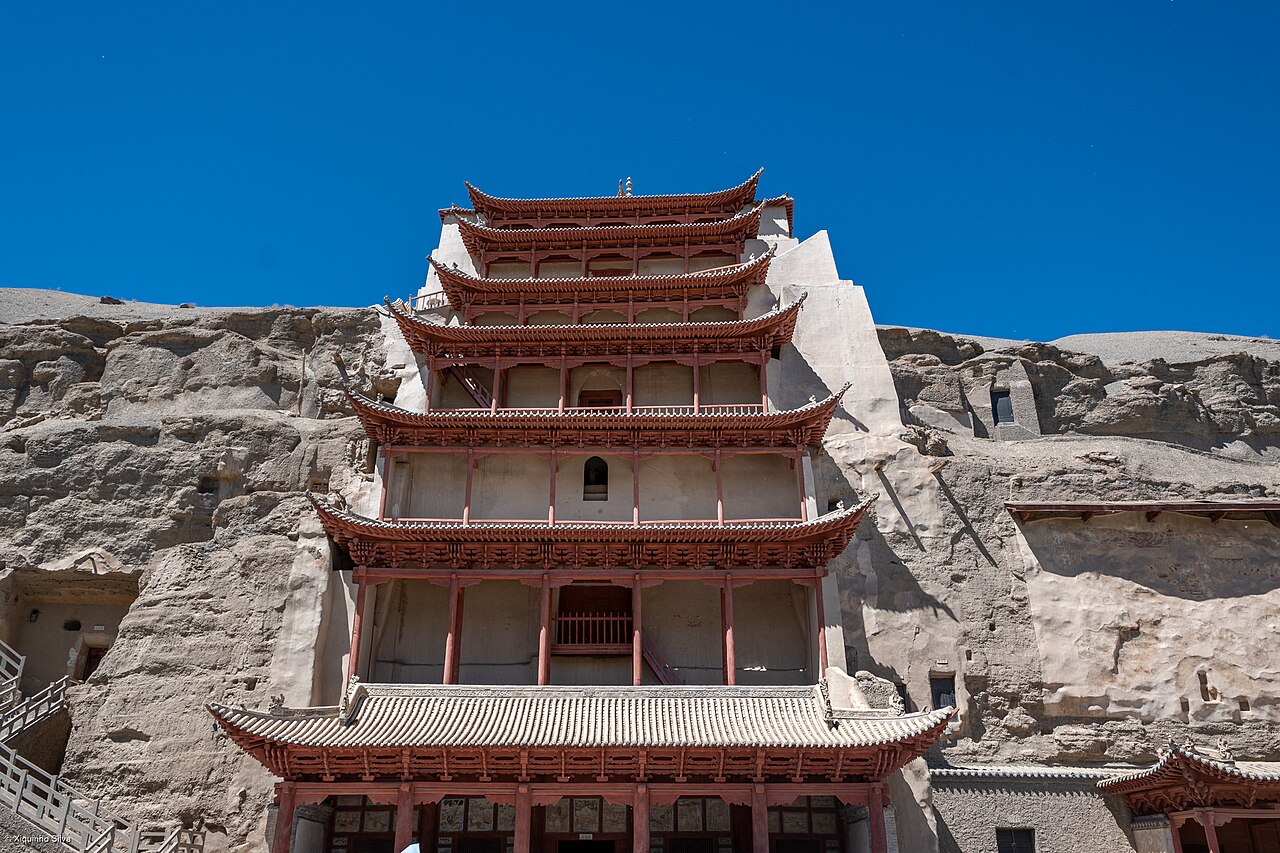
The Mogao Caves are a system of 492 Buddhist cave shrines cut into a sandstone cliff 25 kilometres southeast of Dunhuang, in Gansu province, northwestern China. Commissioned between the 4th and 14th centuries CE, they contain approximately 45,000 square metres of painted murals and more than 2,000 painted sculptures — the largest surviving collection of Buddhist art in the world. UNESCO inscribed the site in 1987.
A Thousand Years of Devotion Carved Into Desert Rock Gansu Province, NW China
Dunhuang sits at one of the most consequential geographical bottlenecks in Asian history. East of the city, the Hexi Corridor — a narrow strip of land between the Tibetan Plateau and the Gobi Desert — was the only viable overland route connecting China’s interior to Central Asia. West of Dunhuang, the Silk Road bifurcated: one branch ran north of the Taklimakan Desert through Turfan and Kashgar; the other tracked south through Hotan and Yarkand. Every merchant, monk, diplomat, and soldier crossing between China and the western world passed through Dunhuang for roughly a millennium.
The Mogao Caves were carved into a sandstone cliff face along the Dachuan River valley, 25 kilometres southeast of the city. The first cave was excavated in 366 CE, when a Buddhist monk named Lezun reportedly experienced a vision of a thousand Buddhas radiating golden light from the cliff face. The name “Mogao” translates approximately as “peerless” — a designation that later generations found apt. For the next thousand years, successive waves of patrons — travelling monks, Silk Road merchants, local governors, military commanders, and members of the Tang imperial court — commissioned new caves, expanded old ones, and added to the accumulating layer of images that today cover 45,000 square metres of wall surface.
The patronage system explains both the variety and the continuity of the art. A merchant setting out across the Taklimakan might commission a cave painting of Vaisravana, the Guardian King of the North, to protect his caravan. A returning official might donate a complete cave with a central Buddha flanked by bodhisattvas to give thanks for a safe journey. Monks in permanent residence maintained the site and added votive images continuously. The result is an unbroken visual record of Buddhist iconography across four dynasties — Northern Wei, Sui, Tang, and Song — that shows how Buddhist imagery evolved as it travelled east from India through Central Asia into China.
The Tang dynasty (618–907 CE) produced the most technically accomplished paintings. Tang-era caves show confident draftsmanship, sophisticated colour use (mineral pigments mixed with clay), and scenes of considerable narrative complexity — depictions of the Pure Land paradise of Amitabha Buddha that extend across entire wall surfaces and include hundreds of individual figures, musicians, dancers, and architectural details. These Pure Land panoramas were not merely devotional images but practical demonstrations of what awaited the faithful after death, painted large enough that illiterate pilgrims could read the stories directly from the walls.
Cave 17 and the 40,000 Manuscripts Sold for £130 Site Access via Dunhuang City
In approximately 1000 CE, a small side chamber off Cave 16 was sealed behind a plastered wall and forgotten. The reason for the sealing remains debated among scholars: the most widely accepted theory holds that the documents were hidden from Tangut (Western Xia) armies advancing on Dunhuang around 1006 CE. An alternative theory suggests the chamber served as a repository for worn-out sacred texts that were too holy to destroy but no longer usable. Whatever the reason, when the wall was breached in 1900, the chamber — now designated Cave 17, the “Library Cave” — was found to contain approximately 40,000 to 50,000 manuscripts, printed documents, silk paintings, embroideries, and textile fragments.
The discovery was made by Wang Yuanlu, a self-appointed Taoist monk who had appointed himself guardian of the site in the 1890s. Wang wrote to provincial authorities in Lanzhou requesting funds to preserve the material; his letters were largely ignored. In 1907, the British-Hungarian archaeologist Marc Aurel Stein arrived at Dunhuang on his second Central Asian expedition. Over the course of several weeks, Stein negotiated with Wang — who was suspicious of foreign interest but in need of funds for restoration work — and eventually purchased a substantial portion of the manuscripts for £130. He shipped 24 crates containing approximately 7,000 manuscripts and 6 crates of paintings and artefacts to the British Museum in London.
Stein was followed in 1908 by the French sinologist Paul Pelliot, who read Chinese and could assess the manuscripts directly; Pelliot selected what he considered the most significant 6,000 items and paid 500 taels of silver. Japanese, Russian, and American expeditions followed in subsequent years. By the time Chinese authorities intervened and moved the remaining material to Beijing in 1910, approximately two-thirds of the Library Cave’s original content had left China. The manuscripts are now distributed across the British Library, the Bibliothèque nationale de France, the National Museum in New Delhi, the Hermitage in St Petersburg, and the National Library of China in Beijing.
Among the documents removed by Stein was a printed scroll containing the full text of the Diamond Sutra, dated to the 11th day of the 4th month of the 9th year of the Xiantong reign era — equivalent to 11 May 868 CE. It is the oldest complete, dated printed book in the world. The text was produced using woodblock printing nearly six centuries before Gutenberg. The colophon states that it was printed “for universal free distribution” by Wang Jie on behalf of his parents. It is held today by the British Library in London.
Since 2003, the Dunhuang Academy has led a comprehensive digital documentation project in partnership with international institutions. High-resolution imaging of every cave surface, combined with 3D scanning of sculptures, has produced a virtual archive that allows access to the interiors without the humidity introduced by visitor breath — one of the primary threats to pigment stability. Several caves that were previously accessible are now closed to standard visitors; digital reproductions in an on-site exhibition centre provide an alternative.
Practical information
The Mogao Caves are located 25 kilometres southeast of Dunhuang city centre. Regular shuttle buses run from the Dunhuang Visitor Centre, where all tickets must be booked in advance online (foreign visitors require a Chinese ID or passport number for the booking system — third-party booking services are available). The standard ticket covers a guided tour of eight caves, a film presentation, and access to the digital exhibition centre; the number of visitors per day is capped at 6,000. Special tickets for additional caves (including caves with Tang paintings not on the standard route) are issued in very limited numbers and must be booked separately. Visits run approximately three hours. The site operates year-round, though late April through October sees the highest visitor numbers. Dunhuang is reached by air from Lanzhou, Urumqi, Xi’an, and Beijing (Dunhuang Airport), or by train on the Lanzhou–Xinjiang high-speed rail line to Dunhuang station (approximately 40 minutes from the city centre). Accommodation ranges from international-standard hotels in Dunhuang city to smaller guesthouses. The nearest large city is Lanzhou, approximately 1,100 kilometres east.
Frequently Asked Questions
What is the significance of the Diamond Sutra found at Mogao Caves?
The Diamond Sutra recovered from Cave 17 at Mogao is a woodblock-printed scroll dated 11 May 868 CE. It is the oldest complete printed book in the world for which a firm production date is recorded. The colophon — a printer’s note at the end of the scroll — explicitly states the date in the Chinese reign-year calendar and records that one Wang Jie commissioned the printing for free distribution in honour of his parents. The scroll is approximately 5 metres long and consists of seven sheets of paper glued end to end, printed from carved wooden blocks in a single black ink impression. The quality of the printing is high: the characters are even, the registration is precise, and the frontispiece illustration — showing the Buddha preaching to his disciple Subhuti — is technically accomplished. The text itself is the Vajracchedika Prajnaparamita Sutra, one of the foundational texts of Mahayana Buddhism. The Diamond Sutra predates Gutenberg’s Bible by approximately 587 years, establishing that movable or block printing was in practical use in Tang China for mass reproduction of religious texts centuries before the technique appeared in Europe. The scroll was acquired by Marc Aurel Stein in 1907 and is held today in the British Library in London, where it can be viewed in the Sir John Ritblat Gallery or accessed in its entirety via the British Library’s digitisation programme.
How were the Mogao Caves commissioned and by whom?
The caves were not state projects in the modern sense but acts of individual Buddhist merit-making. The Buddhist concept of punya — merit accumulated through generous action — made the commissioning of sacred art one of the highest forms of religious investment. A merchant about to cross the desert might commission a painting of a protective deity; a returning official might fund a complete cave with sculpture and wall paintings to give thanks for safe passage; a local ruler might endow a large cave as a statement of political legitimacy and religious devotion simultaneously. Inscriptions inside the caves record the names of patrons, their titles, and sometimes their intentions. The range of patrons is remarkable: Tang dynasty records name members of the imperial family, military governors of the Hexi region, Sogdian merchant families who had settled in Dunhuang as trading communities, local Chinese administrators, and individual monks. During the Tibetan occupation of Dunhuang (786–848 CE), Tibetan noble families also commissioned caves, adding Tibetan iconographic elements to the existing Chinese and Central Asian visual vocabulary. The caves therefore function as a material record not just of Buddhist devotion but of the social composition of Silk Road Dunhuang — a genuinely multicultural community whose artistic output reflects the meeting of Indian, Central Asian, Chinese, and Tibetan traditions.
What damage have the Mogao Caves suffered and how is conservation managed today?
The principal threat to the Mogao murals is moisture. The original pigments — mineral-based colours including malachite green, azurite blue, cinnabar red, and lead white — are chemically stable in the desert environment, where relative humidity remains naturally low. But the breath and body heat of thousands of daily visitors introduced humidity that caused pigments to detach from clay plaster, efflorescence (salt crystalisation) to form on wall surfaces, and biological growth (bacteria and fungi) to accelerate. Studies conducted from the 1990s onward showed measurable deterioration in the most-visited caves. The Dunhuang Academy responded by limiting daily visitor numbers, closing the most vulnerable caves to general access, and installing monitoring systems that track humidity, CO₂, and visitor density in real time. Since 2003, a comprehensive digital documentation programme — developed in partnership with the Getty Conservation Institute and later expanded through the International Dunhuang Project — has created sub-millimetre-resolution photographic records of every painted surface and 3D scans of every sculpture. Replicas of key caves, built to exact scale in the visitor centre, now take much of the educational load previously carried by direct access. The 2030s conservation challenge is stabilising areas where the sandstone cliff face itself is eroding from wind and occasional rainfall — an external threat independent of visitor pressure.

.jpg)