
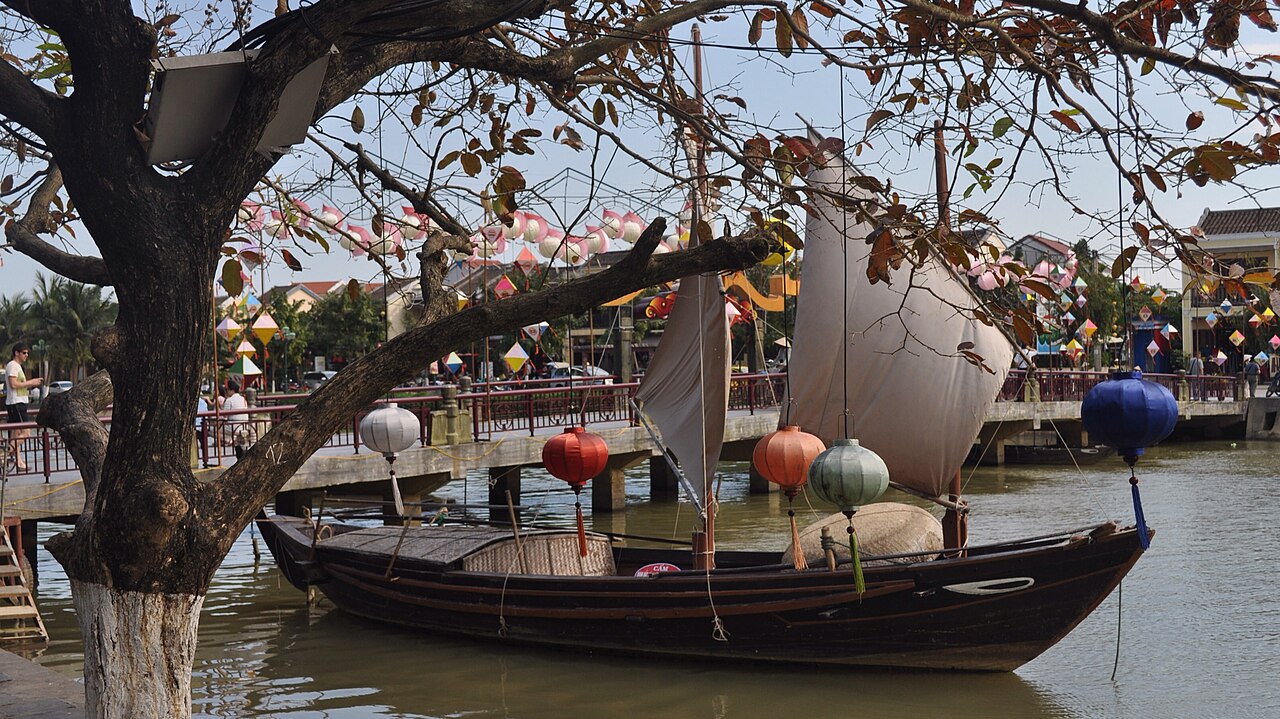
Hội An (formerly Faifo) is a well-preserved trading port town in Quảng Nam province, central Vietnam, on the Thu Bồn River; it was one of the most important trading ports in Southeast Asia in the 16th and 17th centuries, receiving merchants from China, Japan, the Netherlands, Portugal, India, and the Cham Kingdom. UNESCO inscribed it as a World Heritage Site in 1999. The old town’s historic core retains approximately 1,100 buildings from the trading era, including tube houses, assembly halls, temples, and a Japanese-built covered bridge that appears on Vietnam’s 20,000-đồng banknote.
The Port That the World Came To Quảng Nam Province, Central Vietnam
Hội An’s position on the Thu Bồn River, approximately 30 km south of Đà Nẵng and close to the sea, made it one of the most strategically placed trading ports on the maritime routes linking China and Japan with the spice islands of the Indonesian archipelago and the ports of India. From the late 15th century through the 17th century, the town served as a point of convergence for an exceptional variety of trading communities — Chinese merchants from Fujian, Guangdong, Chaozhou, and Hainan provinces established permanent quarters and community institutions; Japanese merchants maintained a significant presence until the Tokugawa shogunate’s 1635 edict restricting overseas trade withdrew the Japanese community; Dutch and Portuguese traders operated through the port; and Indian merchants, primarily from South India and Gujarat, traded textiles and spices.
The physical form of the old town reflects this layered commercial history. The street pattern follows the Thu Bồn riverfront and the parallel lanes running back from it, organised around a logic of waterfront access rather than a planned grid. The buildings are predominantly the tube house (nhà ống) type: extremely narrow frontages — sometimes as little as 4 metres wide — opening onto long, deep interiors that extend back from the street, often passing through a series of rooms separated by small interior courtyards that provide light and ventilation. This form is a Vietnamese-Chinese hybrid, combining Chinese merchant house typology with Vietnamese spatial organisation, and it developed precisely in commercial port contexts where street frontage was expensive and interior depth was the only available expansion direction.
The most celebrated surviving example of the tube house typology is the Tấn Ký House on Nguyễn Thái Học Street, built in the 17th century and still occupied today by the seventh generation of the same family. The house demonstrates the full sequence of a prosperous merchant’s dwelling: a reception room for customers opening directly onto the street, a narrower central corridor leading through interior courtyards, a warehouse section, and private family quarters at the rear. The building materials and decorative details reflect the composite cultural identity of its builders: Japanese roof brackets, Chinese ceramic inlays and carved calligraphy panels, and Vietnamese lacquerwork all appear in the same interior.
The Japanese Covered Bridge (Chùa Cầu, also called Lai Viễn Kiều — “the bridge welcoming visitors from afar”) was built around 1593 by the Japanese trading community, who lived to the west of the bridge, to connect their quarter to the Chinese quarter to the east. It spans a small tributary of the Thu Bồn, is approximately 18 metres long, and is the only remaining covered bridge in Vietnam. What distinguishes it from a straightforward piece of civil engineering is the small Buddhist pagoda built into the bridge structure itself — an element unusual enough to have drawn comment from Vietnamese chroniclers at the time of construction. The bridge appears on the 20,000 Vietnamese đồng banknote, making it one of the most widely circulated architectural images in the country.
The Five Assembly Halls and the Architecture of Community 70 km Northeast of Mỹ Sơn
The Chinese migrant communities in Hội An organised themselves not by individual province of origin but by speech group — a distinction that mattered enormously in a pre-modern Chinese context where mutual intelligibility between dialects was limited and economic and social networks were built along linguistic lines. Each community built its own assembly hall (hội quán in Vietnamese, huiguan in Chinese), which served simultaneously as an ancestral temple, a community meeting house, a social welfare institution for newly arrived migrants, and a place of worship for the sea goddess Mazu (known in Vietnamese as Thiên Hậu), who was the primary protective deity for maritime trading communities across the South China Sea.
Five assembly halls survive in the old town, each associated with a distinct Chinese community. The Fujian Assembly Hall (Hội Quán Phúc Kiến) is the most elaborate and the most frequently visited, dedicated to Thiên Hậu and housing a polychromatic ceramic sculpture of the goddess in her main hall, surrounded by figures of her attendants — the Thousand-Mile Eye and the Wind-Listener — who can see and hear across the sea. The hall’s courtyard contains an 18th-century ceramic model of a three-masted Chinese trading vessel, a votive object donated by Fujian merchants as an offering for safe passage. The Cantonese Assembly Hall (Hội Quán Quảng Đông) is dedicated to General Quan Công (Guan Yu), the deified Chinese general venerated across East and Southeast Asian Chinese communities as a patron of merchants, and contains an impressive carved wooden altar. The Chaozhou, Hainanese, and All-Chinese assembly halls each reflect their communities’ distinct aesthetic preferences in their decorative programmes and altar arrangements.
The Mỹ Sơn Sanctuary — the ruined complex of Cham Hindu temples located approximately 70 km southwest of Hội An — lies within the same UNESCO-designated province and can be visited as a related heritage site on the same trip to central Vietnam. Mỹ Sơn was the religious capital of the Cham Kingdom, which controlled central Vietnam from the 4th to 13th centuries CE; the Cham presence in Hội An predated the Vietnamese and Chinese settlement of the town, and Cham cultural influence persisted in the region long after the Cham Kingdom’s political decline.
Hội An declined as a port in the early 19th century when the Thu Bồn River silted up sufficiently to prevent larger trading vessels from reaching the town’s wharves. Trade shifted north to the newly developed port of Đà Nẵng, which had the deeper harbour access that 19th-century maritime commerce required. The result was a form of economic stasis that preserved the physical fabric of the town while allowing more commercially active ports to modernise and rebuild: Hội An’s merchants and families stayed, maintained their buildings, and continued their lives in a town that was no longer receiving the commercial traffic that had originally built it. This accidental preservation by neglect is the structural reason why 1,100 historic buildings survive in the old town today.
Practical information
Hội An is located in Quảng Nam province, central Vietnam, approximately 30 km south of Đà Nẵng. Đà Nẵng International Airport is the main entry point, with direct flights to Hanoi, Ho Chi Minh City, and several international destinations. From Đà Nẵng, taxis or car hire to Hội An take approximately 45 minutes; buses and shared minibuses are also available. The historic old town core is closed to private motor vehicles during daytime hours; visitors explore on foot or by bicycle. An entrance ticket covering the five assembly halls, the Japanese Covered Bridge, and several historic houses is required to enter the designated heritage buildings; the ticket is purchased at offices near the main entrances to the old town. The town is extremely busy with tourism, particularly in December and January; visiting the historic buildings early in the morning, before tour groups arrive, makes a significant difference. The Mỹ Sơn Sanctuary can be reached by road in approximately 1.5 hours from Hội An, making it feasible to combine both sites in a single day.
Frequently Asked Questions
Why did Japanese merchants build a bridge in Hội An, and why does it have a pagoda in it?
The Japanese trading community in Hội An was one of the most significant foreign merchant groups in the town during the late 16th and early 17th centuries. Japanese merchants lived in a quarter to the west of a small tributary of the Thu Bồn River, while Chinese merchants were established to the east. The bridge was built around 1593 to connect the two quarters and facilitate trade between them — a practical piece of infrastructure serving a commercial community that regularly did business across communal lines. The covered structure over the bridge served to protect the bridge deck from the tropical monsoon rains, extending its usable life and making it more comfortable for the constant foot and cart traffic that commercial activity required. The small Buddhist pagoda built into the western end of the bridge is architecturally unusual — bridges with integrated temples exist in other parts of Asia, but they are uncommon — and its presence in Hội An reflects the religious identity of the Japanese community that built it. The dedication of the pagoda is to a pair of deities: the monkey god and the dog god, whose images flank the pagoda’s interior, corresponding to the years in the Chinese zodiac cycle during which legend holds the construction began and ended. After the Tokugawa shogunate’s 1635 edict prohibited Japanese merchants from travelling overseas, Hội An’s Japanese community ceased to receive new arrivals and gradually declined; by the late 17th century the Japanese quarter had largely merged into the broader Chinese-Vietnamese commercial community. The bridge, however, was maintained and is the only structure in Vietnam unambiguously associated with the Japanese historical presence on the mainland.
What are the five Chinese assembly halls and what distinguishes them from one another?
The five Chinese assembly halls in Hội An were built and maintained by distinct migrant communities organised by their province of origin in China — a form of mutual aid organisation common wherever Chinese merchants settled in large numbers in Southeast Asia. The Fujian Assembly Hall (Hội Quán Phúc Kiến) is the most elaborate, dedicated to Thiên Hậu (Mazu, the sea goddess), and contains a 200-year-old ceramic model of a Fujian trading vessel as a votive offering; it also maintains a genealogical register of Fujian migrant families and their descendants. The Cantonese Assembly Hall (Hội Quán Quảng Đông) is dedicated to Quan Công (the deified general Guan Yu) and is known for its large carved wooden altar and the quality of its lacquered panels. The Chaozhou Assembly Hall (Hội Quán Triều Châu) is distinguished by its carved wooden boat-shaped altar canopy, considered the finest example of that type of decorative woodcarving in Hội An; the Chaozhou community was known for its involvement in the regional pepper and commodity trade. The Hainanese Assembly Hall (Hội Quán Hải Nam) is the most recent and somewhat plainer than the others; it commemorates 108 Hainanese merchants killed by Vietnamese imperial forces in 1851 after being mistaken for pirates. The All-Chinese Assembly Hall (Hội Quán Ngũ Bang) was established jointly by all five communities as a shared space for collective worship and community governance, and its altar is dedicated to Thiên Hậu in her capacity as protector of all maritime Chinese communities regardless of speech-group origin.
How did the silting of the Thu Bồn River lead to Hội An’s preservation, and what does the old town look like today?
The Thu Bồn River, which gave Hội An its commercial importance by providing a sheltered anchorage accessible from the sea, gradually silted up over the 18th and 19th centuries — a natural geological process accelerated by deforestation in the river’s upland catchment and the accumulation of sediment deposited by the seasonal floods that recur throughout the region. By the early 19th century, the draft available at Hội An’s wharves was insufficient for the larger trading vessels that had come to dominate regional maritime commerce. The Nguyễn dynasty, which unified Vietnam in 1802 under Emperor Gia Long, promoted Đà Nẵng, 30 km north, as the region’s primary commercial port; the deeper harbour at Đà Nẵng was more suited to the vessel sizes of the period. Hội An’s merchants did not leave — they continued to inhabit and maintain their buildings, operate local trade, and conduct their communal and religious life — but the town stopped growing and stopped rebuilding. The economic stasis that resulted from the loss of large-scale commercial traffic is, paradoxically, what preserved the built fabric. Towns that remain commercially active rebuild: they replace old structures with new ones suited to current needs, widen streets for motor vehicles, and adapt their building stock to changing commercial and residential requirements. Hội An’s 1,100 surviving historic structures — tube houses, assembly halls, communal temples, the Japanese Covered Bridge — represent the accumulated building of three centuries of active commerce, maintained by communities who had no economic incentive to replace them with something newer. The old town today is dense, walkable, and in places very crowded with visitors; the buildings are in active use as residences, shops, restaurants, and cultural institutions.


.jpg)