
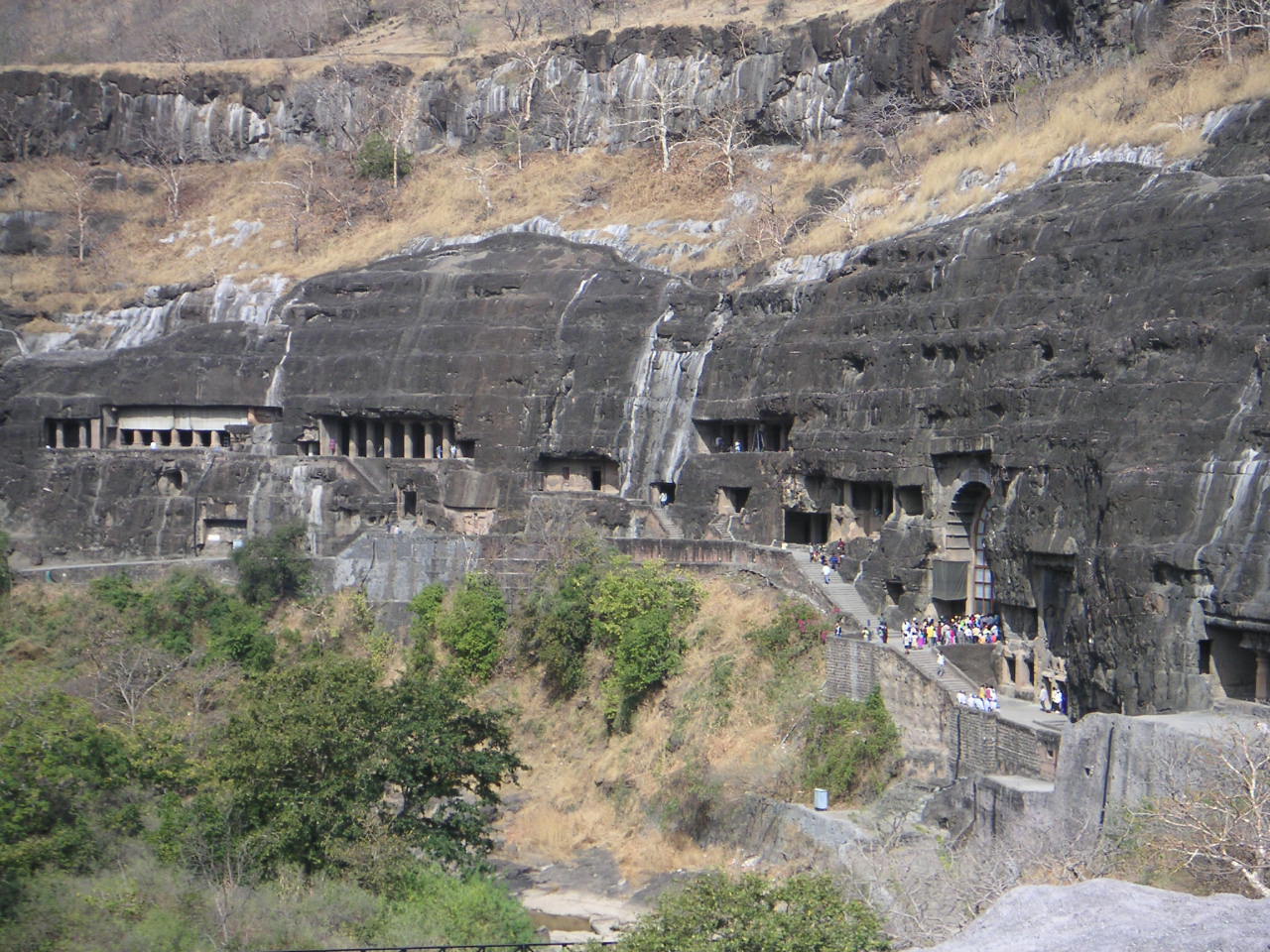
Ajanta is a UNESCO World Heritage Site (inscribed 1983) of 29 Buddhist rock-cut caves set in a horseshoe-shaped basalt cliff above the Waghora River gorge in Aurangabad district, Maharashtra, excavated across two distinct phases between approximately 200 BCE and 480 CE. The site contains the finest surviving corpus of ancient Indian mural painting, produced in mineral pigments on lime plaster, depicting Jataka tales, scenes of courtly life, and portraits of the Buddha and bodhisattvas. Abandoned around 480 CE, the caves were unknown to the outside world for approximately 1,300 years until a British Army officer stumbled upon them in 1819 while hunting tigers.
Two Phases of Excavation Across Seven Centuries Aurangabad district, Maharashtra, India
The caves at Ajanta were not created in a single continuous effort. Two distinct phases of patronage, separated by several centuries, account for the 29 caves visible today. The first phase, from roughly 200 BCE to 100 CE, was funded by merchants, guilds, and local rulers aligned with the Hinayana (Theravada) tradition of Buddhism. These early caves are more austere in decoration; their sculptural programmes are restrained, and the figure of the Buddha appears primarily in symbolic form — as a footprint, an empty throne, or a parasol — rather than in human likeness. Caves 9 and 10 from this phase are among the oldest chaitya halls surviving in India.
The second phase, compressed into roughly two decades between approximately 460 and 480 CE under the patronage of the Vakataka king Harishena, accounts for the majority of Ajanta’s most celebrated painting and the elaborate sculptural facades. This phase reflects Mahayana Buddhist theology, in which the bodhisattva — a being who delays personal enlightenment to assist others — plays a central role. The visual explosion of Cave 1, Cave 2, and Cave 17 belongs to this second phase. Harishena’s death around 477 CE and the political instability that followed brought the second phase to an abrupt halt; several caves appear unfinished, with scaffolding marks still visible on the ceiling rock. The site was abandoned around 480 CE and the jungle encroached.
The physical achievement of the Ajanta excavations should not be underestimated. The cliff face rises steeply above the Waghora River gorge; workers were lowered on ropes from above to cut the cave facades, while those inside worked by the light of oil lamps and polished metal mirrors angled to redirect sunlight from the gorge. The logistics of supplying a workforce in a remote gorge, maintaining the quality of plaster preparation and pigment grinding, and sustaining complex iconographic programmes across dozens of simultaneous worksites — all within the concentrated two-decade window of the Vakataka phase — represent a coordination effort on a scale rarely matched in ancient construction.
Cave 26 from the second phase is a chaitya hall containing a 7-metre reclining Buddha in the parinirvana pose — the moment of the Buddha’s final passing into nirvana — carved in high relief along one entire wall. The vaulted ceiling above it is carved with ribs imitating earlier wooden construction, in the same tradition as Cave 10 at Ellora. The facade of Cave 26 is one of the most elaborately carved at the site, with figures of donors, celestial musicians, and narrative reliefs framing the entrance arch.
The Paintings: Mineral Pigments on Plaster, and the Problem of Survival Caves 1, 2, 17 — principal painting locations
The murals at Ajanta are not frescoes in the Italian sense — they were not painted on wet plaster. The technique is closer to secco: a ground of clay mixed with cow dung and rice husks was applied to the cave wall, covered with a fine finishing coat of lime plaster, and the painting was executed on the dry surface using a binding medium, possibly animal glue or plant resins, to fix the mineral pigments. The colours were derived from materials available within the region: lapis lazuli for blue (imported from Afghanistan), malachite for green, red and yellow ochres from local iron-bearing soils, lamp-black for outlines, and white from kaolin clay.
Cave 1 contains the most famous single image in the Ajanta corpus: the Bodhisattva Padmapani, a figure holding a blue lotus, depicted with naturalistic modelling of the face and body that stands apart from the flat decorative tradition of earlier Indian painting. The figure’s downward gaze, the subtlety of the hand position, and the surrounding detail of court figures and animals give it a psychological depth unusual in ancient religious art. It is frequently cited as one of the masterworks of Indian art across any period.
Cave 17 contains the most intact sequence of paintings at the site, including the famous scene of the flying apsaras (celestial beings) on the ceiling and multiple Jataka tale panels narrated across the walls in continuous pictorial sequences. The Jataka tales recount the previous lives of the Buddha in animal and human form; the Cave 17 panels include the Visvantara Jataka, in which the future Buddha gives away his kingdom, his children, and ultimately his wife to demonstrate perfect generosity.
The deterioration of the paintings since 1819 is severe and well-documented. When the caves were sealed, the atmosphere inside was cold, dark, and dry — conditions that preserved organic materials for over a millennium. Rediscovery brought air circulation, moisture from visitors’ breath, and the instability of the pigments on their lime ground when exposed to changing humidity. Early 19th-century copyists caused additional damage; the British artist Robert Gill spent 27 years (1844–1879) producing oil copies of the murals for the East India Company. His copies were almost entirely destroyed in a fire at the Crystal Palace in London in 1866. The originals continue to fade. The Archaeological Survey of India limits the number of simultaneous visitors per cave to reduce atmospheric degradation.
Practical information
Ajanta Caves are located approximately 100 kilometres northeast of Aurangabad (Chhatrapati Sambhajinagar) and 59 kilometres from the town of Jalgaon. The site is open Wednesday through Monday from 9:00 am to 5:30 pm; it is closed on Tuesdays and on national holidays. Separate entry fees apply for Indian and foreign nationals. From the main gate, a dedicated shuttle bus service (fee applicable) runs to the cave viewpoint and entrance; private vehicles are not permitted beyond the parking area.
The nearest rail junction is Jalgaon, on the main Mumbai–Bhusaval line, which has express train connections to Mumbai (approximately 5 hours) and to Nagpur. Aurangabad airport has domestic flights to Mumbai. Hired cars or taxis from Aurangabad or Jalgaon are the most convenient way to reach the site; state bus services run from both cities. Most travellers combine Ajanta with Ellora Caves (100 km southwest) by basing themselves overnight in Aurangabad — Ajanta typically on the first day, Ellora on the second, since the two sites close on different days of the week (Ajanta: Tuesday; Ellora: Monday).
Facilities at the site include a canteen, drinking water, and toilets near the entrance. The gorge walk between caves involves uneven stone steps. Flash photography is prohibited inside all caves; standard photography is permitted.
Frequently Asked Questions
Who discovered the Ajanta Caves in 1819, and what was the condition of the site at that time?
The caves were encountered on 28 April 1819 by Captain John Smith of the 28th Cavalry of the Madras Regiment of the British East India Company, while on a tiger-hunting expedition in the Waghora River gorge. Smith spotted the facade of Cave 10 through the dense jungle cover from the far side of the gorge and made his way across to investigate. The caves were entirely overgrown; the jungle had advanced inside several cave entrances, and the cliff face was not visible as a coherent architectural ensemble from any angle within the undergrowth. Smith recorded his name and the date on the wall of Cave 10, a marking still visible today.
The caves were not literally unknown to everyone: local villagers in the area knew of their existence, as did the ruler of the Hyderabad state in whose territory the caves lay. What Smith’s discovery initiated was the systematic attention of British colonial scholarship and the eventual publication of the site’s paintings and plans to a global audience. Subsequent expeditions were organised in the 1820s and 1830s; the artist James Fergusson produced architectural surveys; Robert Gill’s painting campaigns began in 1844. The caves had functioned as a seasonal shelter for local herders in the centuries of abandonment, which accounts for some of the smoke blackening visible on certain cave ceilings.
The approximately 1,300-year gap between abandonment (ca. 480 CE) and rediscovery is what makes Ajanta’s surviving paintings remarkable: conditions inside the sealed caves preserved pigments that would not have survived in an actively used site subject to weathering, repainting, and modification.
What makes the Ajanta paintings different from other ancient Buddhist art?
Several characteristics distinguish the Ajanta murals from contemporaneous Buddhist art elsewhere in Asia. The first is the sophistication of spatial representation: the painters at Ajanta used overlapping figures, graduated colour to suggest recession, and foreshortening of limbs — techniques that create an illusion of depth unusual in ancient South or East Asian painting traditions. The Bodhisattva Padmapani in Cave 1 is the most frequently cited example, but the palace and garden scenes throughout Cave 2 show the same spatial ambition applied to architectural subject matter.
The second distinguishing feature is the range of secular subject matter alongside the religious narrative. The Jataka tales required the painters to depict courts, marketplaces, forests, animals, ships, and human figures across a wide social spectrum, from royalty to servants. This breadth of depicted life gives the Ajanta paintings documentary value for understanding the material culture, dress, and daily life of 5th-century Deccan society that is absent from purely iconic religious art.
The third factor is preservation relative to alternatives. Comparable painted sites in India — at Badami, Sittanavasal, and elsewhere — survive only in fragments. Ajanta, sealed by its abandonment and by the obscuring jungle, retained a more complete corpus, however deteriorated it has become since 1819. For this reason, Ajanta occupies a foundational position in the history of Indian painting that is not contested by any rival site within the subcontinent.
How do Ajanta and Ellora compare for a first-time visitor with limited time?
Ajanta and Ellora are complementary in character rather than redundant. A visitor who must choose one should decide based on primary interest: Ajanta is the destination if the priority is ancient painting, narrative art, and the experience of standing inside a 5th-century mural programme; Ellora is the destination if the priority is rock-cut architecture, multi-religion comparison, and the Kailasa Temple as a feat of engineering.
First-time visitors with no prior knowledge of Indian art or archaeology typically find Ellora more immediately legible: the scale of the Kailasa Temple is self-explanatory and the multi-religion structure of the site is easy to follow spatially. Ajanta requires more contextual preparation to appreciate fully — knowing the Jataka tales, understanding the difference between the two excavation phases, and recognising individual iconographic types (the Padmapani versus the Vajrapani, for example) transforms the experience from admiring old paintings in dim caves to reading a complex visual text.
For most international visitors, the two sites work best as a pair over two days based in Aurangabad. If time is severely constrained, Ellora and the Kailasa Temple specifically can be assessed in three hours in a way that Ajanta cannot: the narrative and painterly content of Ajanta rewards time that an architectural monument does not require to the same degree.
.jpg)