
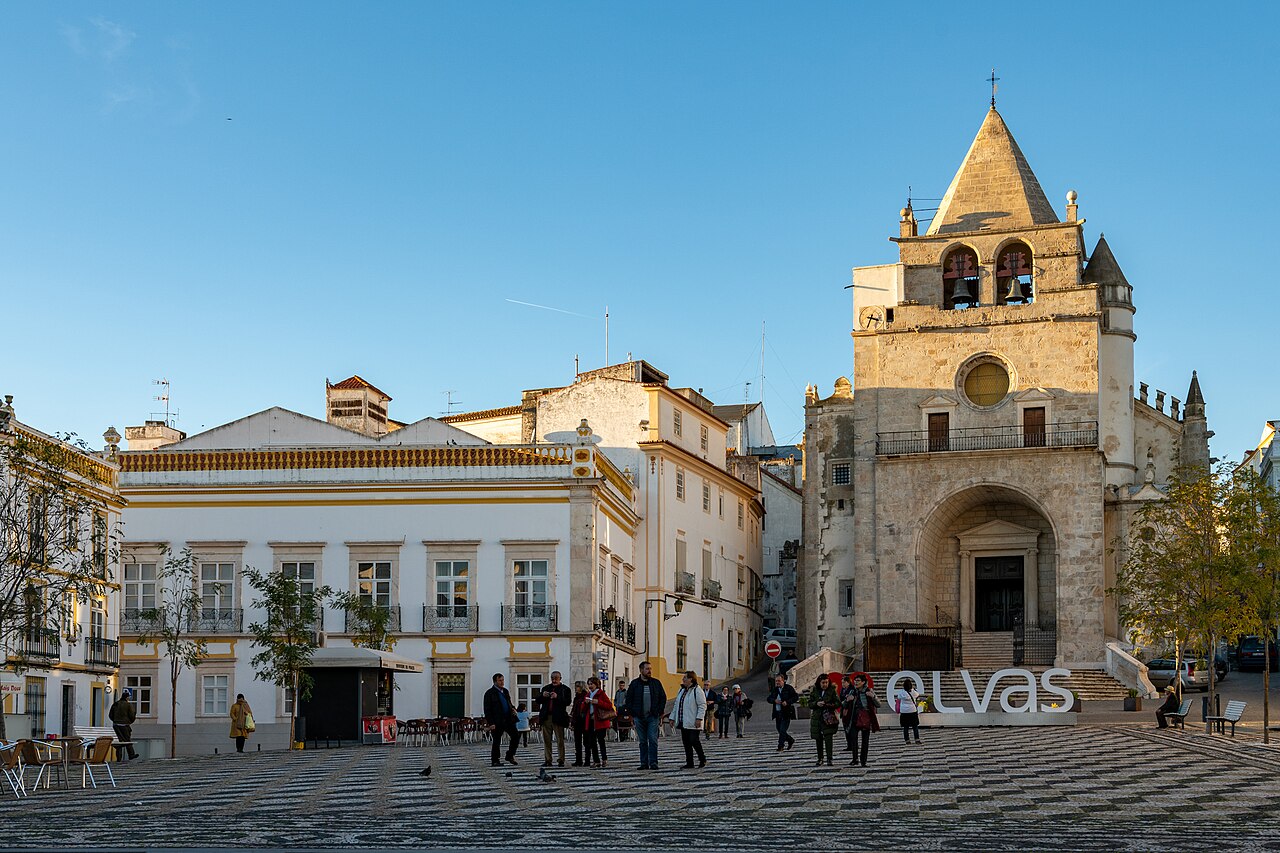
The Garrison Border Town of Elvas and its Fortifications became a UNESCO World Heritage Site in 2012, recognised as the world’s largest bulwarked fortification system still in an intact state. The town sits in the Alentejo region of Portugal, 10 kilometres from the Spanish border town of Badajoz, and its layered defences — built in stages from the 17th century through the 18th — represent the most complete surviving example of the trace italienne fortification system developed to counter artillery warfare. The town itself, a garrison community of approximately 15,000, contains within its walls a late Gothic cathedral, an exceptional Renaissance church, and the 7.5-kilometre Amoreira Aqueduct, built between 1498 and 1622.
The Fortifications: Star-Forts, Bastions, and the Logic of Defence Against Artillery Alentejo, 10 km from Badajoz, Spain; 80 km east of Évora
The military logic of Elvas’s fortifications is inseparable from the invention of gunpowder artillery and the problem it created for medieval defensive architecture. High stone walls, which had been adequate against scaling ladders, rams, and siege towers, proved catastrophically vulnerable to cannon fire from the late 15th century onwards: a bombardment could breach a vertical wall rapidly, whereas a lower, thicker earthwork absorbed cannon shot without collapsing. The solution, developed by Italian military engineers in the early 16th century and disseminated across Europe over the following two centuries, was the trace italienne or bastion system. The key feature of this system is the bastion: a pentagonal projection from the curtain wall, shaped so that its angled faces provide fields of fire that cover every section of the wall adjacent to it, eliminating the dead angles where attackers could shelter from defensive fire. When bastions are placed at regular intervals around a perimeter, the theoretical result is a wall with no blind spots — every metre of the exterior is covered by fire from at least two directions simultaneously.
Elvas’s fortifications were built in successive phases over more than a century and a half, each phase responding to the military priorities of its moment. The medieval castle, which dates to Moorish occupation and was rebuilt after the Portuguese reconquest in 1230, forms the oldest element of the defensive system — a high point within the town that served as the last redoubt. The primary ring of bastion fortifications was constructed between 1641 and 1648, immediately after Portugal’s separation from Spain in the Restoration of 1640: with war against Spain now a reality, Elvas was the most exposed Portuguese frontier town, and the Portuguese crown invested immediately and substantially in its defences. The engineer responsible for this ring, João Pascácio Cosmander, a Dutch military architect in Portuguese service, applied the principles of the Dutch school of fortification — which had refined the trace italienne for conditions of flat terrain and limited stone supply.
The outer defences were completed in the 18th century with the addition of two detached forts. The Fort of Santa Luzia, constructed between 1641 and 1648 on a hill south of the town, guards the road from Badajoz and commands a wide field of fire over the surrounding plain. The Fort of Nossa Senhora da Graça (also known as the Lippe Fort), built between 1763 and 1792 on a higher hill north of the town, was designed by the Count of Lippe — the Prussian-born field marshal who reorganised the Portuguese army after its poor performance in the Seven Years War. The two forts, together with the main bastion ring, create a layered defensive system in which an attacker who breaches the outer works still faces the main ring, and an attacker who reaches the main ring still faces the castle keep. The geometry of the whole system, when viewed from above, produces the distinctive star-shaped plan that characterises the mature trace italienne: a succession of angled surfaces designed not for aesthetic effect but to eliminate every shadow that an attacker might exploit.
The military effectiveness of the system was tested repeatedly. During the Restoration War against Spain (1640-1668), Elvas was besieged seven times and was never taken — a record without parallel among frontier fortresses of the period. The most celebrated episode came in January 1659, when a Spanish force of 15,000 men besieged the town and its garrison of 600 soldiers and citizens. A Portuguese relief army defeated the Spanish at the Battle of the Lines of Elvas on 14 January 1659, a victory that stabilised the frontier and is still commemorated in Elvas. The town’s capacity to sustain its own population during extended sieges depended in large part on the Amoreira Aqueduct.
The Amoreira Aqueduct, the Peninsular War, and the Town Within the Walls From Funchal to Elvas by air + car: 1,200 km; from Lisbon: 220 km east via A6
The Amoreira Aqueduct is one of the largest structures in Portugal and one of the most remarkable pieces of hydraulic engineering of the early modern period. Construction began in 1498 under the direction of Francisco de Arruda and continued intermittently for 124 years until its completion in 1622. The aqueduct carries water from springs at Amoreira, approximately 7.5 kilometres northwest of Elvas, to a central cistern within the town. Its most visible section, approaching the city from the west, consists of 843 arches arranged in four tiers, rising to a maximum height of 31 metres — a structure of considerable visual drama in the flat Alentejo landscape.
The strategic importance of the aqueduct to a garrison town under siege conditions cannot be overstated. Elvas had no significant internal water source; without the aqueduct, a siege could reduce the population by thirst within weeks. The construction of the aqueduct was therefore not a civic amenity but a military investment: a town that could withstand a prolonged siege required a water supply that could not be cut by an encircling army. The aqueduct’s route was designed with this in mind — it approaches the town from the northwest along a line largely covered by the bastions, making it difficult for an attacking force to cut or destroy.
The Napoleonic Wars brought a different chapter to Elvas’s military history. During the Peninsular War (1808-1814), the town served as the principal British logistics base for operations in the Extremadura border region. The Duke of Wellington used Elvas as his headquarters during the campaigns against Badajoz, the Spanish frontier fortress that French forces had fortified and which the British besieged twice — in 1811 and 1812. The siege of Badajoz in April 1812 was among the bloodiest engagements of the entire Peninsular campaign: the town was taken by storm on the night of 6 April in fighting that cost the British forces approximately 5,000 casualties within a few hours. The men who died in and around Elvas during these operations are buried in a British military cemetery that still exists within the town, a quiet and largely unvisited memorial to one of the costliest episodes of a largely forgotten British campaign.
Within the walls of Elvas, the town’s civilian architectural legacy is concentrated around two principal monuments. The Cathedral of Nossa Senhora da Assunção was built in the late Gothic style in the 16th century on the site of an earlier mosque; its facade and side portals are attributed to Francisco de Arruda, the same engineer who began the aqueduct. The Igreja de Nossa Senhora da Consolação, built in 1543, is an octagonal church modelled on the Templar church at Tomar; its interior is entirely clad in 17th-century azulejo tiles, an extraordinary ensemble that represents one of the most complete Baroque tile interiors in Portugal. The octagonal plan, derived from the Templar tradition and ultimately from the Church of the Holy Sepulchre in Jerusalem, produces an interior space of unusual spatial concentration whose tiled walls seem to contract the space to a centralised intensity.
Practical information
Elvas is located 220 kilometres east of Lisbon via the A6 motorway, approximately 2 hours 15 minutes by car. From Évora, the nearest major city to the west, the drive is approximately 80 kilometres (1 hour) via the N4 national road. Public transport connections are limited: there are bus services from Lisbon’s Sete Rios terminal to Elvas operated by Rede Expressos, with a journey time of approximately 3 hours. There is no rail service directly to Elvas; the nearest station is at Elvas-Fontaínhas, 6 km from the town centre, served by occasional suburban trains from Badajoz.
The fortifications are accessible on foot from the town centre; the walk around the main bastion ring takes approximately 90 minutes. The Fort of Santa Luzia and the Fort of Nossa Senhora da Graça can be reached by car or taxi and are open to visitors. The Amoreira Aqueduct is best viewed from the western approach road into town. The Cathedral and the Igreja de Nossa Senhora da Consolação are both in the town centre, within easy walking distance of each other. A municipal museum in the castle contains archaeological finds from the region and military artefacts related to the Restoration War and Peninsular War periods.
The Historic Centre of Évora, another UNESCO World Heritage Site, lies 80 kilometres to the west and makes a logical two-day itinerary pairing with Elvas. The Spanish city of Badajoz, 10 kilometres east across the border, is accessible by car or on foot across the international bridge.
Frequently Asked Questions
What makes Elvas the world’s largest bulwarked fortification system?
The claim to the world’s largest intact bulwarked (bastion-trace) fortification rests on the combination of scale, completeness, and state of preservation that Elvas presents. The designation refers specifically to the total system — the main bastion ring, the two detached outlying forts (Santa Luzia and Nossa Senhora da Graça), the ravelin outworks, the covered way, and the glacis — considered as a functioning defensive ensemble rather than as individual structures. Many European cities have surviving bastion fortifications; few retain the complete layered system of inner ring, detached forts, and outworks at the scale of Elvas, and fewer still have escaped the urban development pressures that destroyed equivalent structures elsewhere. Vauban-system fortifications were built across Europe in the 17th and 18th centuries, but most have been progressively demolished, converted to parks and promenades, or absorbed into urban expansion. Elvas’s relative isolation — a small town in a sparsely populated region, without the industrial or commercial pressures that drove demolition of fortifications in larger cities — allowed the entire system to survive into the present largely intact. The UNESCO inscription in 2012 specifically cited this completeness: the fort presents, in the words of the World Heritage Committee, the most complete and best-preserved example of the bastion-trace system built to Vauban-influenced specifications in the Iberian Peninsula.
What happened during the seven sieges of Elvas, and why was the town never taken?
Elvas was besieged seven times during the Restoration War (1640-1668), the conflict between Portugal and Spain that followed the Portuguese revolt of 1 December 1640 against 60 years of Iberian union under Spanish rule. The town’s strategic position — the principal road crossing between Lisbon and Madrid passed through the Elvas-Badajoz corridor — made it the primary target for any Spanish attempt to push into Portugal from the east. The most critical siege was in January 1659, when a Spanish force of approximately 15,000 men under the command of Don Luis de Haro encircled the town. The garrison inside numbered approximately 600 regular soldiers supplemented by armed citizens — outnumbered more than 20 to 1. The town held for several weeks while a Portuguese relief army assembled at Estremoz, 40 kilometres to the west. The Battle of the Lines of Elvas on 14 January 1659 — also known as the Battle of Elvas — was a decisive Portuguese victory: the relief army broke the siege and destroyed the Spanish force as an organised body. Several factors explain why Elvas was never taken by storm in the conventional sense. The bastion system made direct assault prohibitively costly; the Amoreira Aqueduct sustained the water supply against a blockade; and the Spanish forces, despite their numerical advantage, consistently lacked the heavy siege artillery needed to systematically reduce the fortifications rather than simply invest the town.
What is the Igreja de Nossa Senhora da Consolação and why is its interior remarkable?
The Igreja de Nossa Senhora da Consolação is a 16th-century church built in 1543 in the centre of Elvas, immediately beside the Cathedral. Its most unusual feature is its plan: the church is octagonal, built on the model of the Templar church at Tomar — itself derived from the Church of the Holy Sepulchre in Jerusalem, the prototype for the centralised, radially symmetrical sacred space that the Knights Templar adopted as the architectural signature of their order. The octagonal plan creates an interior without a conventional nave-and-chancel axis, producing instead a centralised space in which all directions carry equal weight and the altar is encountered as the centre of a surrounding enclosure rather than the terminus of a directional approach. The interior is entirely covered in 17th-century azulejo tiles — blue and white tin-glazed earthenware panels — applied to the walls from floor to the spring of the vaulted ceiling. The tiles are attributed to the workshop of Gabriel del Barco and date from approximately 1659-1698; they depict geometric and figurative patterns across an interior surface that the octagonal plan makes unusually continuous and complete. The combination of the centralised Templar plan with a Baroque tile interior of this density and completeness is unique in Portugal. The church is open to visitors and admission is included in the ticket to Elvas’s municipal monuments.
Sources
- S1 — Moreira, Rafael. A Fortaleza de Elvas: Património Militar e Arquitectura. Livros Horizonte, 2012. ISBN 978-972-24-1718-1.
- S2 — Soromenho, Miguel. Arquitectura Militar Portuguesa nos Séculos XVII e XVIII. Edições Colibri, 2006. ISBN 978-972-772-642-4.
Spotted an error? Write to editorial@culturalheritageonline.com and we correct it the same day.


.jpg)