
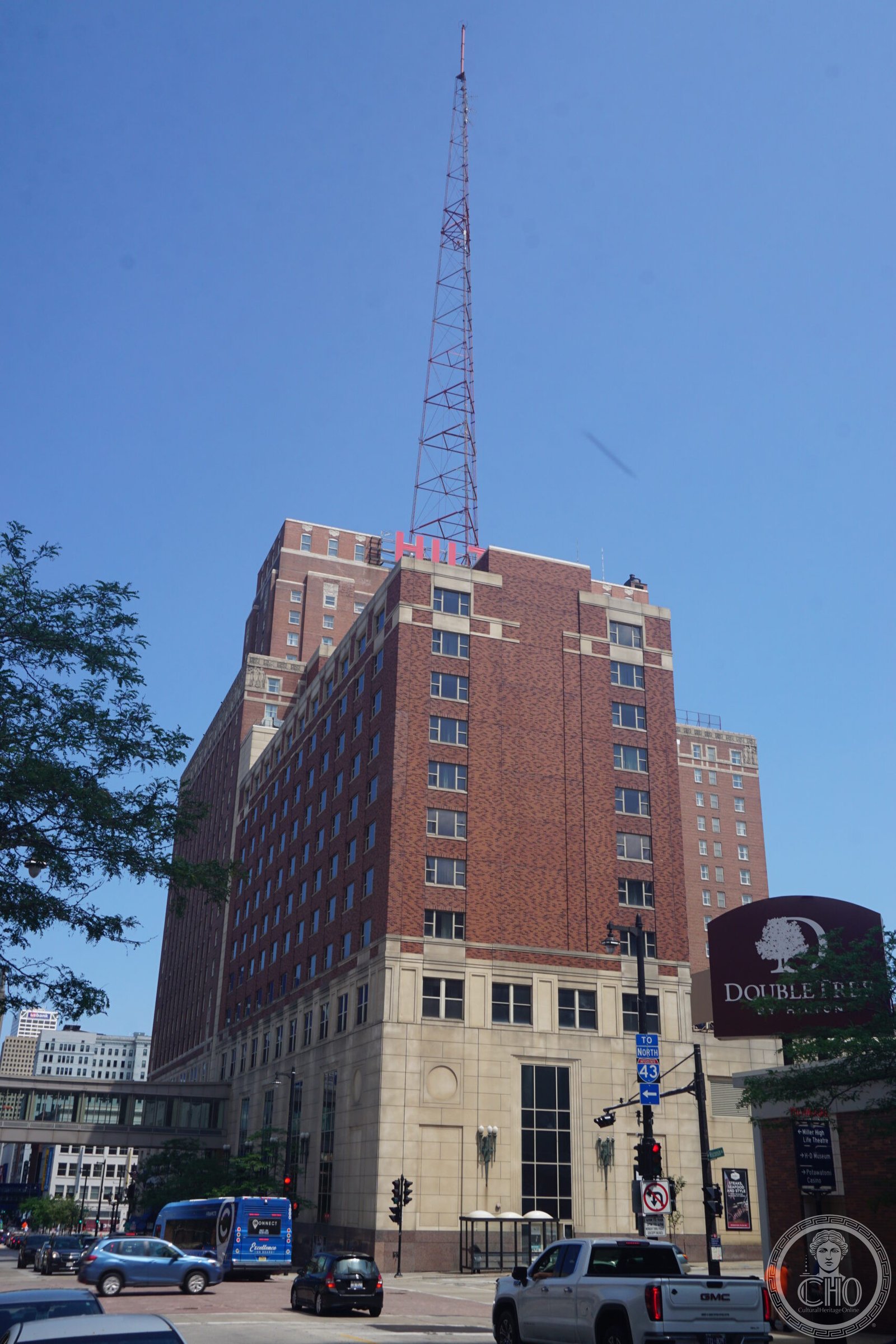
Opened in 1928 as the Schroeder Hotel at 509 W Wisconsin Avenue, Milwaukee’s tallest hotel at its completion is a 25-story tower of formal Renaissance Revival massing with Art Deco ornamental detail, restored and operating as the Hilton Milwaukee City Center since the 1980s.
At a glance
The building that opened in 1928 as the Schroeder Hotel stands at 509 W Wisconsin Avenue, the principal commercial boulevard of downtown Milwaukee, at the corner of 5th Street. At 25 stories it was Milwaukee’s tallest hotel at the time of its completion, and its public rooms — grand ballrooms, a formal dining room, and a lobby of marble and ornamental plaster — served as the principal social venue of Milwaukee’s civic and commercial life through the mid-twentieth century. The building’s massing follows the Renaissance Revival tradition of the American tall commercial hotel, with the ornamental program concentrated at the base, at the transition levels, and at the cornice and crown, while the Art Deco language of the late 1920s appears in the metalwork, the elevator lobby ornament, and the detail of the terra cotta panels. Operating today as the Hilton Milwaukee City Center, the building retains considerable original fabric in its public spaces and continues to serve as Milwaukee’s most historically significant hotel address.
Key facts
- Opened: 1928 (as Schroeder Hotel)
- Style: Art Deco / Renaissance Revival — 25-story brick and terra cotta tower
- Address: 509 W Wisconsin Avenue, Milwaukee, WI 53203
- GPS: 43.0403°N, 87.9137°W
- Current operator: Hilton Milwaukee City Center
- Status: active hotel; locally recognized historic building
History
Milwaukee in the 1920s was one of the great industrial cities of America — a center of beer brewing, heavy machinery, tanning, and Great Lakes shipping whose diverse economy had produced a large and prosperous middle and upper class by the decade of American prosperity that preceded the Depression. The Wisconsin Avenue corridor, running west from the Milwaukee River through the commercial heart of the city, was the address of the best hotels, department stores, and office buildings in the region. The Schroeder Hotel was commissioned to provide Milwaukee with a first-class hotel capable of competing with the grand hotel buildings then being constructed in Chicago, Detroit, and other Midwestern cities: a building of 25 stories with ballrooms large enough for the political conventions and corporate banquets that the city’s size and economic weight should have attracted.
The hotel opened in 1928 and immediately established itself as the premier address for visiting dignitaries, convention delegates, and the business executives who moved between Milwaukee and the national corporate network. Its ballrooms hosted the political events, union conventions, and civic gatherings of Milwaukee’s active democratic culture. The hotel’s name was changed over the decades through a series of ownership transitions: from Schroeder to Marc Plaza (in the mid-twentieth century) to the Hilton Milwaukee City Center (in the 1980s), when the Hilton flag brought the building back to full-service operation after a period of decline. The renovation program that accompanied the Hilton rebranding preserved significant original fabric in the lobby and public rooms while updating the guest floors to contemporary standards.
What you see
The Wisconsin Avenue facade presents a long horizontal base of three stories in rusticated stone, above which the tower rises in brick with limestone trim at the window surrounds and floor courses. The ornamental program — concentrated at the main entrance on Wisconsin Avenue, at the lobby level, and at the upper-floor transitions — mixes Renaissance Revival vocabulary (pilasters, classical cornice detail, arched window heads at the third floor) with Art Deco metalwork and terra cotta ornament at the entrance surround and the elevator lobby. The tower’s upper floors step slightly at the twentieth story, and the crown carries a classical ornamental cornice that anchors the building’s vertical composition.
The lobby interior retains the character of the original 1928 design: marble wainscoting, coffered plaster ceilings, and the ornamental metalwork of the original light fixture housings. The main ballroom, which has been the site of Milwaukee’s most significant civic events for nearly a century, preserves its original proportions and much of its original ornamental program.
Practical information
- Access: 509 W Wisconsin Avenue, Milwaukee WI 53203; hotel lobby open to visitors; restaurant and bar open to non-guests
- Transit: Milwaukee County Transit System — multiple bus routes on Wisconsin Avenue; East-West BRT (GoldLine) stop on Wisconsin at 5th Street
- Amtrak: Milwaukee Intermodal Station (Amtrak + Greyhound) on St. Paul Avenue, 10-minute walk south
- Time needed: 20 minutes for lobby and exterior; meal or event for a longer visit
Getting there
The Hilton Milwaukee City Center is on Wisconsin Avenue between 5th and 6th Streets in the heart of downtown Milwaukee. Milwaukee Mitchell International Airport (MKE) is approximately 8 miles south — 20 minutes by car via I-894 or US-41 to downtown, or approximately 45 minutes by Milwaukee County Transit 80X express bus to Wisconsin Avenue. Amtrak serves Milwaukee via the Milwaukee Intermodal Station at St. Paul Avenue and 4th Street, approximately 10 minutes’ walk south of the hotel. From Chicago, the Hiawatha Service runs eight round trips daily — approximately 90 minutes. The Milwaukee Art Museum (Santiago Calatrava, 2001) is six blocks east at the lakefront. Fiserv Forum (2018) is five blocks north.
Nearby
- Milwaukee Art Museum — the encyclopedic art museum at 700 N Art Museum Drive, six blocks east at Lake Michigan — the Calatrava-designed Quadracci Pavilion (2001) is the city’s most recognized contemporary landmark; free admission on Thursdays.
- Wisconsin Gas Building (1930) — the Art Deco skyscraper at 626 E Wisconsin Avenue, seven blocks east — notable for its distinctive flame ornament at the crown. See the CHO guide.
- Riverside Theater (1928) — Milwaukee’s ornate atmospheric movie palace at 116 W Wisconsin Avenue, four blocks east — active concert venue. See the CHO guide.
- Historic Third Ward — the cast-iron warehouse district along St. Paul Avenue south of downtown — Milwaukee’s most concentrated area of nineteenth-century commercial architecture, now galleries, restaurants, and boutiques.
Sources
- Milwaukee Journal archives — 1928 Schroeder Hotel opening coverage
- Wisconsin Historical Society — Milwaukee building records
- Historic Milwaukee Inc. — Wisconsin Avenue historic district documentation
- Hilton Milwaukee City Center — official hotel history page
- City of Milwaukee — Historic Preservation Commission records
Find it on the map
See this place and what’s around it →📷 Become a Cultural Heritage Online photographer
Share your photos of places: they stay published under your name as the author. The more they're seen, the more you get noticed — and soon a contest will reward the most appreciated photos.
Log in or sign up free to add a photoIs this page about you?
This page is read by travellers and heritage enthusiasts who find it on Google. Tell us how you are connected to this place and we will take it from there.