
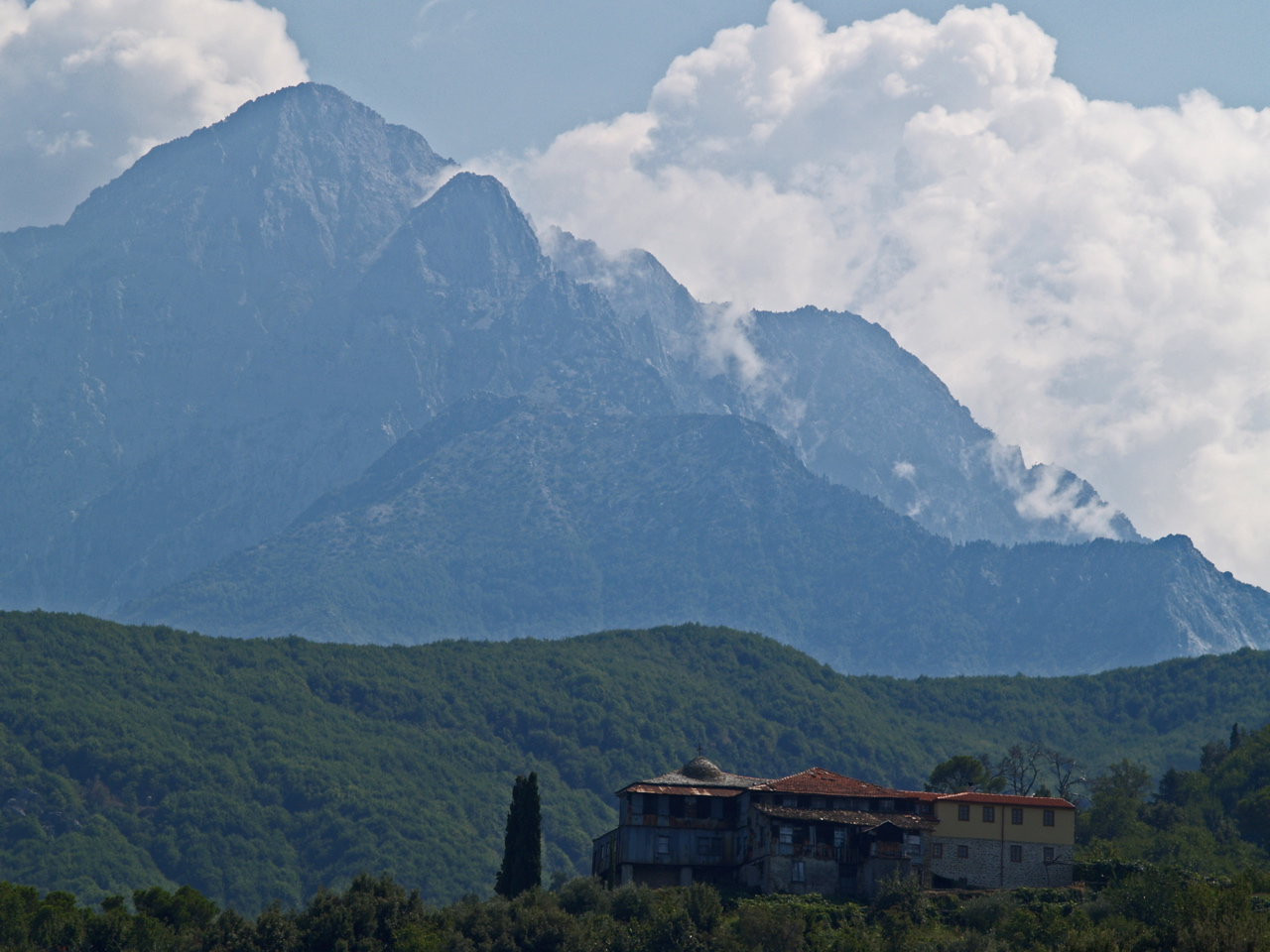
The Athos peninsula in northern Greece is home to twenty Orthodox monasteries that have operated continuously since the 10th century, governed as an autonomous monastic community under Greek sovereignty. Women have been banned from setting foot on the peninsula since 1046, a restriction enforced today under Greek and European Union law. Access for men requires a special permit (diamonitirion), issued at a rate of 100 Orthodox and 10 non-Orthodox visitors per day — making Athos one of the most restricted UNESCO World Heritage Sites on earth.
A Monastic Republic in the Aegean: 20 Monasteries, One Peninsula Chalkidiki, northern Greece · ferry from Ouranoupoli
The Holy Mountain of Athos occupies a 50-kilometre peninsula projecting into the Aegean Sea from the Chalkidiki region of northern Greece. Its tip rises to 2,033 metres, and the entire landmass — roughly 335 square kilometres — functions as an ecclesiastical state within the borders of Greece. The Hellenic Republic retains sovereignty but the peninsula is self-governing under a form of theocratic administration: the Holy Community, composed of representatives from each of the twenty ruling monasteries, manages internal affairs, while civil administration is handled by a Civil Governor appointed by the Greek government.
This arrangement is not a modern creation. The autonomous status of Athos was formalized in the Byzantine imperial charter of 972 CE and has been maintained across Ottoman rule, Greek independence, and two world wars. The peninsula joined the European Union as part of Greece in 1981 with a formal exemption from standard EU freedom-of-movement rules, specifically to maintain the avaton — the prohibition on women entering the peninsula — which dates to 1046. The ban is reinforced by the terms of Greece’s EU accession treaty and enforced by the Hellenic Coast Guard.
The monastic community reached its demographic peak in the 10th century with an estimated population of around 10,000 monks. Today approximately 1,400 monks inhabit the twenty monasteries, along with a number of smaller dependency houses (sketes, kellia, and hesychasteria). Each monastery follows the rule of its founder and its own liturgical calendar; the peninsula as a whole uses the Julian calendar, which runs 13 days behind the Gregorian, and observes Byzantine time — in which the day begins at sunset rather than midnight. A visitor arriving on Athos enters not merely a different landscape but a different temporal system.
The Great Lavra, founded in 963 CE by Saint Athanasius the Athonite with financial support from the Byzantine Emperor Nikephoros II Phokas, is the oldest of the twenty ruling monasteries and remains the largest. Its founding in 963 is taken as the formal beginning of organized monastic life on the peninsula, though hermits had been present in the caves and forests of Athos since at least the 7th century. The Great Lavra’s catholicon (main church) preserves its original 10th-century basilical plan, and its refectory contains frescoes by the Cretan painter Theophanes the Greek (16th century). The library holds manuscripts that escaped destruction during the various crises of Athonite history, including illuminated codices from the Byzantine period.
UNESCO designated Athos as a mixed cultural and natural World Heritage Site in 1988, recognizing both the extraordinary accumulation of Byzantine religious art and architecture across the twenty monasteries and the near-pristine condition of the natural landscape. The absence of permanent lay settlement and the restrictions on access have preserved old-growth forest, endemic wildflowers, and bird populations including raptors that have largely disappeared from other parts of Greece.
What the Monasteries Hold: Art, Libraries, and Living Tradition Accessible only by sea · ferry from Ouranoupoli (Chalkidiki)
The twenty monasteries of Athos represent one of the greatest concentrations of Byzantine religious art outside Istanbul and Thessaloniki. Their collections accumulated over more than a thousand years of donations, bequests, and monastic production — imperial gifts of gold and enamel, manuscript illuminations, carved iconostases, embroidered vestments, and panel icons of every period from the 10th century to the present. Access to these collections is largely informal: monks do not typically offer guided museum visits, and what a visitor sees depends on hospitality and timing.
Two objects deserve particular mention for their art-historical significance. The Vatopedi Monastery — the second oldest on the peninsula, founded in the late 10th century — holds the Epitaphios of Thessaloniki, a 14th-century embroidered liturgical cloth depicting the Lamentation of Christ. It is considered among the finest surviving examples of Byzantine textile art, with gold and silk thread work of exceptional technical quality. The Iviron Monastery, founded by Georgian monks in 980 CE, holds the Iveron Icon of the Virgin (Portaitissa — “Keeper of the Gate”), a panel painting traditionally dated to the 9th or 10th century. The icon is one of the most venerated in the Orthodox world, associated with a tradition that it arrived miraculously from the sea, and pilgrims travel specifically to Iviron to venerate it.
The libraries of Athos collectively hold thousands of manuscripts. The Great Lavra library alone contains approximately 2,100 manuscripts and 20,000 printed books. The Vatopedi library has manuscripts in Greek, Georgian, Slavonic, and Arabic. A digitization project in cooperation with international institutions has begun to make portions of these collections accessible, but the physical manuscripts remain on the peninsula.
For male visitors who obtain the diamonitirion, the experience of Athos is unlike any other UNESCO site. Accommodation is in monastery guesthouses (archontariki), meals are taken with the monastic community in the refectory, and the daily rhythm follows the Byzantine liturgical cycle — offices begin in the early hours of the morning and the sound of the semantron (a wooden or iron board struck with a mallet, used instead of bells in some traditions) marks the passage of canonical hours. The permit allows a stay of up to four days, extendable in some cases. The infrastructure is basic: dirt tracks connect most monasteries, and the primary means of travel between them is on foot.
The nearest UNESCO sites provide a useful wider context. The Paleochristian and Byzantine Monuments of Thessaloniki, 130 km to the west, include fifteen buildings (churches, a rotunda, and city walls) that trace the development of Byzantine religious architecture from the 4th to the 15th century. The Archaeological Site of Vergina, also approximately 130 km west, contains the royal tombs of the Macedonian kingdom including the tomb attributed to Philip II of Macedon, father of Alexander the Great, with intact gold funerary objects and wall paintings. Meteora, 280 km to the southwest, offers another register of Greek Orthodox monastic heritage built in a dramatically different landscape.
Practical information
Access to Mount Athos requires advance planning. Male visitors must obtain a diamonitirion (monastic permit) before travelling. Greek Orthodox pilgrims apply through the Pilgrims’ Bureau of the Holy Community of Mount Athos in Thessaloniki. Non-Orthodox visitors apply through the Ministry of Foreign Affairs of Greece or through the Greek consulate in their country of residence; the allocation is 10 non-Orthodox visitors per day across the entire peninsula, so permits must be booked weeks or months in advance. The permit is valid for a four-day stay and specifies an entry date. Visitors travel to the peninsula by ferry from Ouranoupoli (Chalkidiki); the journey takes approximately 2 hours to the port of Dafni, from which point travel is on foot or by boat between monasteries. There are no hotels on the peninsula; accommodation is in monastery guesthouses, which is free or offered for a donation. Women are not permitted to enter the peninsula under any circumstances. The best season for visiting is late spring (April–June) or early autumn (September–October); summer can be very hot. Thessaloniki is the practical base city for pre- and post-Athos travel, with a major international airport, a full range of hotels, and direct connections to both the Chalkidiki ferries and the Vergina archaeological site.
Frequently Asked Questions
Why are women banned from Mount Athos, and is this ban legally enforceable within the EU?
The prohibition on women entering the Athos peninsula — known as the avaton — has been in force since 1046, when the Byzantine Emperor Constantine IX Monomachos issued a chrysobull formalizing the existing monastic practice. The theological basis is the dedication of the entire peninsula to the Virgin Mary (Theotokos), whose sole presence as a woman on Athos is symbolically sufficient; the monks regard the avaton as a form of respect for her. Practically, the prohibition also reflects the hesychast tradition of withdrawal from the world, which includes withdrawal from family and domestic life. The avaton survived Ottoman rule, Greek independence, and two world wars. When Greece joined the European Community (now the European Union) in 1981, the avaton was preserved by a specific exemption written into the Act of Accession: the EU’s general rules on freedom of movement do not apply to Athos. This makes the ban legally enforceable within EU law. The Greek Coast Guard patrols the maritime boundary of the peninsula and turns back boats carrying women. Several attempts have been made to challenge the avaton through European legal channels, including a European Parliament resolution in 2003 calling on Greece to lift the ban; Greece has maintained that the exemption in the accession treaty is valid and has no obligation to comply. The monastic community’s position is that the avaton is a matter of religious freedom and monastic self-governance, not discrimination.
How do I obtain a permit to visit Mount Athos as a non-Orthodox visitor?
The process for non-Orthodox male visitors requires advance application and patience, as only 10 non-Orthodox permits are issued per day for the entire peninsula. The standard route is to contact the Greek consulate or embassy in your country of residence and request a diamonitirion for non-Orthodox visitors. You will typically need to provide a copy of your passport, a statement of purpose (academic, cultural, or religious pilgrimage), and specify the dates you wish to visit. The application is forwarded to the Ecumenical Patriarchate of Constantinople and the Holy Community of Mount Athos for approval. Processing times vary: applications should be submitted at least three months in advance for peak season visits, and six months is not excessive. An alternative route is to contact a specialist travel agency in Greece that handles Athos permits — several operate out of Thessaloniki and Ouranoupoli and can navigate the administrative process on your behalf, though this involves a fee. Once the permit is issued, it specifies an entry date and the duration of stay (typically four days, sometimes extendable to six). Orthodox Christians — Greek, Russian, Serbian, Romanian, Bulgarian, Georgian, and other national Orthodox churches — apply through the Pilgrims’ Bureau of the Holy Community in Thessaloniki, which has a higher daily quota (100 Orthodox visitors per day). American and British Orthodox Christians typically apply through their bishop or through the Greek Orthodox Archdiocese.
What nearby UNESCO World Heritage Sites complement a visit to Mount Athos?
Mount Athos sits in northern Greece within reach of several other UNESCO-listed sites that together provide a comprehensive picture of Byzantine and ancient Macedonian heritage. The Paleochristian and Byzantine Monuments of Thessaloniki, approximately 130 km west of Ouranoupoli, form the most direct complement: fifteen monuments in the city — including the 4th-century Rotunda, the 5th-century Acheiropoietos basilica, the 8th-century Hagia Sophia, and the 14th-century Decani-era frescoes in several churches — trace the entire arc of Byzantine architectural and artistic development. Thessaloniki is also the city where the diamonitirion for Athos is processed, making it a natural base. The Archaeological Site of Vergina, accessible by bus from Thessaloniki (roughly 75 km), contains the 4th-century BC tomb complex of the ancient Macedonian royal dynasty, including the tomb believed to be that of Philip II. The museum beneath the burial mound preserves the gold larnax with the star of Vergina, the gold-and-ivory royal diadem, and fragmentary wall paintings from the antechamber. Meteora, 280 km southwest of Athos, offers the most dramatic spatial contrast: if Athos represents Orthodox monasticism embedded in a peninsula of forest and sea, Meteora represents the same tradition building upward onto vertical sandstone pillars above the Thessalian plain. Both sites are recognized under the same UNESCO inscription category (mixed natural and cultural), reflecting the relationship between dramatic landscape and monastic aspiration that defines both places.

.jpg)