The White Monuments of Vladimir, Suzdal and Kideksha, inscribed by UNESCO in 1992, preserve the finest surviving architecture of the Vladimir-Suzdal principality — the dominant Russian state of the 12th and early 13th centuries before the Mongol invasion of 1237–1240 ended an era of extraordinary artistic ambition. Clustered along the Klyazma River in Vladimir Oblast, roughly 180–200 km northeast of Moscow, these limestone churches and cathedrals established the visual grammar that would define Russian Orthodox architecture for the next eight centuries. Two hours by Lastochka express from Moscow’s Kursk station places visitors at the heart of this ensemble.
Vladimir: the cathedral city of medieval Russia Vladimir city centre, walkable from the railway station
Vladimir served as the capital of the most powerful Russian principality from the mid-12th century until the rise of Moscow, and its two great cathedrals document both the ambition and the aesthetic refinement of that era. The Cathedral of the Assumption (Uspensky Sobor), begun in 1158–1160 under Prince Andrei Bogolyubsky and substantially expanded between 1185 and 1189, occupies the highest point in the city on a bluff above the Klyazma River. Its prominence was deliberate: Andrei had moved the seat of Vladimir-Suzdal power from the old royal capital of Suzdal to Vladimir, and he wanted a cathedral that would announce the primacy of his new capital to the entire Russian world. The building he commissioned would later serve as the direct prototype for the Cathedral of the Assumption in Moscow’s Kremlin — and through that model, for virtually every major Russian Orthodox cathedral built in the following centuries.
Inside the Cathedral of the Assumption, two distinct decorative layers survive from different periods and hands. Fragmentary frescoes from the 12th century remain in the side aisles, representing some of the oldest surviving Russian wall paintings. The more celebrated works, however, are the fragments of the Last Judgement fresco cycle painted by Andrei Rublev and Daniil Chyorny in 1408. Rublev, the greatest icon painter of medieval Russia, is best known for his Trinity icon, but the Vladimir frescoes demonstrate his mastery at monumental scale. The portions that survive in the nave and under the choir gallery show his characteristic luminosity and the restrained, deeply spiritual expression that distinguished his work from Byzantine convention.
Standing roughly 400 metres away, the Cathedral of St Dmitry (Dmitrievsky Sobor), built between 1193 and 1197 under Prince Vsevolod III — known as “Big Nest” for his many children — presents perhaps the most astonishing exterior of any medieval Russian building. The upper two-thirds of all four facades are covered with 566 carved bas-relief panels arranged in three horizontal tiers. The programme is encyclopaedic: King David, the royal patron of Christian rulers, appears enthroned at the centre of the upper register; Alexander the Great’s ascension into heaven serves as a political allegory of royal aspiration; fabulous beasts — griffins, centaurs, lions — inhabit the middle tier alongside stylised vegetation; saints and angels occupy the borders. The carving is precise and deeply cut, throwing sharp shadows that animate the surface across changing light. No other medieval Russian building concentrates this level of sculptural ambition on its exterior.
Suzdal and the Church of the Intercession on the Nerl Suzdal 35 km from Vladimir by road; Bogolyubovo 10 km, local bus or taxi from Vladimir
Suzdal operates as a functioning small city — population approximately 10,000 — but contains 53 churches within its boundaries, giving it a density of sacred architecture unmatched in Russia. The Cathedral of the Nativity (1222–1225), at the centre of the Kremlin, preserves its original copper-gilt doors on the southern and western portals. These doorways, worked in the cloisonné technique with scenes from the Old and New Testaments, are considered among the finest examples of medieval metalwork in Russia — each panel a miniature narrative in gilded copper against a black niello ground. The surrounding kremlin earthworks, dating from the 11th century, remain visible and help convey the original scale of the fortified episcopal complex. The town beyond the kremlin unfolds across a flat landscape of wooden houses and bell towers, largely unchanged in outline since the 18th century.
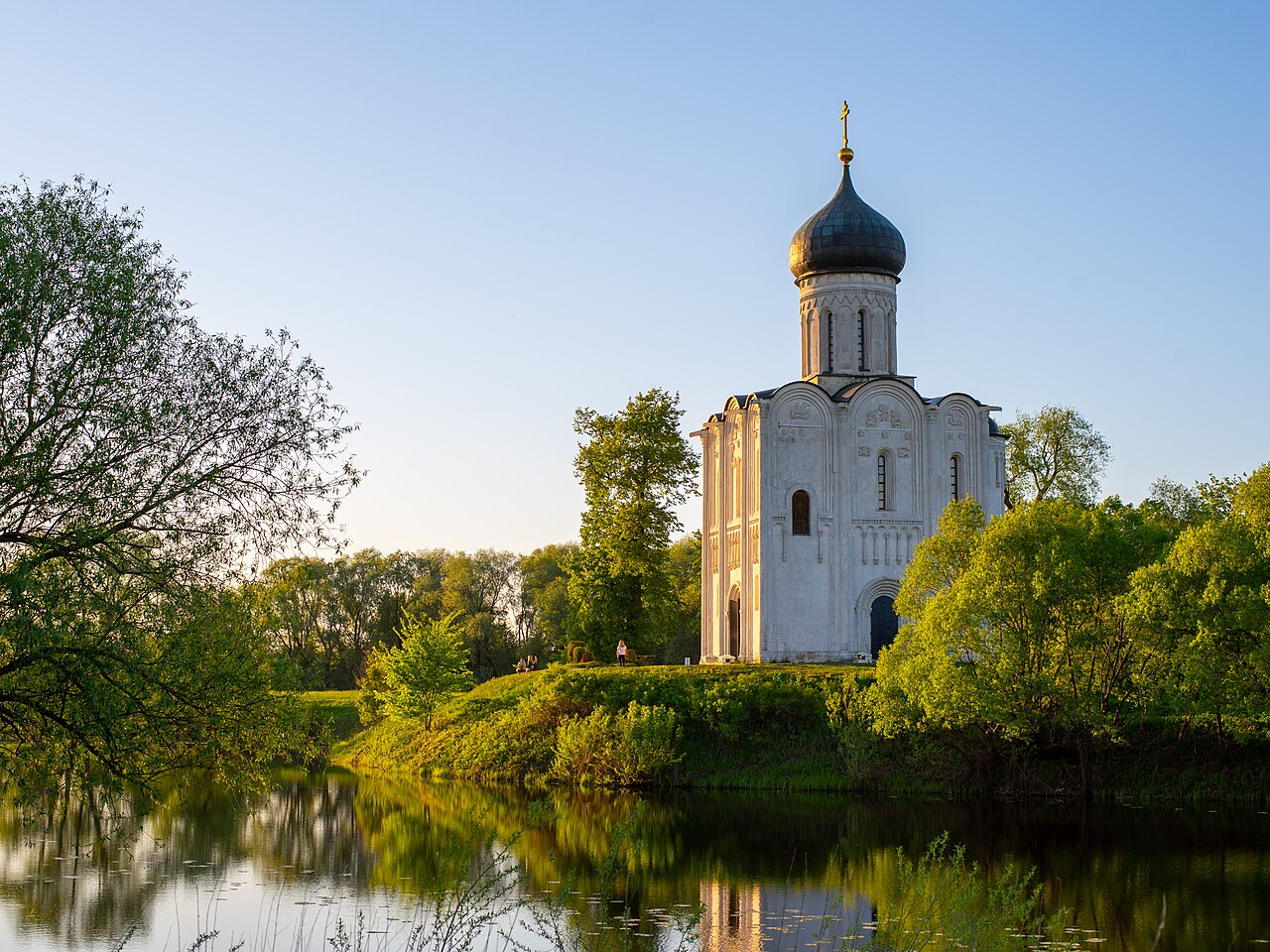
Ten kilometres west of Vladimir, in the village of Bogolyubovo, stands the monument most consistently cited as the masterpiece of the entire ensemble: the Church of the Intercession on the Nerl (Pokrov na Nerli), built in 1165. Andrei Bogolyubsky ordered it constructed on a specially raised stone platform — the natural floodplain required an artificial foundation — at the precise point where the Nerl River joins the Klyazma. The choice of location was not pragmatic but symbolic: the church was to be visible from the water, standing alone, marking the confluence with the same authority that a lighthouse marks a headland. Andrei built it as a memorial to his son Izyaslav, killed in 1164 fighting the Volga Bulgars.
What makes the Church of the Intercession exceptional is its proportion. The relationship between the base, the drum, and the dome approaches a mathematical equality that appears effortless rather than calculated. The slender vertical emphasis makes the building seem taller than its modest actual height; in spring, when the Klyazma floods and the surrounding meadow fills with water, the church appears to float on the plain. The carved limestone exterior deploys the same programme of King David and fabulous beasts seen at the Dmitrievsky, but at a scale appropriate to the solitary building in its landscape — restrained enough that the architecture reads before the ornament. A 1.5 km walk from the Bogolyubovo bus stop across the floodplain reaches the church on foot; in flood season (typically April–May) the path may be impassable.
Practical information
Vladimir is served by Lastochka express trains from Moscow Kursk station (approximately 1h 45m, several departures daily). From Vladimir, buses and fixed-route taxis (marshrutki) connect to Suzdal (35 km, 40 minutes) and Bogolyubovo (10 km, 20 minutes). Vladimir and Suzdal each have hotels across a range of categories; Suzdal’s hotel stock includes several conversions of monastery outbuildings. The Cathedral of the Assumption and Cathedral of St Dmitry are open daily except Tuesdays; the Church of the Intercession on the Nerl has no interior access (the exterior and grounds are the attraction). Entry fees are charged separately at each monument. The best light for the Church of the Intercession falls in the morning from the east; the Dmitrievsky facade faces south and photographs well throughout the day. Summer (June–August) brings the most visitors; May and September offer cooler temperatures and smaller crowds. Carry cash — card readers are unreliable at smaller sites. All monuments are within easy walking distance of their respective town centres, though Bogolyubovo requires the 1.5 km meadow walk to reach the Nerl church.
Frequently Asked Questions
How do the Vladimir-Suzdal monuments relate to later Russian Orthodox architecture?
The connection is direct and documented. When Ivan III of Moscow decided in the 1470s to rebuild the Cathedral of the Assumption in the Moscow Kremlin — to serve as the principal church of the unified Russian state — he commissioned the Italian architect Aristotele Fioravanti specifically to study the Vladimir Cathedral of the Assumption before beginning work. Fioravanti travelled to Vladimir, measured the 12th-century building, and modelled his Moscow design on its proportional system and spatial organisation. The result, completed in 1479, became in turn the prototype for all major Russian Orthodox cathedrals of the following centuries: the five-dome composition, the elevated placement on a bluff or platform, the white stone exterior, the hierarchical internal arrangement with the iconostasis as a screen between nave and sanctuary. When you stand inside any large Russian cathedral — in Novgorod, Yaroslavl, or Moscow — you are standing inside a building that traces its lineage directly back to the work of Andrei Bogolyubsky’s craftsmen in Vladimir. The Vladimir-Suzdal principality also established the precedent of importing or training specialised stone carvers, distinct from the woodworking tradition dominant elsewhere in early Russia, which is why the stone architecture of this region has no close parallel in contemporary Novgorod or Kiev.
What is the best way to visit both Vladimir and Suzdal in a single day from Moscow?
A single day is feasible but tight. The earliest Lastochka trains from Moscow Kursk station depart before 07:00 and reach Vladimir by approximately 08:45. From Vladimir station, the Dmitrievsky Cathedral and Cathedral of the Assumption are within a 15-minute walk; allowing 2–2.5 hours for both (including the Rublev frescoes, which require time for the eyes to adjust to the interior light) brings you to midday. Marshrutki to Suzdal run from the bus station adjacent to Vladimir’s central market, with the journey taking 40 minutes. Suzdal’s Kremlin and Cathedral of the Nativity with its golden doors can be visited in 1.5–2 hours; the surrounding town with its wooden architecture museum (Muzey Derevyannogo Zodchestva) is worth additional time if available. Return by marshrutka to Vladimir for an evening Lastochka back to Moscow. The Church of the Intercession on the Nerl at Bogolyubovo does not fit comfortably into this itinerary unless you are willing to make it the first stop immediately upon arriving in Vladimir and accept a rushed visit to Suzdal. Alternatively, an overnight in Vladimir or Suzdal allows a more measured pace and access to the Nerl church in morning light.
What survives of Bogolyubovo, the palace complex of Andrei Bogolyubsky?
Andrei Bogolyubsky established his primary residence not in Vladimir but at Bogolyubovo, 10 km to the east, where he built a fortified palace complex in the 1150s and 1160s. In 1174 he was assassinated there by a group of boyars who entered his bedchamber at night — an event described in detail in the Primary Chronicle and representing one of the earliest political murders recorded in Russian history. Of the original palace complex, very little stands above ground: a fragment of the white limestone staircase tower and a connecting gallery that linked the palace to the palace church survive as the only substantial above-ground remains. The 12th-century Bogolyubsky Convent now occupies the site, and its 17th-century buildings dominate the visible ensemble. The surviving fragments — the staircase tower with its carved window surrounds and the arched gallery — are accessible to visitors and have been designated as part of the UNESCO ensemble. Architectural historians value them as rare examples of 12th-century secular princely construction in Russia, a category of building that was almost entirely replaced or destroyed in subsequent centuries. The site is a short walk from the Bogolyubovo village bus stop and can be combined with the 1.5 km walk onward to the Church of the Intercession on the Nerl.