Levuka Historical Port Town, inscribed by UNESCO in 2013 on the island of Ovalau in Fiji’s Lomaiviti group, is the only UNESCO-inscribed historic colonial town in the Pacific Islands and the site where, on 10 October 1874, the paramount chief Ratu Seru Epenisa Cakobau signed the Deed of Cession transferring sovereignty over Fiji to Queen Victoria. The town’s nineteenth-century timber buildings survive intact because the geography of Ovalau — a steep volcanic cliff on one side, the sea on the other — left no room for the expansion and redevelopment that obliterated comparable Pacific port towns. When the colonial capital transferred to Suva in 1882, Levuka’s moment of historical importance was over, and the town’s very marginalization preserved it.
From sandalwood port to Pacific capital Ovalau Island, Lomaiviti Group, Fiji — ferry from Natovi Landing, Viti Levu
European contact with Ovalau and the wider Fiji group intensified in the 1820s and 1830s when sandalwood traders and later whalers began using the harbor at Levuka as a reprovisioning stop. The sandalwood trade was brutal and brief: within a decade of contact, the sandalwood forests of Fiji were commercially exhausted, and the traders moved on to other Pacific islands. What they left behind was a small but established European shore community at Levuka — beachcombers, traders and ex-sailors who had found reasons to remain — and a set of trade relationships with local Fijian chiefs that gave Levuka a semi-permanent character. Methodist missionaries arrived from Tonga in 1835, followed by Catholic missionaries, and their presence added schools and churches to the nascent settlement.
By the 1860s Levuka had become the busiest trading port in the Pacific after Sydney. Cotton planting had expanded rapidly in Fiji in the early 1860s, partly as a result of the American Civil War disrupting the global cotton supply, and the harbor at Levuka was handling shipments of cotton, copra, trepang and timber alongside the provisioning of whaling fleets. The European settler population had grown to several hundred, and the town had hotels, stores, a courthouse and a newspaper — the Fiji Times, founded in 1869 and still publishing today, making it the oldest newspaper in the Southern Hemisphere still in continuous publication. The settler community established a municipal government of sorts, and Levuka had the appearance, if not the legal status, of a colonial town.
The political situation in Fiji during this period was one of increasing instability. The paramount chief Ratu Seru Epenisa Cakobau had unified much of Fiji under his authority through a combination of military power and strategic alliance, and in 1871 he became “King of Fiji” in a constitutional arrangement devised partly by European settlers seeking stability for their commercial interests. But Cakobau’s government was underfunded, its authority contested by rival chiefs, and increasingly unable to prevent conflicts between Fijian communities and European settlers who were encroaching on land and introducing firearms and disease. After a failed attempt to establish an independent Fijian state with settler support, Cakobau and other leading chiefs concluded that cession to the British Crown offered the only reliable path to stability. On 10 October 1874, in a ceremony held in Levuka, Cakobau and eleven other chiefs signed the Deed of Cession. The date is celebrated annually in Fiji as Fiji Day — a public holiday marked by ceremonies in Levuka as well as in the modern capital, Suva.
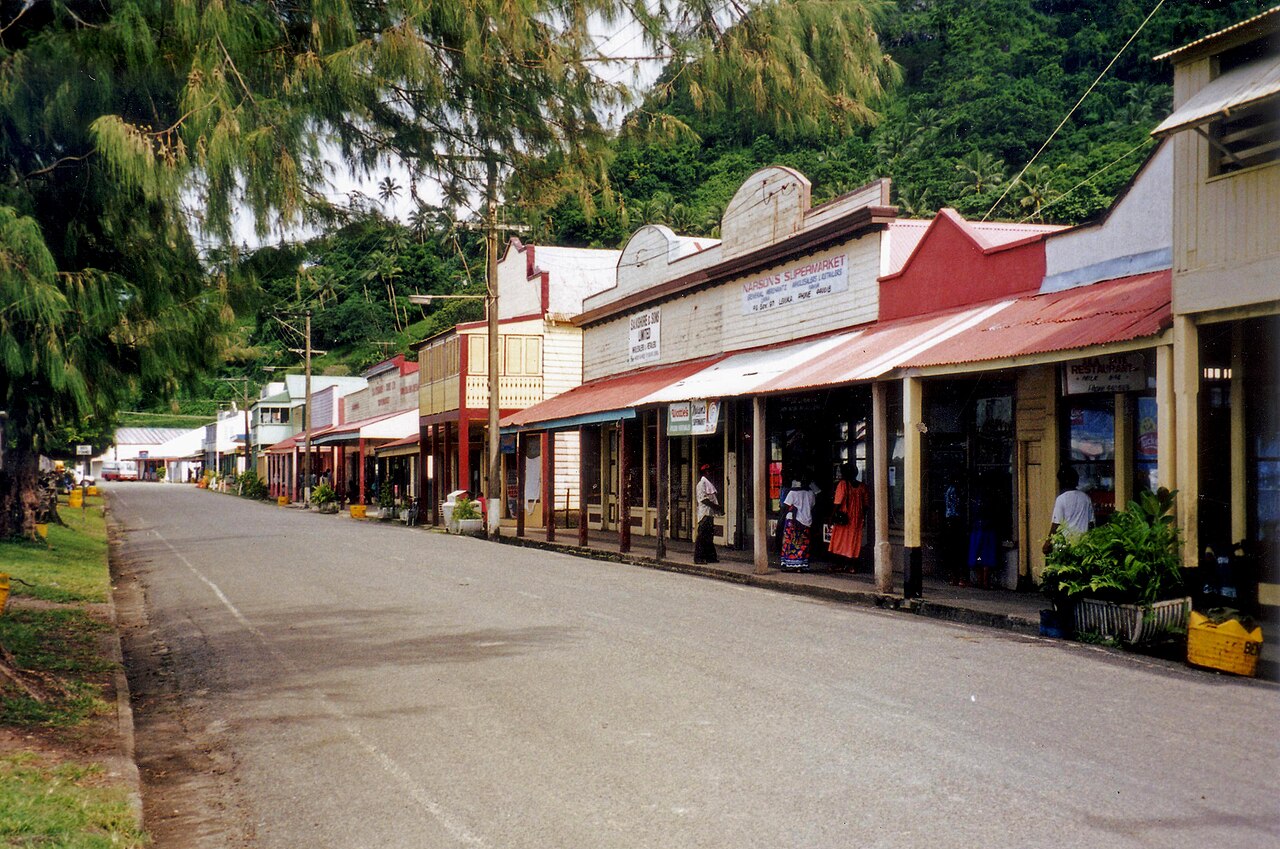
Architecture frozen in 1882 Beach Street, between volcanic cliff and reef — no room to expand
The physical geography of Ovalau Island is the key to understanding why Levuka looks today much as it did in the 1880s. The town occupies a narrow coastal flat between the sea and the abrupt volcanic slopes of Mount Uluda, which rises steeply directly behind the buildings of Beach Street. This strip of land, never more than a few hundred meters wide, could not expand laterally because the mountain blocked any inland development, and the coral reef and harbor limited seaward extension. When Governor Sir Arthur Gordon arrived to establish the new colonial administration after cession in 1874, he quickly recognized that Levuka’s confined site could not accommodate the offices, barracks, botanical garden and planned street grid of a proper colonial capital. The decision to relocate the capital to Suva on Viti Levu was made by 1877 and completed by 1882.
That decision saved Levuka’s architectural fabric. With the departure of the colonial government, the pressure for new construction — which obliterated historic quarters in Sydney, Singapore, Colombo and Suva itself — simply did not arrive. The buildings of Beach Street, constructed largely in timber on elevated posts in the Pacific vernacular tradition adapted for a colonial commercial context, continued to be used and maintained but were never replaced. Sacred Heart Church, built in 1858, is the oldest church in Fiji. The Ovalau Club, a members’ club for European traders and administrators dating from 1904, still occupies its original building. The Morris Hedstrom store at the corner of Beach Street — part of the Lever Brothers commercial empire that dominated Pacific trade in the early twentieth century — dates from 1868. The courthouse of 1904 and the town hall of 1898 complete an ensemble of civic buildings that would be routine in a preserved English market town but is extraordinary in the Pacific context.
Ratu Kadavulevu School, founded in 1906 on a hill above the town, was established specifically to educate the sons of Fijian chiefs — part of the British colonial policy of co-opting traditional aristocracies through education. Its alumni include several of Fiji’s modern political leaders. The school’s buildings, set in grounds overlooking the harbor, are part of the UNESCO inscription. The population of Levuka today is approximately 1,200, with a significant Indo-Fijian community descended from the indentured laborers brought to Fiji by the British colonial administration between 1879 and 1916 to work the sugar plantations — a labor history that is part of the broader story the World Heritage inscription aims to represent.
Practical information
Levuka is located on Ovalau Island, approximately 50 km northeast of Suva. The most common way to reach it is by ferry from Natowi Landing on the northeast coast of Viti Levu (approximately 40 minutes to Buresala on Ovalau, then a short drive or boat to Levuka). Patterson Brothers Shipping operates a regular service. Small aircraft also serve Levuka Airport from Suva’s Nausori Airport. From Suva to Natowi Landing is approximately 1.5 hours by road. The town is small enough to walk entirely in half a day; all the main historic buildings are on or close to Beach Street. The Levuka Community Centre houses a museum with material on the colonial era and the Deed of Cession. The Levuka Historical and Cultural Society operates guided walking tours. The annual Cession Day celebrations on 10 October are the town’s major festival. Levuka has a small number of guesthouses; for a wider range of accommodation, most visitors day-trip from Suva or Ovalau’s resort areas. The climate is tropical; the drier season is June to October.
Frequently Asked Questions
Why did Fiji cede sovereignty to Britain in 1874, and what was the role of Ratu Cakobau?
The Deed of Cession of 1874 was the outcome of a decade of political crisis in Fiji rather than a single decisive moment. Ratu Seru Epenisa Cakobau was the most powerful chief in Fiji by the 1850s, having consolidated authority over much of the island group through military campaigns and strategic alliances. In 1871 he became “King of Fiji” under a constitutional arrangement designed partly by European settlers who needed a recognized authority to validate land purchases and commercial contracts. However, Cakobau’s government faced structural problems it could not solve: it lacked reliable revenue, its legitimacy was contested by rival chiefly lineages, it could not control the behavior of European settlers who were encroaching on land with firearms and alcohol, and it could not prevent the epidemic diseases introduced by contact with outsiders from killing large proportions of the Fijian population. A series of confrontations between settlers and Fijian communities in the early 1870s demonstrated that neither Cakobau’s government nor the British consular officials present could maintain order. After several years of deliberation and negotiation, Cakobau and eleven other paramount chiefs concluded that formal British sovereignty was preferable to continuing instability. The Deed was signed on 10 October 1874. Cakobau himself reportedly said at the signing that he was not selling Fiji to Britain but giving it to her, to be looked after. He died in 1883, nine years after cession, and is buried on his home island of Bau, which lies just off the coast of Viti Levu.
Why has Levuka been so well preserved compared to other Pacific colonial towns?
The preservation of Levuka’s nineteenth-century townscape is directly attributable to the town’s physical geography and its subsequent economic marginalization. Ovalau Island is the eroded cone of an ancient volcano, and the town of Levuka occupies a narrow coastal shelf between the reef-edged harbor and the abrupt volcanic slopes of Mount Uluda, which rise steeply immediately behind Beach Street. There was no room for the town to expand inland, no space for the new commercial blocks, government offices and residential suburbs that developed in Suva, Auckland, Noumea or Sydney. When the colonial government relocated to Suva in 1882, Levuka lost its primary function as a capital and commercial hub, and the investment that drives urban renewal followed the government south. The buildings on Beach Street continued to be occupied and maintained — the church, the club, the stores, the courthouse — but there was no economic incentive to demolish and rebuild them. This combination of geographic constraint and economic marginalization, which would normally be considered disadvantages, produced the outcome that UNESCO recognized in 2013: the best-preserved example of a nineteenth-century Pacific colonial port town. Comparable towns — Papeete in French Polynesia, Apia in Samoa, Honiara in the Solomon Islands — were rebuilt after wartime damage or modernization pressure and retain little of their nineteenth-century fabric.
What is the significance of the Indo-Fijian community in Levuka’s heritage?
The presence of a significant Indo-Fijian community in Levuka is part of the broader colonial history that the UNESCO inscription represents. Between 1879 and 1916, the British colonial administration of Fiji brought approximately 60,000 indentured laborers from India — primarily from Bihar, Uttar Pradesh, and parts of what is now Andhra Pradesh and Tamil Nadu — to work on the sugar cane plantations of Viti Levu and Vanua Levu. The system of indenture, known in Fiji as the girmit (from the English word “agreement”), was a form of bound labor that required workers to remain on their assigned plantation for five years under conditions that included highly restricted movement, very low wages, and limited legal recourse against abusive overseers. After their indenture expired, workers had the right to remain in Fiji as free settlers, and the majority chose to do so rather than return to India. Their descendants — known as Indo-Fijians or Fiji Indians — today constitute approximately 38 percent of Fiji’s total population. In Levuka, the Indo-Fijian community has been present since the indenture era and is represented in the town’s commercial and social life. The UNESCO inscription of Levuka explicitly acknowledges that its Outstanding Universal Value encompasses not only the European colonial architecture of Beach Street but also the multicultural social history that the town represents: Fijian, European, Indo-Fijian and other Pacific Islander communities whose interactions shaped the modern Fijian state.