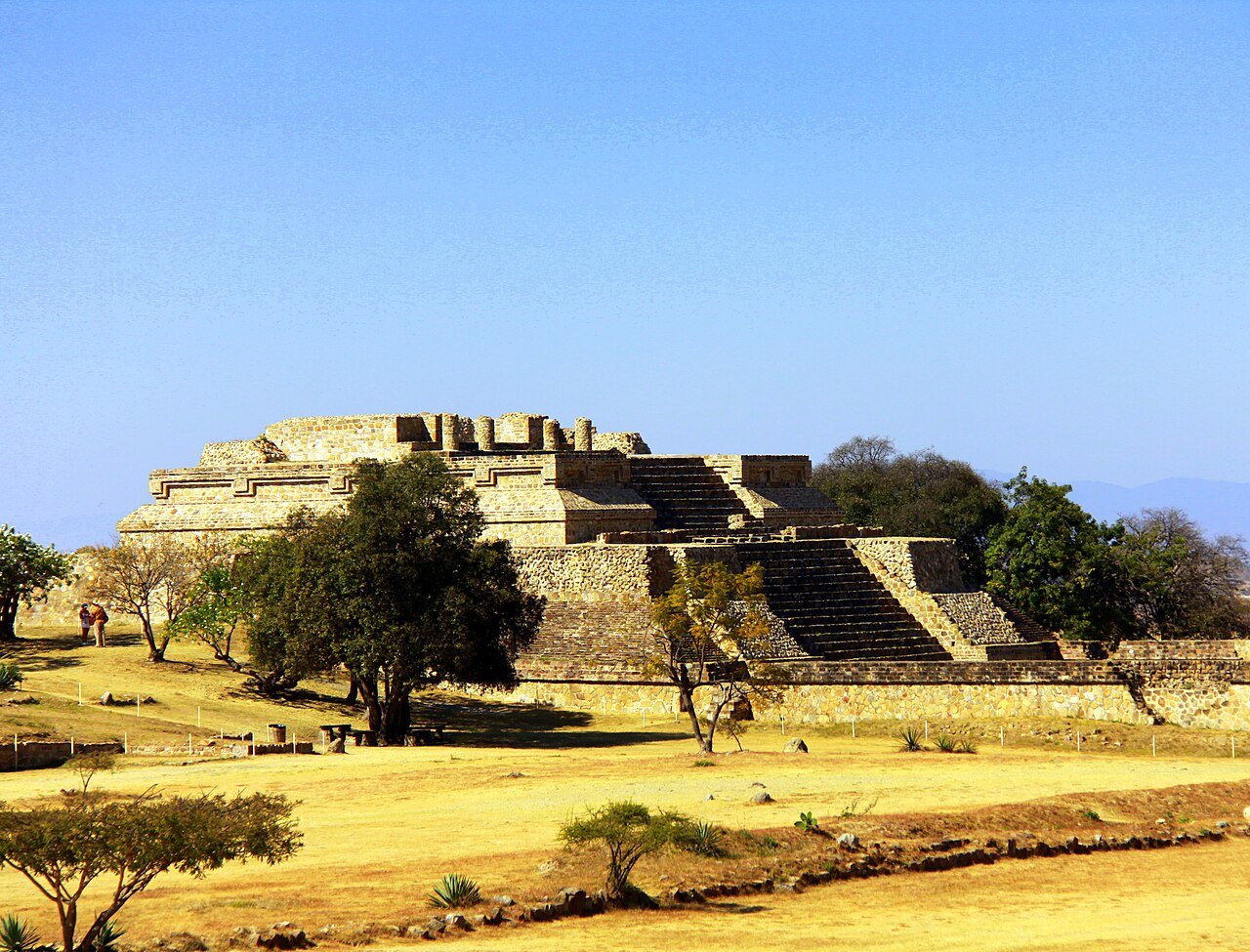
Monte Albán sits at the junction of three valleys in the highlands of Oaxaca, on a mountaintop that its builders physically leveled to create one of the most impressive civic plazas in pre-Columbian history. Founded around 500 BCE by the Zapotec people, it remained the dominant political, religious and economic centre of the Oaxacan region for over a millennium. The UNESCO inscription, granted in 1987, covers both Monte Albán and the colonial city of Oaxaca below it — two periods of political ambition separated by more than a thousand years but sharing the same extraordinary valley landscape.
The Zapotec capital on the mountain 9 km west of Oaxaca city, Oaxaca State, Mexico
The Zapotec people referred to their mountaintop capital as “Danni Hipáa” — Hill of the Tiger. The Spanish name Monte Albán (White Mountain) came later and refers either to the pale limestone rubble that covers the site or possibly to an early colonial landowner. What the Zapotec built here, beginning around 500 BCE, was the first genuine city in the Mesoamerican highlands: an urban centre with a planned layout, monumental public architecture, a writing system, a numerical notation, and a calendar — all developed independently from the better-known Maya and Aztec civilisations.
The Great Plaza is the defining feature of the site: a rectangular space 300 metres long and 200 metres wide, artificially leveled from the summit of a mountain 400 metres above the Valley of Oaxaca. The labour required to move this amount of material using only hand tools and human carrying baskets is staggering. The plaza is bounded on the north and south by massive platforms, and along its flanks by a series of temples and palaces whose alignment is consistent with astronomical observations — the position of the sun at the summer solstice, the rising of specific stars, and the zenith passage of the sun (when the sun passes directly overhead, casting no shadow) were all apparently incorporated into the site plan.
Monte Albán reached its peak between approximately 200 and 700 CE, when its population stood at around 25,000 — making it one of the largest cities in the Americas at the time and a significant regional power capable of projecting military and commercial influence across the southern Mexican highlands. The site shows evidence of contact with Teotihuacán, the great city north of modern Mexico City that was contemporary with Monte Albán at its height: a dedicated “Oaxacan barrio” (neighbourhood) has been identified archaeologically at Teotihuacán, suggesting long-term Zapotec residency there, and Teotihuacán-style imagery appears on several Monte Albán structures.
By approximately 700 CE, the city was in decline. The reasons remain debated — deforestation leading to agricultural collapse, political fragmentation, shifts in regional trade routes, or some combination of these factors are all proposed by researchers. The site was never completely abandoned: the Zapotec continued to use it for burials, and the Mixtec people who rose to prominence after 800 CE reused the elaborate tomb chambers under Monte Albán’s platforms for their own elite burials. The famous Tomb 7, excavated in 1932, contained the remains of Mixtec royalty along with the largest collection of pre-Columbian gold objects ever discovered in Mexico — more than 500 gold ornaments, carved bone, turquoise mosaic and alabaster vessels — all now held in the Oaxaca Regional Museum.
The Observatory, the Danzantes and the writing system Within the Great Plaza complex
Building J, the Observatory, is the most architecturally anomalous structure at Monte Albán: an arrowhead-shaped platform oriented at 45 degrees to the main north-south axis of the site, with a narrow corridor running through its interior. This eccentric orientation was almost certainly deliberate. Archaeoastronomical studies have determined that the building’s orientation aligns the observer in the interior corridor with the rising of the bright star Capella at specific times of year, and with the zenith passage of the sun. A row of carved stones on the lower section of Building J shows representations of Zapotec place names — possibly conquered towns, or towns with which Monte Albán maintained tribute relationships — accompanied by an inverted human head, a symbol that appears elsewhere at the site in contexts associated with military victory.
The Temple of the Danzantes (Building L), one of the oldest structures on the site, is named for the approximately 300 carved stone slabs set into its facade. When first described by Spanish colonial chroniclers in the 16th century, the contorted figures on these slabs were interpreted as dancing human figures — hence “danzantes.” Twentieth-century scholarship overturned this reading entirely. The figures are depicted naked (a sign of defeat and submission in Mesoamerican iconography), with closed eyes, open mouths and sometimes visible wounds or excised genitalia. They represent captives, conquered rulers, or sacrificial victims displayed as a public assertion of Zapotec military power. Many figures are accompanied by carved glyphs — numerical and calendrical notations combined with what appear to be name glyphs — that constitute some of the earliest writing yet found in Mesoamerica, possibly dating to the 4th century BCE in the case of the oldest slabs.
The Zapotec writing system remains only partially deciphered. It uses a combination of logographic signs (where a symbol represents a word or concept) and syllabic signs (where a symbol represents a sound), arranged in columns read from top to bottom. The system was used primarily for calendrical notation and political records on stone monuments, not for extended literary texts; no Zapotec equivalent of the Maya books (codices) is known to survive. The numerical system used bar-and-dot notation (one dot = 1, one bar = 5), which is also found in Olmec and Maya contexts, suggesting either shared origins or cultural diffusion across Mesoamerica.
The Ball Court at Monte Albán is I-shaped in plan, as are most Mesoamerican ball courts, with sloping stone walls that players used to keep a rubber ball in play using hips and elbows. Unlike some other Mesoamerican sites where ball game iconography emphasizes decapitation and human sacrifice, Monte Albán’s ball court shows little evidence of sacrificial associations; the game here was likely more ceremonial and political in character, possibly used to resolve disputes or ratify alliances between competing groups.
Practical information
Monte Albán is 9 kilometres west of the city of Oaxaca, a 20-minute drive by taxi or colectivo (shared minibus). Colectivos depart from near the second-class bus terminal on Trujano Street; the journey costs a few pesos. Taxis from the central Zócalo charge a fixed rate displayed at the rank. The site opens at 8:00 AM and closes at 5:00 PM daily; the entry fee is charged in Mexican pesos (confirm the current amount locally, as it changes periodically). The site has a small museum at the entrance displaying ceramics, carved stones and tomb objects found during excavations — allow time for this before climbing to the plaza level.
The best time to visit Monte Albán is early morning, when the light is soft, the temperature is cool, and tour groups from Oaxaca have not yet arrived. The site sits at 1,940 metres elevation and the plaza is fully exposed with no shade; bring water, a hat and sunscreen regardless of season. November through April is the dry season and offers the clearest skies. The colonial city of Oaxaca itself warrants at least two full days alongside Monte Albán: its baroque churches, markets, mezcal distilleries and the outstanding Oaxaca Regional Museum (which holds the Tomb 7 treasures and a comprehensive survey of Zapotec and Mixtec art) are among the finest in Mexico.
Frequently Asked Questions
How significant is Monte Albán compared to other Mesoamerican archaeological sites?
Monte Albán holds a distinctive position in Mesoamerican archaeology for several reasons that set it apart from the more widely visited Maya and Aztec sites. First, it is older: the Zapotec occupation of the site from approximately 500 BCE predates the Classic Maya period (250–900 CE) and the Aztec empire (ca. 1300–1521 CE) by centuries, and Monte Albán was already a major urban centre with writing, calendrics and monumental architecture before either of those civilisations reached their florescence. Second, the site represents a wholly independent development: the Zapotec were not ancestors or cultural descendants of the Maya or Aztec but a separate cultural tradition with their own distinct language (unrelated to Nahuatl or Mayan), their own calendrical system (the 365-day solar calendar combined with a 260-day ritual calendar in the same interlocking system found across Mesoamerica, but developed locally), and their own artistic conventions. Third, Monte Albán is unusually well preserved: the Great Plaza was never built over by later colonial or modern construction, as happened to Teotihuacán (partially) and to the Aztec capital Tenochtitlán (entirely, now Mexico City), so the site’s original layout remains legible. In the broader hemispheric context, Monte Albán alongside contemporaneous sites like Cerros in Belize and El Mirador in Guatemala represents the first generation of true cities in the Western Hemisphere.
What happened to the gold treasures found at Monte Albán, and where can they be seen?
The treasures from Tomb 7 at Monte Albán — the largest single find of pre-Columbian gold in Mexican archaeological history — are displayed in the Oaxaca Regional Museum, housed in the former convent of Santo Domingo de Guzmán in the centre of Oaxaca city. The museum is essential viewing for any visitor to Monte Albán, as it provides the material context that the site itself cannot offer. The tomb was discovered in 1932 by Alfonso Caso, the archaeologist who directed the first systematic excavation of Monte Albán, when a worker’s pickaxe broke through the vault of a burial chamber beneath the North Platform. Inside, Caso found the remains of nine individuals (one primary burial and eight secondary interments) accompanied by over 500 gold objects including elaborate pectoral ornaments, earspools, rings, necklaces and a famous skull carved from rock crystal with a detachable jaw inlaid with turquoise mosaic. The stylistic analysis of these objects indicates they were made by Mixtec craftsmen, not Zapotec — confirming that the Mixtec were reusing earlier Zapotec tombs at Monte Albán for their own elite burials after 800 CE. The broader museum collection covers the full sweep of Zapotec, Mixtec and later Aztec-period material culture from the Oaxacan valleys, making it one of the most important pre-Columbian collections in Mexico.
Can visitors enter the tombs at Monte Albán, and how many survive?
More than 200 tombs have been identified at Monte Albán, built into the fill and sub-floors of the platforms and temples over the site’s long occupation history. A small number are accessible to visitors. The most important is Tomb 104, located beneath the North Platform, which retains its original painted plaster walls depicting Zapotec deities, the corn god and rain deity Cocijo, and calendar signs. The paintings are fragmentary but sufficient to convey the visual programme of Zapotec funerary art. Tomb 105, adjacent, is also occasionally open. The condition of accessible tombs varies with season and conservation work; it is worth asking at the entrance whether specific tombs are open on the day of your visit. The construction of the tombs is consistent across the site: a rectangular corbel-vaulted chamber accessed by a descending stairway, with a sealed stone door. The chambers were designed for repeated use over generations, with earlier burials pushed to the sides to make room for new interments. Objects placed with the dead included grey Zapotec pottery (the distinctive clay ware of the culture), jade ornaments, obsidian blades and, in elite tombs, painted ceramic urns depicting deities with elaborate headdresses that are among the most recognizable objects in Oaxacan art.