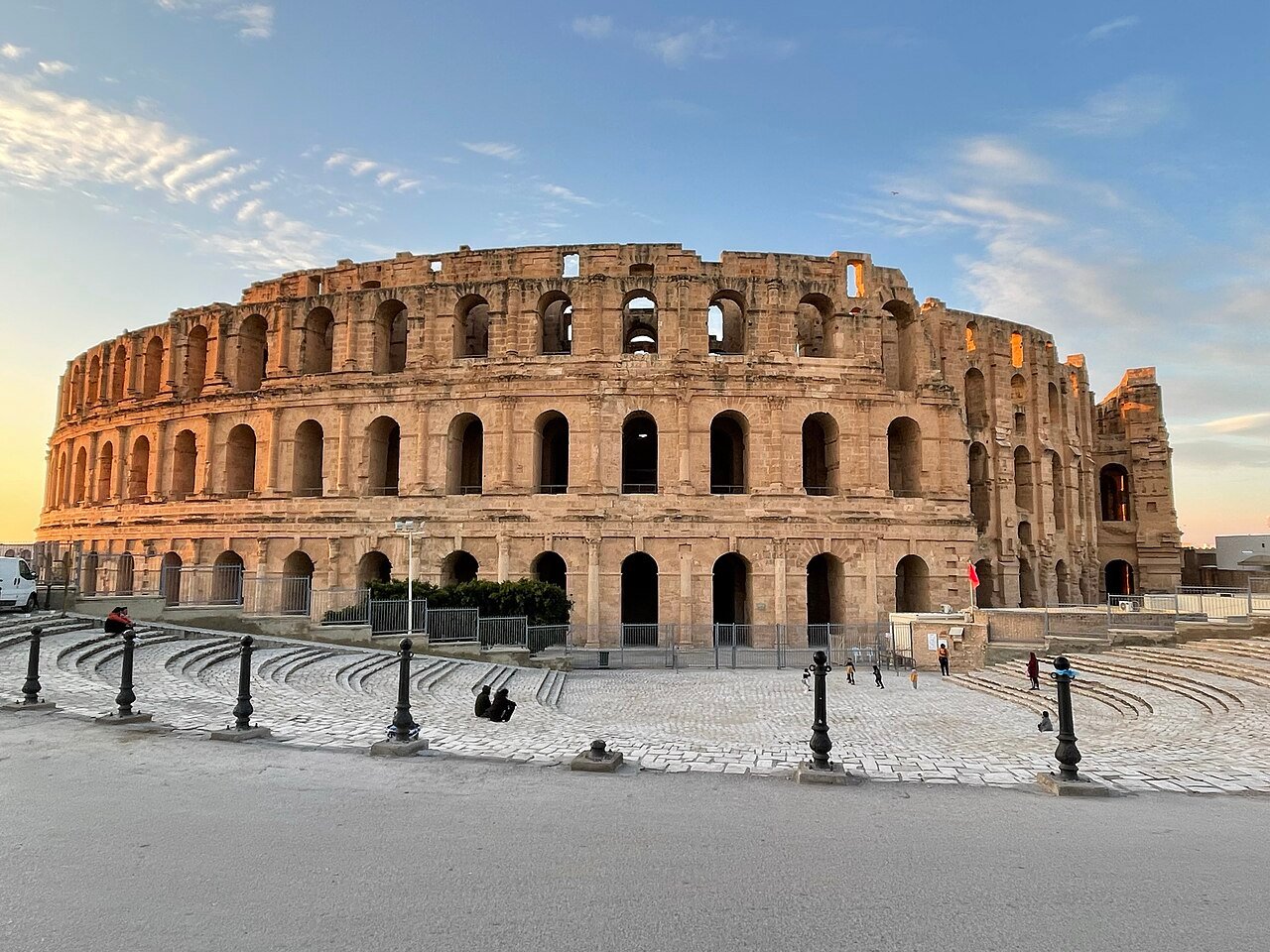
The amphitheatre of El Jem stands on the flat steppe of central Tunisia like a statement that was never finished but never retracted. Built around 230–238 CE in the Roman city of Thysdrus, it is the third-largest Roman amphitheatre in the world, after the Colosseum in Rome and the amphitheatre at Capua, with a capacity of approximately 35,000 spectators. The UNESCO World Heritage inscription dates to 1979.
The structure and the olive oil economy that funded it El Jem town, central Tunisia, 200 km south of Tunis
The numbers establish the scale first: 148 metres on the long axis, 122 metres on the short axis, 36 metres high. The amphitheatre of El Jem was built entirely of cut limestone blocks without mortar — dry-stone construction at the level of monumental civic architecture — and it has held its form through seventeen centuries of North African history, including earthquake, siege, and quarrying for building material. The outer wall stands on three storeys of superimposed arcades, each arcade flanked by engaged columns: Doric on the first storey, Ionic on the second, Corinthian on the third. The sequence is the canonical Roman elevation, borrowed from the Colosseum’s three-storey programme and applied here on the Tunisian steppe, far from any city that might ordinarily have justified this scale.
That spatial anomaly — a monument of metropolitan ambition in a small provincial town — is explained by money. Thysdrus became enormously wealthy in the 2nd and 3rd centuries CE as the olive oil capital of Roman Africa. The landscape surrounding the city was covered with olive groves: modern archaeologists have traced traces of pressing facilities and storage infrastructure across a wide radius around the site. Olive oil produced here was exported across the empire — to Rome, to the military camps of the Rhine and Danube frontiers, to the cities of Gaul and Spain. Oil paid for the amphitheatre, and the amphitheatre was the most eloquent possible statement of civic wealth in the language of Roman architecture. No city in Africa Proconsularis spent more visibly on spectacle.
Unlike the Colosseum, El Jem’s amphitheatre had no subterranean passages. The Colosseum’s hypogeum — the network of underground corridors, lifts, and animal holding cells beneath the arena floor — gave its engineers control over the spectacle’s staging: animals and gladiators could appear through trap-doors in the sand. At El Jem, animals and fighters entered directly through ground-level side doors cut into the arena wall. The absence of underground infrastructure does not diminish the site; it distinguishes it, and it means that the arena floor level is visible without the complication of later excavation.
The arena itself is an ellipse 65 metres by 40 metres, with the arena floor surrounded by a high podium wall that separated the spectators from whatever was happening at ground level. The seating cavea rises steeply above this podium wall through multiple tiers. At 35,000 capacity, the amphitheatre would have accommodated a population several times larger than Thysdrus itself — drawing spectators from across the region for the games, festivals, and public executions that Roman amphitheatre culture staged as civic performance.
Gordian I, the 36-day empire, and the centuries of reuse From imperial proclamation site (238 CE) to 17th-century fortress
In 238 CE, the governor of Africa Proconsularis — Marcus Antonius Gordianus Sempronianus, known as Gordian I, aged 79 — was proclaimed emperor in Thysdrus, reportedly by landowners protesting against the tax policies of the reigning emperor Maximinus Thrax. Gordian immediately appointed his son Gordian II as co-emperor, and the Senate in Rome recognised both. The joint reign lasted 36 days. Gordian II was killed in battle near Carthage when the governor of the neighbouring province of Numidia — who remained loyal to Maximinus Thrax — led his legion against the new claimants. Gordian I, on receiving the news, committed suicide. The episode is among the most compressed imperial accessions in Roman history: from provincial proclamation to extinction in just over a month. The amphitheatre of Thysdrus is the backdrop to this moment; whether Gordian was proclaimed in or adjacent to it is not documented with certainty.
The decline of Thysdrus through the 3rd century CE — linked to the economic disruption of the wider Roman crisis of the 3rd century — left the amphitheatre progressively marginal to any urban population that could maintain it. By the medieval period it had passed from civic monument to defensible structure: its massive limestone walls and cellular interior made it a natural fortress. In the late 17th century, the Ottoman Turks demolished a section of the outer wall on the northwest side to dislodge a Berber rebel leader who had barricaded herself inside — the rebel in question, known in local tradition as Kahena or Dihya, was a Berber queen who led resistance to Arab expansion in North Africa; some accounts of her final stand place it at El Jem, though the precise historical record is disputed. The gap in the outer wall, visible in every photograph of the monument, dates from this demolition.
The Archaeological Museum of El Jem, located adjacent to the amphitheatre, holds the finest collection of Roman mosaics in Tunisia — arguably one of the finest in the world. The mosaics were recovered from the domestic and public buildings of Thysdrus and range from simple geometric floor coverings to large-scale pictorial compositions depicting mythological scenes, hunting, and marine life. The quality and quantity of the El Jem mosaic collection reflects the wealth of the olive oil economy: these are not provincial imitations of metropolitan taste but commissions of a standard that competed with anything being produced in Rome itself.
Practical information
El Jem is located 200 km south of Tunis and 60 km south of Sousse, in the Mahdia Governorate of central Tunisia. The town is on the main Tunis–Sfax railway line, making it one of the most easily reached UNESCO sites in North Africa: trains from Tunis take approximately two and a half hours to El Jem station, which is within walking distance of the amphitheatre. Buses from Sousse and Sfax also serve the town. By car, El Jem is reached from Tunis via the A1 motorway to Sousse, then the GP1 national road south.
The amphitheatre is open to visitors daily; hours extend in summer months. Entrance fees are modest by European standards. The site allows visitors to walk through the arcade galleries of the outer wall, descend to the arena floor level, and access parts of the seating cavea. The Archaeological Museum of El Jem — five minutes’ walk from the amphitheatre — requires a separate entrance ticket and should be treated as an integral part of any visit; the mosaics alone justify the detour. El Jem hosts an international festival of symphonic music in July and August, held inside the amphitheatre at night — the acoustics of the stone cavea carrying the sound as they carried the crowd noise of Roman spectacles. Tunisia requires no visa for European Union citizens and most Western passport holders; check current requirements for your nationality before travel. The flat steppe location means the site is exposed and hot in summer; morning visits are recommended from June through September.
Frequently Asked Questions
How does El Jem’s amphitheatre compare to the Colosseum in Rome?
The Colosseum in Rome is the largest surviving Roman amphitheatre, with a capacity estimated at between 50,000 and 80,000 spectators. El Jem’s amphitheatre is smaller — 35,000 capacity, third-largest in the Roman world after Rome and Capua — but in one critical respect it is better preserved. The Colosseum has lost its entire marble seating and most of its outer wall; it is an interior skeleton. El Jem retains three-quarters of its outer arcade wall, standing to its full height of 36 metres, with the three-storey superimposed arch-and-column programme intact along most of the structure’s circumference. The gap caused by the 17th-century Ottoman demolition on the northwest side is the principal break in an otherwise continuous outer envelope. The dry-stone limestone construction — no mortar — has also proved more resistant to the particular weathering conditions of the Tunisian steppe than the concrete-and-tufa core of the Colosseum proved to Roman marble quarriers and later construction projects. The interior of El Jem’s amphitheatre is also distinctive for the absence of subterranean passages (the hypogeum that defines the Colosseum’s current appearance): the arena floor level is original and visible without later excavation. Standing inside El Jem at ground level, looking up at the full height of the cavea and the arcade beyond, gives a clearer impression of the spatial experience of a Roman amphitheatre at capacity than the Colosseum — where the underground excavation and the missing seating make the original spatial logic harder to read — currently provides.
How did olive oil make Thysdrus wealthy enough to build this amphitheatre?
The relationship between olive oil and Roman North Africa is one of the better-documented economic stories of the ancient world, traceable through amphora distribution patterns, agricultural residue analysis, and the written record of Roman commerce. Africa Proconsularis — roughly modern Tunisia and northeastern Algeria — was one of the most productive olive oil regions in the empire. The combination of suitable climate, large agricultural estates (latifundia), and an extensive road and port network gave African oil a competitive advantage in Rome’s supply chains from the 1st century CE onward. By the 2nd century, Africa Proconsularis had displaced Spanish Baetica as Rome’s principal oil supplier. Thysdrus, in the central steppe region, sat within one of the densest olive grove concentrations in the province. Archaeological surveys have located pressing facilities and storage structures across a wide radius around the site, and the typology of amphoras (Dressel 2-4 type) found at Roman sites across the empire has been linked to African oil production. The wealth this generated was expressed in the domestic architecture of Thysdrus — the exceptional mosaic floors now in the El Jem museum reflect expenditure on interior decoration that matches the best work from Rome and Ostia — and in the public monuments. The amphitheatre was the largest single capital investment the city ever made. Its scale can only be understood as a statement by a community that had accumulated, through oil, the financial resources to build at a level normally reserved for provincial capitals.
What is the historical role of El Jem’s amphitheatre beyond spectacle?
The amphitheatre of El Jem has served at least four distinct social functions across its seventeen centuries of existence. First, as a Roman spectacle venue (c. 238–5th century CE): public games (ludi), gladiatorial combat (munera), and animal hunts (venationes) staged for the population of Thysdrus and the wider region. Second, as a refuge and fortress during the decline of Thysdrus and the subsequent periods of Vandal, Byzantine, and Arab-Berber conflict (5th–7th century CE): the massive limestone walls made it a defensible enclosure during episodes of political instability. Third, as a contested stronghold during Berber resistance to Arab expansion in the late 7th century, when the rebel leader known in local tradition as Kahena or Dihya reportedly used the structure as a base; the Ottoman demolition of a section of the outer wall in the late 17th century was intended to dislodge a similar rebel hold. Fourth, as a quarry for building material: local inhabitants of medieval and early modern El Jem extracted finished limestone blocks from the less-exposed sections of the monument for construction of local buildings, a form of reuse that was common to virtually all Roman monuments in North Africa and accounts for some of the differential preservation of the outer wall. The modern fifth function — tourism and cultural performance, including the international music festival held inside the structure in summer — adds a contemporary layer to this sequence. The inscription of the site on the UNESCO World Heritage List in 1979 formalised international interest in its preservation and provided the framework for the current conservation programme.