Palenque reached its artistic and political peak under two rulers whose ambition outlasted the jungle that grew over their city for more than a thousand years. The Maya city-state in the highlands-to-lowlands transition zone of Chiapas produced some of the most sophisticated relief carving and the longest known Maya text in stone, and in 1952 one of the most remarkable tomb discoveries of the twentieth century was made beneath its principal pyramid. UNESCO inscribed the Pre-Hispanic City and National Park of Palenque in 1987. The site is 8 kilometres from Palenque town and 150 kilometres from Villahermosa.
Pakal the Great and the Temple of the Inscriptions Chiapas, Mexico · 8 km from Palenque town · 150 km from Villahermosa
Palenque’s rise to regional prominence began under K’inich Janaab’ Pakal, known as Pakal the Great, who acceded to the throne in 615 CE at the age of twelve and reigned until his death in 683 CE — one of the longest reigns in Maya history at 68 years. Under Pakal and his son K’inich Kan Balam II (r. 684–702 CE), the city expanded dramatically and its sculptural and architectural programmes achieved a refinement that distinguishes Palenque from contemporaneous Maya centres.
The Temple of the Inscriptions is the funerary pyramid Pakal commissioned for himself: seven platforms rising 23 metres above the plaza floor, its summit temple named for three stone panels bearing a total of 620 hieroglyphs — the longest continuous Maya text known in stone. The inscriptions record a dynastic history spanning three centuries, correlating events in Palenque’s past with astronomical cycles and establishing the political legitimacy of the ruling line. They remain one of the most important documents in the decipherment of the Maya script.
In 1949, the Mexican archaeologist Alberto Ruz Lhuillier noticed that one of the flagstones in the temple floor had a double row of holes stoppered with stone plugs — a feature that could only be an access point. Three years of excavation cleared a rubble-filled staircase descending through the pyramid’s core to a burial chamber at the level of the plaza floor, a depth of 25 metres below the summit temple. The chamber was sealed by a massive triangular stone slab; behind it, in June 1952, Ruz found Pakal’s sarcophagus. The king’s remains lay wearing a jade mosaic death mask and surrounded by jade jewellery, red cinnabar, and the remains of six attendants who had been sacrificed to accompany him. The sarcophagus lid — a carved limestone panel 3.8 metres long — shows Pakal at the moment of death: his body falls backward along the World Tree, the central axis of Maya cosmology, while a celestial bird perches at the tree’s summit and the underworld opens beneath. The image is a standard representation of Maya beliefs about death and rebirth. It was misread by the popular writer Erich von Däniken in 1968 as depicting a man piloting a spacecraft — a claim rejected without exception by Mayanist scholars, who note that every element of the carving corresponds precisely to documented Maya iconography.
The sarcophagus and lid remain in the burial chamber inside the pyramid; a replica of the lid is displayed in the site museum and in Mexico’s National Museum of Anthropology in Mexico City. The chamber is currently closed to public entry to preserve the microclimate that protects the carvings.
The Palace and the Temple of the Cross group Core site walkable · Only ~10% of known city excavated
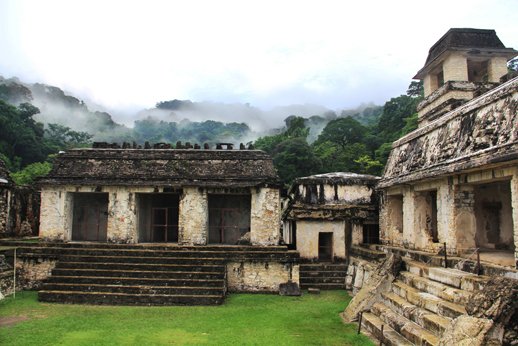
The Palace is the largest complex at Palenque and the one that dominates the site’s central plaza. Built and expanded over roughly two centuries beginning in the sixth century CE, it consists of a series of galleries, subterranean passages, and open courtyards arranged on an elevated terrace platform. Its most conspicuous feature is the four-story tower on the northwest corner — the only known example of a multi-story Maya tower, rising approximately 15 metres above the platform. The tower’s precise function is debated; it may have served as an astronomical observatory, as a watchtower commanding views over the surrounding jungle canopy and the lowland plain to the north, or as both. The central courtyard of the Palace contains a series of carved stone panels, some showing the presentation of captured enemy lords to Pakal and his successors — a formulaic but politically explicit assertion of military dominance.
East of the main plaza, the Temple of the Cross complex was built by K’inich Kan Balam II following his accession in 684 CE, explicitly as a monument to his own reign. Three temples sit on a hillside: the Temple of the Cross, the Temple of the Foliated Cross, and the Temple of the Sun. Each contained a carved limestone panel — the “tablet” — set into the back wall of the inner sanctuary, depicting K’an Balam receiving emblems of power and engaging in ritual bloodletting alongside his deceased father Pakal. The panels are now in the National Museum of Anthropology; casts remain on site.
The Otolum river, one of several watercourses that cross the site, was channelled by the ancient Maya into a corbel-vaulted aqueduct in the seventh century CE — an engineering solution to the problem of running water through a densely built urban core. The aqueduct is still partially visible near the Palace. The broader site covers an area of approximately 2.5 square kilometres of known occupation, of which only about 10 percent has been fully excavated; a further 1,400 structures have been identified through LiDAR survey but remain unexcavated beneath the jungle floor.
Practical information
Palenque archaeological zone is 8 kilometres from the modern town of Santo Domingo de Palenque in Chiapas, reached by shared taxi or colectivo from the town centre in about 15 minutes. The nearest airport is Palenque’s small domestic airport; Villahermosa airport (Tabasco state, 150 km) has more connections and is the preferred entry point for travellers from Mexico City, Cancún, or international connections. The site can also be reached overland from San Cristóbal de las Casas (five hours by bus through mountain scenery) or from Mérida via Villahermosa.
The site is open daily except Mondays. Tickets are purchased at the entrance. The adjacent site museum, a short walk from the main entrance, holds original carved panels, the replica of Pakal’s sarcophagus lid, jade objects from the tomb, and other finds. Allow at least three to four hours to cover the main monuments; the full site takes a full day.
Best season is November through March, the dry season in Chiapas lowlands. The site is in a rain-forest transition zone; even in the dry season, mornings can be misty and humidity is high year-round. Lightweight, breathable clothing, insect repellent, and walking shoes with grip are practical necessities. The paths between monuments are unpaved and can be slippery after rain.
Frequently Asked Questions
What was found inside Pakal’s tomb and where can I see it?
When Alberto Ruz Lhuillier opened the burial chamber inside the Temple of the Inscriptions in June 1952, he found the undisturbed tomb of K’inich Janaab’ Pakal (Pakal the Great), who died in 683 CE after a 68-year reign. The king’s skeleton lay inside a monolithic limestone sarcophagus. The remains were covered in red cinnabar pigment, and Pakal wore a jade mosaic death mask assembled from approximately 200 individual jade pieces, with shell and obsidian inlay for the eyes. He wore jade ear ornaments, a jade collar, jade bracelets, a jade ring on each finger, and held jade pieces in each hand. The chamber walls bear nine stucco relief figures of the Bolon Yokte’ Ku — deities associated with transitions between world eras. Six subsidiary burials, identified as sacrificed attendants, were found in a chamber adjacent to the main tomb. The sarcophagus and the remains are still inside the pyramid; the burial chamber is closed to visitors. The jade death mask is in the National Museum of Anthropology in Mexico City. A full-size replica of the carved sarcophagus lid is displayed in the Palenque site museum, and another is in the National Museum of Anthropology. To see the original stone panels from the Temple of the Cross group, also go to the National Museum of Anthropology — the panels on site are high-quality casts.
What does the sarcophagus lid actually show?
The carved limestone lid of Pakal’s sarcophagus, measuring 3.8 by 2.2 metres, depicts the king at the moment of death. His body reclines at the centre of the composition, falling backward along the trunk of the World Tree — the axis mundi of Maya cosmology, which connects the underworld, the earth plane, and the celestial realm. At the summit of the tree sits the Celestial Bird, a supernatural entity associated with the sky. Below Pakal’s falling body, the open jaws of the underworld (the skeletal maw of a serpent or earth monster) await. The scene encapsulates Maya beliefs about royal death and rebirth: the dead king descends into the underworld to undergo transformation before rising again, just as the sun descends each night and rises each morning. Every element of the image has documented parallels in Maya iconography from other sites and periods. The 1968 claim by Erich von Däniken that the image shows Pakal piloting a space vehicle has been rejected by every Mayanist scholar who has addressed it; the “astronaut” reading requires ignoring the standard symbolic vocabulary of Maya art entirely. The lid is currently not accessible inside the pyramid but is reproduced in high-quality replicas in two Mexican museums.
Why is the Palace tower at Palenque significant?
The four-story tower in the northwest corner of the Palace complex at Palenque is the only known multi-story free-standing tower constructed by the ancient Maya. Most Maya architecture uses horizontal mass — broad platforms, wide pyramid bases, rooms built side by side rather than stacked — because the corbel arch used in Maya construction cannot span large spaces and limits the interior dimensions of upper storeys. The Palenque tower achieves its height through a different structural logic: it is essentially a solid mass with small interior staircase, rather than a building with habitable floors in the conventional sense. The tower was built during the reign of K’inich Janaab’ Pakal or his immediate successors in the late seventh century CE. Its proposed functions include astronomical observation (the tower’s position and orientation align with certain solar events), military surveillance over the surrounding lowland plain, and ceremonial signalling. Archaeoastronomical analysis has found alignments between the tower’s windows and the winter solstice sunset, which is consistent with the astronomical practices documented in Maya calendrical records from other sites. The tower is not accessible to visitors for climbing, but it is visible from the courtyard of the Palace complex immediately below it.