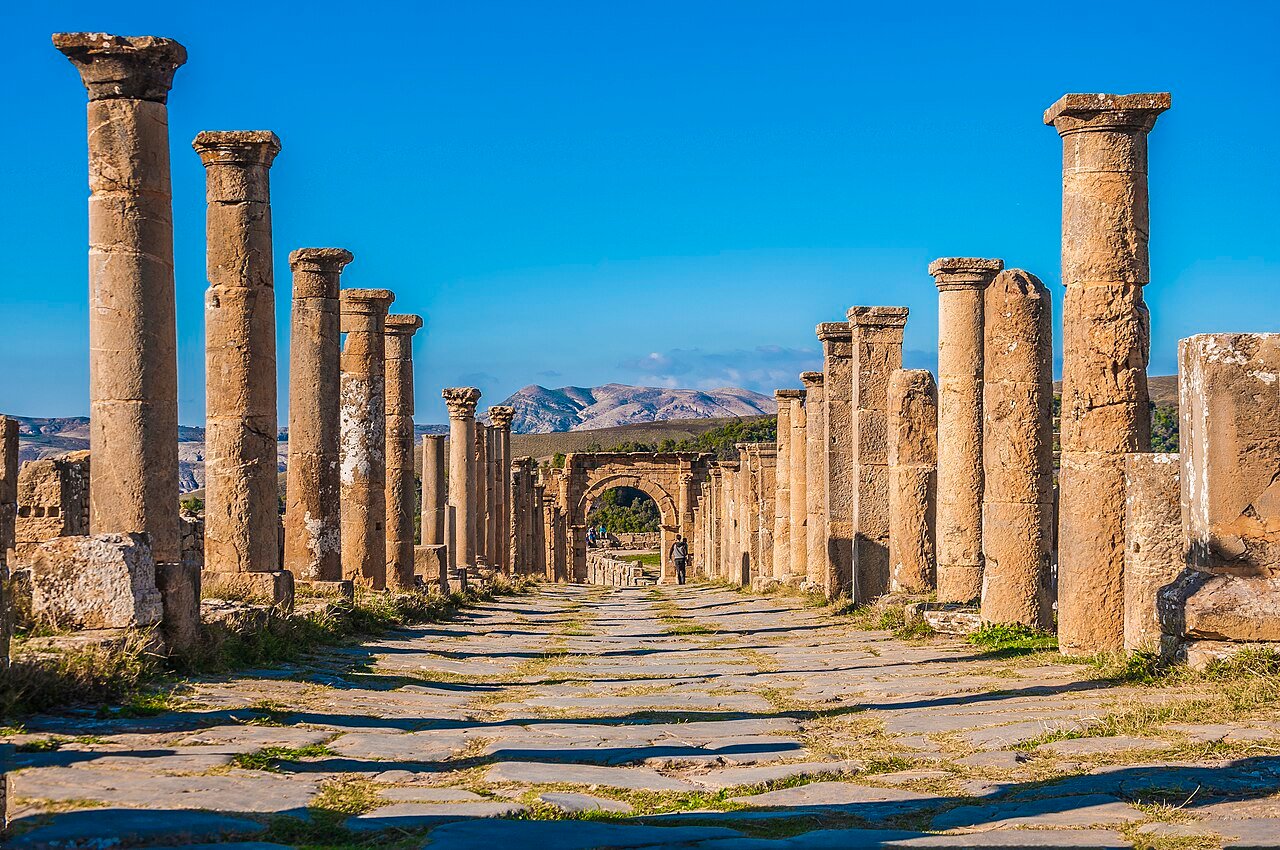
At 900 metres above sea level in the mountain valleys of northeastern Algeria, the Roman city of Cuicul — known today by its Berber name Djémila, “the beautiful” — survives in a state of preservation that surprised even its first modern excavators: streets, forum pavement, temple steps, theatre seating tiers and private house mosaics intact under centuries of soil, never robbed for building material because no later settlement wanted to live at this altitude in this valley. Albert Camus, who visited in the 1930s, called these “the most beautiful Roman ruins in the world” — a subjective verdict, but one that has been repeated by enough informed visitors since to be taken as a serious critical assessment rather than mere hyperbole.
A veteran colony at altitude: the founding and growth of Cuicul History & Archaeology
Cuicul was founded between 96 and 98 CE, under Emperor Nerva and the first years of Emperor Trajan, as a colony for military veterans. The choice of site was strategic rather than agricultural: a narrow plateau between two river valleys — the Guergour and the Betame — at the junction of road routes between the coastal cities and the Saharan frontier zones. The elevation offered defensible terrain and a commanding view of both valleys; it was not the kind of fertile plain that Roman planners preferred when they had the choice, which is why the colony was always more military outpost than agricultural settlement.
The city grew according to the standard Roman colonial template: a forum at the intersection of the main axes, temples to the Capitoline triad (Jupiter, Juno, Minerva) at the forum’s north end, a theatre carved into the hillside to use natural topography, baths, market buildings and private houses arranged on the street grid. What makes Cuicul unusual is the clarity with which you can read the sequential phases of Roman urbanisation on a single compact site. The original 1st-century CE nucleus — the old forum, the market building, the early baths — is architecturally distinct from the 2nd-century expansion southward, which added a new forum, the magnificent Temple of the Severan Family (dedicated to Julia Domna and the Severan dynasty around 211 CE), and the Arch of Caracalla (216 CE) that frames the processional route between old and new civic centres.
The Arch of Caracalla is one of the most photographed monuments in Algeria, and for good reason: it stands alone on the ridge between the two forums, its three arches still supporting a substantial portion of the original attic story, and the valley falls away on both sides so that the arch appears to float in landscape rather than anchor a street. The Capitolium temple, though missing its roof and much of its upper superstructure, retains its podium, staircase and three of its six front columns in a state that communicates the scale and authority of the original building clearly. The theatre, built into the hillside to the east of the main forum, has tiers of seating that retain their stone benches and a stage building whose lower walls survive to a height of several metres.
The baths complex, southeast of the old forum, covers an area of nearly 2,500 square metres and includes the standard sequence of Roman bathing rooms — cold room (frigidarium), warm room (tepidarium), hot room (caldarium), sweating room (laconicum) — plus service corridors, a latrine block and the remains of the hypocaust heating system. The floor mosaics from several of the bath rooms have been lifted and are now in the on-site museum, which houses one of the finest collections of provincial Roman mosaics in North Africa. The most celebrated piece is a large floor mosaic depicting the Four Seasons as female figures, surrounded by mythological hunting scenes in a border of geometric interlace — technically accomplished and locally commissioned, which speaks to the prosperity of the city’s upper class in the 2nd and 3rd centuries CE.
Early Christianity at altitude: the basilicas of Cuicul Late Antiquity & Transition
The 4th and 5th centuries CE brought a transformation of Cuicul’s religious landscape that is visible in the physical fabric of the ruins. The old pagan temples were abandoned or converted, and at least two substantial basilica complexes were built within the city’s limits, representing the transition from the provincial Roman city to the Christian Late Antique settlement. The larger of these, the Christian basilica complex in the southern quarter of the site, includes a cathedral church, a baptistery with a preserved octagonal font, a bishop’s residence and subsidiary chapels — the full institutional apparatus of a prospering North African see in the period when Augustine of Hippo was transforming Christian theology 200 kilometres to the east in Annaba (Roman Hippo Regius).
The preservation of this Late Antique layer is one of Cuicul’s distinguishing features. Most visitors focus on the Antonine and Severan monuments — the Arch of Caracalla, the forum, the theatre — but the basilica complex repays close attention for what it reveals about the continuity and transformation of urban life in North Africa between the 3rd and 7th centuries CE. The site was probably abandoned gradually after the Arab conquest of the Maghreb (roughly 700 CE), as the population either dispersed to lower-altitude settlements or converted and moved to the new Islamic towns of the plain. What remained was left to accumulate soil and vegetation, which is the condition that preserved it.
Getting to Djémila requires a car or a bus to Sétif (the provincial capital, 36 km southeast) followed by a local taxi or collective taxi to the site. From Algiers, the journey by road takes roughly 3 hours (250 km east on the A1 motorway to Sétif, then north on secondary roads). From Constantine, 90 km northeast, the drive takes about 90 minutes. The site can be combined with Timgad (UNESCO 1982), 100 km further south, for a two-day Roman archaeology circuit in the Algerian highlands.
Practical information
Getting there: Djémila is 36 km north of Sétif, reachable by collective taxi from Sétif’s central station (15–20 minutes). Sétif has bus connections from Algiers (3h) and Constantine (1.5h). By car from Algiers: A1 east to Sétif, then north on the W19 to Djémila. Mohamed Boudiaf International Airport (QSF) in Sétif is 40 km from the site.
Entry: Open daily except Monday, roughly 08:00–17:00. Entry fee is nominal. The on-site museum is included. Allow at least 3 hours for the ruins and museum combined; a full half-day is better.
When to go: April–June and September–October. Winter at 900m altitude can be cold with snow; summer is hot but bearable in the morning. The site has limited shade, so morning visits are recommended in warmer months.
What to bring: Sturdy footwear — the site involves walking on uneven paving stones and gravel paths. Water is not reliably available inside the park. The museum café may be open; confirm on arrival.
Combine with: Timgad (Roman Thamugadi, UNESCO 1982), 100 km south near Batna; and Tipasa (UNESCO 1982) on the Algerian coast for a comprehensive Algerian Roman circuit.
Frequently Asked Questions
Why are the ruins of Djémila so well preserved compared to other Roman sites?
Several factors combined to produce the exceptional preservation visible today. First, altitude and isolation: Cuicul was founded on a narrow mountain plateau chosen for military defensibility rather than agricultural productivity or commercial access, and once the Roman administrative structure that justified its existence collapsed in the 5th–7th centuries CE, there was no strong incentive for later populations to settle on the same site. The Arab-Islamic settlements that replaced Roman North African cities were generally established on lower-altitude, more agriculturally favourable ground. Second, the absence of subsequent building: many Roman sites across the Mediterranean were continuously inhabited through the medieval and early modern periods, which meant their building materials were systematically quarried for new construction. Cuicul was largely abandoned, so its stone columns, paving slabs and wall foundations were never robbed to build a medieval medina or a colonial-era farmhouse. Third, soil accumulation: the plateau’s position between two valleys meant that wind-blown and water-carried sediment gradually buried the lower courses of buildings, protecting them from frost, rain erosion and casual damage. When French archaeologists began systematic excavation in the 1909–1957 period, they found extraordinary quantities of architectural detail — mosaic floors, carved capitals, inscribed bases — that would have been destroyed at a continuously occupied site. The result is a site that offers a nearly complete cross-section of a mid-sized Roman provincial city at its peak and through its Late Antique transformation.
What did Albert Camus write about Djémila and why does it matter?
Camus visited Djémila (and other Algerian sites) in the mid-1930s while he was a student at the University of Algiers studying philosophy and writing early essays. His essay “Le Vent à Djémila” (The Wind at Djémila), published in Noces (1939), is less immediately joyful than his Tipasa essay and more concentrated on the desolation of the high-altitude ruins, the cold wind that sweeps the plateau even in summer, and the confrontation with extinction that a completely abandoned city produces. Where Tipasa offered an ecstatic immersion in a landscape still charged with biological life — flowers, insects, warm stone — Djémila’s altitude and isolation produced for Camus something closer to an experience of pure time: the realisation that the people who built these streets and walked this forum were simply gone, without remainder. The essay is not about Roman history; Camus was not particularly interested in the historical specifics of Cuicul. It is about what a certain kind of ruin does to the sensibility of a person who takes it seriously. The essay influenced a generation of Francophone writers from the Maghreb, and Camus’s designation of Djémila as “the most beautiful Roman ruins in the world” — made somewhere in the text or, more likely, in conversation — has been used in Algerian tourism promotion ever since, sometimes with and sometimes without acknowledgment of the fact that it comes from a writer whose relationship with Algeria is now politically contested.
What is the Arch of Caracalla at Djémila and when was it built?
The Arch of Caracalla at Djémila is a triple-arched triumphal gate built in 216 CE to honour the Emperor Marcus Aurelius Antoninus — known to history as Caracalla, a nickname derived from the Gallic hooded cloak he favoured — and dedicated by the local city council (ordo) of Cuicul. It stands at the southern end of the old forum, marking the junction between the original 1st-century nucleus of the city and the 2nd-century expansion to the south that included the Temple of the Severan Family and the new forum. Architecturally, it is a standard three-bay triumphal arch in Corinthian order — a central wide arch flanked by two narrower arches, with an attic storey above bearing a dedicatory inscription. What distinguishes it at Djémila is its context: because the plateau falls away on both sides of the ridge where the arch stands, and because no later buildings obstruct the view around it, the arch is seen against sky and valley rather than against an urban backdrop. It reads as a monument in landscape rather than in townscape, which gives it a grandeur out of proportion to its actual size (it is not large by the standards of Roman triumphal arches). Caracalla is most famous in Roman history for extending Roman citizenship to virtually all free inhabitants of the empire in 212 CE — the Constitutio Antoniniana — a decision that had significant consequences for tax revenue, legal status and the meaning of Roman identity across the provinces, including in North African cities like Cuicul that had significant indigenous Berber populations.