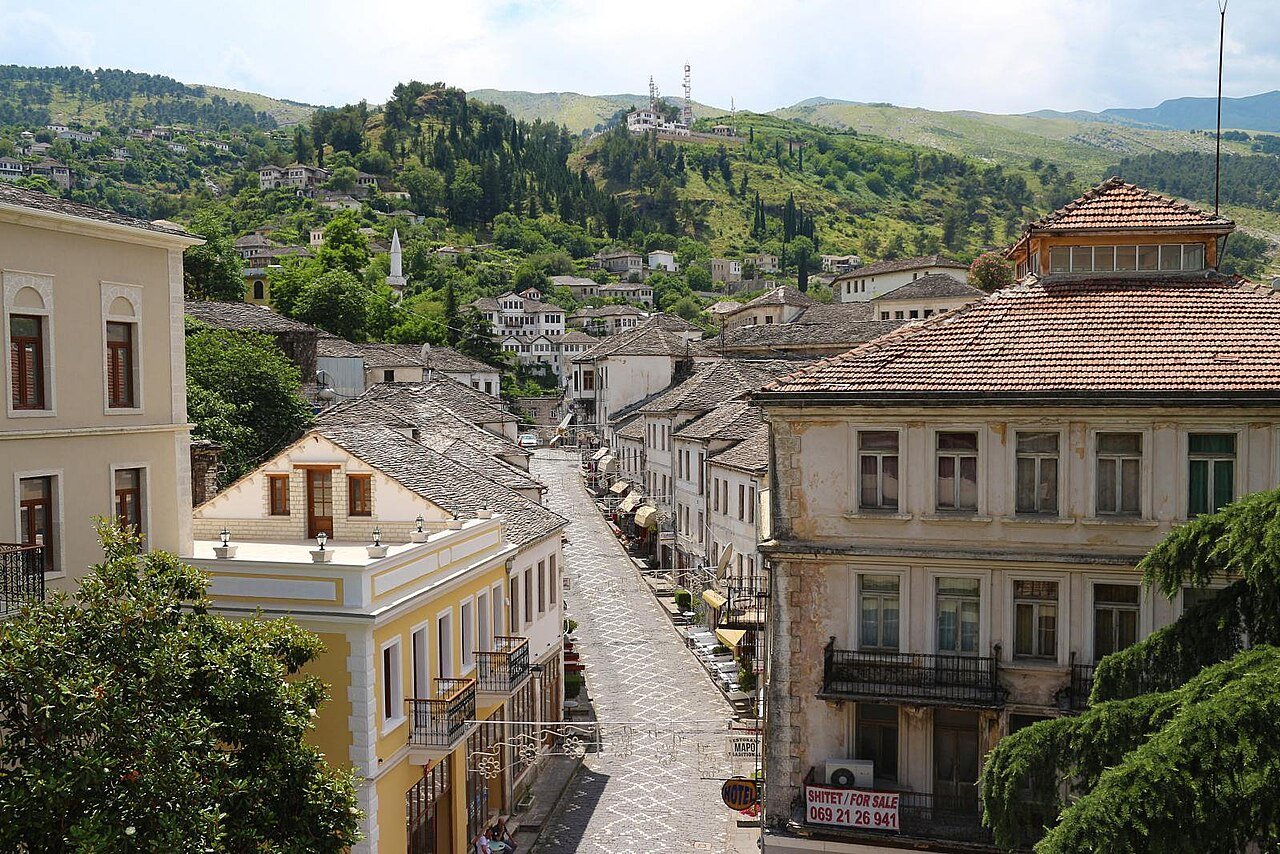
Gjirokastër is the anti-Berat: where Berat is white and open, Gjirokastër is grey and closed. Its Ottoman-period tower houses are built of slate and limestone with thick defensive walls, narrow arrow-slit windows and roof terraces fortified like battlements — a townscape so unlike conventional images of the Ottoman Balkans that it registers as an entirely distinct tradition. Birthplace of both Albania’s most famous dictator (Enver Hoxha) and its greatest novelist (Ismail Kadare), this UNESCO World Heritage city in the mountains of southern Albania is one of the most architecturally remarkable and historically layered places in the Balkans.
The Stone City: Tower Houses, Ali Pasha and the Castle of Gjirokastër Historic Centres of Berat and Gjirokastër, UNESCO 2005 · southern Albania
The city’s form was shaped by centuries of insecurity. Located in the mountains of the Drino River valley in what is now southern Albania, close to the Greek border, Gjirokastër was for much of its history a frontier town between competing powers: the Byzantine Empire, the Ottoman Empire, and the Albanian and Greek principalities that contested control of the region. The tower house (kulla) — the dominant building type — reflects this condition directly. Three to four storeys of dressed stone, with the lowest storey used for storage and animal shelter, the upper storeys for living quarters, and the roof modified as a defensive platform: the kulla is at once a home, a fortress and a status symbol, each built to function independently if the town around it fell.
The most spectacular of Gjirokastër’s kullë are gathered in the old town on the hillside below the castle: the Skënduli House (seventeenth century, one of the oldest surviving), the Zekate House (1811, one of the grandest, now a museum), and dozens of others in various states of preservation and habitation. The Zekate House’s twin towers, its vaulted ground floor, its upper-storey reception room (divanhane) with painted wooden ceilings and built-in furniture, and its commanding panorama over the valley below, represent the fully developed Ottoman Albanian domestic tradition at its most accomplished. Walking between these houses, on the cobbled lanes that wind between their blind stone facades, gives the sensation of moving through a medieval city that has been preserved not in aspic but through continued use and gradual adaptation.
The Castle of Gjirokastër, occupying the rocky ridge above the old town, has a history dating to the twelfth century CE, with major expansion in the nineteenth century under Ali Pasha of Ioannina — the semi-independent Ottoman warlord who controlled much of what is now northern Greece and southern Albania between 1788 and 1822. Ali Pasha is one of the great ambiguous figures of Balkan history: a brutal tyrant who maintained his power through terror and assassination, but also a moderniser who attracted European visitors (including Lord Byron, who met him in 1809) and whose administrative capacity made his domain one of the most economically dynamic in the late Ottoman Balkans. His fortifications at Gjirokastër castle — towers, magazines, cisterns and a large barracks — are now the primary architectural feature of the site. The castle also contains, improbably, a captured American military aircraft from the Cold War period, installed as part of an Albanian military museum established during the Hoxha era.
The bazaar of Gjirokastër, a covered arcade of shops and workshops at the base of the old town hill, is one of the best-preserved Ottoman commercial districts in Albania. Its characteristic çarşi (market) form — a continuous covered street with small specialized shops opening onto it — is largely intact, and several of the shops still function as traditional craftsmen’s workshops, particularly in metalwork, which has been a Gjirokastër speciality for centuries.
Enver Hoxha, Ismail Kadare and the City’s Literary Memory Gjirokastër old town · Ismail Kadare’s house, 15 min walk from bazaar
Gjirokastër produced, within a few years of each other in the late 1930s and early 1940s, two of the most significant Albanian figures of the twentieth century — who represent almost opposite poles of the Albanian experience. Enver Hoxha (1908–1985) was born here to a Muslim merchant family and went on to establish one of the most totalitarian communist regimes in Europe, ruling Albania from 1944 until his death with an isolation and ideological rigidity that made the country a byword for political extremism. His birth house in the old town has been pointed out by guides for decades, though its status as a heritage site is necessarily complicated by the crimes of his regime.
Ismail Kadare (1936–2024), born less than thirty years later in the same city, became under Hoxha’s rule — with extraordinary skill and calculated ambiguity — Albania’s most celebrated writer, author of novels that used historical and mythological subjects to encode a critique of totalitarianism while remaining just publishable within the regime’s constraints. His Chronicle in Stone (1971) is a novel about Gjirokastër itself — a child’s-eye view of the city during the Italian and German occupations of the Second World War — that is also a meditation on memory, identity and the weight of history in a place where stones themselves seem to accumulate time. Kadare’s house in the old town is open to visitors as a small museum, and his work in translation is the most insightful preparation anyone can bring to a visit.
The National Folklore Festival, held in Gjirokastër every four or five years in the castle courtyards, is one of the most important gatherings of Albanian traditional music, dance and costume in the country. The festival was established during the communist period as a state-sponsored celebration of “folk culture,” but it has outlasted that context and become a genuine celebration of the extraordinary diversity of Albanian regional traditions — polyphonic singing from the south (a UNESCO Intangible Heritage), the shepherd’s epics of the highlands, the urban song tradition of Gjirokastër itself. Check festival dates before planning a visit; the event transforms the city.
Access from Tirana takes approximately 3 hours 30 minutes by furgon or bus, with the road passing through the dramatic mountain landscapes of the Albanian interior before descending into the Drino valley. From the Greek border crossing at Kakavia (30 km south), the journey takes approximately 30 minutes — making Gjirokastër easily accessible from Ioannina in Greece (90 km south). The nearest Albanian airport is Tirana (TIA); the nearest Greek airport is Ioannina (IOA).
Practical information
Getting there: Gjirokastër is 232 km south of Tirana and 30 km from the Greek border at Kakavia. Furgons and buses from Tirana take approximately 3 hours 30 minutes. From the Greek border, the city is 30 minutes by car. Ioannina in Greece (90 km south) is the nearest city with direct European airport connections. Berat (120 km north) can be visited as a paired trip over two or three days.
When to visit: May to June and September to October are ideal — warm, clear and uncrowded. July and August are very hot. The National Folklore Festival (held irregularly, check ahead) is a compelling reason to time a visit. Winter is cold in the mountains but the stone city has a particular atmosphere under grey skies.
What else is nearby: The archaeological site of Antigonea (15 km north), a Hellenistic city founded by King Pyrrhus of Epirus in the third century BCE, is accessible as a half-day excursion. The Blue Eye (Syri i Kaltër), a natural spring of extraordinary clarity 24 km southwest, is a popular Albanian destination. Butrint National Park and its UNESCO-inscribed ancient city (90 km southwest) is a natural extension of a southern Albania itinerary.
Frequently Asked Questions
What is the significance of the tower houses (kullë) of Gjirokastër?
The kullë of Gjirokastër represent the most fully developed expression of a domestic defensive building type that occurs across the highlands of Albania and the western Balkans. The tower house tradition reflects historical conditions — blood feuds, Ottoman administrative instability, banditry, inter-clan conflict — in which a family’s home needed to function as a place of refuge and last defence as well as a dwelling. In Gjirokastër, the kulla evolved over the seventeenth, eighteenth and nineteenth centuries into something beyond a mere fortified tower: grand three-and-four-storey structures whose upper storeys contain lavishly decorated reception rooms (divanhane) with painted wooden ceilings, carved plasterwork, built-in sofas and niches for storage, expressing the wealth and status of the merchant and landowning families who built them. The contrast between the defensive exterior — blind stone walls, narrow openings, fortified roof — and the refined interior is deliberate and characteristic. The Zekate House (1811) is the best example open to visitors: its combination of military robustness and domestic sophistication captures the essence of the Gjirokastër kulla tradition at its height.
How does Ismail Kadare’s Chronicle in Stone portray Gjirokastër?
Chronicle in Stone (Kronikë në gur, 1971) is Kadare’s most directly autobiographical novel — a child narrator’s account of wartime Gjirokastër, occupied successively by Italian forces (1939–1943), Greek nationalist partisans, and German forces (1943–1944). The city itself is the novel’s primary character: Kadare describes it as a place where history has accumulated in the stones themselves, where the weight of the past is physically present in the architecture. The narrator experiences the violence and dislocation of occupation with the heightened, defamiliarising perception of a child who does not fully understand what he sees — a narrative strategy that allows Kadare to render the horror of war through sensation and image rather than political explanation. Published during the Hoxha period, the novel navigated the regime’s censorship by focusing on the pre-communist period and using mythological and folkloric registers that obscured its more critical implications. It remains the most accessible entry point into Kadare’s work and the most vivid literary portrait of Gjirokastër available in translation.
What is the connection between Gjirokastër and Ali Pasha of Ioannina?
Ali Pasha of Ioannina (c. 1740–1822) was a semi-independent Ottoman warlord of Albanian origin who, from his base in Ioannina (now northern Greece), built a personal dominion covering much of what is now northwestern Greece and southern Albania. He operated with nominal loyalty to the Ottoman sultan while pursuing his own political agenda with considerable ruthlessness — eliminating rivals, taxing trade routes aggressively and cultivating relationships with European powers, including Napoleon’s France and later Britain, who saw him as a potential ally against the Ottomans. He substantially expanded and modernised the castle of Gjirokastër, which he used as a regional garrison and administrative centre for his Albanian territories. His ultimate defiance of the Ottoman sultan led to a military campaign against him and his death in 1822 at the monastery of St Panteleimon on Lake Pamvotis in Ioannina. Ali Pasha’s life attracted enormous European attention in his lifetime — Byron’s account of meeting him in 1809 is one of the most celebrated passages of early Romantic travel writing — and his legacy as a figure who straddled Greek, Albanian and Ottoman identities remains contested in all three national historiographies.