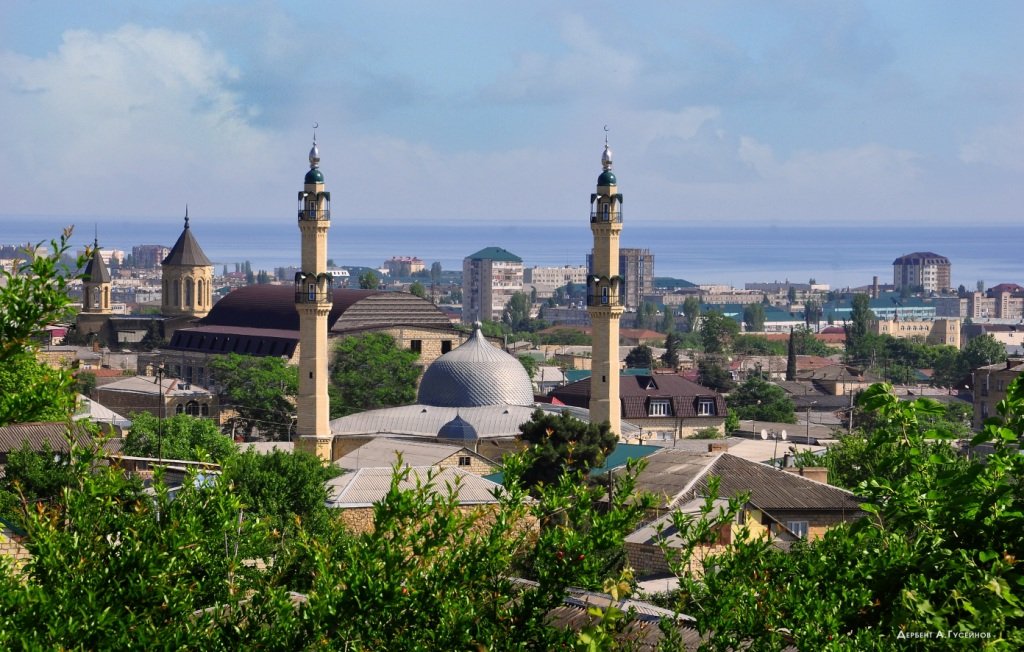
At the narrowest point where the Caucasus mountains approach the Caspian Sea, leaving a pass barely three kilometres wide, Derbent has controlled a crossroads for more than five thousand years. Claimed as the oldest city in Russia, it preserves Sassanid Persian fortress walls from the sixth century CE, a citadel that commanded the “Caspian Gate” of the ancient world, and an urban fabric shaped by a succession of empires that includes the Persians, Arabs, Mongols, Safavids, Ottomans and Russians. The UNESCO inscription of 2003 recognised this exceptional concentration of fortification history in a city of over 120,000 inhabitants on the coast of Dagestan.
The Caspian Gate: Naryn-Kala Citadel and the Sassanid Walls Citadel, Ancient City and Fortress Buildings of Derbent, UNESCO 2003 · Dagestan, Russia
The strategic logic of Derbent is so obvious from the map that it seems almost inevitable: a mountain range that forms a wall across the Eurasian landmass, a sea that extends to the horizon, and between them a narrow coastal corridor through which armies, merchants and nomadic peoples must pass. Whoever controlled Derbent controlled movement between the steppes of the north and the civilisations of the south. It is no accident that the city changed hands among virtually every major power that has ever been active in the region.
The oldest known fortifications on this site date to the early first millennium BCE — traces of Albani and early Persian construction have been identified in the lower layers of the excavated archaeological record. But the structure that dominates the city today is the work of the Sassanid Persian emperor Khosrow I Anushirvan, who built or substantially rebuilt the citadel and the double line of walls in the sixth century CE, between 531 and 579. The Sassanids recognised that Derbent was the single most important chokepoint in their northern frontier: their empire extended from Mesopotamia to the Caucasus, and the nomadic peoples of the Eurasian steppe — Huns, Alans, Khazars — presented a constant threat from the north. The walls at Derbent were their answer.
The Naryn-Kala Citadel sits on the high ground above the modern city, its massive curtain walls of carefully coursed limestone enclosing an area of approximately 4.5 hectares. Within the citadel, the remains of the Sassanid palace, cisterns, a Christian basilica from the early Arab period, and an early mosque — one of the oldest in Russia, built by Arab conquerors in the eighth century CE — are all visible. The transformation of the Christian basilica into a mosque after the Arab conquest of 643 CE is documented in the physical fabric: the building’s orientation was altered and its interior divided to accommodate Muslim prayer.
From the citadel, two parallel walls descend in straight lines to the shore of the Caspian, sealing the coastal corridor completely. The northern wall and the southern wall, each several metres thick and originally reaching from the mountains to a sea wall that extended into the water, formed a fortified corridor that could be closed at any point. The sea wall has largely been lost to erosion and the changing level of the Caspian, but the land walls survive in substantial sections — 3.5 kilometres of stone that stand, in places, up to 9 metres high. Walking along the top of these walls offers an extraordinary panorama: the modern city spreading northward along the coast, the Caspian shimmering to the east, and the Caucasus rising to the west.
The city that grew within and around the walls reflects every subsequent period of Derbent’s occupation. The Arab governors built mosques and madrasas; the Mongol invasion of 1221 destroyed much but left its own traces; the Safavid Persian rulers of the sixteenth and seventeenth centuries undertook major reconstruction; the Russian Empire, which captured Derbent definitively in 1806, built administrative structures that now anchor the modern city’s centre. The result is a layered urban organism that requires time and patience to read but rewards the effort.
The Old Town: Mosques, Baths and a Multireligious History Derbent old city · within the fortress walls
The old town of Derbent, enclosed within the Sassanid walls, is one of the few surviving examples of an early medieval Islamic urban plan in the Caucasus. The street pattern — narrow, winding lanes leading to small neighbourhood mosques and public baths (hammams) — preserves the logic of an Arab garrison town overlaid on the earlier Sassanid settlement. The Juma Mosque (Friday Mosque), founded in the eighth century by the Arab governor Maslamah ibn Abd al-Malik, is the oldest mosque in Russia. Its current form dates largely to the ninth century, with subsequent Ottoman and Safavid-period modifications, but the building’s core — a hypostyle prayer hall with columns of varying provenance salvaged from earlier structures — is of extraordinary antiquity.
The old town also preserves several Sassanid-period underground cisterns — large subterranean chambers built to store water for the citadel’s garrison — as well as the remains of public baths from the early Islamic period. The Khan’s Mosque (eighteenth century), built during the period of the Derbent Khanate when the city was nominally independent under local Muslim rulers, is a more recent structure but stands as evidence of the continuous Islamic cultural tradition within the city walls.
The religious diversity of Derbent is genuine and historically deep. The city has, at various times, been home to Zoroastrian, Christian (Armenian Apostolic, Georgian Orthodox), Jewish and Muslim communities, each leaving physical traces. The Mountain Jews (Juhuro) — a community of Tat-speaking Jews who have lived in Derbent and the surrounding Caucasus region for at least 1,500 years, possibly much longer — built synagogues in the city that survived both the Soviet period and the post-Soviet years; the community has largely emigrated to Israel and the United States in recent decades, but the synagogues remain. An Armenian church from the eighteenth century, now a museum, stands within the walls as evidence of the Armenian community that was active here under both Persian and Russian rule.
Access from Makhachkala, the capital of Dagestan and the nearest city with an airport, takes approximately 2 hours by bus or train (125 km). Direct train services also connect Derbent with Moscow (approximately 40 hours) and Baku in Azerbaijan (approximately 4 hours). The Makhachkala airport (MCX) has connections to Moscow and several Russian cities. Foreign visitors should verify current entry requirements and regional travel conditions before planning a visit to Dagestan.
Practical information
Getting there: Derbent is 125 km south of Makhachkala on the Caspian coast highway and rail line. Regular buses and marshrutkas (minibuses) connect the two cities in approximately 2 hours. The Makhachkala airport (MCX) has flights to Moscow and other Russian cities. Train services connect Derbent with Moscow (Moskovsky Vokzal, approximately 40 hours) and with Baku in Azerbaijan (approximately 4 hours across the border at Samur).
When to visit: April to June and September to October offer the most comfortable temperatures. July and August are very hot on the Caspian coast. The city’s Festival of Pomegranates in autumn is a significant local event. Winter visits are possible; the climate on the Caspian coast is relatively mild compared to inland Dagestan.
What else is nearby: The Tabassaran carpet-weaving villages in the mountains west of Derbent produce some of the finest traditional pile rugs in the Caucasus and can be visited as a half-day excursion. The Sarykum sand dune — the largest sand dune in Europe, approximately 60 km north of Derbent in the Nogai steppe — is a remarkable natural anomaly protected as part of the Dagestan Nature Reserve.
Frequently Asked Questions
Is Derbent really the oldest city in Russia?
The claim is supported by archaeological evidence but requires qualification. Human habitation on the site that became Derbent is documented by archaeological finds dating back at least 5,000 years, to the late Neolithic and Chalcolithic periods — making it one of the oldest continuously inhabited sites in the territory of modern Russia. The city’s official 2,000th anniversary was celebrated in 2015, a figure that reflects the first reliable documentary mention of Derbent as an established urban settlement rather than the full span of human presence on the site. Rival claims are sometimes made for other ancient cities in the region, including Derbent’s neighbour Derbent-Kale and sites in the Caucasus more broadly, and historians debate the precise criteria for “city” status across these early periods. What is not in dispute is that Derbent’s strategic location at the Caspian Gate made it a site of continuous political and military importance for millennia, and that the surviving Sassanid fortifications of the sixth century CE are the oldest military engineering structures in Russia at this scale.
Who were the Sassanid Persians and why did they build the walls at Derbent?
The Sassanid Empire (224–651 CE) was the last great Persian empire before the Arab-Islamic conquest, ruling from Mesopotamia to Central Asia and functioning as the eastern counterpart to the Roman and then Byzantine Empire. At their greatest extent, the Sassanids controlled the entire Caucasus region, and their northern frontier — running along the line of the Caucasus mountains from the Black Sea to the Caspian — was constantly threatened by the nomadic confederacies of the steppe: Alans, Huns, Khazars and others. The walls at Derbent were part of a wider system of Caucasian frontier fortifications that the Sassanids built and maintained over several centuries. Emperor Khosrow I (531–579 CE), whose reign is sometimes called a Persian golden age for its administrative and cultural achievements, undertook the most systematic expansion of these works. The walls at Derbent sealed the Caspian Gate definitively: no large army could move between the steppe and the south without either passing through Derbent or attempting the much longer and more difficult mountain routes to the west. The fortifications made Derbent one of the most strategically important single points in the ancient world.
What is the status of the Mountain Jewish community in Derbent today?
The Mountain Jews (Juhuro, also called Caucasian Jews or Tat Jews) are a community whose presence in the Dagestan and Azerbaijan region is documented for at least 1,500 years, with some scholars and community traditions suggesting an even earlier arrival following the Babylonian exile or the destruction of the Second Temple. They speak Judeo-Tat, a language related to Persian, alongside Russian and increasingly Hebrew. Derbent was one of the major centres of Mountain Jewish life in the Soviet period, alongside Makhachkala and several villages in the region. The community maintained synagogues and schools despite Soviet anti-religious policies. From the 1990s onwards, large-scale emigration to Israel and the United States substantially reduced the community’s size in Derbent: from a peak population of several thousand, the community has dwindled to a few hundred individuals. The historic Keleh Synagogue and other synagogue buildings in the old city have been maintained and occasionally restored, serving the remaining community and standing as monuments to a presence that defined one strand of Derbent’s remarkable multicultural history.