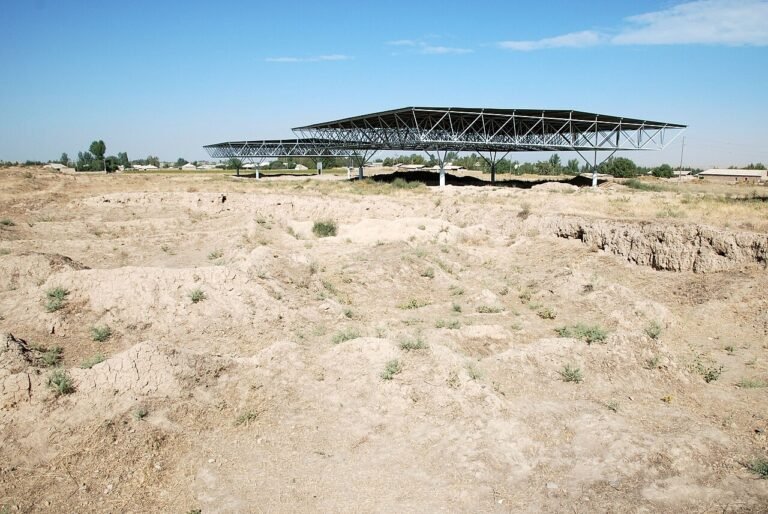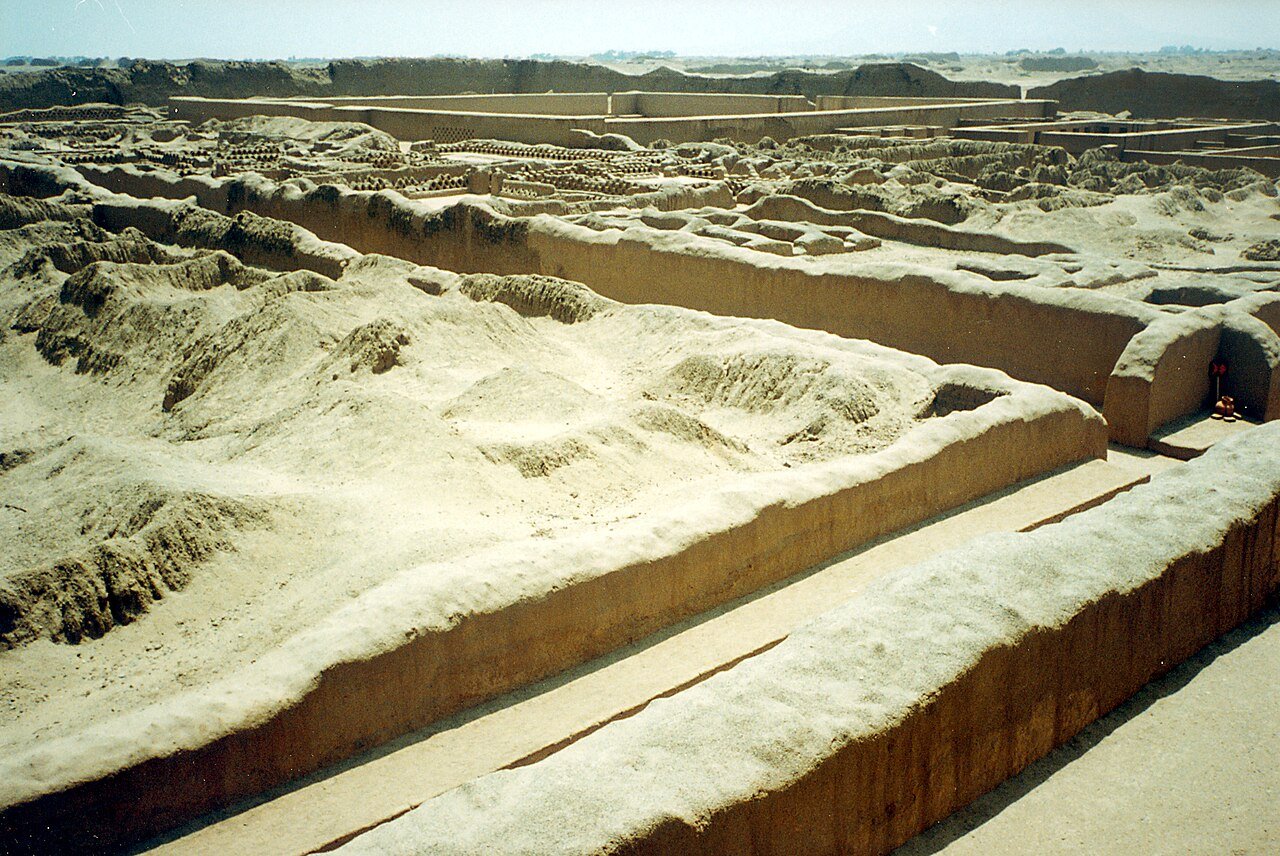
The Chan Chan Archaeological Zone, inscribed in 1986 and on the World Heritage in Danger list since the same year, is the largest pre-Columbian city in South America — the capital of the Chimu Empire (c. 900–1470 CE), a coastal desert city of 10 royal mud-brick compounds covering 20 km² in the Moche Valley of northern Peru, whose geometric friezes of fish, birds, and marine mammals represent the most extensive surviving example of Chimu artistic achievement.
Chan Chan: The Largest Adobe City in the World Moche Valley, La Libertad Region, 5 km west of Trujillo, Peru
The Chan Chan Archaeological Zone (inscribed in 1986 under criteria (i), (ii), and (iii), placed on the World Heritage in Danger list in 1986 — the only site inscribed and immediately endangered simultaneously — and still on the list as of 2024) is the capital of the Chimu Empire, the largest and most sophisticated pre-Inca state of the Pacific coast of South America. Chan Chan was founded approximately 900 CE by the Chimu king Taycanamu (who, in Chimu tradition, arrived by sea from the north on a balsa raft) in the Moche Valley, near the mouth of the Moche River, on the hyperarid Pacific coast of northern Peru. The city grew over approximately 500 years through the successive addition of 10 royal ciudadela compounds (each built by a successive Chimu king during his lifetime as his palace, administrative centre, treasury, and eventual mausoleum) plus surrounding residential barrios for craftsmen (Chimu goldsmiths, weavers, and potters were the most technically accomplished in the pre-Columbian Andes), a hydraulic system (wells and canals supplying water to the desert city), and agricultural land reclaimed from the desert through irrigation. At its peak (approximately 1400 CE), Chan Chan had a population estimated at 30,000–60,000 — making it the largest city in South America and one of the most significant on the Pacific coast of the Americas. The city was conquered by the Inca Emperor Tupac Inca Yupanqui in 1470 CE after a decade of siege warfare; the Inca transported the Chimu king Minchancaman to Cusco as a hostage and carried off Chan Chan’s skilled craftsmen to serve the Inca court.
Huacas del Sol y de la Luna and the Moche Culture 🚗 ~8 km south of Trujillo
The Huacas del Sol y de la Luna (Pyramids of the Sun and Moon), 8 km south of Trujillo in the Moche Valley, are the principal monuments of the Moche culture — the pre-Chimu civilization that dominated the Peruvian north coast from approximately 100 to 800 CE and whose ceramic art (the most naturalistic and iconographically complex of any pre-Columbian culture) represents the peak of pre-Inca artistic achievement. The Huaca del Sol (the Pyramid of the Sun) was the largest adobe structure in South America at its construction (c. 100–450 CE) — approximately 340 × 160 × 40 metres, built from approximately 140 million adobe bricks — and served as the political and administrative centre of the Moche state. The Huaca de la Luna (the Pyramid of the Moon), 500 metres from the Huaca del Sol, served as the ceremonial and religious centre and contains the most spectacular Moche fresco paintings surviving in South America — polychrome painted murals of the Moche pantheon (the Decapitator deity, the Fanged God, and the Moon God), applied over successive construction phases in a series of six superimposed walls, each with its own painted frieze. The Moche archaeological site (not UNESCO-inscribed as a separate entity, but within the buffer zone of several Peruvian archaeological sites) is currently one of the most actively excavated sites in the Americas.
Practical information
Trujillo has direct domestic flights from Lima (Captain Carlos Martínez de Pinillos Airport, TRU, 1 hour, multiple daily) and is accessible by bus from Lima (8 hours on the Pan-American Highway). Chan Chan is 5 km west of Trujillo’s city centre by taxi or combi (minibus); entry fee approximately S/. 10 for the Tschudi compound and the on-site museum. The Huacas del Sol y de la Luna are 8 km south of Trujillo (separate admission approximately S/. 15, includes guided visit). A combined Chan Chan + Huacas del Sol y de la Luna visit requires a full day. Trujillo’s historic city centre (the Plaza de Armas, the Cathedral, and the colonial mansions — particularly the Casa Urquiaga) is a separate historical district. El Brujo archaeological complex (35 km north of Trujillo, containing the Huaca Cao Vieja and the tomb of the “Lady of Cao,” the only female Moche ruler discovered to date, with her sceptres, sacrificial victims, and battle clubs) is the most exciting Moche site currently being excavated.
Frequently Asked Questions
Is Chan Chan a UNESCO World Heritage Site?
Yes. The Chan Chan Archaeological Zone was inscribed in 1986 under criteria (i), (ii), and (iii), and was simultaneously placed on the World Heritage in Danger list — the only UNESCO site to be inscribed and immediately listed as endangered in the same session. The primary threats are (1) El Niño rainfall events (which dissolve the adobe walls and friezes); (2) illegal occupation of parts of the archaeological zone by squatter settlements; and (3) industrial salt extraction from the coastal pans adjacent to the site. Peru has the most UNESCO-threatened sites in South America; Chan Chan is the flagship case of the vulnerability of adobe construction in a desert climate exposed to periodic torrential rain.
What was the Chimu Empire?
The Chimu Empire (the Kingdom of Chimor, c. 900–1470 CE) was the most powerful state in South America before the Inca — controlling approximately 1,300 km of Pacific coast from the Tumbes Valley (modern Peru-Ecuador border) to the Chancay Valley north of Lima, a total population estimated at 500,000 under Chimu rule. The Chimu state was organized around a vertical hierarchy (the paramount king, the Chimu Capac, exercising absolute authority from Chan Chan, with provincial lords controlling the conquered valleys), a redistributive economy (tribute in the form of textiles, metalwork, and labour from conquered peoples, redistributed to Chan Chan’s craftsmen and administrators), and a system of hydraulic infrastructure (intervalley canals linking the Chicama, Moche, and Virú valleys) that was the most sophisticated irrigation system in the pre-Inca Americas. The Chimu metalwork (particularly gold and silver objects, including the famous Tumi ceremonial knives, feathered headdresses, and ear spools of the lords) is the finest pre-Columbian goldwork surviving from Peru; most examples are in the Museo Tumbas Reales de Sipán (Chiclayo) and the Gold Museum of Lima.
Who was the Lady of Cao and why is she significant?
The Lady of Cao (Señora de Cao, discovered 2006 at Huaca Cao Vieja, El Brujo archaeological complex, 35 km north of Trujillo) is the only female Moche ruler identified to date — a woman of approximately 25–30 years of age, buried approximately 400 CE with the full regalia of a Moche warrior-priest-ruler: two ceremonial sceptres (the symbols of political authority), 28 sacrificed human bodies (retainers buried with her), war clubs, the finest Moche gold objects known (necklaces, earrings, nose rings), and textiles of extraordinary quality. Her discovery overturned the assumption that Moche rulership was exclusively male and has been compared in significance to the discovery of Queen Puabi at Ur (Mesopotamia, 2600 BCE). The tomb is now a dedicated museum at the El Brujo site, which is one of the most important archaeological sites currently under active excavation in the Americas.
Sources
- S1 — Moseley, Michael E., and Kent C. Day, eds. Chan Chan: Andean Desert City. University of New Mexico Press, 1982. ISBN 978-0-8263-0588-6.
- S2 — Bawden, Garth. The Moche. Blackwell, 1996. ISBN 978-1-55786-520-5.
Spotted an error? Write to editorial@culturalheritageonline.com and we correct it the same day.