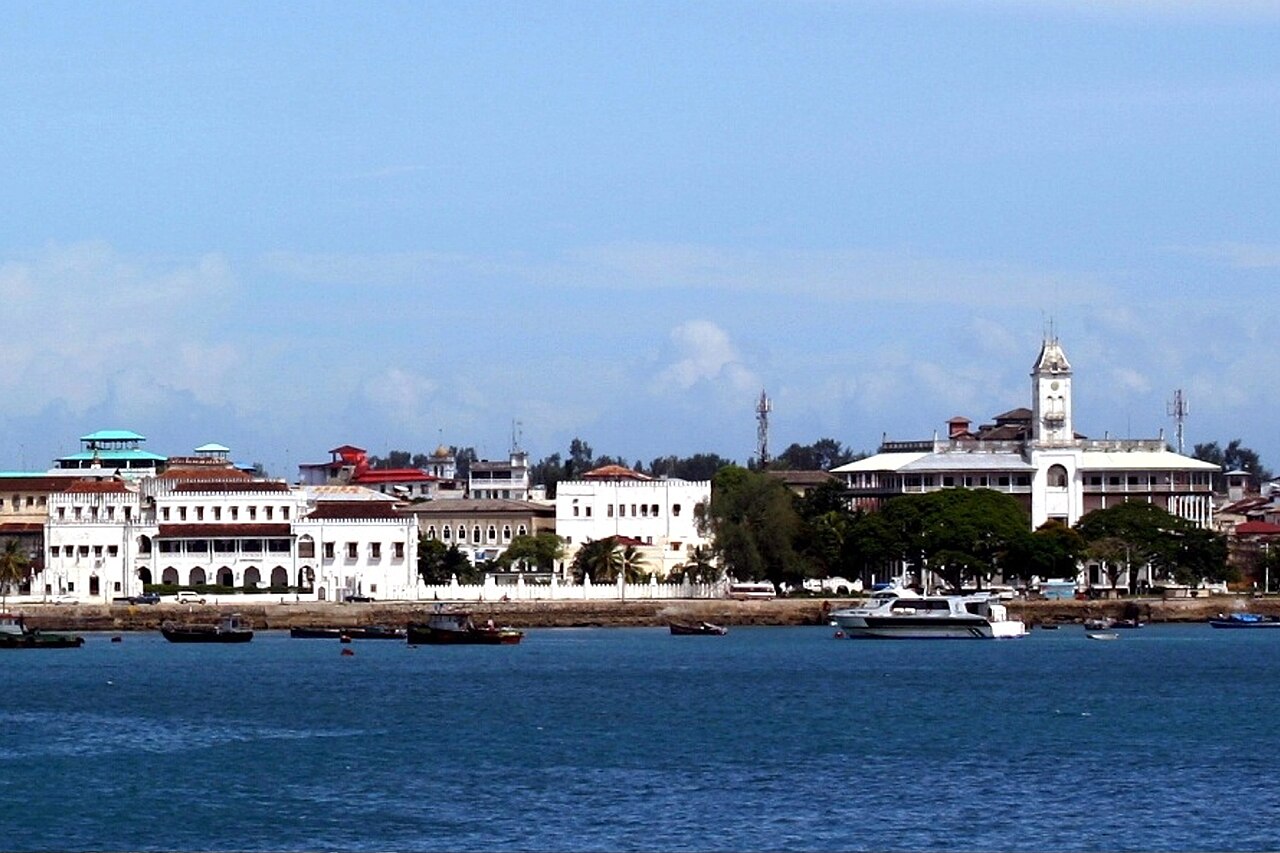
The Stone Town of Zanzibar, inscribed in 2000, is the mercantile capital of the Zanzibar Sultanate — a fusion of Swahili, Arab Omani, Indian Gujarati, and European architectural traditions in a labyrinth of carved wooden doors and coral-stone buildings on the Indian Ocean’s western edge, once the hub of the East African spice and slave trades. Kilwa Kisiwani extends the Swahili Coast heritage itinerary to the medieval Indian Ocean gold and ivory trade.
Stone Town of Zanzibar: Indian Ocean Crossroads City City centre — walkable
The Stone Town of Zanzibar, inscribed in 2000 under criteria (ii), (iii), and (vi), is the historic core of Zanzibar City — a settlement of coral-stone and lime-plaster buildings whose architecture documents five centuries of Indian Ocean trade between East Africa, the Arabian Peninsula, the Indian subcontinent, and Europe. The town became the capital of the Busaidi Sultanate (Oman) in 1840 when Said bin Sultan moved his court from Muscat to Zanzibar, transforming a Swahili fishing town into the most important commercial port on the East African coast. The 500-plus carved wooden doors of Stone Town are its most celebrated architectural feature: each door carved by Indian craftsmen (Gujarati joiners) in patterns of lotus flowers, chains, fish, and marine imagery, with a central brass knocker in the form of a fish or a hand. The doors document the owner’s religion (Muslim doors typically have Arabic script verses from the Quran; Hindu doors have lotus flowers; Christian doors — rare, for colonial officials — have cross motifs), social status (wider and more elaborately carved = higher status), and trade connections. The Old Fort (Ngome Kongwe), built by Omani Arabs in 1698 on the foundations of a Portuguese chapel (demolished 1698 in the same year as the construction), is the oldest building in Stone Town and now functions as a cultural centre.
Slave Market and the East African Slave Trade Anglican Cathedral area
Zanzibar was the principal hub of the East African slave trade from the seventeenth to nineteenth centuries — the market through which an estimated 50,000 slaves per year passed at its mid-nineteenth century peak. The Old Slave Market of Zanzibar, where 600–700 enslaved people were sold daily in the 1860s, was closed under British pressure in 1873 (the same year the last legal slave market in the Ottoman Empire was closed); the Anglican Cathedral of Christ Church Zanzibar was built immediately on the site by the Universities Mission to Central Africa in 1873 as a deliberate act of Christian symbolism. The cathedral’s altar is positioned over the precise location of the whipping post; the church building reused stones from the demolished market buildings. The slave cells beneath the Cathedral (where slaves were held before sale in chambers 3 metres underground) are open to visitors; the stone ring on the wall where slaves were chained and the height marks of the doorframes designed to prevent standing upright are the most tangible relics of the trade’s physical conditions. David Livingstone used Zanzibar as his base for three East African expeditions; the last formal photograph taken of him before his death in 1873 was taken in Zanzibar.
Ruins of Kilwa Kisiwani: Medieval Gold Trade on the Swahili Coast ✈ 1 hr to Dar es Salaam then 4 hrs south by road + boat
The Ruins of Kilwa Kisiwani and Ruins of Songo Mnara, inscribed in 1981 under criteria (iii) and (iv), preserve the remains of Kilwa Kisiwani — the most important medieval Swahili city on the East African coast, through which the gold of Zimbabwe’s Great Zimbabwe Empire was exported to the Indian Ocean trade network between the tenth and sixteenth centuries. The Great Mosque of Kilwa (twelfth century, expanded fifteenth century) is the largest pre-Portuguese mosque in sub-Saharan Africa; its nine-bay main hall with barrel-vaulted ceiling is structurally similar to the mosques of Oman, Persia, and India, documenting the architectural circulation of the Indian Ocean trade network. The Husuni Kubwa palace complex (fourteenth century), built on a promontory over the sea, had 100 rooms and a swimming pool — the most sophisticated secular architecture in sub-Saharan Africa of its period. Ibn Battuta visited Kilwa in 1331 and called it “one of the most beautiful and well-constructed cities in the world.” The town was captured by the Portuguese in 1505 and entered a long decline; the ruins are today accessible only by boat from Kilwa Masoko on the mainland.
Freddie Mercury and Zanzibar’s Cultural Legacy Mercury’s House, Stone Town
Farrokh Bulsara — known to the world as Freddie Mercury of the rock band Queen — was born in Stone Town, Zanzibar on 5 September 1946, to a Parsi Zoroastrian family from Gujarat who had settled in Zanzibar during the British colonial period. Mercury left Zanzibar for boarding school in India in 1954 and never returned; his family fled to England in 1964 during the Zanzibar Revolution. The house where Mercury was born (26 Kenyatta Road, Stone Town) is now operated as a Mercury-themed restaurant (Mercury’s) with a small museum; the town has embraced Mercury’s legacy as an important part of its cultural heritage, somewhat to the surprise of observers given Mercury’s openly gay identity in a largely conservative Muslim community. The Mercury connection is one of the few elements of Zanzibar’s colonial-era population (Indian, Parsi, British, and Arab communities largely departed in the 1960s–1970s) that the island’s heritage tourism narrative has recovered and made visible.
Practical information
Zanzibar International Airport (ZNZ) receives international flights from the Gulf states and European charter flights; the ferry from Dar es Salaam (2 hrs, Fast Ferry; 3 hrs, standard ferry) is the alternative arrival. Stone Town is compact and walkable; the main sites — Old Fort, Palace Museum, Cathedral, Slave Market, Hamamni Persian Baths — can be covered in a full day on foot. Spice tours of the island’s interior (departing from Stone Town, 3–4 hours) visit clove, nutmeg, cinnamon, and vanilla plantations; Zanzibar produces approximately 70% of the world’s cloves. The beaches of the north and east coasts (Nungwi, Kendwa, Paje) are 45–60 minutes by taxi from Stone Town. Kilwa Kisiwani is a full-day excursion from Dar es Salaam requiring a 4-hour drive to Kilwa Masoko and a boat crossing; it is rarely visited due to poor transport connections. The best season for Zanzibar is June–September and December–March (avoiding the long rains of April–May and the short rains of October–November).
Frequently Asked Questions
Is Zanzibar Stone Town a UNESCO World Heritage Site?
Yes. The Stone Town of Zanzibar was inscribed in 2000 under criteria (ii), (iii), and (vi). The inscription covers the historic urban core of Zanzibar City — the labyrinthine streets, carved wooden doors, coral-stone buildings, and monument ensemble including the Old Fort, the Palace Museum, and the Anglican Cathedral — as a preeminent example of a Swahili trading town that documents five centuries of Indian Ocean mercantile history.
What is Swahili architecture?
Swahili architecture is the building tradition of the East African coast, developed from the eleventh century onward by the Bantu-speaking Swahili people in interaction with Arab, Persian, Indian, and (later) European traders. Its characteristic materials are coral ragstone (cut from the living reef, which becomes harder as it dries), lime plaster made from burned coral, and mangrove-pole roof timbers imported from the mainland forests. The buildings are typically two to three stories, with internal courtyards and roof terraces; the ground floor was commercial, the upper floors residential. The carved wooden doors of Stone Town are the most elaborate surviving expression of the Indian craftsmen (Gujarati joiners) who settled in Zanzibar in the nineteenth century.
What happened to Zanzibar’s Asian and Arab communities?
The Zanzibar Revolution of January 1964 — a violent uprising by the Afro-Shirazi Party against the Sultanate’s predominantly Arab and Indian-origin ruling class — resulted in the flight of most of Zanzibar’s Arab and South Asian population within weeks. Estimates of deaths in the revolution range from 5,000 to 20,000; an estimated 60,000–80,000 people of Arab, Indian, and Comorian descent fled the island or were expelled. The community that had built Stone Town’s carved-door mansions over three centuries was effectively ended in a few weeks; many of the mansions they left behind were subdivided into apartments or fell into disrepair, creating the heritage conservation problem that UNESCO inscription in 2000 was partly designed to address.
Sources
- S1 — Sheriff, Abdul. Slaves, Spices and Ivory in Zanzibar. James Currey, 1987. ISBN 978-0-85255-015-1.
- S2 — Horton, Mark, and John Middleton. The Swahili: The Social Landscape of a Mercantile Society. Blackwell, 2000. ISBN 978-0-631-18919-0.
Spotted an error? Write to editorial@culturalheritageonline.com and we correct it the same day.