
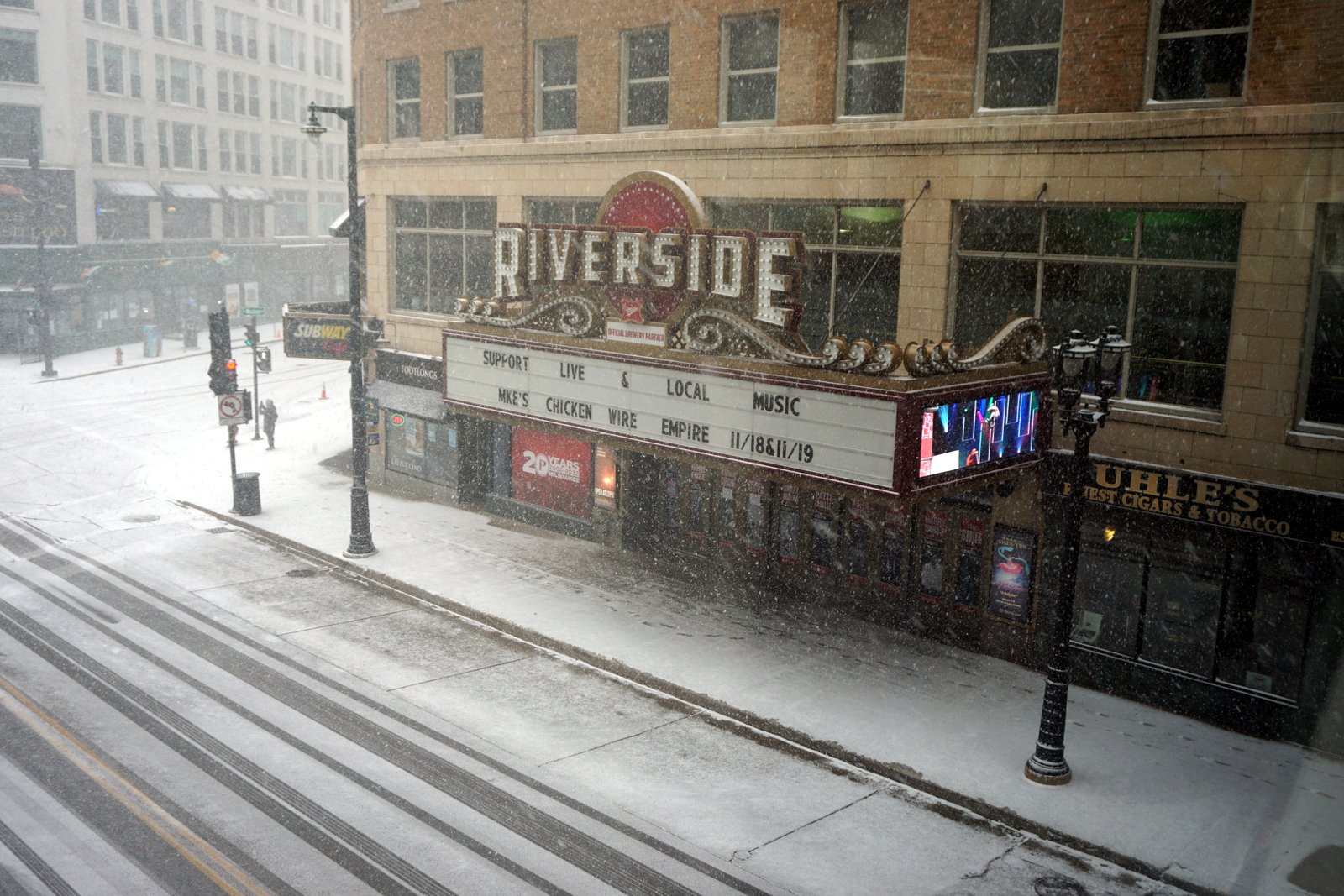
Rapp & Rapp—the Chicago firm that built the Chicago Theatre on State Street and the Paramount in Portland—brought the same French Renaissance grandeur to Milwaukee’s Wisconsin Avenue in 1928, producing a concert hall that has outlasted its original purpose as a cinema by several decades.
At a glance
The Riverside Theater opened in 1928 at 116 W. Wisconsin Avenue as one of Milwaukee’s premier movie palaces, designed by Rapp & Rapp with the same French Renaissance vocabulary the Chicago firm had applied in city after city during the golden decade of American cinema palace construction. The building’s façade of cream terra-cotta ornament, a tall vertical marquee, and an interior of gilded plasterwork, painted ceilings, and crystal chandeliers gave Milwaukee audiences the metropolitan splendour that the Rapp brothers delivered as a standard product wherever they worked. The Riverside is now operated as a live entertainment venue and has hosted performers from Frank Sinatra to contemporary touring acts across its nearly century-long history.
Key facts
- Address: 116 W. Wisconsin Avenue, Milwaukee, WI 53203
- Architects: Rapp & Rapp
- Opened: 1928
- Style: French Renaissance / Baroque Revival
- Capacity: approximately 2,500 seats
- Landmark status: Milwaukee Historic Landmark; National Register of Historic Places
- Current use: Live entertainment venue; concerts and touring productions
History
The Riverside opened during the peak of the American movie palace era, when exhibitors competed for first-run product by offering the most lavish possible building environments. Rapp & Rapp had established a recognisable brand in this competition: their theatres—from the Chicago Theatre (1921) to the Paramount in Portland (1928) and now Milwaukee—shared a French or Spanish Baroque vocabulary applied at a consistently large scale, with interiors that deliberately evoked the royal opera houses of Paris and Vienna. At the Riverside, the firm scaled its standard programme to the dimensions of a 2,500-seat auditorium on one of Milwaukee’s principal commercial streets.
The theatre operated as a first-run and second-run cinema through the mid-twentieth century before the familiar pattern of downtown cinema decline led to its transformation into a live concert venue. This transition preserved the building more effectively than would have been possible had it remained a standard multiplex: concert promoters and event managers valued the Riverside’s large capacity, sight lines, and acoustic properties. The Milwaukee Historic Landmark designation and NRHP listing secured the building’s protection and supported restoration work on the interior. Today the Riverside is one of the primary large-capacity venues in Milwaukee for national touring acts.
What you see
The Wisconsin Avenue façade is a characteristic Rapp & Rapp composition: a vertical sign identifying the building from a distance, a ground-floor arcade of arched openings in cream terra-cotta, and a series of upper-storey windows framed in the Baroque manner with elaborated keystones and pilaster strips. The ornament is denser at the cornice than at the lower floors, following the standard movie palace formula that concentrated visual interest at the roofline to attract the eye from blocks away.
Inside, the lobby and auditorium continue the French Renaissance vocabulary in gilded plaster relief, painted ceiling panels, and crystal chandeliers hung at the auditorium’s full height. The proscenium arch frames the stage with a depth of ornament characteristic of Rapp & Rapp at their most elaborate. The balcony—a single sweeping curve rather than the tiered multiple-balcony format of some larger palaces—provides excellent sight lines from every seat. The building’s conversion to concert use has generally preserved these elements while adapting the stage for live performance.
Practical information
- Open for scheduled performances; check the Riverside Theater website for current events
- General admission concerts: early arrival recommended for best standing positions on the orchestra floor
- Seating events: advance tickets required; check reserved seating maps for balcony views
- The Milwaukee Skywalk system passes adjacent to the building and connects to the surrounding downtown
- Multiple food and drink options available in the surrounding Wisconsin Avenue corridor
Getting there
The Riverside Theater stands at 116 W. Wisconsin Avenue in downtown Milwaukee. The Milwaukee streetcar (The Hop) stops on Wisconsin Avenue within one block; MCTS bus lines serve the Wisconsin Avenue corridor. Milwaukee Mitchell International Airport (MKE) is approximately 6 miles south; the Airport Coach or taxi services provide direct connections. By car from Chicago: I-94 north to the downtown exits is approximately 90 miles; Milwaukee’s Amtrak Hiawatha service connects directly with Chicago Union Station in approximately 90 minutes.
Nearby
- Milwaukee Art Museum (Calatrava addition, 2001) — approximately 0.5 miles east at the lakefront; Santiago Calatrava’s signature movable wing structure is visible from much of downtown
- Milwaukee City Hall (1895) — 2 blocks north on E. Wells Street; Flemish Renaissance Revival tower, a National Historic Landmark
- Third Ward / Historic Third Ward — approximately 0.5 miles southeast; Milwaukee’s arts and design district in preserved 19th-century warehouse buildings
Sources
- National Register of Historic Places nomination: Riverside Theater, Milwaukee
- City of Milwaukee Historic Preservation Commission: landmark designation documentation
- Naylor, David. American Picture Palaces: The Architecture of Fantasy. New York: Van Nostrand Reinhold, 1981 (chapter on Rapp & Rapp)
- Gomery, Douglas. Shared Pleasures: A History of Movie Presentation in the United States. Madison: University of Wisconsin Press, 1992
Find it on the map
See this place and what’s around it →📷 Become a Cultural Heritage Online photographer
Share your photos of places: they stay published under your name as the author. The more they're seen, the more you get noticed — and soon a contest will reward the most appreciated photos.
Log in or sign up free to add a photoIs this page about you?
This page is read by travellers and heritage enthusiasts who find it on Google. Tell us how you are connected to this place and we will take it from there.