
The Byrd opened in Carytown on December 21, 1928 as one of Richmond’s most opulent movie palaces, and it has never stopped showing films—making it one of the very few single-screen theatres in the United States to have operated continuously in its original function for nearly a century.
At a glance
The Byrd Theatre sits at the heart of Carytown, Richmond’s historic commercial neighborhood west of the downtown grid, in a building that has anchored the street since 1928. The theatre’s Italian Renaissance Revival façade—terra-cotta ornament, arched windows, and an illuminated marquee—opens into an interior of sweeping balconies, gilded plasterwork, and painted murals that established the design standard for Virginia’s movie houses in the late 1920s. The Mighty Wurlitzer pipe organ installed at the original opening remains in playable condition and is still heard on weekends before selected screenings, a tradition maintained by the Byrd’s dedicated staff since the silent-film era.
Key facts
- Address: 2908 W. Cary Street, Richmond, VA 23221
- Opened: December 21, 1928
- Style: Italian Renaissance Revival
- Capacity: approximately 1,300 seats
- Landmark status: Virginia Historic Landmark; National Register of Historic Places
- Current use: Operating single-screen cinema and event venue
- Neighborhood: Carytown, Richmond
History
Carytown developed in the 1920s as Richmond grew westward along Cary Street, and the Byrd Theatre was part of the neighborhood’s coming-of-age as a commercial destination. The building was designed to accommodate the full spectrum of film exhibition: a large orchestra and sweeping balcony could accommodate nearly 1,300 patrons, while the orchestra pit and stage machinery allowed the venue to present variety acts alongside films during the transition from silent pictures to sound. The Byrd opened just weeks before the final consolidation of sound film technology, and adapted smoothly to the new format.
The theatre operated continuously as a first-run cinema through the 1960s before transitioning to a second-run and discount model that proved commercially resilient where larger competitors failed. When the downtown cinema market collapsed across the United States in the 1970s, the Byrd survived by adapting its programming to the tastes of the Carytown neighborhood—a mix of students, artists, and long-term residents who sustained the theatre’s audience through lean decades. By the 1990s the Byrd had secured its Virginia Historic Landmark and National Register designations, and the nonprofit foundation that subsequently took stewardship of the building has invested in the restoration of the organ and interior.
What you see
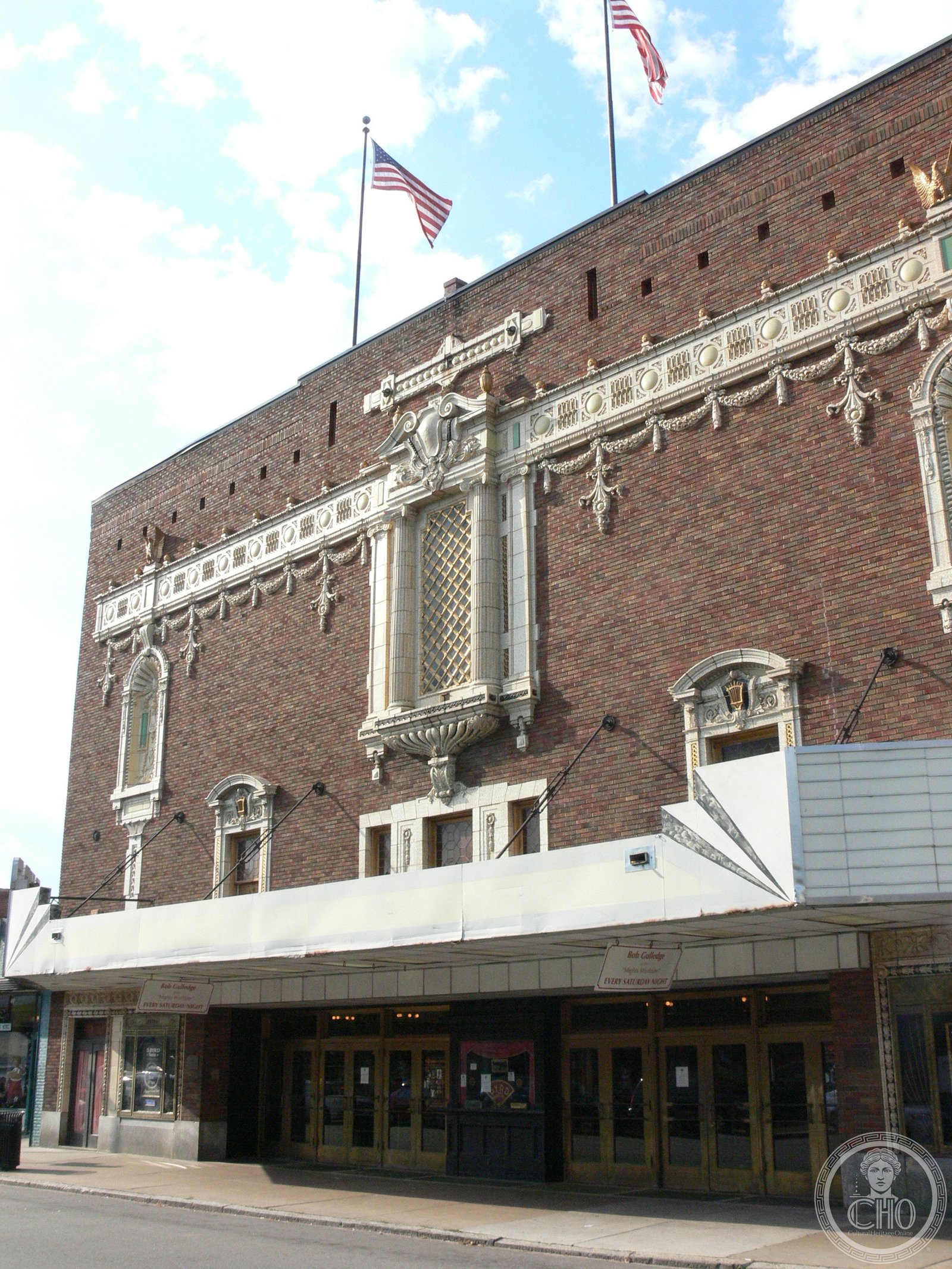
The façade presents a two-storey elevation of pale terra-cotta ornament beneath a low roofline, the entrance canopy extending to the sidewalk with a marquee that lists the current programme in changeable letters above the box office windows. The Italian Renaissance vocabulary—arched windows, console brackets, and stylized foliage at the cornice—is applied with the controlled restraint typical of late-1920s American commercial work: enough ornament to signal an occasion, not so much as to overwhelm a shopping street.
Inside, the auditorium rises through orchestra and a single sweeping balcony to a ceiling of painted plasterwork. The proscenium arch—flanked by gilded plaster columns and framing a painted tableau of figures in Renaissance dress—gives the interior its monumental scale. The Wurlitzer organ console rises from the orchestra pit on a hydraulic lift, as it did for the opening-night audience in December 1928. The gilded surfaces and indirect lighting of the side walls create the warm amber atmosphere that the Byrd’s patrons associate with the building as much as with any particular film.
Practical information
- Open for regular screenings; check the Byrd Theatre website for current programming
- Organ performances before selected Saturday evening screenings; arrive early to hear it
- Ticket prices kept intentionally below mainstream cinema rates as a community service
- The lobby and merchandise area reflect the building’s preservation aesthetic; original details intact
- Allow extra time before the film to tour the lobby and observe the architectural detail of the balcony stairways
Getting there
The Byrd Theatre stands at 2908 W. Cary Street in Carytown, approximately 2.5 miles west of downtown Richmond. By car: take Cary Street west from the downtown business district; Carytown begins at the Boulevard intersection. Richmond International Airport (RIC) is approximately 9 miles east; the Virginia Museum of Fine Arts is approximately 1 mile east on Boulevard. Street parking is available on Cary Street and on the surrounding residential grid; a public garage sits one block north.
Nearby
- Virginia Museum of Fine Arts (VMFA) — approximately 1 mile east on Boulevard; one of the largest and most encyclopedic art museums in the American Southeast, free general admission
- Hollywood Cemetery — approximately 0.5 miles west; 19th-century garden cemetery on a bluff above the James River; contains the graves of two US presidents
- Carytown shopping district — immediately adjacent; ten blocks of independent shops, restaurants, and cafes in a preserved late-1920s commercial street environment
Sources
- Virginia Department of Historic Resources: Virginia Historic Landmark designation file
- National Register of Historic Places nomination, Byrd Theatre, Richmond, VA
- Richmond Times-Dispatch archive: opening night coverage, December 1928
- Byrd Theatre Foundation: institutional history documentation
Find it on the map
See this place and what’s around it →📷 Become a Cultural Heritage Online photographer
Share your photos of places: they stay published under your name as the author. The more they're seen, the more you get noticed — and soon a contest will reward the most appreciated photos.
Log in or sign up free to add a photoIs this page about you?
This page is read by travellers and heritage enthusiasts who find it on Google. Tell us how you are connected to this place and we will take it from there.